Winds of Change
Finally got a hold of my work laptop and my user account and things start moving!
The week before last was spent completing my industry safety training. This was composed of Basic Off-shore Survival and Emergency Training (BOSIET) and Minimum Industry Safety Training (MIST). BOSIET focuses on what to do if your rig/helicopter burns down and gave a very good insight into the industry as a whole. One of the delegates on the course turned out to be a member of the BP Assurance team who goes out to old and new installations to commission or re-commission the production lines and control systems. Interesting job and I certainly had at least one interesting chat with him about the Deepwater Horizon disaster that I am not allowed to tell you about, but it sounds very much like Project Engineers will be prosecuted for deleting emails after the fact and on the advice of BP lawyers. Welcome to the digital age, I wonder what court cases would have arisen following the Piper Alpha disaster, had email been around then. Computers certainly help in many areas of engineering and, quite rightly y they stand by to condemn also. He is quite busy at the moment as BP continues to automate their installations which should result in a step increase in off shore safety.
The course was an excellent appreciation of the reality of my role as an SPA. These oil rigs are exceptionally dynamic places in that they are a chemical factory, building site, metal works, hotel and heliport all stacked vertically over 150m of cold North Sea. Even the simplest of changes to an installation can have serious repercussions if not planned correctly and I have spent the last week correlating these two courses to the BP best practices. There was, however, a lot of dross in the week and I sincerely hope I don’t have to listen to anyone drone on about HASWA 1974 for at least 12 months. On the plus side, I did rather enjoy the heli-dunker:
http://www.youtube.com/watch?v=a1d1bF5ec4Q&feature=youtu.be
This last week has seen me connected to the BP server and suddenly the world opens up. The BP distance learning portal is excellent and contains a plethora of courses that have begun my understanding of how Projects and Mods works, along with ample helpings of Chris’ experiences.
BRUCE P60 Bridge Inspection Platform
Kerry Scott (Programme Lead for Bruce) has been on leave this last week which has given me time to start getting to grips with this project. With confirmation that it is mine and access to email and documents, the process has begun moving. I’ve been assigned two job responsible engineers, one for Cassions and one for the project itself. This project has changed hands numerous times and has been scoped on at least two occasions but at present there is funding for about 700 hrs of work which may be enough to take it well into the Define stage. This would see the project designed in detail with constructibility reviews and all of the required hazard analysis. What I need from Kerry this week is definition of where she sees the project and what the next gate is. There is some uncertainty as to whether, in the BP scheme of Appraise, Select, Define, Execute, Operate, the project is actually through the select gate or not.
In terms of funding it certainly sounds like we are poised on the edge of Define, but this could all change this week as Kerry holds the purse strings and she has said previously that she does not consider this project to be that advanced. This project has floated in the ether for the last ten years and so I don’t know whether to be optimistic that this is the time for it to move forwards or whether it will get kicked back into the long grass. Either way, it is on the brink of Define and therefore I will be able to get some good design and general management experience. The company is also getting to grips with its new electronic Management of Change software (eMOC) and a renewed focus on risk management and so it is set to be a good learning opportunity at the very least.
and in other news…
Hugo had a brief stint in hospital last weekend as he came down with Bronchiolitis, but to look at him now, you wouldn’t believe it! On the plus side, Aberdeen Royal Infirmary is probably the best hospital I have visited and the staff were brilliant. Cycling to work is going well and I have found a nice off road route which should save me from being squashed on the 2 miles of rat run that I usually have to negotiate.
I leave you with a dubious piece of advice from Aberdeen County Council…
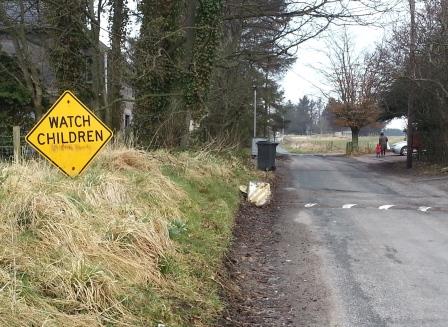
Measure twice, pour once!
This week as seen fairly poor progress primarily due to rain but exacerbated by a growing supervisor turf war between my supervisor John McNally and the civil team supervisor working in the area. We couldn’t do much about the rain although we should have protecetd our excavation alot better than we did and I now understand the sort of volumes of water you can experience in this country in a very short period of time. We managed to blind abutment B in prepartion for the pile trimming to happen but the following day when checking the levels for abutment A we realised that the levels for the other abutment were wrong. My part in this was not insignificant as one of my drawings I produced to make the excavation easier to understand for the leading hand who was checking the levels for the excavator was wrong. The other two were correct and of course the designers drawings were there to cross check any ambiguity but it seems they fixated on one particular sketch. Neither I nor the supervisor checked the levels prior to pouring and so we had to rip out the blinding the next day and re-pour later in the week. Fortunately it was only a blinding layer (20MPa) of 6m^3 instead of a major structural component which would have been an expensive mistake rather than a lesson learned I think.
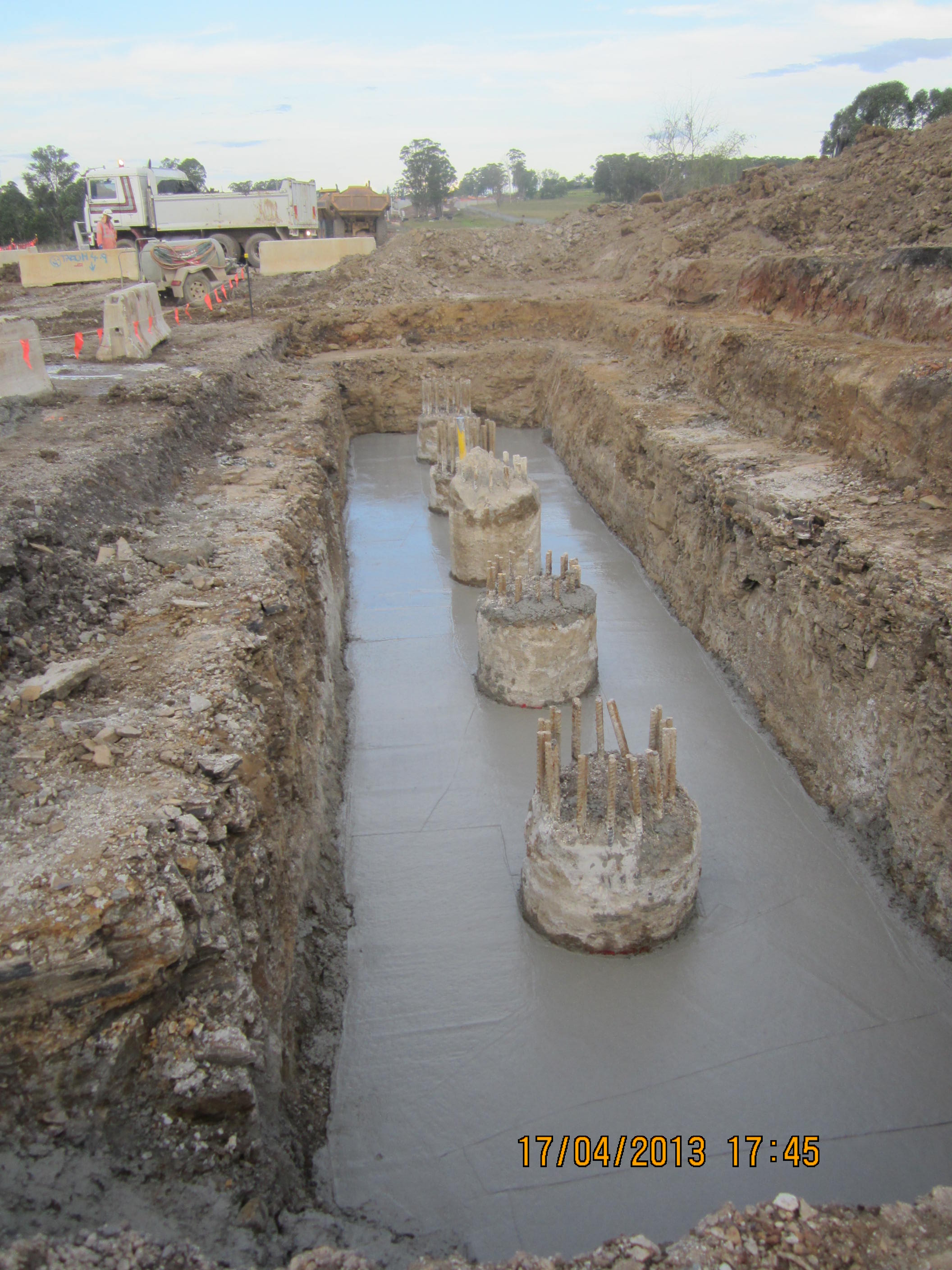
 Blinding complete followed by rain stopping play for a day!
8 out of the 10 piles have now been trimmed to the correct RL so at least the steel fixers can start work on abutment A on mon morning and weather permitting we can get that pile cap ready to pour by the end of next week (only a 3 day week next week due to ANZAC day)
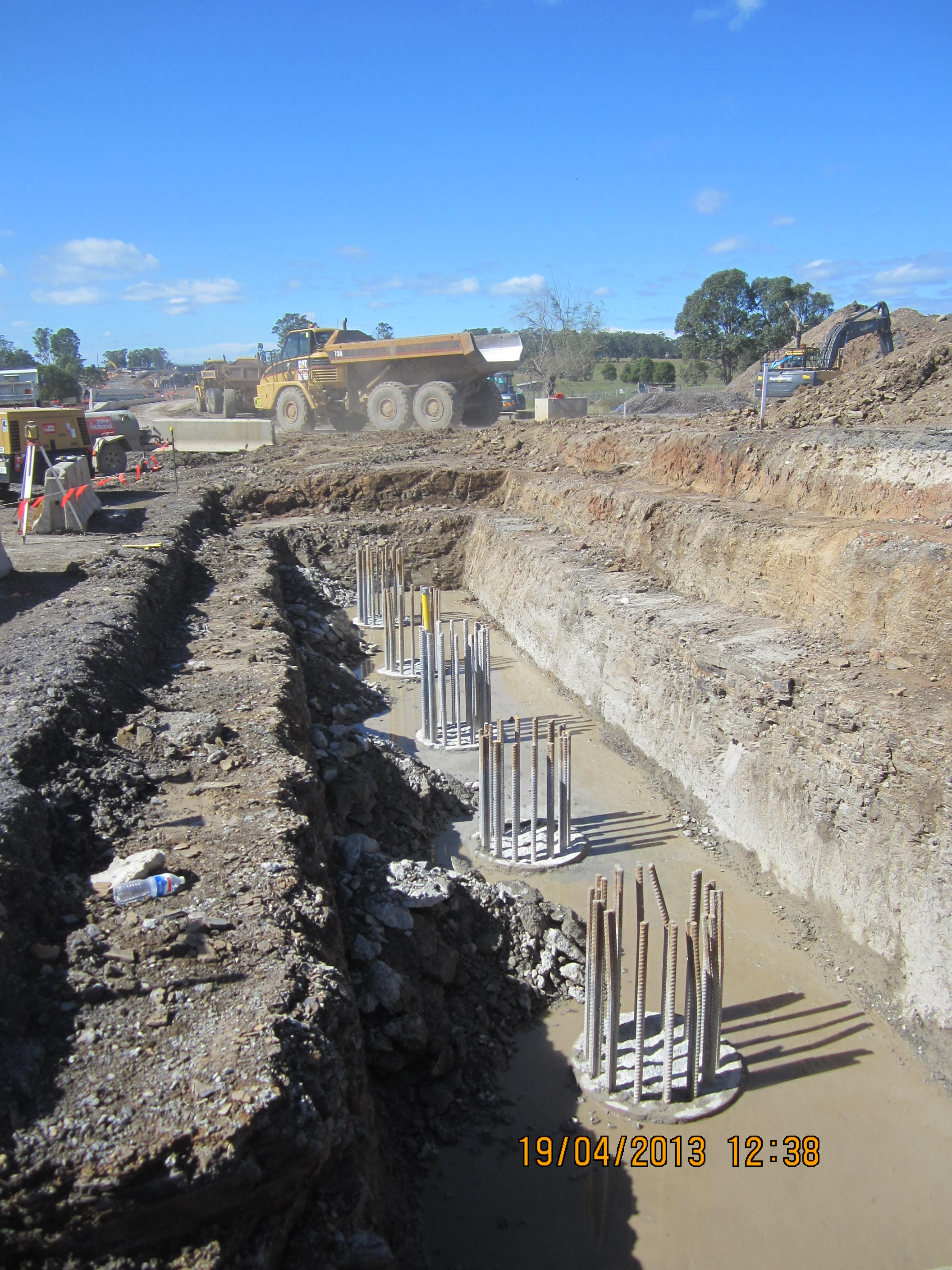 Abutment A pile trimming complete.
The supervisor war on site has become a little childish and I am staggered about the lack of communication between departments. In this small area there have been 5 different teams trying to work around each other. At first I realised that the civil team need to take possesiion and do the bulk earth removal and I was fully aware of them and them of us after having a few meetings together and de-conflicting space and time issues. Since then the Combined Services Route (CSR) team have dug trenches right through our retaining wall areas (we have had to change the design of one of the retaining wall base slabs by cutting a corner off to miss the CSR) the rail team are constructing the overhead stanchions either side of the retaining walls and the other day a signals team arrived who started marking out and spray painting on the ground in the middle of both abutments. I am fairly sure they would have spray painted over my boots if I had stayed static for too long, this just highlights the attitude of work throughout the project for me. Everyone seems rather blinkered to their work only with little regard for others. I assumed we owned the site after all we are building the bridge and so any other trade/team would have to report to us or at least communicate with us, this however seems optional. When I have raised questions, concerns and recommendations it is met with a shrug of the shoulders and agreement that the situation is bizarre but no suggestion of why or how it can be changed. The issue still lies with the civil team who are all over the site and who have very little work left to do on this project apart from at Dickson Rd. Their supervisor has clashed with ours all week reagarding control of water on site. As we have produced the lowest point on site water will inevitably find us but due to earth stock piles further up the alignment we had directed and contained the surface water run off to abutment B only and had protected that with the use of bunding. By blocking access between the two abutments for safety reasons to stop 30T Moxy vehicles transiting through we seem to have aggrevated the civil team supervisor who decided to install a drainage pipe through a stock pile further up the site which has subsequently flooded both abutments. John McNally who is our supervisor and a fairly laid back chap responded by constructing a bund (the great wall of McNally) across the entire width of the alignment and blocking said drainage pipe. The arguments continue with both our superintendent and the general superintendent getting involved whose solution from what I can gather seems to be ‘bund more’ and ‘just deal with it’. I am not entirely sure anymore who has real control over who, engineers seem to have very little. Having thought at the start of this attachment that the structure and CoC was very similar to the Army it now seems more of a façade with little bite. The construction manager seems to have all the real power as he can fire and hire people which is what people ultimately care about.
 Clearing my tubes!
The inclonometer tubes after the civil team clipped the top of both of them a few weeks back had collecetd about 3m of water and a few clumps of clay which we managed to clear with a water hose and air compressor, heath robinson stylee effort. This managed to clear abutment A tube which I need to repeat on abutment B next week. Having had the inclonomter PDA sent back to me from Melbourne following repair I have finally taken the second reading and have a full set of initial results. Apparently the client requires a variation of no more than 3mm between readings which I think we are very close to if not slighlty over so I am not sure what the repurcussions will be. There is a history of coal mining in the area which seems to be the reason for inclonometer readings being required for any pile works on the project and I am supposed to produce a report once the abutment walls are complete and the final readings have been taken. I am not sure what form the report takes and if the readings are greater than 3mm at any point what remedial action needs to be taken. As I think we already have a reading very close to the allowed tolerance I assume the client needs to be aware of this now but what I have been briefed is that the client gets all the results contained within one report after the final reading has been taken. I need to look into this in a lot more detail over the next few weeks as the more I have got involved in the inclonometer the more questions it has raised – topic for TMR1 I think!
Hopefully this British style weather will go back to where it came from very soon and we can make some progress.
Superstructures, Site Visits & Surveys
SUPERSTRUCTURE
Maximising space and rationalizing the use of steel and concrete in Project Armada (The London Development) continues….. along of course with weekly Client changes to floor plans! The link to ‘design development’ is becoming increasingly tenuous as the completion of Stage D approaches. Demolition planning has started and the detailed Architects (conveniently based in New York!) have started detailing the retaining wall and foundation proposed scheme. In terms of a design objectives and development, The London Development has many similarities to the nearly completed Heron Project which I visited last week.
SITE VISIT
The Heron. WSP have recently completed Milton Court (now to be known as ‘The Heron’ and the Guildhall School of Music and Drama). The building is a 36 storey development comprising a six storey lower level structure for the Guildhall and a residential tower above the school. The unique nature of the building resulted in some very interesting design features. The main objectives were to provide an efficient a buildable scheme with minimum quantities of raw materials (i.e. minimize shear walls and transfer structures). Design development to Stage D recommended to following key elements
1. Steel Framed: Concert hall & foyer structure providing slim but strong vertical structure and address buildability issues associated with the ‘box-in-box- approach to acoustic performance.
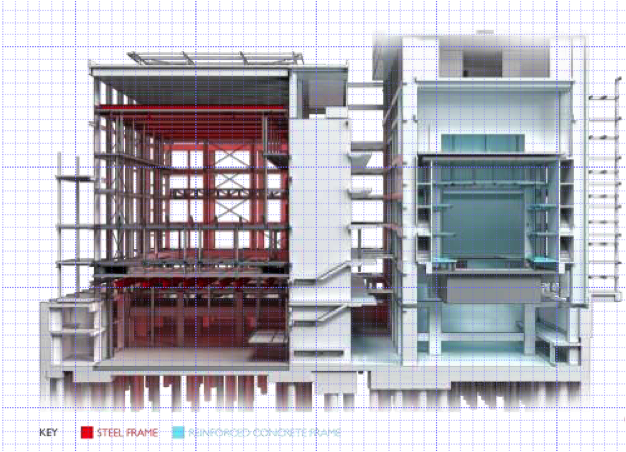 2. Concrete Framed: Tower and teaching theatre, compatible RC for the theatre and PT for the tower to provide flat soffits to all floor plates, good acoustic separation and a maximum number of floors within the stack and height restriction.
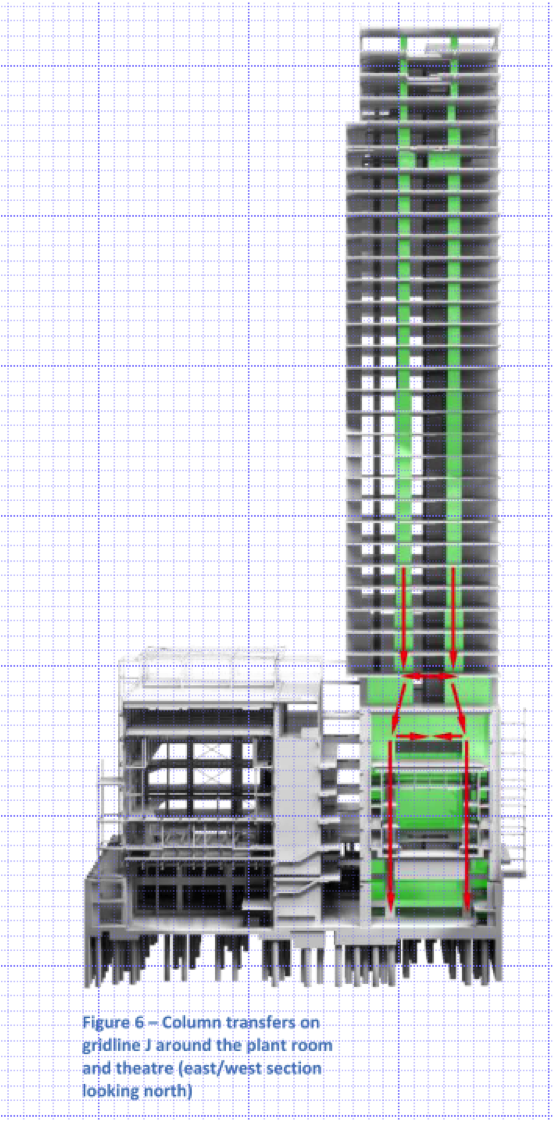
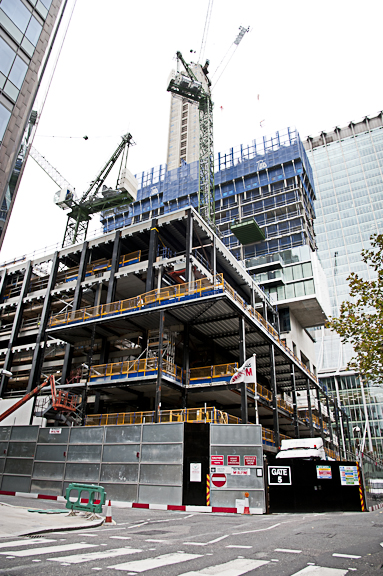
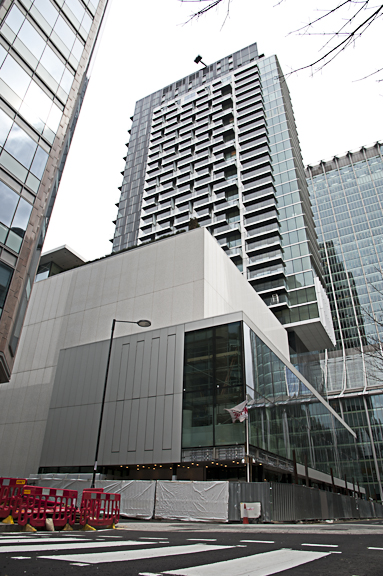
The Heron – before and after.
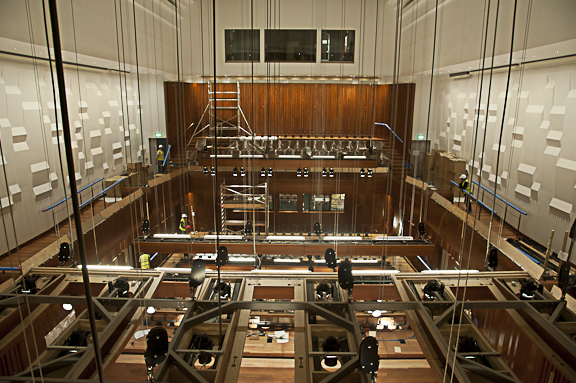
Steel-framed concert hall.
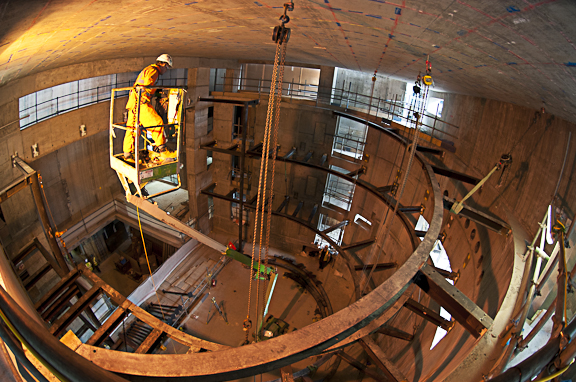
Concrete-framed theatre below residential tower.
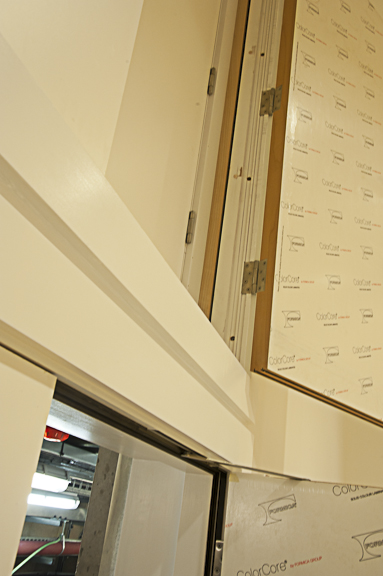
‘Box-in-Box’ construction joint, note separation void between boxes.
SURVEYS
Water Leakage Survey. Heron is one of London’s principal property developers. As part of the development The Heron acquired some basement space under the road, through to some car parking spaces in the Barbican. The acquisition of additional space in a 1960s development however comes at a price beyond that of the space alone. Movement joints within the Barbican podium have deteriorated such that water leaks onto Client’s potential parking spaces, and the basement on the other side of the road is now leaking. I had been initially tasked with providing retrofit waterproofing solutions for the podium slab, before the basement was also identified as leaking…!
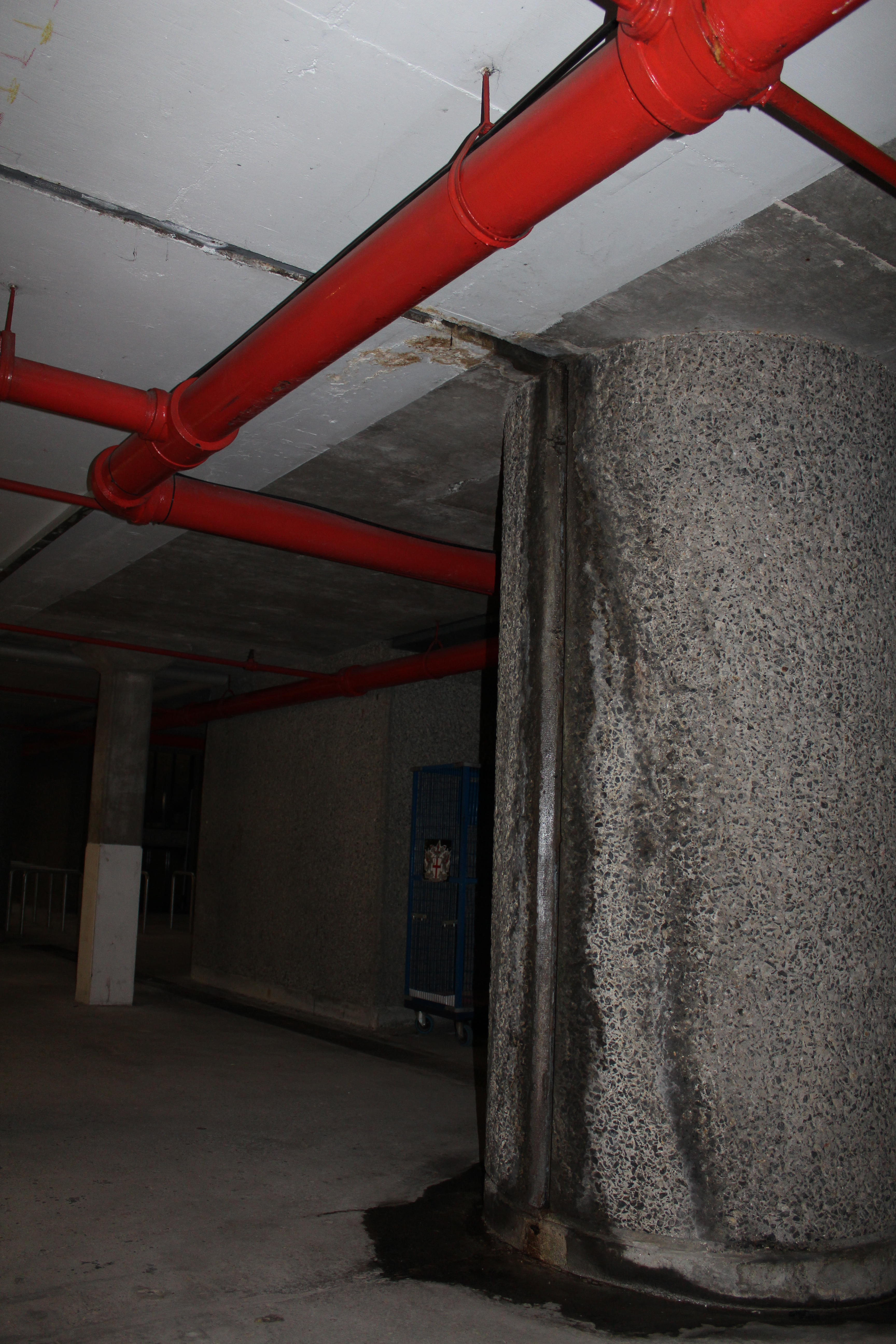
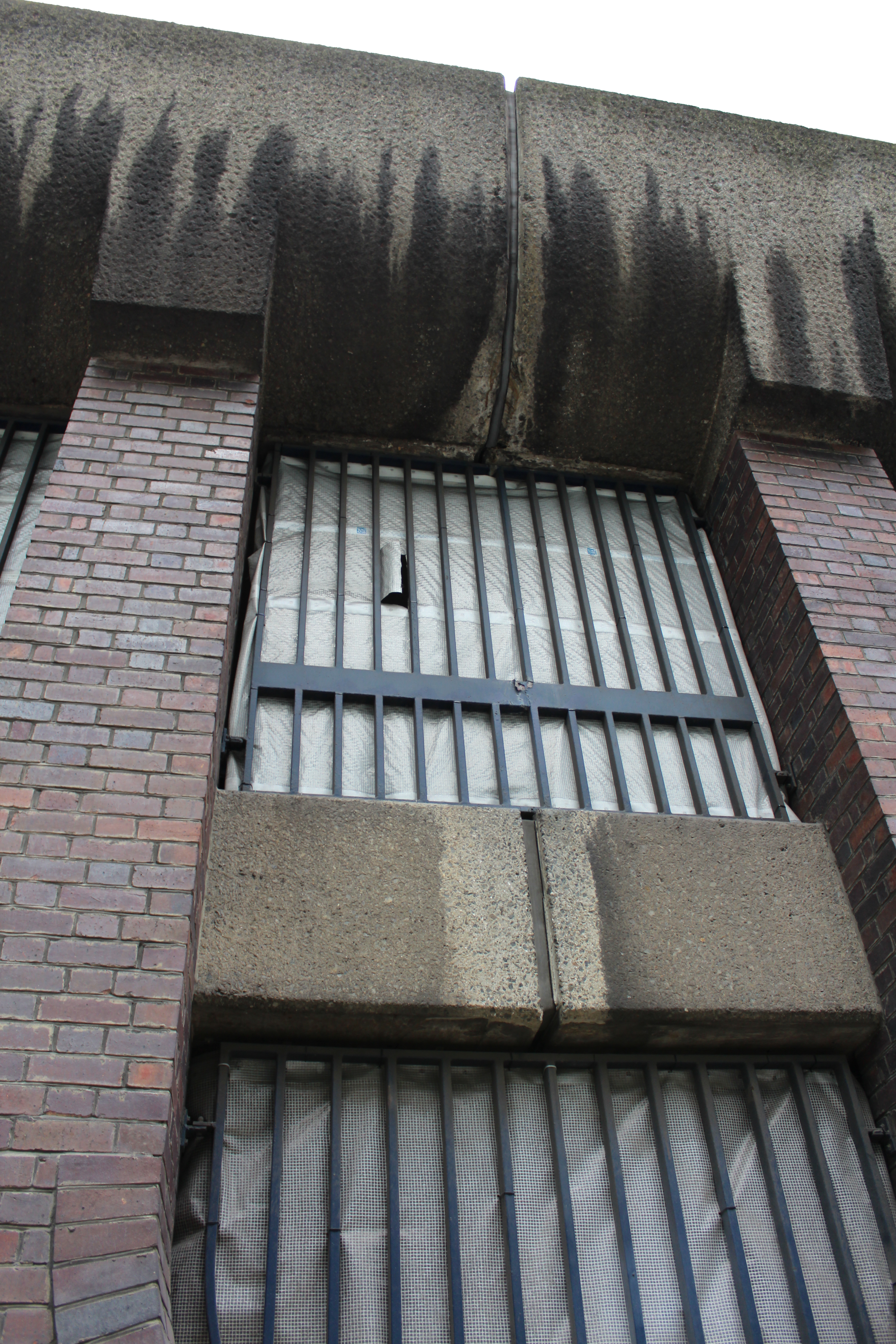
Movement joint in car park column and podium slab.
The picture below was taken 2 hours into the site visit to determine the cause of the problem and agree possible solutions. In attendance where the Client, the Heron Project Managers, the contractor SRM, City of London Surveyors, WSP, representatives from the Barbican. A total of 8! The eventual outcome of the visit was that the two issues were either mutually exclusive or the leaking basement was as a result of the leaking podium slab. City of London roads are treated as structures (i.e. the surface is deemed to be an impermeable layer) and as such additional waterproofing measures are not incorporated into road build up. Fine, until the road is dug up for services installation and maintenance! The waterproofing at site boundaries as specified by WSP does not extend the full pavement width and is not incorporated under the pavement lights adjacent to the Barbican car park. A number of possibilities were identified, all of which would see financial responsibility with a different party – funny how that added at least an hour onto the investigations! It was decided that a water test be carried out by the contractor using a Barbican fire hydrant and coloured dyes to establish the source of the problem……. so look forward to more exciting photos next time in colour!!! In conclusion, water is extremely difficult to trace through structures!
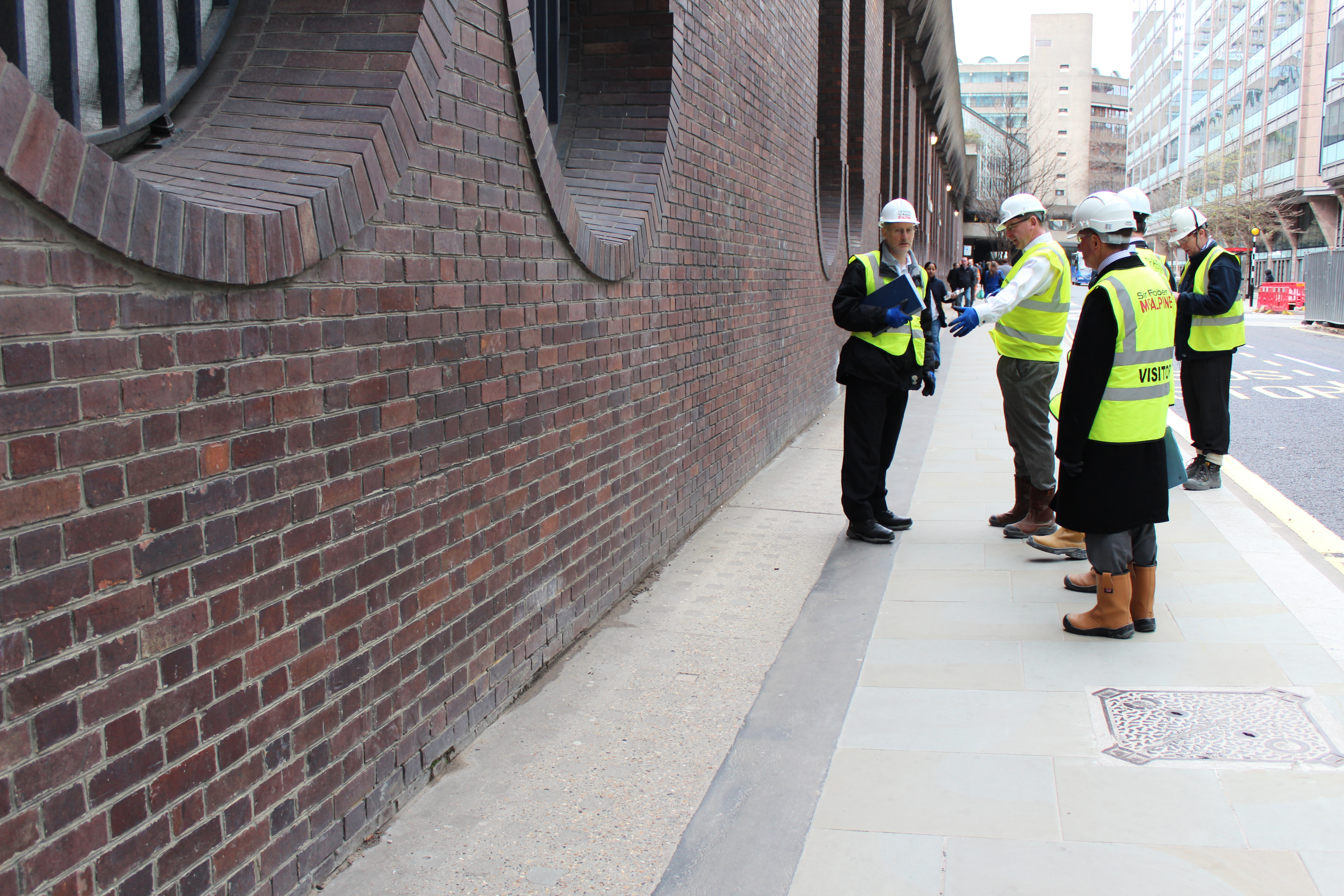
The water source identification team adjacent to the Barbican on the left hand side.
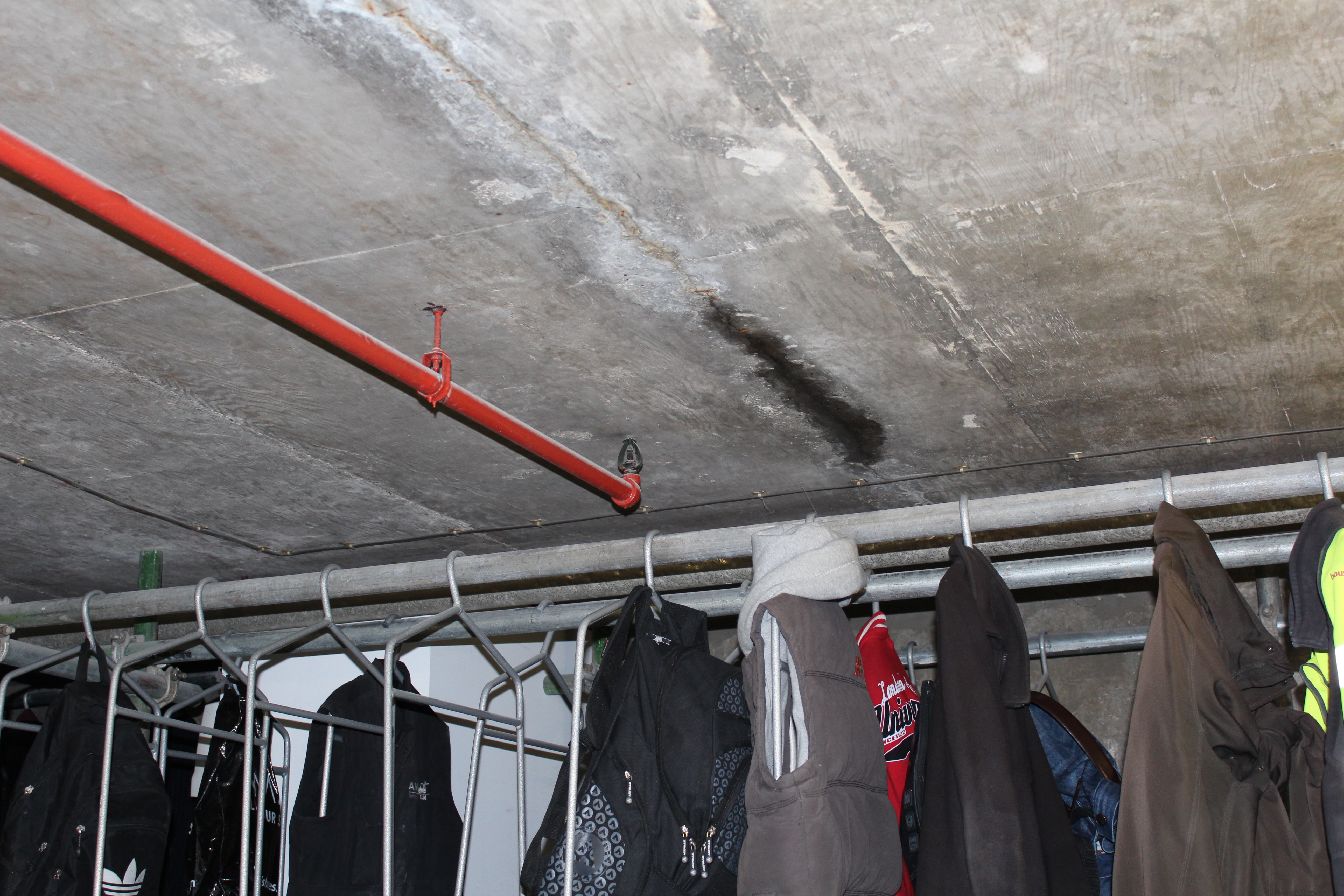
Tracing the water through to the Heron basement (on the right hand side of the above picture).
Employee Survey. On return from the site survey, I was approached by one of the Directors about my thoughts on the WSP employee survey, which are now mandatory in almost all large UK firms. He told me that the Structures department boss was very disappointed, surprised and concerned about the results. He asked me to put a few bullet points together (from an outside/military perspective) for a meeting the following day. After a year in industry these were my slightly de-militarised thoughts:
1. Survey results. Unfortunately I have not yet seen the survey results, however, from what you said I understand that there was a general consensus of apathy and negativity towards the way people feel they are managed and the company in general? The two main reasons people fail to complete, or adopt a ‘whatever’ attitude towards surveys is that they either:
a. Don’t believe they will be listened to.
b. Don’t believe that actions will be taken from the results.
This causes results to be skewed towards those who completed the survey (i.e. highly satisfied or disgruntled). Before deciding on any action, it is therefore important to fully analyse the results and carry out further investigation if required (i.e. interviews or meetings to determine the crux of the issues). For future surveys, techniques to maximise employee participation could be used (e.g. one company used charitable donations post 50% completion in individual units).
2. Response to survey. The next stage is demonstrating to employees that their opinions count and that they are a valued part of the decision making process. This can be simply achieved by communicating what the survey said and what actions have been taken as a result of employee feedback.
3. Engagement. Fundamental to dissatisfaction is an unengaged workforce. Engagement is quite simply meeting basic, social and esteem requirements of employees. Research show that “people join an organisation but leave a manager”! Engaged employees are proven more likely to share their views with their managers, take less sick days, have improved performance and productivity and be more innovative. Engagement is a reflection of a manager’s individual leadership qualities, and will only happen if managers have a clear understanding and are committed to realising the benefits of motivated and value-adding employees. This requires buy-in from all levels of the organisation.
4. Managers responsibilities. Every employee is different and hence effective engagement requires a very personal style of leadership. This involves managers making every effort to understand the needs and aspirations of their team (both within an individual and group context). This can be achieved through regular meaningful engagement: informal (daily/weekly), formal (6 monthly annual performance and potential reports and PDRs). Goals should be set at the start of every project which are clear and realistic, feedback should be immediate (and honest) and every effort should be made to match skill and challenge levels appropriately.
5. Employee responsibilities. Employees should be incentivised to optimise their performance and potential, as well as contributing to the wider company ethos. Manager’s reports should reflect employees levels of engagement, and they should be rewarded accordingly (responsibility, position, project assignment, promotion*). Engaged employees should be empowered to instigate change, from changing dysfunctional or unpopular processes, to tasking graduate engineers to get maximum participation at a company team building event.
*I appreciate that there are always financial constraints however, fewer quality, ‘engaged’ and appropriately salaried personnel are much more valuable than many short-term ‘unengaged’ employees.
I have since been asked to a follow up meeting with HR…… sports afternoon Wednesdays, early knock off Fridays and ‘enforced fun’ socials here we come….!!!!
Bull$h*t Baffles?
The latter part of last week and the former part of this week have been spent preparing for the pour of Upper Basement Zone 4, oh and dealing with the aftermath of the Zone 3 pour. We called in a professional slab scanner to assess the perceived cold joint and had the lads from Cut’n’Break take a couple of core samples along the join. This involved a nifty little radar car (not dissimilar to Imran’s efforts on his attachment) that was rolled around the surface taking scans of the slab. This was initially done to locate the core samples in the dodgy areas and do so missing the reinforcement – not entirely successful but it seems nothing ever is. The radar car then spent the following day taking cuts across the centre line at 1m intervals in order to build a picture of the state of joint. Both sets of results came back in whilst I was on course but I have yet to have a good look at them. What I do know is that of the 6 core samples at 7 days their strengths (for a 32MPA mix) range from 25 to 10 – so I would hazard that it doesn’t look good for zone 3. The next stage is working out exactly what to do. The initial suggestion is to chip out the joint and either side of it and re-pour but the ultimate decision rests with the structural consultant.

The GPR scanner car
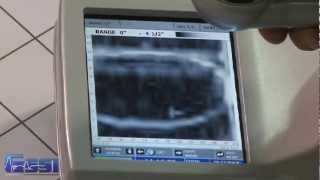
Example of GPR output (low point of curve = reo location)
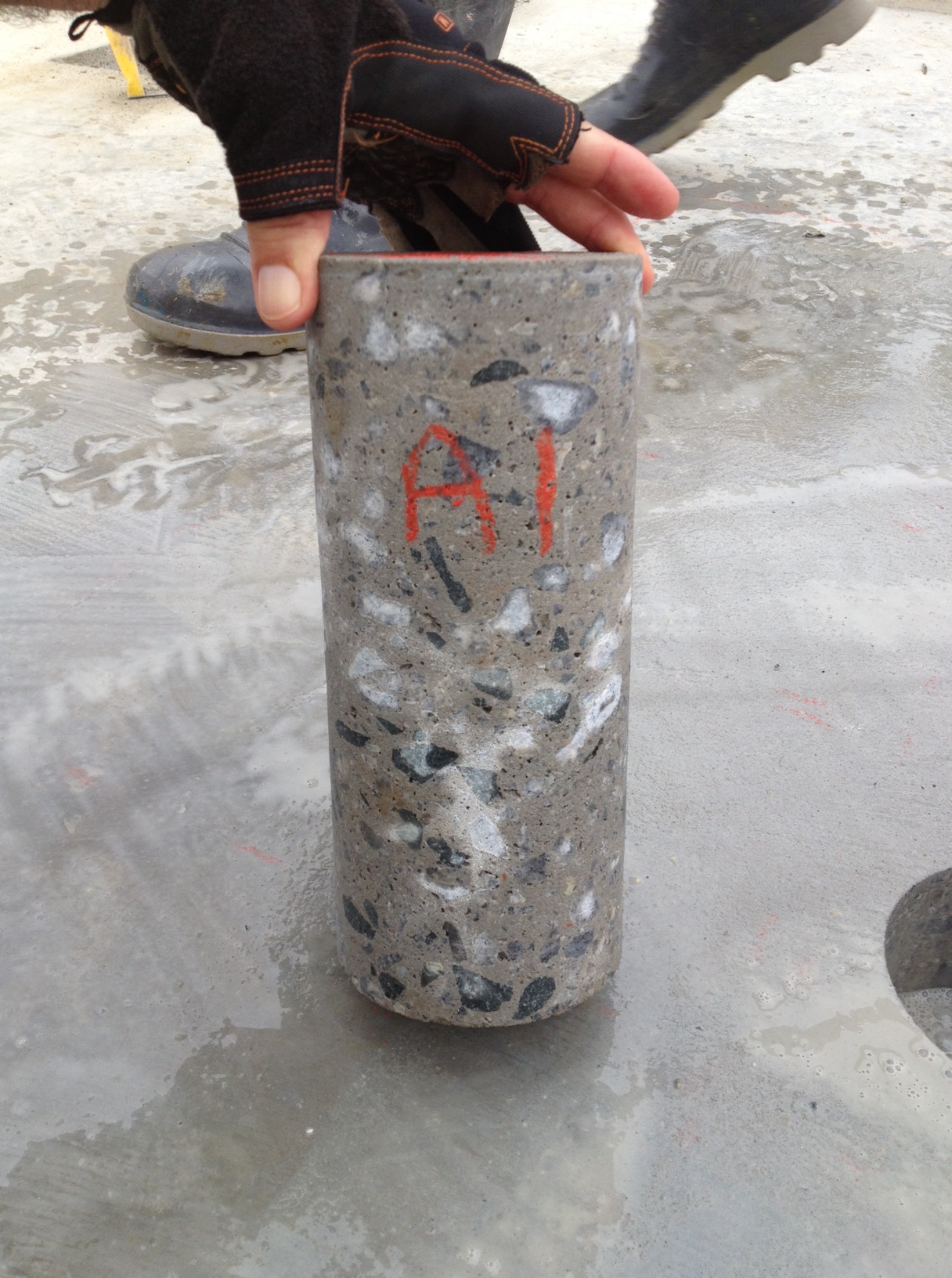
Cored concrete sample
The fallout from this situation is that the client’s representative (CR) is not convinced that JHG are taking quality seriously and placed a suspension notice on the pouring of suspended slabs until it was proved that the processes are in place. This notice will remain indefinitely for all suspended slab pours which will be cleared for construction by the CR on a individual basis. What this means for me is not much really, I keep doing what I was doing before but just pay a little more attention to the presentation of my pour card, and ensure that site looks the part.
On Thurs and Fri I attended the Operational Safety, Quality and Environmental (SQE) Risk Management course. I was expecting a typical half-arsed training course that nobody wanted to be at but was pleasantly surprised. Aside from a couple of days respite ‘off the log’ from site it was actually a very full and well structured course. The attendees were a mix of JHG supervisors and site managers from across the spectrum of business units as well as a couple of additional blokes who were working as contractors with JH (one of whom was a 30 year soldier in the Arty/RAPTC). The programme was loose for the 2 days but this allowed a lot of talking around the topics which for me was good to gain an understanding of how the different units and workers approached the systems that JHG uses. The syllabus basically ran through the SQE process from Tender to Site and explained all the process’s and roles throughout. I found that it built upon the subjects that were merely touched on in the inductions, and I left with a better understanding and the confidence to implement and question the processes on site.
Whilst I was away Zone 4 was poured through an intricate system of pipes, pumps and towers. The original plan was for a 0700 pour from a mobile pump in the slip-lane which was feeding a tower pump that rises out of the slab through a penetration. This all worked fine in principle, (calculations were put together to ensure the load of the mobile pump was not too great to compromise the integrity of the piled wall) but in reality, feeding 260m3 of 120mm slump concrete through a 150mm diameter pipe for 130m and expecting it to be of a consistence (they still use workable here) that can be poured is not an act of war. I had to request a new mix from the concrete supplier which then had to be cleared through the concrete pouring contractor and the structural engineer before we could send it to commercial for pricing and order the material for the next day. A surprisingly long winded process but it covered all the bases and was completed in a couple of hours. I am told that there were issues with the pump, but nothing that wouldn’t have happened anyway (My ‘Actions On’ section of the pre-pour meeting come into their own and the delay was assessed and concrete paused at the batching plant), and also that the main hold up which delayed the pour till 1400 was because of the Unions holding their members back from site due to a H&S issue the day before. The H&S issue was one that their own union members had caused through blind stupidity – instead of waiting for a bloke to finish surfacing a poured concrete edge or going a different route, they decided to carry the concrete pump tube over him, inevitably dropping it on his head. This initial delay meant that the slab was not finished until 1900!
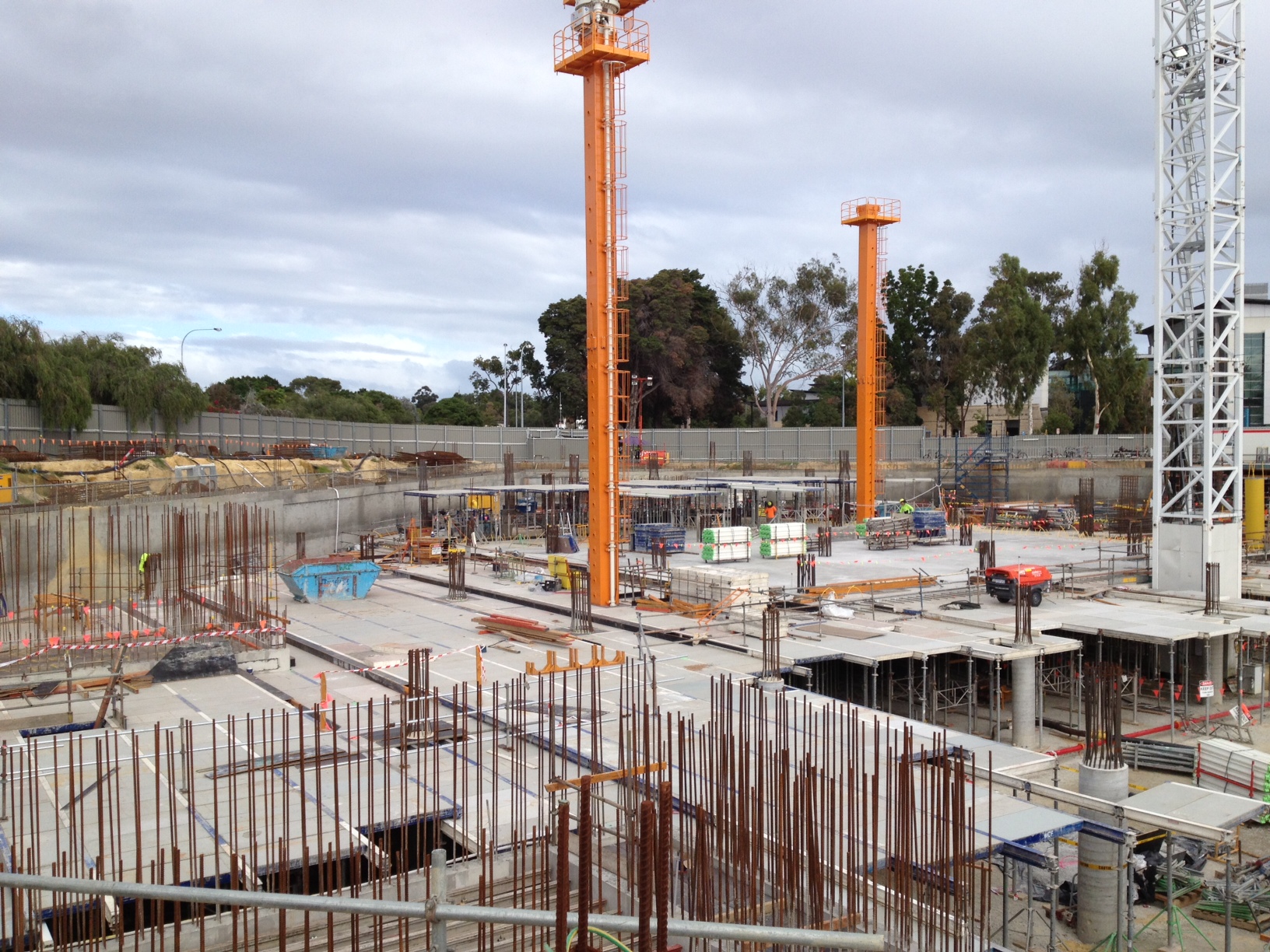
Zone 4 (poured) between 2 Tower Boom pumps
The CR later said that the zone 4 pour was one of the best prepared zones they had seen yet which leads me to think that they don’t really know what they are looking for. In my opinion, as the bloke coordinating both slab preparation, they were identical in preparation and only separated by trivial but obvious issues such as concrete splatter on reo. Maybe it is true that “Bull$h*t Baffles?”
Who is watching the Watchmen….?
Well it’s been one more week closer to the Cross rail Mile stone of excavating the shaft by 2 May, and we have got no closer.
Temporary Works
1. The Temporary Works design for the steel platform has finally been produced and after a few alterations we have sent the final design to the fabricators.
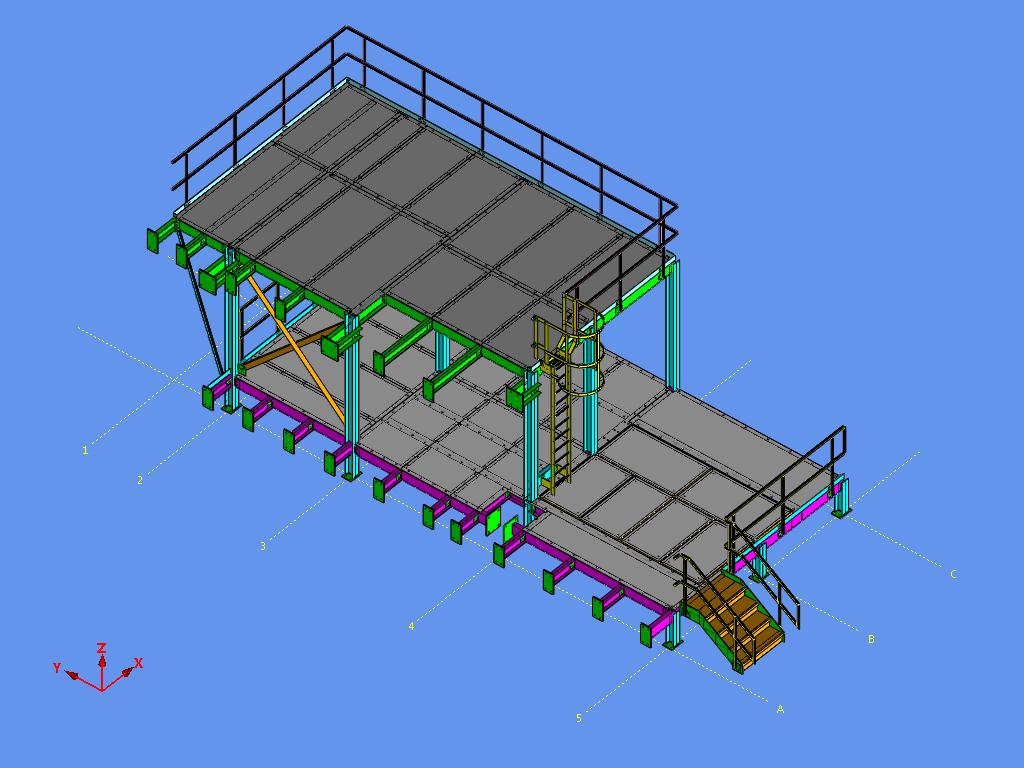
The new delivery date for the steel platform has moved to the right and SHOULD be delivered by the 29th Apr. My fear is that once it gets delivered it’s not going to fit without some serious alterations on site… we shall see. However once the platform is in place the generator, compressor, receiver, settlement tank, siltbuster and electrical MDU can be placed in position. As you can see the platform is most defiantly on the critical path for this project.
2. The Muck bin saga continues, it looks like the design has been approved by Cross rail, now that Merebrook Consulting have resolved the sub-basement propping issues in the building opposite. This means that the reinforced concrete slab can be poured next week and the retaining wall units put in place later that week.
3. The equipment steel platform on the other side of the shaft has now been designed and should go in later next week. This will allow the Concrete pump, accelerator tanks and the concrete remixer to be put in place.
4. Finally the 80T crane platform has been signed off by Cross rail. The idea is that the Over Site Development Geothermal Piles that have been put in place will be able to take the load of the 80T crane. The majority of the bearing capacities of the piles are through the end bearing capacity and not the soil friction. As the piles are deeper than the shaft there should be limited loading onto the shaft wall.
Who is watching the Watchmen?
As the Cross rail project is funded by the public taxpayer, the client (Cross rail) has employed an entire team that monitors the contractors (BFK). This ensures that we (BFK) comply with the standards that were drawn up in the contract. However it means that every single piece of paperwork has to be authorised by Cross rail. That includes the: Daily Briefs, Work Specific Activity Briefs, Method Statements, Risk assessments, ITP’s (Inspection Testing Programs) and signing off on all the materials that we use. However, we sub contract a vast amount of work, so we have to check that the sub-contractors are applying then Cross rail ensure that we are complying, the whole process is man power intensive and massively inefficient. Who would have thought that a Public funded project would have been so inefficient…?
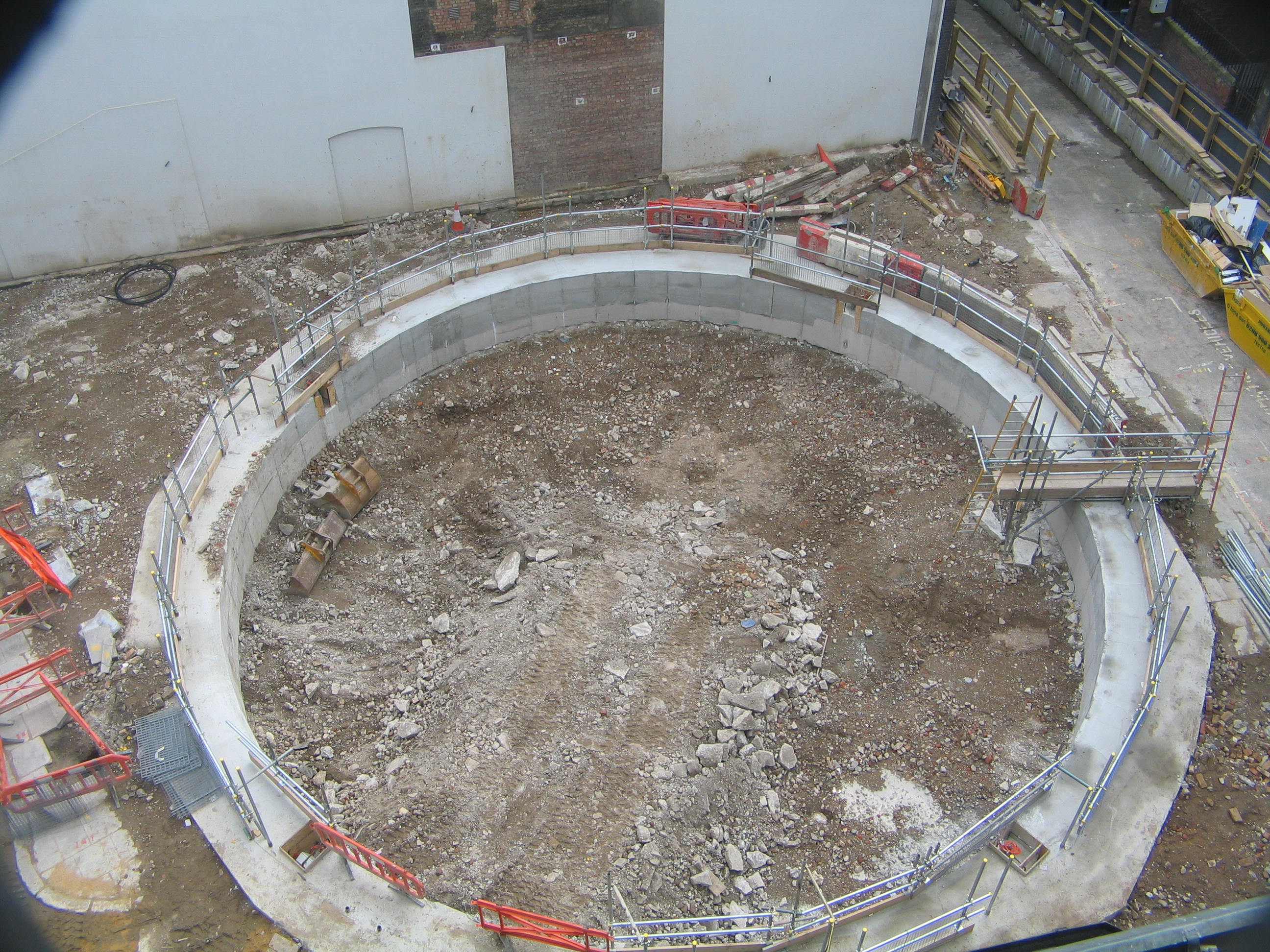
Anyway, less moaning. I’m off on a two week holiday next week for my Easter break. I will keep you updated with the site photos. AS you can see below, not much change from last week. Hopefully you will see much improvement over the course of the next two weeks.
Technical Engineering…
Residential Technical Engineer????
OK, so, rather than working on technical drawings and engineering matters with Flowserve week-on-week, my role has evolved to become more of a fixer, working in their office one day a week and kicking people’s backsides there (as well as in Aberdeen) accordingly. It’s certainly interesting seeing their side of the story and their frustrations and I’m not shy in telling people where they are delaying the project (and strangely this does all seem to working) but I’ve effectively promoted myself to consultant rather than getting stuck into the roots of engineering which was the plan. Far from ideal, but it looks to be opening some mechanical engineering opportunities (and it needs to do so quick!). These opportunities are currently quite limited, but as follows:
- Working on the Lube Oil System (LOS) skid with WG PSN in Aberdeen – still yet to happen but hopefully get a handover this week. Good stuff.
- Develop the NDT procedures and ensure they’re in line with BP’s engineering technical practices (ETPs). OK stuff
- Continue to gain an understanding of the manufacturing processes. Not-great stuff, but interesting.
- Develop a quality action plan with the BP Technical Authorities (TAs) – something that we “definitely need”, but no-one knows what it looks like (and it still isn’t a definitive A and B competency filling tick, although I’m sure I’ve seen it mentioned in UK SPEC somewhere). Generic project management stuff.
Meanwhile, I’m still progressing the three TAR jobs that need constant attention to be ready for offshore execute in July – lots of details that no-one thought to mention earlier! Imran’s starting on the Bruce bearing access platforms (chuckle chuckle) that stagnated with both Ish and I due to lack of interest from BP management. However, the programme lead (1-up) for these is now Kerry Scott who seems to have a bit more of an inclination to progress the project than her predecessor did, so he should get somewhere…
In a completely different engineering role (but maybe good point-scoring come Review), Imran and I got ourselves “Primary Engineer” qualified at a one-day training event last month so we can now go into schools across the UK to help primary school teachers do some hands-on engineer stuff with kids. Once this thesis is finished I’m going to find a school and get myself well and truly stuck in. “Primary school children are the engineers of the future and it’s important to enthuse them at this young age if we’re going to sustain our role as a great engineering nation”. Having chatted to some of the IMechE honchos at the annual dinner in Glasgow and at a Young Members’ Panel meeting in Aberdeen, they’ll absolutely love that at Review…
And you know when you’ve changed when you’re in the KLM lounge sat opposite the free bar, there’s a taxi in Aberdeen to take you home and you’re doing work. Hold on a second – how much work can I really get done in 30 minutes…
Loose lips costs time and effort
Following the successful pour of South Block’s Upper Basement Zone 2 slab last week I continued the motion to start on Zone 3 this week with a programmed pour date of Wed 10th. This involved the coordination of concrete cylinder testing and post tensioning to ensure that the pour could be completed on time after Zone 2 had been tensioned. The stated criteria for tensioning on a 32MPA concrete suspended slab beam is 9MPa or 24hrs for the initial stress to 25% of the maximum, and 5days and 22MPa for full tensioning. In this case the structural consultant allowed the period to be reduced to 3days and 22MPa for speed of construction. The RFI to use a stronger early age mix to assist in this process has now been approved by the structural consultant but has been held up at commercial the commercial level. In my view, with a liquidated damages rate of A$180,000 per day, the increased cost of a 40MPa early strength mix will be negligible if the project runs over.
The reinforcement tying went in without major issue except a couple more clashed with PT ducts and a lack of reinforcement design for a stair core that was partially encased by the slab. The design was for finally released on the Thursday evening before the Wednesday pour placing an increased pressure on the steel scheduler and the steel provider to get the couplers to site in time to be fixed. This didn’t happen, they arrived at 1745 the day before the 0530 pour and still sit idly next to the stairs. (I can potentially use them for a penetration that has been missed from the initial steel schedule but will require structural sign off first.) The solution to this issue is to drill and epoxy starter bars into the core wall prior to construction of the internal landing. This was already the solution for the other half of the stair wall that missed the inclusion of couplers when initially cast prior to my arrival so is not seen as a major issue. In my eyes it is galling that the parts were on site prior to the pour but there was nobody there to fix them. If I could have done it myself I would have.
The clients representative made a visit to the site the evening prior to the pour and made several observations to the structural consultant about finishes on column tops (not rough enough) and splashed concrete on reinforcement. Both easily fixed, one by me with a spare piece of reo smashing into the top of the column to scabble, the other after a fair degree of effort coercing the contractor to do it and in the end having to do it the morning of the pour.
The pour itself began well. The initial concrete mix was a 32MPa with Xypex and Eclipse as the surface was to be subject to external weathering and hence would require these additives to increase its durability. This mix flowed into a normal 32MPa mix. I placed myself at the concrete pump to check the mix prior to pouring and ensure quality of the batch. About halfway through the pour the formwork contractors spotters below the deck who move with the pour monitoring any deflections alerted the site manager that one prop had settled 30mm and that the pour should move to another area while they fixed the issue. This was done but the concreters deemed the deck to move so were immediately removed to a safer area whilst an inspection of the underside was conducted. The area was re-propped and initial props placed ahead of the pour to ensure stability. The pour continued with the concrete just on the limit of its use-by time (90mins post batching). The slump had decreased but was still in range.
The concreters then claimed the formwork moved again and were once again removed from the slab. The H&S coordinator barricaded the slab and called in the Construction Director and Project manager to manage the initial investigation. It was found that a prop was not sat on the roadbase surface and had been undermined by water flowing from the deck above and had consequently settled 30mm. The subsequent additional propping had been a little over zealous and had lifted one of the deck units 15mm give the concreters the impression that the whole deck had dropped. The slab was deemed safe and after a brief H&S representative meeting the concreters returned to work, working a nearly cold joint. This continued whilst I turned away 5 trucks that were out of range and waited for new concrete to arrive whilst the concrete pump cleaned its pipes. The remainder of the pour was relatively uneventful.
My pour card was removed for evidence in the H&S investigation. Comcare (equivalent of the H&S executive was informed but as it was not a complete of partial collapse, and the incident caused no injuries, it was not notifiable. The unions were also informed and were reluctantly granted access to site – they found nothing and were satisfied with procedures. That said the rumour mill amongst tradies is similar to soldiers and pretty soon news that the deck had collapsed and dropped 180mm were rife. I hear it also made local news and Glenn Palin, MD of JHG was also informed. I am informed that there is often a small degree of settlement that occurs in falsework but to call it a collapse is an exaggeration. The clients representative has now issued a suspension notice to prevent any further suspended slab pours until it is satisfied by a JHG report that the correct processes were and are in place to manage such issues and ensure quality of the product. My pour card formed a substantial part of this report and included density tests of the roadbase, falsework plans and sign off from a 3rd party certified engineer of its compliance and structural stability, and sign off from all contractors that their work was to the required standard. I’m glad I had all the ducks in a line and the only issue that my PM had to answer for was that of quality management.
I was subsequently involved in the H&S investigation to establish the root causes of the problem, not to issue blame, though it was blatantly evident that everybody in the room was posturing to remove themselves from the circle of blame.
I think the incident, although it had the potential to be catastrophic, was managed well. The systems were in place to monitor the pour and have been proved to be effective. One of the bigger issues I think is one of information release. Even the contractor referring to the incident as a partial collapse sends out the wrong message from the start and required stamping out early. In the event it wasn’t and spread across the site and indeed country rapidly which only served to increase pressure to perform on an already pressurised build. The additional work to compile reports took a day from all the South engineers and PM which was time that was not spent making an impact on site.
Moving dirt.
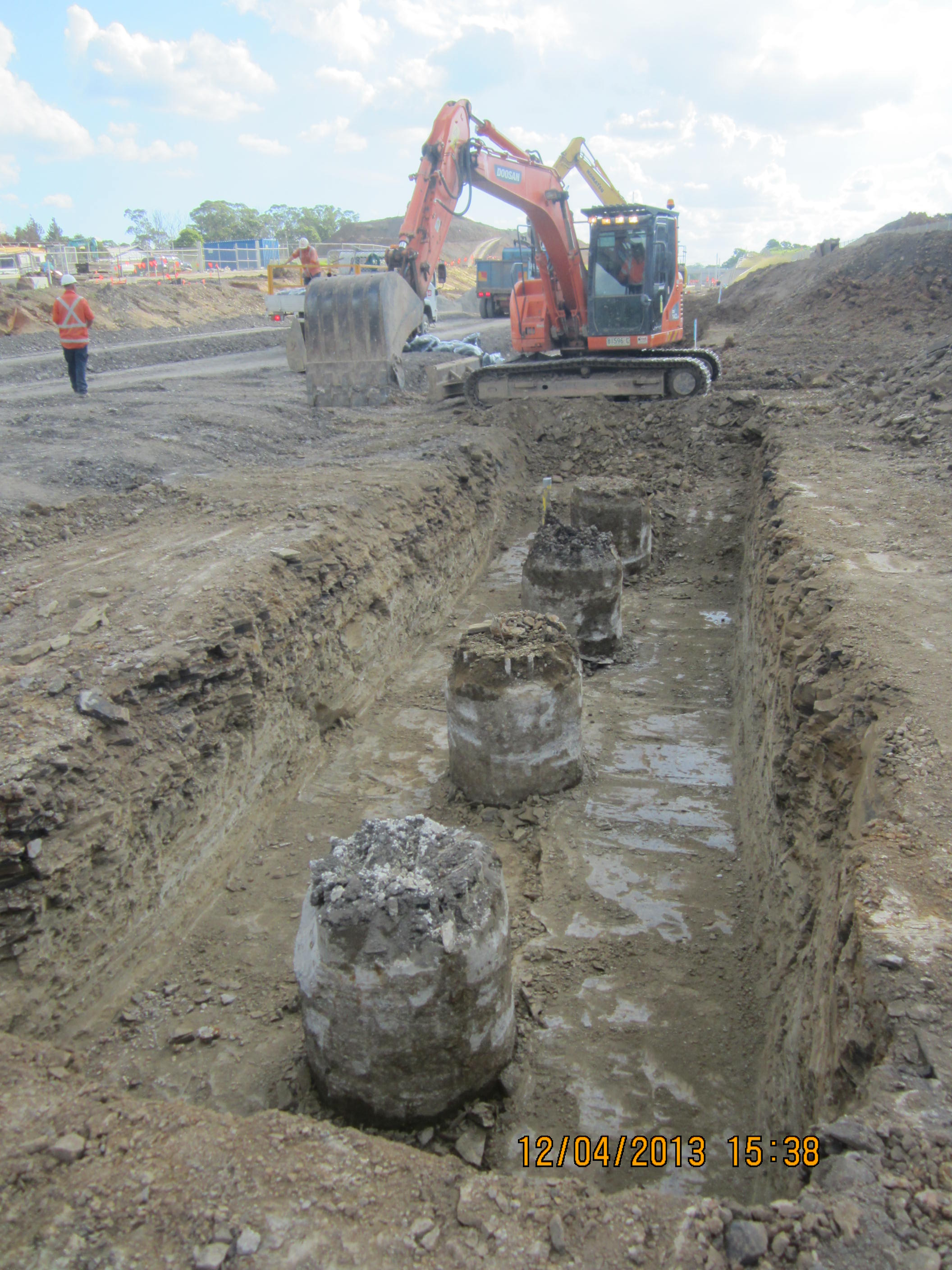
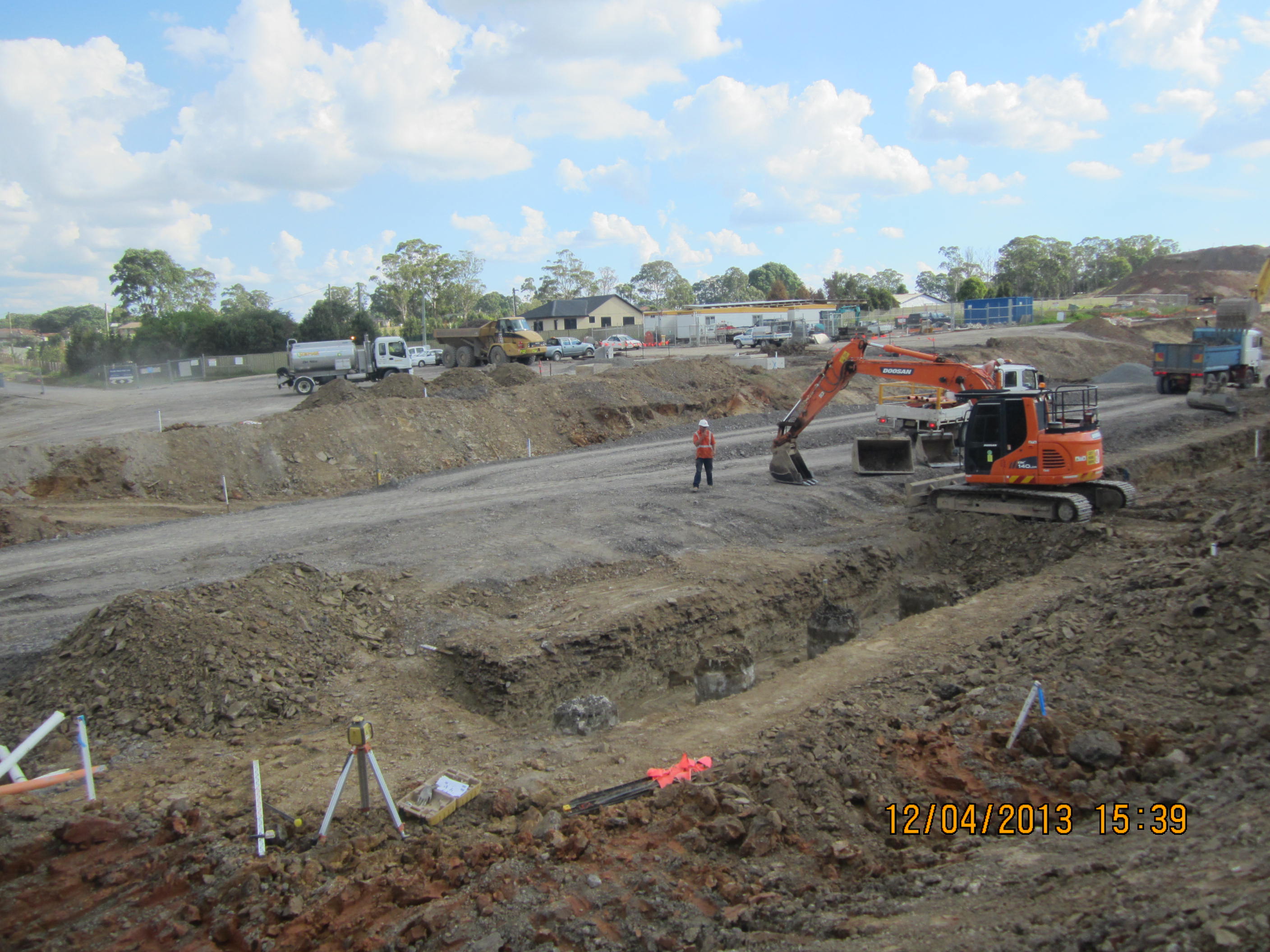
We completed all 10 piles on 3 Apr and for the past week and a half I have watched the civil team move a lot of dirt from one side to the other with no obvious plan. They have now taken possession of the site since we finished (they actually started ripping the road up while we were still on it!) to carry out the bulk excavation down to a sensible RL for us to carry out a more detailed excavation for the pile caps and embankment retaining walls. It has been a frustrating week trying to get a coherent answer or any information out of the civil team and I have picked up on a very strong sense of us and them between the civil and structures team throughout the project. The issue lies with the lack of work available to the civil team who are being pushed to close their worklots as soon as possible and move to other projects before coming back later in the year to proceed with the landscape works. There has been over million cubic metres of earth to move on this project and the Dickson Rd bridge is the final structure to start so they have been keen to get in and for us to progress so they can complete their work. Their impatience shows and results in less dialogue rather than more but by the end of this week we were all on a more even keel and the help of a few simple powerpoint sketches seems to have impressed and helped visualise the work required for all involved. We also have the Combined Services Route (CSR) digging away in the same patch of ground with one route adjacent to abutment B which we have successfully de-conflicted with but another route passes through abutment A and which at the moment looks like it travels directly through our excavation works. I am sure there will be more on this in next weeks blog but we first need to raise this issue with the designer.
As the civil team work to raise the ground on either appraches to the bridge we have manged to gain access to the abutments a day earlier than planned to start the detailed excavation at abutment B which we continued on saturday and hope to finish on Monday. We have now excavated about 2.5 metres below the existing road level and once we have cleaned out the excavation we can start the FRP works. Once complete the excavations will be blinded and the piles trimmed next week.
The pressure has been on at the other end of my section of works at Kemps Creek bridge which is at the entrance to the Stabling Yard. The stabling yard becomes a rail site as of Monday which seems to mean security gets beefed up to that of an army barracks (minus the armed guards) and the rail team works at a more relaxed pace. What this means for the rest of us is that we all work to the rail timelines. Track is starting to be installed at the stabling yard and so the civil team need to be laying the capping layer which the ballast sits on and so we need to have completed that end of the bridge so that the capping layer can be laid. We managed to pour the last segments of walkway at abutment B which faces the yard so come monday the civil team have a completed end to lay the capping up to. We still have the remaining walkways which house the Combined Services Routes (CSR) within them for the remaining 70m length of the bridge and we have been told we are on the critical path. We need to complete this bridge by 15 May for the track to continue from the stabling yard. Track is also being laid from the Glenfield end from 4 May so the bridge at Dickson will soon become critical also as the track approaches from Glenfield which is about 8Km away at a rate of 400m a day. Our aim is to complete the abutment walls by mid may so that capping, ballast and track can be laid between us.
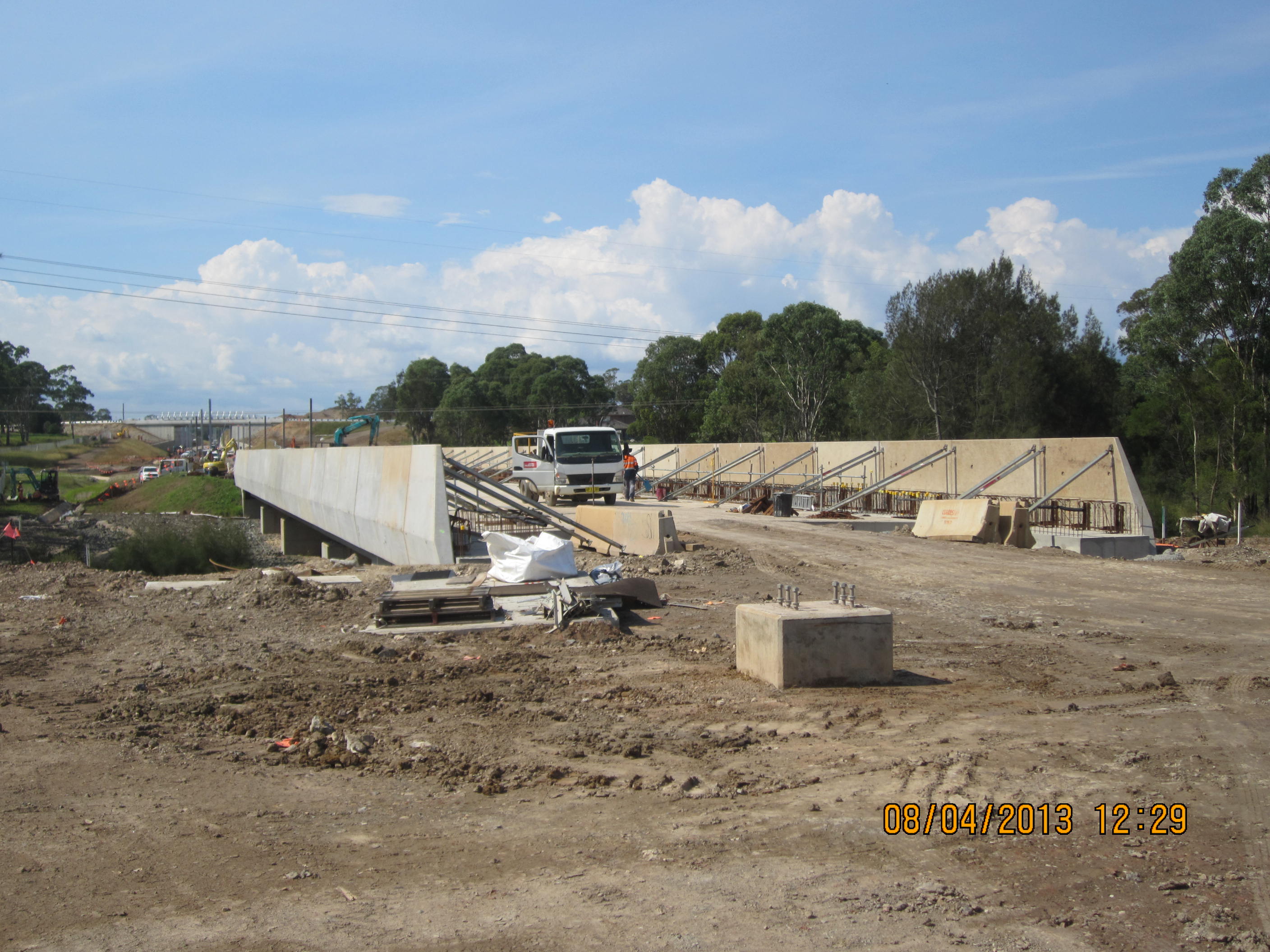
The pre-cast parapets have been installed and propped before the CSR walkways are poured which tie-in and secure the parapet sections permanaently.
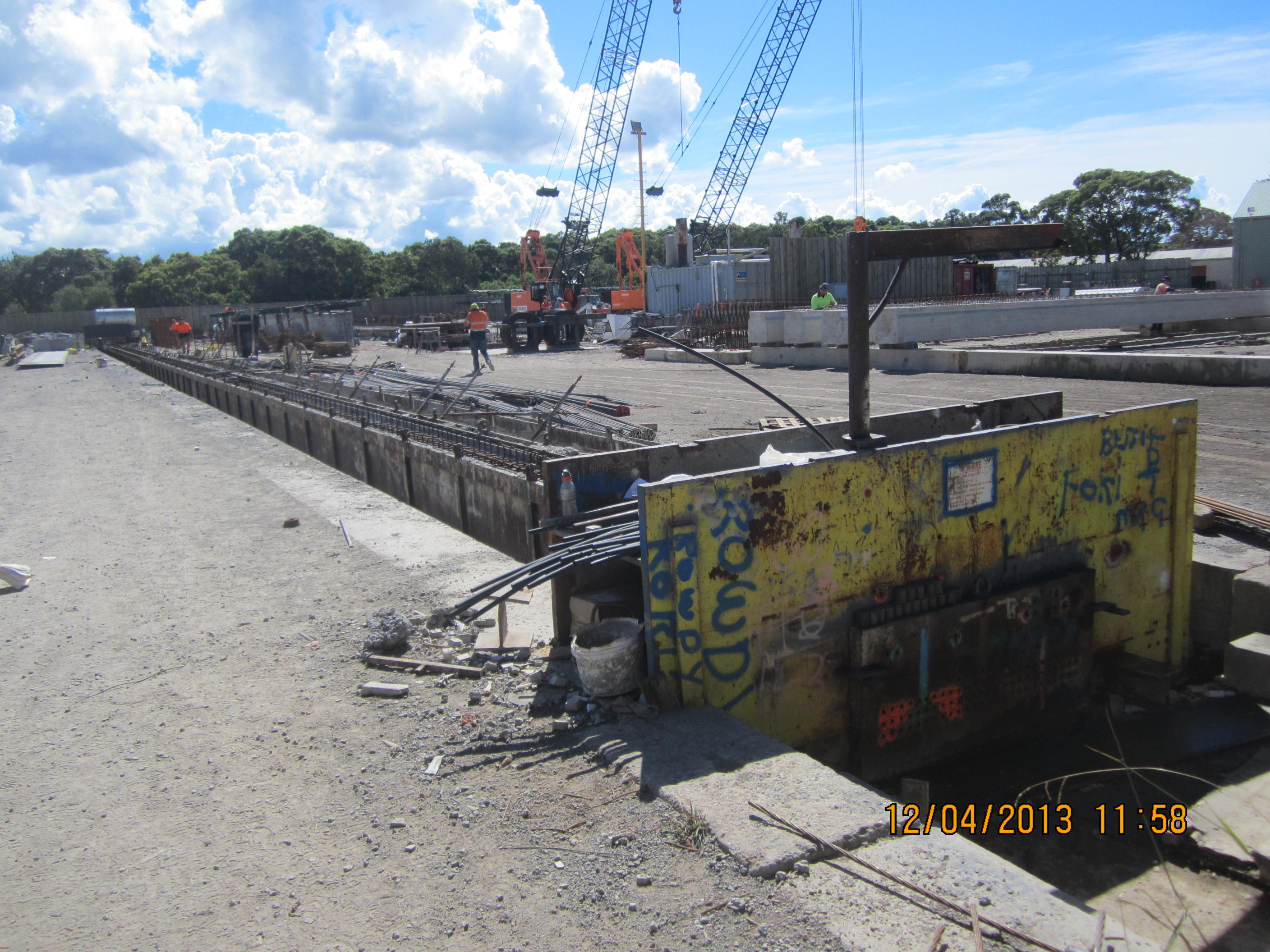
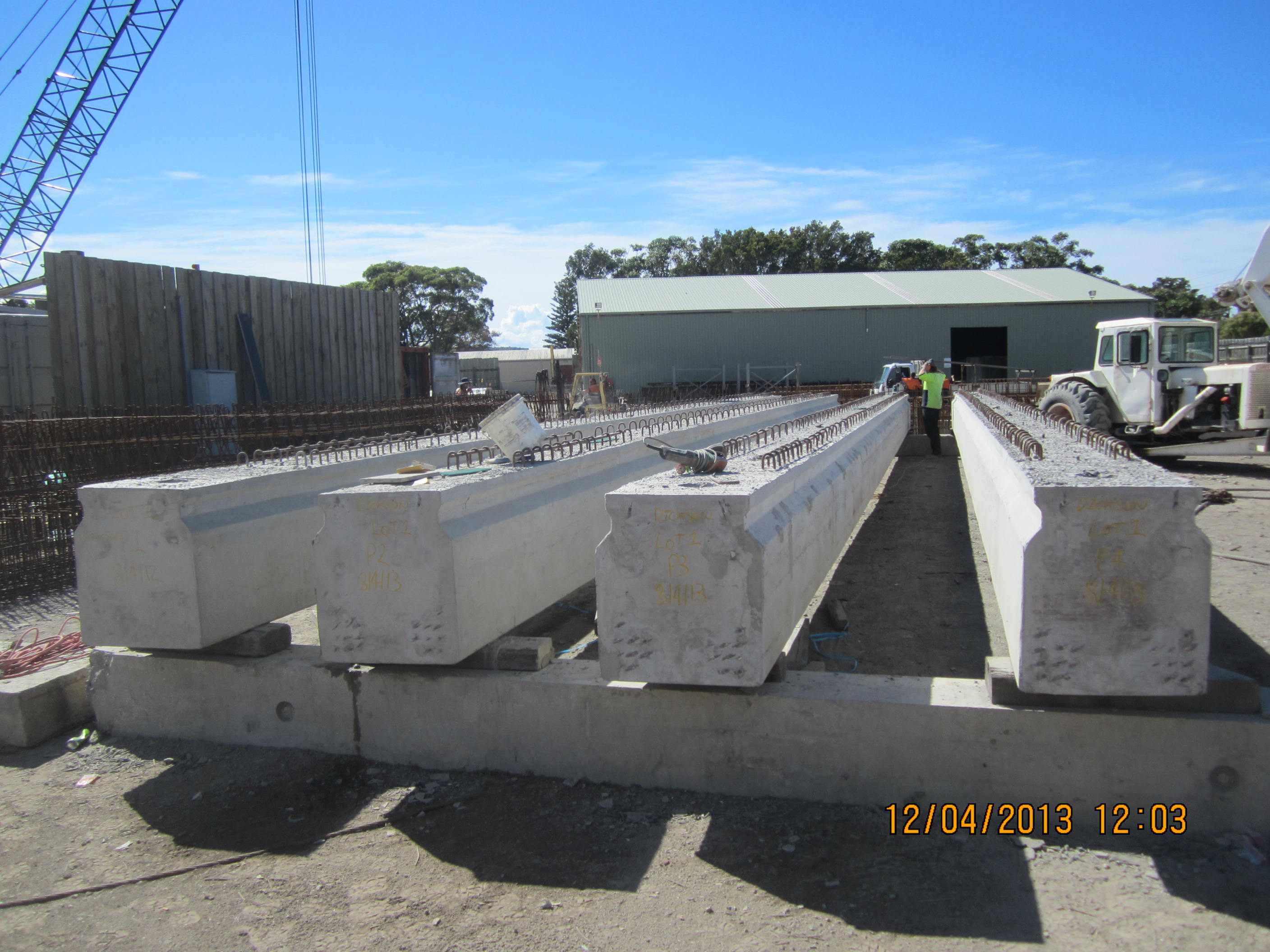
At the end of the week I got an opportunity to visit Civilbuild who are producing all of the pre-cast work for the project. These include the pre-cast parapet sections for all bridges for which there are over 2000 of various sizes and the pre-stressed concrete beams for Dickson Rd which was the reason I visited. I went up with the Project Verifiers to witness them pouring 4 of the beams for Dickson Rd but they eneded up cancelling the pour without informing any of us after a 3 hour drive to get there. 3 hours is considered popping down the road in Australian terms but having driven back to the project after an hour at the pre-cast yard and then driving home it ended up being 7 hours of driving. I did manage to see 4 beams they had already cast and 4 more that were formed up and ready to pour on mon. We require 22 beams for Dickson Rd and the yard has the capacity to pour 4 in a day. Each beam has a 300mm cylindrical void in the centre to reduce weight and is pre-stressed using 20 x 15.2mm (7 wire) strands with a force at mid-span for each strand once the tensioning jack is released of 175kN.
Organisations need a direction….if only someone could tell us which one!
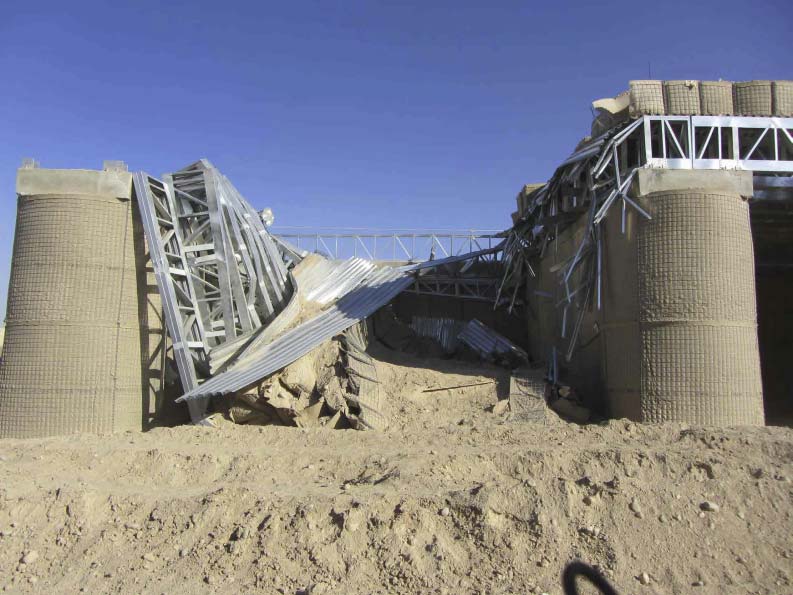
Afghanistan Bunker Collapse:
After some additional feedback from Richard Farmer I re-visited this report (as it had kind of become my favourite drum to bang on). Just to add some more murk to the mire I went through some of the background information such as the early statement of works and it would appear that the mad design was almost dictated to the contractor by the USACE. It detailed that the walls would be of HESCO and would support the roof structure. There is sufficient verbiage in there to be sure that the contractor shoulders all risk but now I am of the mind set that the contractor was pretty much set up for a fall. I have had further battles with the USACE Engineering and Research Development Center (ERDC) to get them to carry the torch on this and sort it out. BLUF = Put actual numbers in the design guides for what loads the concertainers can safely carry (bearing in mind poor local construction methods and materials) and we’ll have more peace of mind.
I finally got authority to release sanitised photographs to HESCO (Jake McQueen) so that they can use them to educate the RE, the USACE and the industry in general. Subsequent contact with Jake has highlighted that he has been invited to go and visit ERDC with relation to loading tests on bunkers…so even though they haven’t admitted it (to us) it seems the ERDC are actually taking my comments on board.
Poplar Island:
Here’s the pop-quiz: water flow over a crest, into free fall, to then land in a crash zone before flowing into a pipe which has an existing (variable) tidal level which then has to normalise under gravity….. Having tried to develop a model for what appears to be the most complicated fluid dynamics question I could have possible attempted – I gave up in favour of identifying common features for identifying and comparing various designs that will allow me to decant the top layer of a dredge material through a level culvert and into the sea. At least it gives me comparables to make decisions. If anyone is feeling clever – please feel free to give me a hand!
I suppose the question would be something like “A lake is 1000m by 1000m and 4m deep (assume a datum of 0). A 2m wide weir is used to allow water to flow into a 2m by 2m square chamber. At the bottom of the chamber is a 2m by 2m square culvert with a zero incline. The culvert opens out into the sea which is currently filling the culvert to a depth of 1m. What is the maximum allowable release depth of the weir that will maintain efficient flow through the system?”…….well I’m buggered if I can figure it out…..and the hydrologists here at work make excuses or fake heart attacks when I present it to them. I think I’ll stick to my stick and string engineering for now!
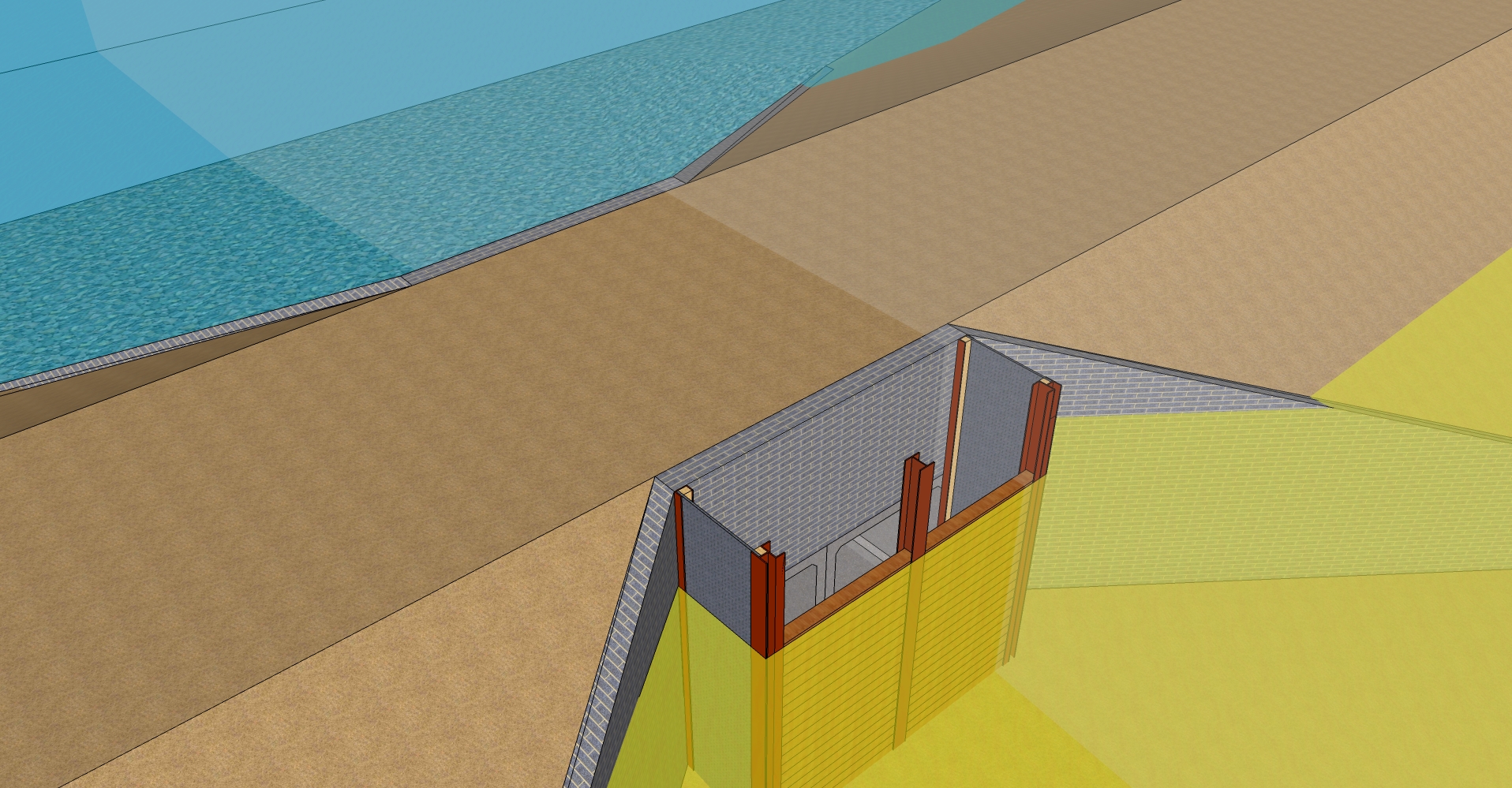
Model showing high chamber to release dredge material into concrete culverts and out to sea.
I am now confident that the entire operation at Poplar Island has never had any kind of plan for emergency discharges into the bay (for if the main dikes were in danger of being compromised – we need to be able to balance any head differences as quickly as possible). Having applied some thought process to this I now see that traditional methods of using stop-logs to create the weir crests would actually be too dangerous to operate in such a manner. The more logs you remove, the quicker the velocity of the water (and the deeper the water) gets, making it extremely difficult and dangerous. So the answer to the emergency discharge question is ubiquitously ‘it’s never happened….yet’. If the need ever arises – they are currently screwed. I’m looking at some ways around this – none of which have ever been tried before by anyone in USACE at least. One idea was for a large scale mechanical roller-shutter device. Whilst the idea is probably a non-starter for a silty environment, it may have a wider application on flood defences where space and access issues are a concern. I discussed the idea with a roller shutter manufacturer – warning them that if they stole my idea I’d hate to have to hunt them down and kill them! Another idea which I am trying to develop uses an array of flexible tubes that will increase the flow into the structure…but more to follow once I get my own head around it first.
Building 45:
One Colonel promises another Colonel he can get his staff a lovely new home because they are being cruelly kicked out of their current offices. His staff prepare a request for some dollars from congress to re-fit building 45 for the purpose. They balls up the estimates but it gets approved. All wheels are now in motion but now it’s kind of clear that they will not be able to get what they promised congress they would be able to for that money. A bunch of the funding has already been spent on looking at options and now it falls to USACE to try and fix the issue. Make savings of about $2M by ‘getting creative’ so that the project manager that screwed it up doesn’t get sacked and the colonel doesn’t end up breaking his promise.
My role has been to do the seismic analysis which has demonstrated that the building does not currently fulfill the code requirements and I am designing a bracing system to overcome this. A number of structural defects are also present that will need to be repaired and I am drawing up some specifications to allow the work to be bid for. The drawings are proving a little challenging even though we had that really long CAD course at PEW.

Lovely water damage to floor joists. (over 3cm penetration with a trusty screwdriver)
The really interesting thing in this one for me is the way in which everyone is now in complete denial about how this is going to turn out. The Project managers are continually trying to come up with creative methods of mixing and matching different sources of funding to make up the numbers – but this is where people go to prison. “Dear Mr Congress man – I asked for a bunch of cash to build X but I actually borrowed from Y and Z as well and gave you less than we promised we would in the first place.”. More than a month has passed and the brass are still unable to come to terms with the fact that someone needs to put a copy of the yellow pages in their breeches and go and take the spanking. All the while we have been cutting from the electrical, mechanical, architectural and fire control systems to the point that we aren’t actually doing anything except make the building structurally sound… Others are worried we may be leaving too much money left on the table, to which the response form the Branch Chief was ‘don’t worry – it will be a sole source bid so they’ll spend as much as we tell them to”!!!! WTF!!! Reminding people that this is tax payers money seem to be un-cool apparently. The final straw for me was when I asked sufficient questions to basically get them to admit that while ever the Client (Army Support Group) can’t make up their minds, we are happily employing people and spending ASG money because there is little work elsewhere for the architects…..again – we are wasting tax payers money for no other reason than we can’t generate work from other sources. We now have internal Government organisations screwing each other over so they can get the money….which all comes from the same pot…..shoot me now.
I keep offering to go and be the bearer of bad news and even help the Client look at other options (like how the re-shuffle could be accommodated by moving other personnel etc) but if I do that I will dry up their source of tax money sooner rather than later… so this is not the preferred option (even if it’s the ethical option).
Costings Briefs:
In an effort to get a better understanding of the costing problems I saw with the canopy project for Ft Meade, I liaised with the head of costing to see if he could give myself and Ben a run down of how they do detailed cost analysis. This essentially turned into a CPD session and was extremely beneficial. He showed us how the contingency that is added is reduced further into the project development to account for unknowns and level of clarity. He showed us his sources of info, from means spec to direct quotes and how his software builds up the analysis to include estimates for contractors overheads, sub-contractor overheads, contingencies and tax.
I have since seen his data spectacularly abused by the project managers on the building 45 project. “it says here base price of $1.8M which puts us on budget.”…..well if you want to go to bid with no contingency, expect no modifications or changes or unexpected surprises, for the prime to do all the work and not sub anything out AND get the best dollar on all quotes from a sole source……be my guest. The result will be no bids within your budget and a colossal waste of time effort and money.
Internal Quality Assurance:
I have finished preparing a Quality Assurance system for use within the structures section and delivered training to the group on how it is to be used, monitored and maintained. This involved getting to grips with all kinds of tasks that the section undertakes, from civil, military, domestic, overseas, bridge inspections, dam inspections and levee inspections to be able to come up with a method of making sure that a simple, effective, user friendly structure was achieved. There were several iterations with user feed-back before going firm and handing over the product which is now being used across the section.
Officer Professional Development:
All of the District Officers (14 in total) attended a mammoth OPD spanning 3 days and camping out in -6 degree weather. The development included a battlefield tour of the Gettysburg civil war site with specific reference to the principles of war (the yanks have 9 – and they aren’t really like ours), a tour of the 23 mile long recreational lake that USACE maintains at Raystown PA, a tour of the level 4 biomedical research facility that is currently under construction at Ft Detrick, a tour of the Raystown Dam facility, a tour of the Raystown hydro power station and a bunch of environmental briefs (it seems the environmentalists are hell-bent on killing stuff….perhaps it’s an american thing). The highlight was a dining in function which Ben and I coordinated with more than a hint of British tradition and an opportunity to make some presentations on behalf of PEW and MKC for the ongoing partnership between PEW and USACE. At first I was pretty pissed off when they decided to make me Mr Vice – until I found out the role is slightly different to back home. I was basically in charge of keeping the entertainment going and dishing out fines to all and sundry. It’s probably the first and last time I will ever get to give forfeits to full colonels and get away with it! The Commander here has said he would like to fly me back to do it again for next year’s OPD – and I might just try and hold him to it!
REVIT Weakness:
The penny dropped whilst working with some drawings that appeared to have varying details depending on which set you were looking at. Upon questioning this with the senior structural engineer it turns out that REVIT doesn’t deal with multiple skinned walls. As a result we appear to have a window over a column that has gone unnoticed for a while and a modification is required. I was immediately reminded of my earlier role as Project Engineer on a reservist center where exactly the same thing happened. Many RFIs were sent back to the architects and engineers at District who continued to reference the drawings that seemed to make sense (inner skin drawings) – whilst all the while on site there was quite clearly a beam showing through one of the windows (outer skin drawings). In the end it was the contractor’s fault and he made the mods himself. There were many bad words said by both parties on site about the apathy from District on that occasion – but I now see how this comes about. There is insufficient residual knowledge and training to ensure that this is resolved for future projects and I’m sure we’ll see it again.
Developing Future Engineers (and me!):
I have observed that there is a great divide between the experienced ‘old guys’ (of which there are 2) and the ‘young bloods’ in need of training (of which there are 5). The experienced guys are so overworked they have too little time to help develop the young bloods, but without the young bloods taking on more work, learning more and becoming more independent the situation will never change. Speaking with the head of department it seems they lost a load of experienced guys and not all were replaced. Those who did join the group are young graduates with little experience. I have outlined a plan with the boss (for after the thesis deadline) to start a mentoring process and to formalise the interaction between the experienced and the junior engineers. I have begun to find other engineers from outside of the group to be able to mentor the group and offer ‘lessons I wish they’d taught me before I got here’. I will report more as it takes shape.
And in other News:
It was great to welcome Nick Colvin to the fold and help him start getting his clan settled. My wife is still plotting on how she can kidnap his children. I am working on how we can harness the energy they produce as it might solve some of the worlds power issues. It has highlighted however, how little time is left before the big push and CPR.
It’s great to see all the new blogs appearing and to be kept up to date with the new round of activities – best of luck to you all.
The kids are in their last 48 hours with us before they go back to the UK and back to school. We just got back from a mini vacation with them to Canada where we visited Toronto and Niagra Falls. Lukas did some of the driving and Ulli and I did all of the panicking and screaming. (Just for Richard – road kill along the way included raccoon, deer, a bird (difficult to gauge other than a ‘big black one’) and you’ll be pleased to hear we saw our first flattened beaver in the carriageway. As spring is coming we also clocked several ‘yellow splats’ on the windscreen and some ‘red splats’ on the windscreen. I thought we’d discovered and immediately wiped out a new species of ‘purple splat’ but it turned out to be a red on yellow coincidence.)
I now realise that this blog is becoming thesis avoidance (whilst maintaining clear conscience because it’s work……honest) – so I will leave you be and get back to my scale model of ‘fluid mechanics for idiots’ using the sink bowl, a set of straws, a toilet roll tube and some sticky back plastic. Who said engineering can’t be fun?!?….although Ulli’s going to kill me when she sees the mess I’ve made.
McFry
Wanted: Dutch boy for permanent position under a ground floor slab
This week has seen a number of changes, specifically with the sub-contractor, a number of new black hats have been handed out (the mark of a supervisor on our site), civilians don’t seem to get the phrase ‘You’ve changed!’
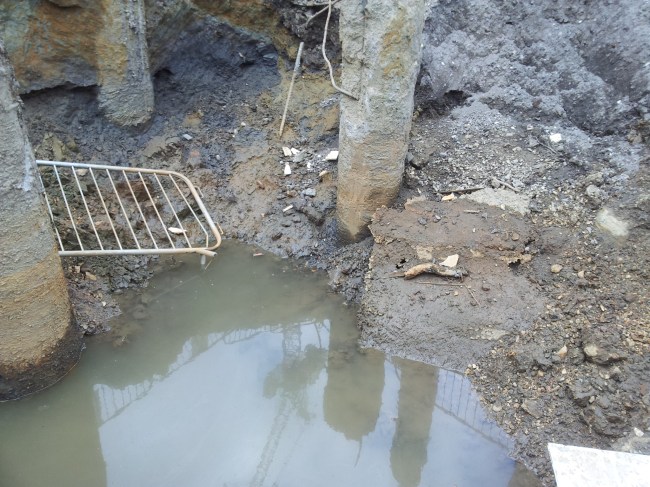
Artesian water continues to flow, sometimes I feel like we’re de-watering Southampton, without the help of a pump. The visit from our geotechnical expert was pretty unsuccessful, in truth he was an environmental expert that was going back to report on what he had seen to his geotechnical experts. The geotechnical experts have said ‘You’re F*$!ed’ clearly I’m paraphrasing, the best solution that has been suggested is to try and over bore, or encapsulate the former borehole location with a hollow casing allowing it to find a level and then backfilling with a tremie pipe using a grout, they are fairly non-committal on the possible success rates of such an undertaking and there will be a significant cost associated with getting something done and getting a specialist to deal with it. This would be all very well and good to try except for a couple of problems:
1. We don’t really have time to experiment, this is now holding up the build, I find this situation pretty frustrating because everyone seems to have ignored it for quite sometime now.
2. The attempt to cap the water with the concrete plug means that to execute this plan would require breaking out of about 6 m^3 of C50 concrete, so we’re going to get hammered for dayworks.
This leaves us with the french drain option, drawing the water off to a point where it can be collected and enter the drain system, the Environment Agency don’t seem too worried about the situation but winning over Southern Water might be a harder sell. A conversation with the Great Orator has helped, but in reality nobody can be sure of what may happen. I’ve done a bit of research and the waterproof joints that have been put in use a product that’s certified for 80m, we’re only talking 3m on my site and therefore it should shrug it off as long as the workmanship is up to scratch.
Such a seemingly simple problem has become quite a big issue, it is made so much worse considering the option to cap the piezo on the first place was offered up for a mere £600 per borehole, I would say we’ve easily spent that in fuel to run the pump. I think next week will see an attempt at the french drain option attempted, perhaps we’ll pull it off.
 Holdfast Training Services Trial Blog