Who ever knew that starting the construction phase would require so much paper work.
We are now only 2 weeks from starting the shaft excavation. The Section 61 noise consent form has been accepted by the council. The predicted water discharge consent form has been approved by Thames Water even the British Heritage have signed off on the refurbishments to the office building. It looks like we may even hit the Crossrail Milestone of starting the shaft excavation by the 2nd May.
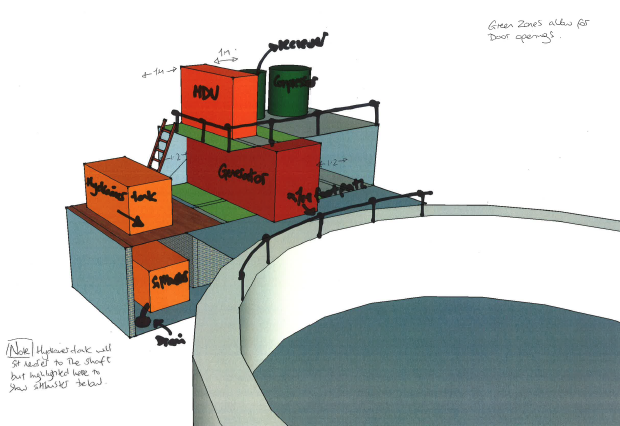
The major issue for this site has been its restricted site. The amount of equipment necessary to excavate an 8m radius shaft 80m deep has been enormous. This has led us to produce extra space in the form of 2 storey steel platforms. Rich Phillips would be proud of my Google sketchup concept sketch that I used in the Temporary Works Design Brief. See below Rich.
After being volunteered … I have now been nominated as the site Temporary Works Co-ordinator after successfully passing the Kier ran Temporary Works course 1 and 2 and a scaffolding course.
This has meant that a number of site issues have been left to me to resolve, the one causing the biggest headache is the muckbin area.
Muckbin Area
Unfortunately, no one joined the dots together and realised that for each 1m of the shaft excavated there would be approx. 370m3 of soil. Where to put it on such a restricted site?
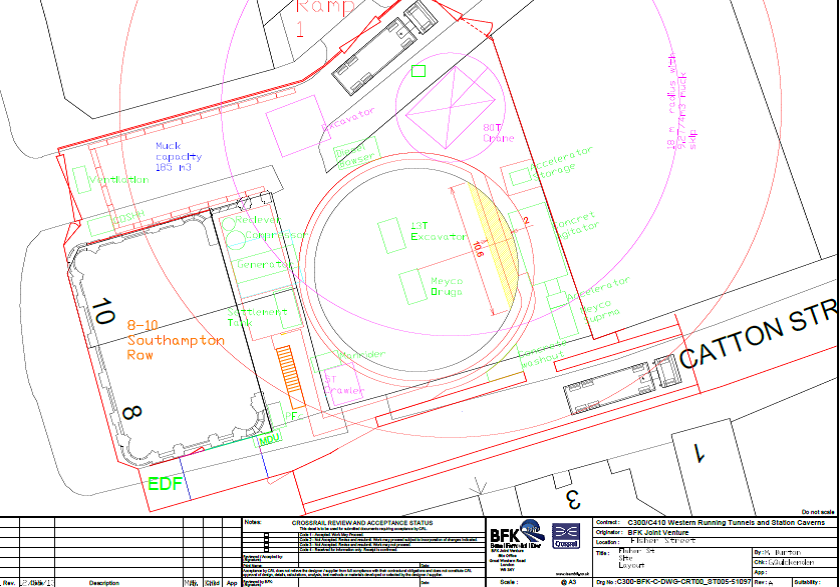
The only place to store the soil is on a road between two existing buildings. However both buildings have basements and sub-basements that would require propping due to the additional loading. Anyway a solution has been found, the sketch below illustrates the concept.
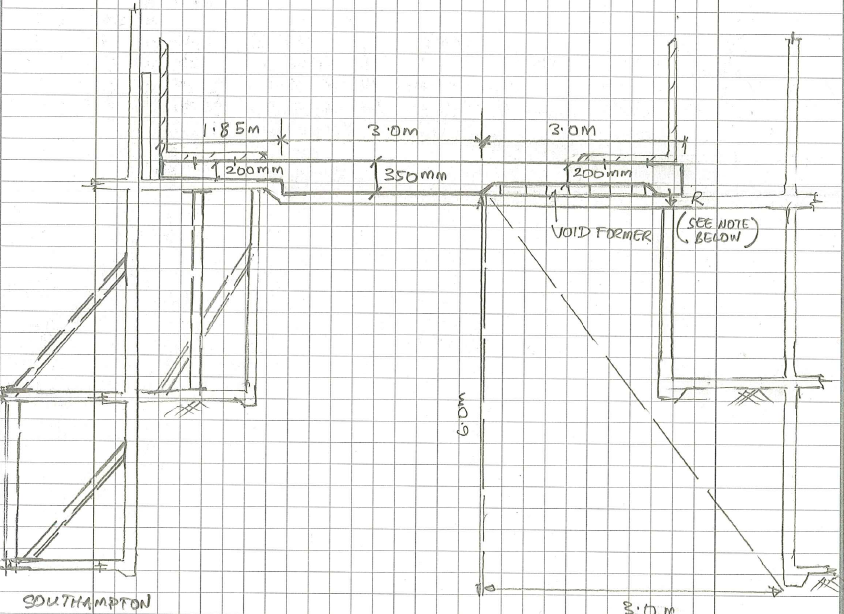
With the addition of a void former the additional load can be carried pass the adjacent buildings basement and sub-basement. The only issue now is deferential settlement on the unknown services that run below the road. However we will resolve that next week.
The Temporary Works Co-ordinator role has been quite an eye opener. In recent weeks we have had to produce briefs and partial designs for: sub-basement propping, muckbin area, 80T crane platform, 2 storey steel platform to house the generator, compressor and receiver and a single storey steel platform to house the concrete remixer and concrete pump.
The next 2 weeks are extremely important. All of the temporary works must be in place before we can start the main excavation. Hopefully between now and the 2nd May you will see some big changes to the site.
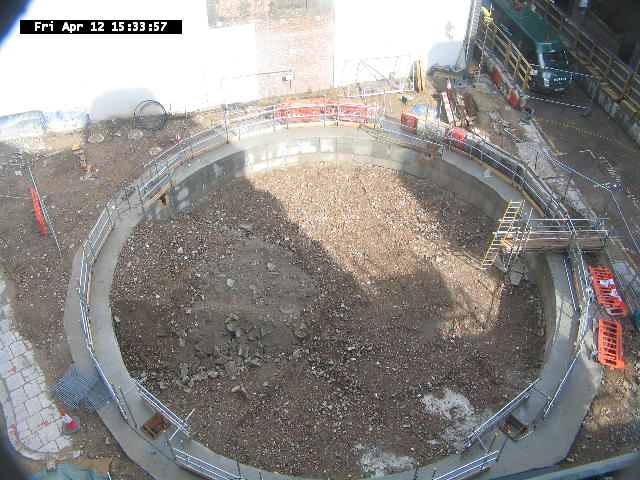
I got piles!
This blog covers the last two weeks as it has felt like a continuous week with one aim to get 10 piles completed for the foundations to Dickson Rd overbridge. There was Fri and Mon off of course for easter and all ‘non salary’ personnel had last Thu off as well so that was a non productive day.
MGI piling were the sub-contractors who we brought in to carry out the piling and the main realisation of the last two weeks is related to the AMS and site control. MGI piling arrived the Tue before Easter and the AMS was briefed to everyone so that they can ‘sign on’ to the method, then a services brief was carried out and the permit to excavate signed (this permit is about 50 pages long with 98% of the content irrelevent to my actual site and has remained on the back seat of the Ute ever since!). It seems an AMS is similar to an “Admin Instruction’ in the Army where the Engineer/Officer spends a great deal of his time to produce a document that very little people read unless I suspect an accident/incident happened where it would be scrutinised with a fine tooth comb. Even though everyone on site had signed on to the AMS to say they agree with it etc, a sub-contractor will invariable do what he has always done regardless! I have no big specific gripe on this issue it has just been an observation throughout the piling works.
As we had ordered oversized cages in the event we had to drill further than expected the Geotech Engr and subby concluded we would just drill further anyway to the depth of the cages so that we would not have to cut and weld on site – we had already got the welder on site ready to go before this was decided to the slight annoyance of the superintenedent who had to re-employ the welder that day and is another case of the sub-contractor deciding something without consulting either the suprervisor or myself, having already agreed to the methodology. A possible concern with this was if the sub-contractor would charge us more for drilling further and pouring more concrete but the time saved would be of more benefit in the longer term.
Each pile was drilled through the road surface and was fairly straight forward, I remained on site for the majority of the works in order to check off the Inspection and Testing Plan (ITP) checklist as the works progressed for QA purposes and to control the concrete coming on to site. We encountered water at about 9m of a 9.5m depth drill and in some it was only about 50mm at the bottom once the bucket had cleaned the toe out so on most occassions I eneded up calling the concrete forward so we could pour the pile before an excessive amount of water could trickle in through the shale below.
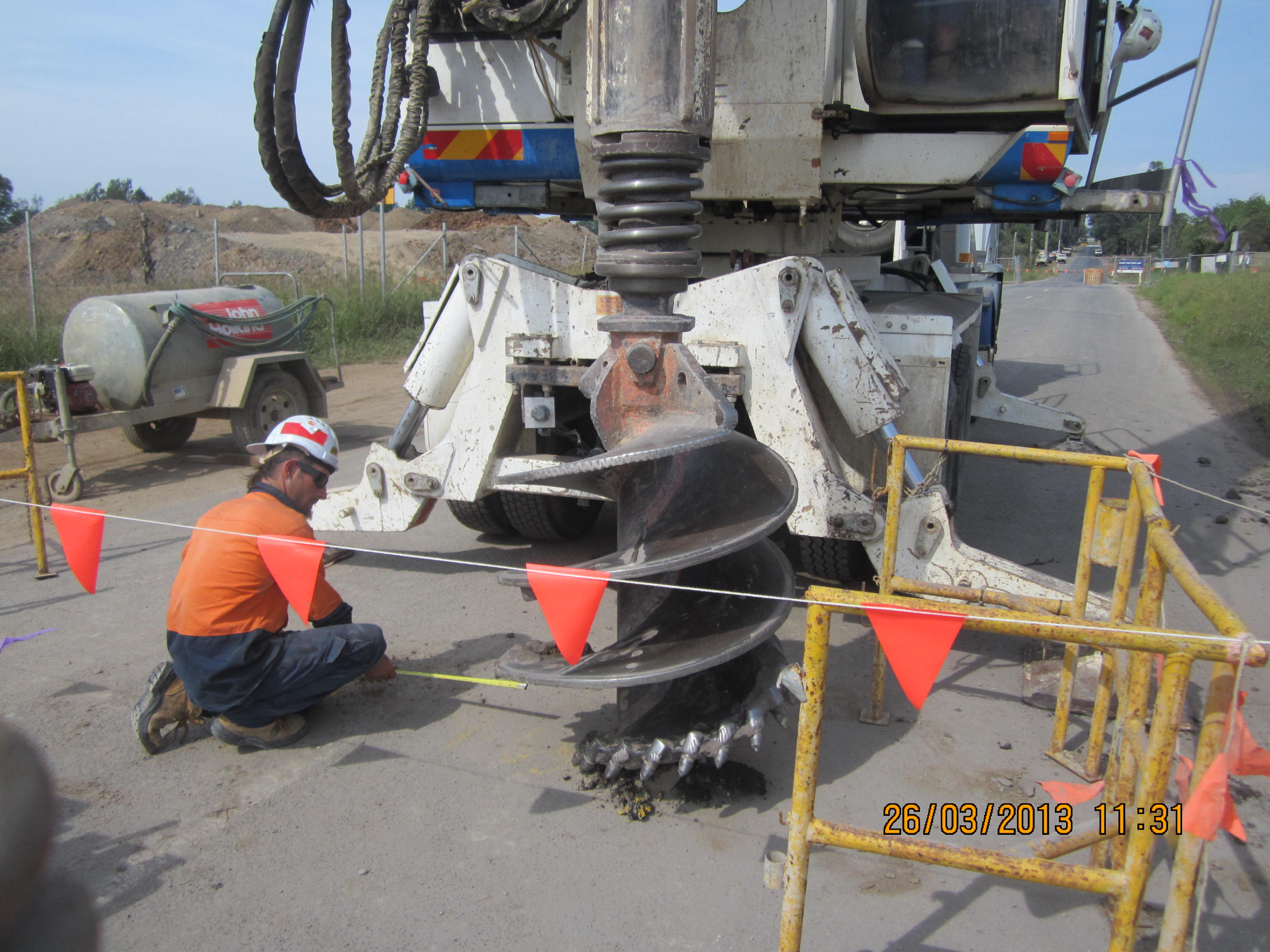
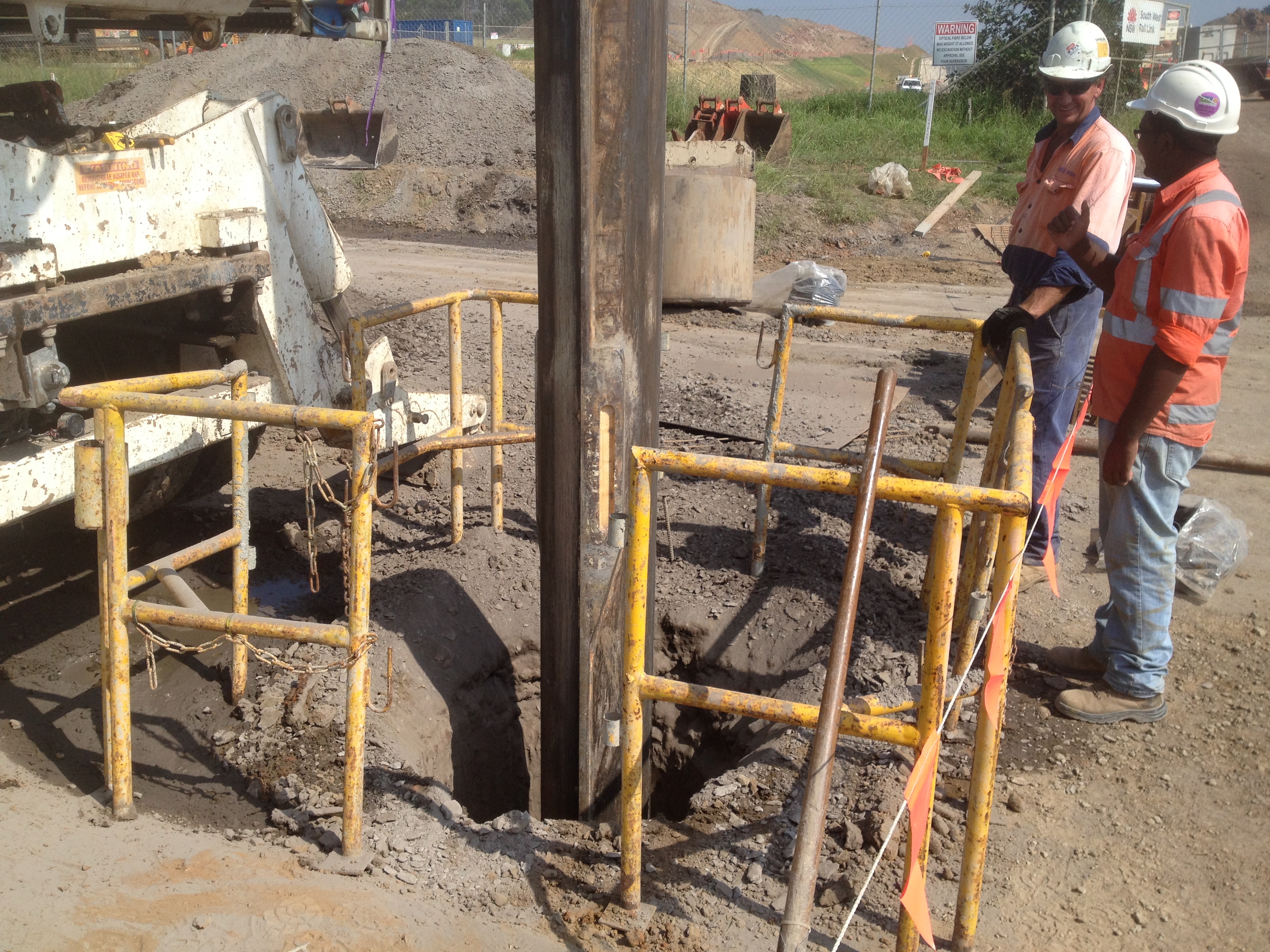
The sub-contractor arrived on site with a different rig (T-108 rather than a Mait 130 if your interested) than what we were expecting which meant the whole works took an extra day than we thought. As the reo cages did not need cutting we did save time here and each cage weighing 1.7T were positioned to the rear of the rig with a Franna crane and easily lifted by the rigs winch and lowered into the pile hole. Concrete placement was done by a ‘lay flat’ hose as opposed to a tremie pipe due the lack of water although on one or two in my very inexpert opinion it probably should have been tremied. They would check the water level in each hole before we poured and inform either myself or the supervisor depending who was there and we would be happy to expect about 100mm (65 litres of water) with the lay flat. On one pile post pour I observed water about 100mm below the top of the reo and considering there was a 1000mm projection and 400mm overpour this meant we had a least 400mm (320litres) of water in there. Water being lighter than concrete means it probably isn’t an issue providing the ‘lay flat’ worked like a tremie as they assumed.
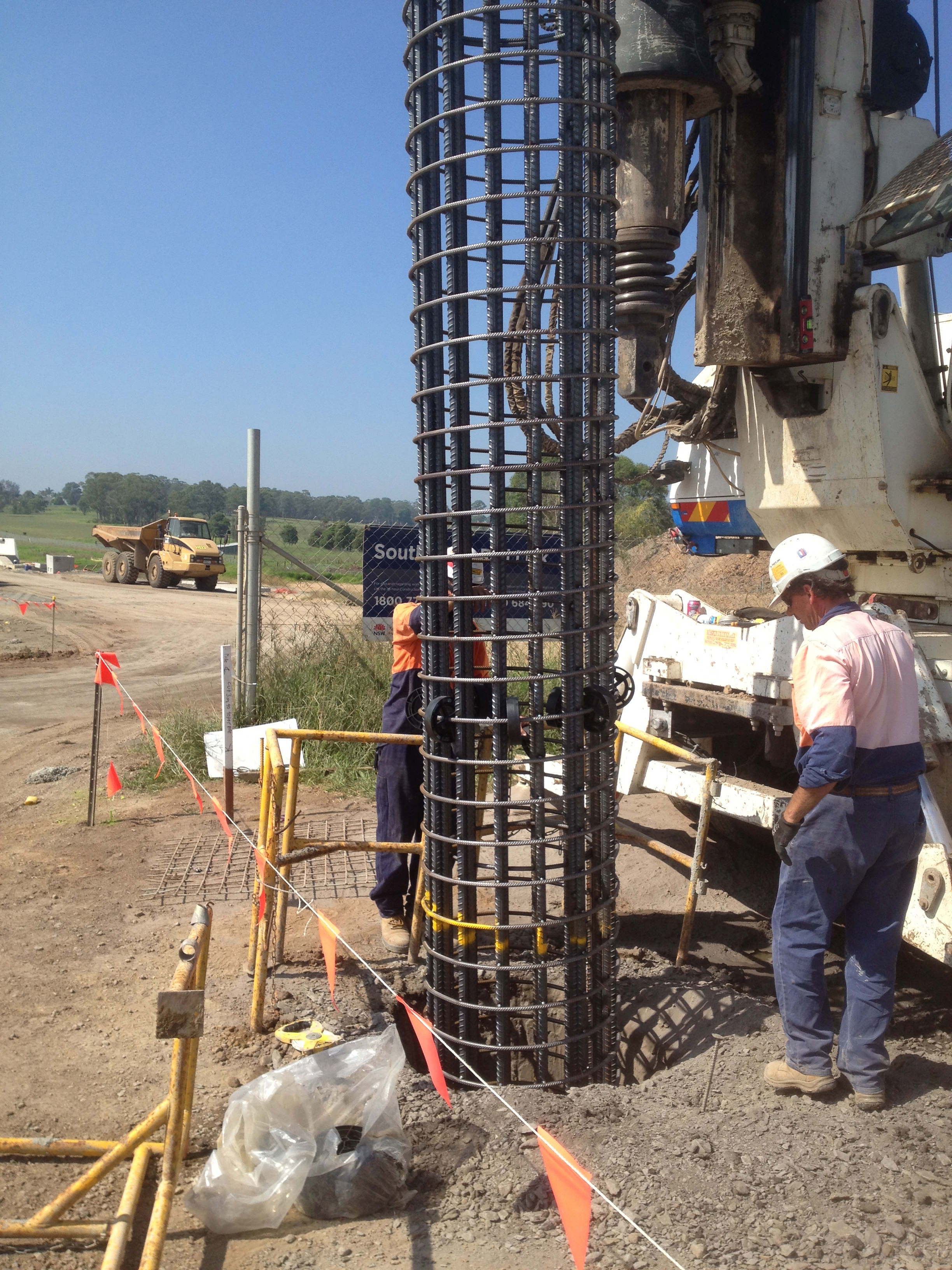
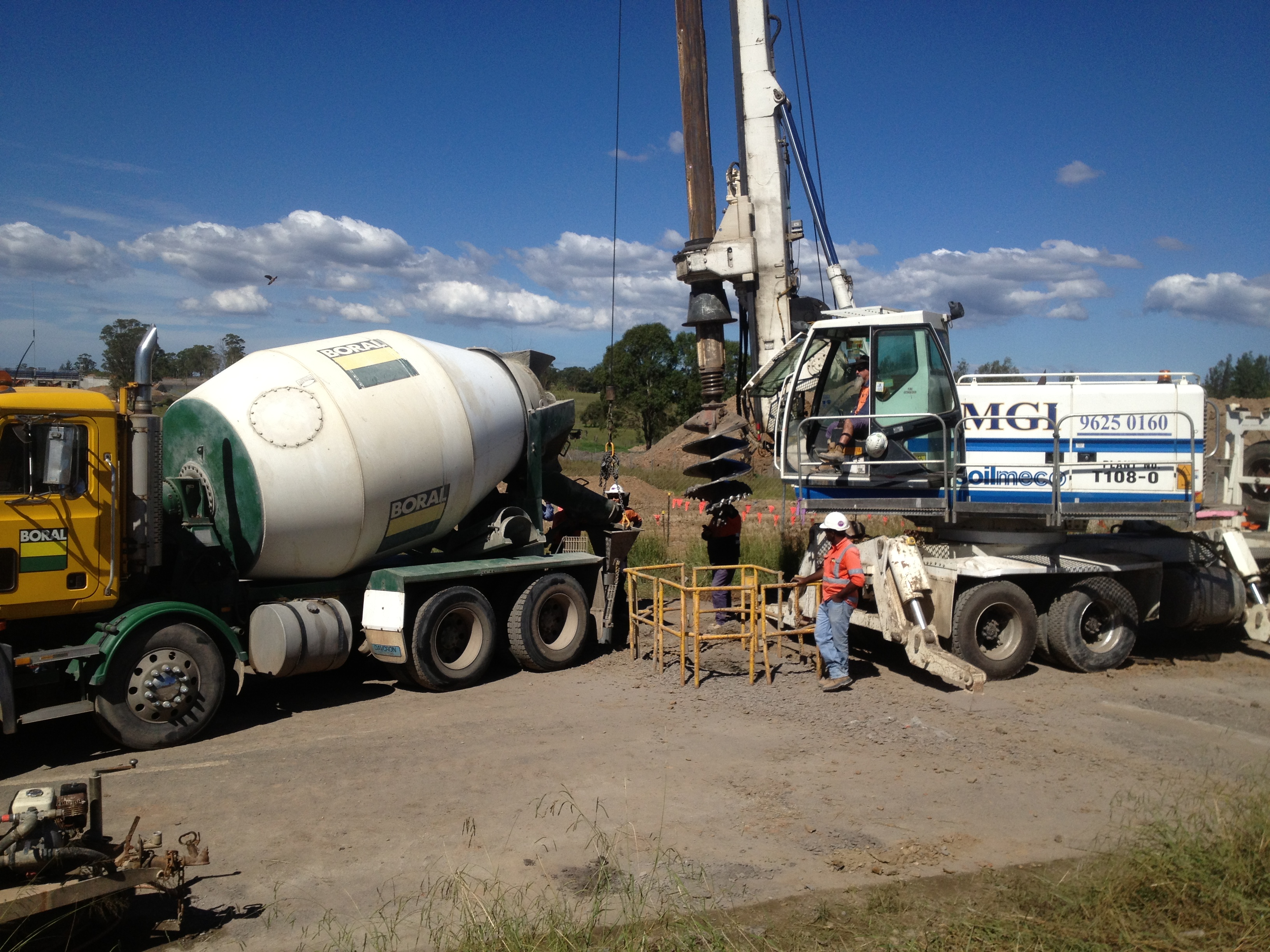
I learnt a great deal about the practical issue of placing concrete this past couple of weeks. I had calculated 4.7m3 per pile and thinking that this figure was not allowing for the displacement of reo an order of 9.4m3 for the first two which we poured together would be alright – it was just! There was nothing left on the last truck and we just managed to fill both piles but I didn’t want it to be that close again so ordered 5 per pile/truck for the rest. I also learnt that you can never underestimate the stupidity of a concrete truck driver. One decided to drive past the site twice after us flagging him down but he still decided to go on a personal tour of the entire alignment before realising he had legs and could get out of his cab and ask someone where he should be! This meant the concrete was an hour old before it arrived and we had 30 mins to place it which wouldn’t have be an issue if it hadn’t failed its slump test twice (tremie mix 180mm slump). We ended up ready to pour just before the 90 min mark having added the maximum amount of water we could so not to affect the w/c ratio, it was 1645 in the afternoon and the Project Verifier had just arrived to witness the pour. In the end I decided that we had been fairly quick in placing the concrete with the other piles and we wouldn’t get another truck until tomorrow so I decided to go ahead thinking if we start to pour on 90 mins it will be alright. It went alright up until the last 0.5m where the concrete was fairly unworkable and kept clogging the hopper. With hindsight I wish I had just turned that truck away and even if we poured the next day we still would have completed all works on the same day. A Non-Conformance Report (NCR) may have to be raised although the PV has not mentioned anything about it and I have got his signature on the ITP checklist already. As we are overpouring by 400mm this will help and I think the top will be where the problems may lie but we can visually check the top of the pile once we excavate and trim. Although the tremie mix is self compacting we could have also tried comapcting the top 1m or so, another lesson learnt.
 Corporate pose – inclonometer readings.
Another annoyance was the back-filling of the holes as we had at least a 1.5m drop to the top of the cages from ground level we were to backfill the holes after 24hrs for safety reasons but the sub-contractor was quite keen to do this after about 3 hrs which included covering the inclonometer tubes. Fortunately I had made sure they were capped but having to dig them out again to take readings was a little irritating. I have taken readings on abutment B (24-72 hrs after pouring follwed by a second 24-72 hrs after the first) but have been unable to take the second reading at abutment A as the civil team have arrived and on Fri morning I went on site to see abutment A piles with a little earth covering them!
 The 5 piles of Abutment A are under there somwhere.
Some interesting local Sydney news for you over the Easter weekend: “Police were called to a domestic disturbance of a retired couple over the weekend. A 64 year old male has been discharged from hospital after having superglue poured into his ears and eyes. A 62 year old female is also accused of beating him with her prosthetic leg!”
A Long 4 day Week
After a relaxing, if short 4 day Easter break on Rottnest Island off the coast of Perth I returned to a 4 day week that has felt like a month. Prior to leave a milestone had been missed and it was now best effort to get the South Block Upper Basement Zone 2 suspended slab (320m3) poured by Wednesday and the following Zone 3 (120m3) poured by Friday. Even to my inexperienced eye I could see this was pushing it especially because the Senior Engineer was off for the week and it was down to me to manage.
I was handed control of the pour with about 50% of the Reo on Zone 2 complete but for a first slab it was a bit of a nightmare to comprehend. It was not regularly shaped, it had 3 step ups, 6 integral beams (4 with PT), 2 Temporary Movement Joints (TMJ) (for seismic design), 3 ramped sections, 1 stairwell, and 2 penetrations (one of which was to accommodate the up ramp from Lower Basement). To deal with the more interesting details in a little more details:
The reo schedules and mark-up drawings were fairly epic in themselves and took me a good couple of days to get my head around which was unhelpful as I was being asked questions from the point of arrival on Tuesday morning. This mainly involved multiple trips to the slab deck to identify the issue, to steel fixers (NRG) office to discuss a solution, then to the site office to call the scheduler to check measurements, delivery dates and bar marks to ensure all the required steel was there to complete the task. Having been on the task for 3 weeks at this point with minimal top cover, it was inevitable that there were going to be issues. There were plenty, culminating on the night before the pour, after the structural designer had completed his structural check, that we found we were missing wall starters and were unsure of the wall dimension. After a few frantic emails and an early morning dash around site, the size of the pour became an advantage as after the 0600 pour start we had approximately 3 hours to get it rectified if we poured in the correct configuration. We didn’t pour in the correct configuration but luckily the fixers were quick and it was done in the hour.
Slab joints are a fairly new one for me, and it seems that the TMJ technique used on the NCH is for a lot of people in Perth. The TMJ’s are designed to give the structure a degree of flexibility between slab edges during construction to accommodate shrinkage due to curing and PT. The project is using a range of Ancon shear connectors that are either locked off after a specified period or allowed to accommodate movement throughout it’s life. The benefit of using the shear connectors is that it speeds up the rate of construction as it reduces the requirement for complicated or additional formwork, and only leaves a small joint and connector that required grouting to finish the connection.
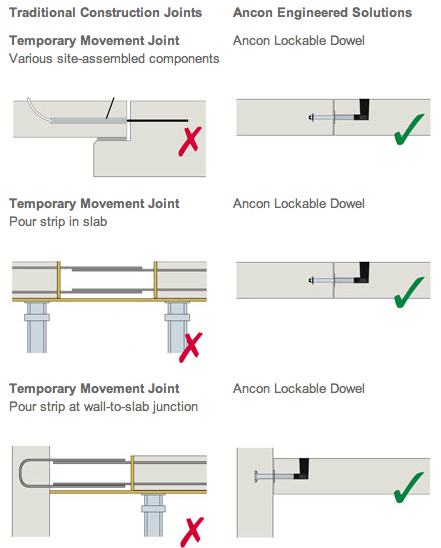
Post Tensioning in the beams is quite an issue, it appears that the structural drawings when sent to the contractor to produce shop drawings get changed ever so slightly that they always clash with the top reo. There has been several issues with the lateral placement of the ducts as many are detailed to pass through columns, but as the PT shop drawings were not complete at the time of column pour the bars were cast in the standard positions, therefore requiring bars to be removed and replaced by drilling and epoxying new starters in place. The issue that I have now found to be the biggest issue is the lack of any consideration in programming for the lag that occurs in construction due to tensioning. The initial stressing can occur at 24hrs post pour (concrete approx. 9MPa), however as per the structural specification the final stress can not occur until the slab reaches 22MPa and 5 days post pour. This builds in an additional 2 days per slab to each pour date. I have looked at the sequencing of the slabs and think there may be a more efficient way of doing it, but I need to speak to the programmer to ascertain the assumptions behind the decisions.
From a RE background of pouring a maximum of 5m square flat slabs, the idea of moulding the concrete into ramped sections concerned me a little – it turns out to be pretty much by eye. Pouring 320m3 of concrete in one hit was pretty hectic considering steel was still being fixed at the other end of the slab. This was the last ‘easy’ pour as the truck mounted pumps will no longer have access to the bottom of the hole. From now on concrete will be pumped from the access slip lane into a standing boom pump, which will pour to the final destination. The complication comes in the fact that the agitator trucks will not have the space to wait in the slip lane, where all the other deliveries arrive, so coordination is vital. This will be yet another task for the site engineers but in my view is so crucial it should have a single responsible person as there is so much scope for errors and with the prospect of turning concrete/reo away due to lack of space it could get pretty costly.
One of the overarching issues for me is the complication that so many contractors on one job creates. Not just the usual issues of construction but also the issues between themselves (Rivalry, Unions). I realise the intent of employing workers and sourcing materiel separately is to cut the costs of the project, but it appears that the time taken to liaise between the various consultants (architects, structural, services), the individuals who are doing the work, and those sourcing the materiel takes the vast proportion of the engineers day leaving only a small element for actual forethought and fault finding prior to construction. I don’t think that many sub-contractors makes light work and cost effective construction, quite the opposite actually.
A Slow Week
No blog last week as I was on leave with nothing significant to report other than an interview for my design placement at Ramboll UK.
It was been a slow week for personal involvement, and therefore a short blog.
With the first slab poured on my block just before I went on Easter leave the transformation in the time I was away was significant, starter bars had become walls, starter bars for columns were still awaiting design details which made things a little awkward, the M&E fairies were still trying to magic holes in walls by the power of though alone. Most of Tue and Wed were spent setting up a significant retaining wall that when poured will mean that we can backfill and progress at a much faster rate; as much of the areas awaiting groundworks are at a higher level posing a problem for formworking and working at height. One thing that has become very clear is, the instant a slab is hard enough to walk on every man on site want a little bit of space on it, either the carpenters, the steel fixers or just for storage. It is impossible to keep a slab clear and no matter what you put in place to try and control the space it won’t control the people, short of being there constantly there is no way to stop it from degrading into a mass of men and materiel.
The most interesting thing that happened this week was to go on a day long crane rescue course. The background to this is about the requirement in both Working at Height Regulations and LOLER to have a rescue plan and competent people to conduct the rescue. The emergency service can’t be relied upon to recover people from tower cranes as in general a standard firefighter lacks the techniques and equipment to do so and the urban search and rescue teams aren’t a continually formed unit and therefore are slow to respond. So it falls down to 3 people who have done a 1 day course to drag a large man from a small cab up a tall tower. The system is quite easy to use and doesn’t require any knowledge of knots or rope systems. Our site has been operating without an evacuation plan for the cranes, one for working at height in general is in place and now it will probably fall to me to write the rescue plan. The one question it has raised in my mind is how we plan for the use of the dems harness or ISHK on exercise, never have I been briefed on a resuce plan for someone that falls from a dems bridge and dangles from a lanyard and as an exercise conducting officer I’ve never used it although I would not have planned for that eventuality, thoughts from the floor?
Our artesian water problems continue and have been exacerbated by attempts to stem the flow whilst I was on leave. The rather unscientific solution of dig down further and chuck a load of concrete on it has failed and now the flow of water has increased. Today will see a visit from RSK (the environmental and ground consultants) who will see what could be done, I don’t believe there is one personally, the nature of the ground gives multiple routes to the surface for the water through the fissured clay that sits below my block. A chance conversation with someone who was involved in the foundations of the BBC Radio Solent building next door has revealed that they had the same problem, an uncapped borehole that continued to flow under artesian conditions, and in the end they resorted to what was in effect a French drain under the slab to the nearest point where the water could be disposed of.
Rich
Oppa is Gangnam Style
New Start
Well, things have definitely progressed. I have been assigned a new laptop and although I am yet to get my hands on it, it comes with a BP identity and all the perks therein. Basic Offshore Safety Induction and Emergency Training (BOSIET) and Minimum Industry Safety Training (MIST) have been confirmed for the second week of April, but luckily this will be local to the BP office allowing me to get a hold of said laptop and confirm my first project, the P60 Bridge Inspection Platform on the Bruce asset.
Bruce P60 Bridge Bearing Change out
The Bruce asset is comprised of three platforms, one each for drilling (D), Process\Utilities\Quarters (PUQ) and Compression Reception (CR). The P60 bridge spans the gap between the D and PUQ platforms allowing access but also piping carrying live hydrocarbons (sounds exciting doesn’t it). It is secured by three free bearings, a guided bearing and a fixed pin, then upshot being that since 1995 the bearings have been failing on a regular basis requiring quarterly inspections that involve the installation of temporary scaffolding over the edge of the platform. Interestingly no-one has a clue of what effect the bridge seizing in place would have on the two structures and a long term study has been recommended, but as long as the bridge is being inspected regularly, it is not really an issue.
The End Appraise Stage Decision Support Package for the Bearing Replacement Study has indicated that doing nothing to the bearings is actually the best way forward at present although building a permanent inspection platform to mitigate the cost of quarterly inspection and maintenance would be a really good idea. Step forward Ish Mk III. The yearly bill for scaffolding comes out at £100,000 and the estimated capital cost comes to £250,000, a drop in the aquifer in real terms and my gut feeling is that this should drop out as an independent project starting in the Select phase, so options evaluation, contractor engagement, design; all the good stuff. Hopefully this will be a good opportunity to tackle some UKSpec competencies! If this does go to sea, then it looks very much like it would be in 2015, which is a shame, but potentially good for Ish Mk IV. I look forward to finding out more after Easter.
Primary Engineer
I had the pleasure of attending a training session for the Primary Engineer Scheme on Thursday. This is an IMechE sponsored initiative to encourage the teaching of STEM at primary (and secondary) level to inspire the next generation of Dysons and Nobles. I had great fun ‘helping’ two Primary teachers build this;
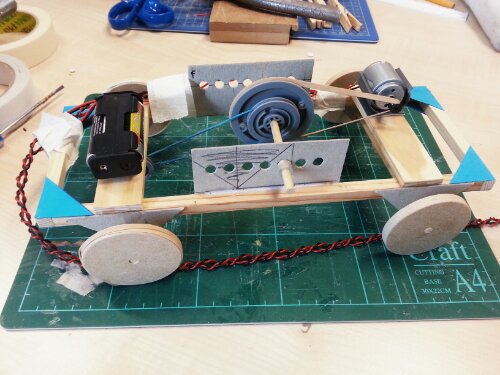
I’ve made some connections and will be attending at least one local primary to assist in delivering this area of the syllabus. The scheme is supported by BP who are very strongly engaged with the local
schools and quite rightly too! I also attended an interesting presentation on the Kincluny Village proposal, a sustainable concept village which is awaiting planning permission from the council. It utilises a ‘closed loop’ approach that seeks to maximise self sufficiency within a defined community space in terms of energy and water consumption. There is definitely scope for a TMR there and so I won’t give to much away yet!
In Other News
It has stopped snowing. We are off to Edinburgh this week for a little sightseeing, which will be nice. This week I have been mostly been listening to Gangnam Style as Hugo has been teething quite badly and this is one of the few things that will pacify him…for about 4 mins 13s.
Its been a while, but things are ticking along fine in the design office
Hmmmmm, been a while since I’ve written one of these, anyone would think that a thesis, several reports, a day job and moose-dodging in the Alaskan wilderness might use up one’s blog-writing time…..!
For the serious stuff (if like me you read the funny stuff first, scroll down to the bottom):
I’ve now been working the Mechanical section of the USACE design office for a couple of months, and am enjoying the work greatly, the 3 hours each day wasted in the Baltimore commute not so much, thankfully though no car accidents yet.
The largest single piece of work I’ve been working on has been progressing the design of a renovation of some military accommodation in Boston. As handed to me, this was at a very early stage of development and so I have been able to take responsibility for the advancement of the mechanical design. This has been considerably slower than I would have liked due to the necessity of learning several of USACE’s software programs that I am unfamiliar with (I long for HEVAComp!) It does seem that every individual step requires a new piece of software, so whilst I am broadening my horizons dramatically, I am getting a little frustrated with it all.
I am currently evaluating which technology to employ for the updated HVAC system, thus exploring many HVAC options, ruling out the truly ludicrous, and conducting an annual energy analysis of the most likely. The most feasible few, I have explored in more detail; 2-Pipe, 4-Pipe and Water Source Heat Pump in order to cost the initial retro-fit installation. I produced a whole-of-life costing for each option and this is leading me towards the WSHP. The next stage of this will be a more detailed design of the WSHP, although this depends on future funding approval (see below – sequestration). One other frustration is that I have had to work entirely from poor quality pdf As-Builts, given that the opportunity for a recce (jolly) to Boston is not on the cards. It certainly hammers home the importance of good quality As-Builts.
Other responsibilities within the section include inspection of completed drawings for adherence to fire regulations, which gets considerably easier once you understand the basics of US regulations and can anticipate common problems. It was slightly embarrassing to have to point out an error made by one of my mentoring co-workers in a drawing already released to the contractors, which seems to have now highlighted a serious and complex problem that I am now required to help him fix (whoop!). The problem was that he had implemented a system that would easily end up using the main through corridor as a duct, never a good idea! Clearly this is difficult to solve, but much better to have caught it early.
Problems at the SSP continue to roll on.
I am still maintaining a link with the construction work happening at the SSP and USAMRIID. The USAMRIID is moving into the fully fledged commissioning of all the diverse systems, and also getting closer to the point where the contractor ceases to be able to argue that his schedule is true to life. The communication within the SSP project appears good on the surface yet very little work is actually happening and almost inevitably it will move to litigation in due course. I am hoping to be able to observe this.
One of the problems that may critically affect the entire future use of the SSP is the poor concrete quality in the basement, which leaks ground water, not ideal for a bio-containment facility….. If this cannot be solved it may force extensive rework.
New projects on the burner.
I have a couple of new projects on the go, both of which are basically writing specification documents. One is for the plumbing of the renovation of a military building, and yep, you guessed it, it requires me to learn yet another piece of software (and liaise with the IT department for installation, which in itself is a mighty challenge!). The other is editing an Request For Proposal (RFP) for the fire suppression systems of some US Airforce installations in Abu Dabai. This is an interesting insight into the requirements of the fire suppression system and the USACE standardisation (or lack of) of specification documents.
Sequestration concerns.
I’m sure the media has adequately relayed that the US Government’s inner workings are about as cooperative as a box of coathangers, so they have rolled from one near financial miss to another, and the current solution appears to be implementing a four day week for Government workers. This is yet to be finalised within USACE as many people are employed as part of the project funding and thus making the situation more complicated. The lack of clarity is generating lots of rumour control, with people trying to work out what they will do with an extra day off a week (and 20% pay cut). This may affect project budgets but no one is sure yet.
In other news.
Close but no venison steaks for the Hancock family after a hunting season where something called a thesis was getting in the way of a good hunt! I’ve heard that there is to be a deer cull in the UK, hopefully I can help!!
We had a brilliant delayed honeymoon to Alaska, where oddly enough it was quite cold! We stayed in a wilderness hut at -30C on Valentines Day – I really know how to treat a wife on a special occasion….. We did see the Northern Lights, learnt how to husky sled and snow shoed up a mountain until we almost caused an avalanche (we snow shoed down pretty quick!)
I also managed to convince a co-worker to go on sabbatical last month – which management was pleased about, not because she was bad at her job but rather that she had been planning to quit outright, this way they get to hang on to her for a while.
Sarah is looking forward to quitting her job – having recently had to fire a temp for sleeping on the job, mainly bad because he was the site nailgun operator and was standing up with his finger on the trigger.
I hope that everyone is getting on well with their theseseses, it seems very close to hand in date and to us all getting back to the UK. Aaaaaaaah, proper Cadbury’s………
There can be only one!
As if in preparation for the move North, the snow in Gillingham began the night before the movers arrived. It hasn’t stopped for more than a few hours since, although the vagaries of the Aberdeen weather system has ensured that it hasn’t accumulated more than a few centimetres. Certainly not enough to discourage cycling to work, but it’s good to see it is not confined to us Northerners.

New Start
BP appear somewhat bemused to have another Sapper in the office and are at present deciding which team I am to work in, HR are scurrying around trying to find out how to register my employment, but despite this I ( under supervision) have managed to get an ID and so my foot is firmly in the door. I’ve been assured that I will have a laptop and a staff number soon and, much like Chris before me, the work will ramp up. Unsurprisingly I’m working in the same office as Chris at present, namely Projects and Mods, and so far I’ve mainly been referred to as Ish MKIII or Chris MKII proving there can be only one.
In the meantime I have started wading through the BP best practice doctrine such as “The Way We Work” an outline of the process by which projects and modifications are brought to the platforms and some guidance on the electronic system for managing change. I’ve booked myself on several of the courses required for onward integration, including the old heli dunker and survival at sea training which, by all accounts, is not as hard as in the good old days. No suprises there.
Bruce P60 Bridge Bearing Changeout
This is by no means on my plate at present, but I had the opportunity to sit in on Chris’ meeting with the Asset Programme Lead for Bruce, Kerry Scott. There is a distinct possibility that this project will come my way, which is mildly amusing in that it has been something of a PET project since Ish’s time with Chris writing the SOR for the Appraise phase and pushing it through to what is arguably the select phase. Either way, I’ve been reading up on it and will have my view on the situation next week.
Re-location
Corine and Hugo survived the move and are settling in well. The boxes are mostly unpacked and I have plenty of new furniture to un-flat-pack. Deep joy (love it really). Hugo was most entertained during the unpacking process and it just goes to show that you don’t always need expensive toys!
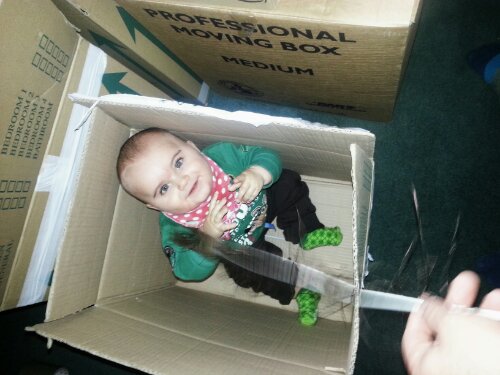
Time to enjoy this momentary lull!
Adding value!
By the end of the week I finally felt like I was adding value to what I was doing and not just being a newbie asking lots of questions. I am still asking lots of questions which I can only see increasing in the next few weeks as things get a little more complicated but after 3 weeks I am now producing product that contributes to delivery! With a large amount of handrailing from previous AMS’s I have now completed the AMS for the Dickson Road piling which starts on tue morning. It has taken a full week to get everyone to sign off the method statement and there has been a lot of red pen learning throughout the week. The biggest hurdle was of course health and safety and to understand the various management plans and JH procedures that I need to understand and quote. It has turned out to be a 39 page document for 3 days work! Luckily Australia have recently updated their H&S act from the Occupational Health & Safety Act to the Work Health & Safety Act from Jan 2012, which my ‘white card’ instructor told me was practiaclly copied from the UK so it is fairly familiar. Environmental issues are also a large consideration with the main issue seeming to be ‘dirty water’ run off into the various creeks that the alignment passes through. Any water that leaves the site must be treated before being discharged into a natural water course by digging a holding pond and adding floculant. It has been very dry here and recent excavtions down to 10m did not encounter any water nor did the boreholes which were done 3 years ago so we are not expecting a wet bore. However, we are planning for the worse as you do so we are using a tremie and as the hopper will be at ground level we will pour directly from the agitator truck. We will also excavate a trench to channel any water to a sump or pond but as long as it doesn’t leave the site we will leave it aone or use it as dust suppression. The top of pile will be about 3m below the current ground level so we will be drilling about 9m deep. As there is a 1m projection and due to RTA (Road Traffic Authority) spec we have to overpour by 400mm (dirty/unpure concrete top to be trimmed) so we ended up ordering 8m cages incase we have to drill further to achieve the required 5m socket depth within the rock. We also ordered additional L bars which we will weld onto the top of the cages at the required length so that they will sit flush with ground level to making unhooking the load easier for the rigger.
I have started to spend JHG’s money this week ordering 44m3 of concrete with a message (I hadn’t got a clue what he was on about initially but a message just seems to mean ‘there abouts’ so that you can tailor your last truck to the exactish quantity you require + or – your original order). I have planned for 3 days to complete all 10 piles (5 for each abutment) which would have meant we could have wrapped it up by easter but apparently thu is a RDO (Rostered Day Off) for all in the construction industry – apart from those on a salary – so we will have a 5 day break before competing the last 3-4 piles.
Having generated worklots for the two abutment pile groups and having produced a concrete pour plan you are also required to send out notifications based on the relevent HOLD and WITNESS points prescribed by the spec. Quality control on this project requires that both the client (Transport for NSW) and the RTA/RMS (Road Transport Authority – recently rebranded to the Road and Marine Service). The client has its own ‘surveillance officers’ that work along the alignment that need to be informed about what you are doing so that they can view the work with some points being HOLD points in which we can not proceed until they are happy. As we are working on the roads and rail we effectively have two sets of parents and the RMS have employed Halcrow to carry out Project Verification on their behalf so they also need to be notified about what and when we carry out specific work and it is these characters who take a keener engineering interest to make sure the RMS spec is being adhered to.
Overall this week has been a little too desk bound for my liking but unfortunately neccessary and I feel like I am now contributing and getting to grips with the project/company specific procedures. Having the power to spend alot of money and being aware/conscious of what you are spending is an experience I have rarely worried about in the army but here it is at the forefront of my mind. This mornning I spent $7000 on stainless steel dowels!
Next/this week as I am writing this on a mon, I will be mainly site bound as we install the piles and I also intend to focus on understanding the contract a little more. It is a Design & Construct contract and I have managed to grab a copy of it for some evening reading tonight before meeting up with Terry Stroud the commercial manger by the end of the week.
The weather remains rediculously hot – I hear there is a little snow in the UK – but I’m glad the Ute has aircon. Although the fact that everyone has a white Toyota Hilux with a flashing amber light has meant it takes me a lot longer than it really should for an educated man to try to remember where I parked!
On the Rise(r)
At the end of the 2nd week I am gradually settling in on site. The pace is furious but that is probably because the project is nearing a milestone that is worth about $20m and without a big push it may be missed. To couple with that the next 2 weeks are short due to Easter so I don’t expect the pace to slacken much.
There has been a restructure of the project team since last post which has seen a split into North and South project teams. This has meant a move of offices but probably only for a while before we move again when the growing hospital superstructure expands into the space we are currently sitting.
It turns out that I have picked up responsibility for a stricken riser in the Central block that appears to have been passed from pillar to post by both management and contractors alike. I have inherited the task after its initial lift from pile caps to RL 6.2m but quality control seems to have been an issue. On first inspection it was clearly evident that not only was the reinforcement completely different to the schedule, but its placement within the walls was pretty poor. The cover ranges from 10-60mm and the surface finish (Australian Standard (AS) Class 3) is debatable, but due to continuation prior to resolution it would appear that a precedent has been set and parties agree to disagree.
I was due to monitor the 2nd pour by shadowing one of the lead project engineers but ended up managing it myself. I was quite reliant upon the contractors for information but very wary that they were only telling me what they wanted. The reinforcement continued to be an issue for the 2nd pour as it turned out it had been incorrectly scheduled by the reinforcement provider and due to time pressures the design was amended to use what was available. This actually increased the overall strength of the wall, but threw up issues with header beams above and below wall penetrations. Because the header beams were designed to fail in bending it meant that the shear reinforcement was greater. However by increasing the bending reinforcement meant increasing the shear reinforcement further which led to crowding of steel around the beams and a lot of awkward fixing to ensure room for the vibe which increased time delays. Due to the rush to complete this task I was left feeling like a young Troop Commander with a clearance certificate again cutting about site to get the required contractor signatures to certify their work before the concrete could be called forward.
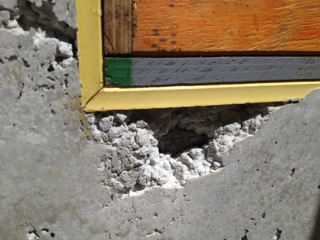
The pour appeared to go well from my amateur perspective, but after the shuttering was removed it looks pretty poor. There are a couple of small areas where the concrete hasn’t quite reached on the underside of voids and a couple of corners that appear to have honeycombed somewhat (potentially a leak in the formwork).
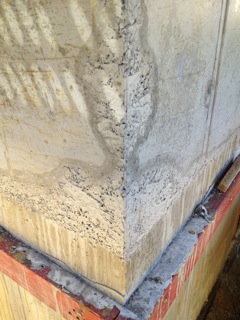
honeycombing at base of pour
poor access for concrete flow
One thing I should definitely picked up on was the starter bars to the next level. Although this lift will be capped by a slab and the subsequent lift will then tie in after it has been cast, there are sections of the next lift where door voids are designed. By dealing with the lower lift in isolation I didn’t check the reinforcement plan for the upper lift and should have noticed that the reinforcement should have been closed off. As it stands now there is only a very short length of reinforcement at the top that will be enclosed by the slab. This is not a huge issue as the slab reinforcement can be amended to accommodate this oversight, however it does highlight to me how looking at the bigger picture will save time in the future. I should have ownership of the next lift from the start and will be able to manage it to completion with the correct Reo, and correct starts for the next lift.
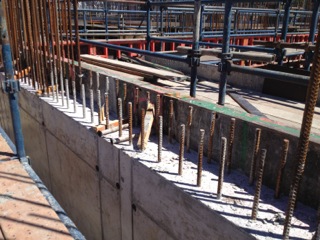
stubby starters
I am now looking at column and wall pours in the South Block from the upper car park level to ground level. In an attempt to make up some time it was suggested that the columns and ramp walls should be poured as one unit. I agree that this would save time in pouring, but after the issues with reinforcement fixing that I experienced with Riser 1, think that the additional effort of getting the whole thing formed and fixed could take longer than expected. The other option is to use couplers embedded into the columns and pour a more simple, un-structural flat wall at a later date. I will be looking into this next week.
My objective for this week is to get my head fully into the contracts. I have booked a meeting with the project commercial director to do this
Peaks and Troughs
This week has been particularly variable in the level of activity. The project has very definitely been split into 3 separate blocks now with 3 distinct teams, I have found myself on Block B which is the largest at 17 storeys. Being the highest pretty much puts my block on the critical path, and rather critically we are running about 4 – 5 weeks behind depending on who you talk to, the high level of liquidated damages on this job £500 000 per week brings the delay into sharp focus, the week commenced with my project manager under considerable pressure, I think I was one of the few people who started this week with a guarantee of employment by Friday.
- Last Friday the sub-contractor stated that the first slab pour on my block would happen on Wed 20 Mar 13, even my inexperienced eyes knew this to be a complete work of fiction from the outset, hitting that timeline required the laying of all the drainage on the basement level, pouring of a further 4 pile caps, installation (once receipt of the finalised design and materials) of a pump chamber that will raised the foul water into the main sewer on the road outside, the steel fixing of the slab (thank God for the industrious Eastern Europeans, although not when I’m the one locking up as they always leave last) and the fixing of the internal walls and slab step up. Funnily enough the slab pour didn’t happen until today (Fri 22 Mar 13). The problems encountered along the way have been interesting, some of which I’m kicking myself as I feel I should have seen them coming.
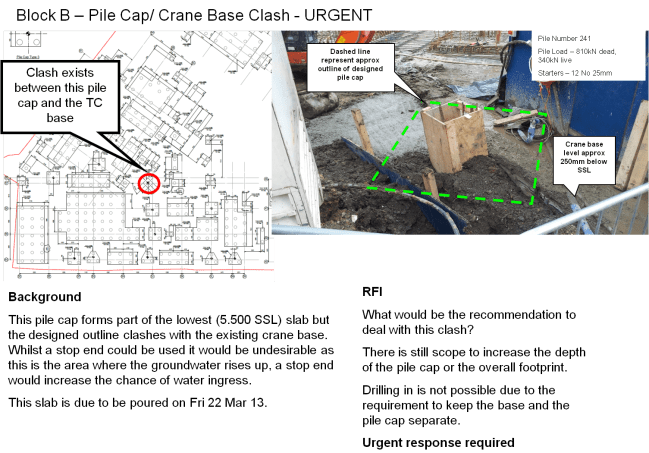
- Crane Base and Pile Cap. The crane base for my block sits just below the finished slab level of the basement, inside the basement itself but outside of the final structural walls. Somewhere along the line, either in design or tolerances during construction the base was constructed very close to one of the structural piles and overlapped quite severely with the pile cap as designed. Due to the artesian water conditions on the site we wish to minimise the number of joints in the concrete and therefore wished to include the pile cap in question. I was brought to my attention by the sub-contractor’s foreman. The design engineers have been somewhat overwhelmed with RFIs on this job and as such a response is not guaranteed in a timely fashion, I decided on a new approach. The world of construction doesn’t seem to have seen a quad slide before, it works. The response was received in good time to implement the solution although in the end time simply got the better of the pour and that particular slab pour didn’t include that pile cap.
- Mistaken Pile Cut Off. Those of you that know me know that diplomacy isn’t a strength of mine and it took all my effort to remain as neutral as possible during this incident. In the rush to get the slab poured on my block, the sub-contractors normal MO of banging in RFIs constantly about the most minor of items fell by the wayside, they assumed that a pile cap drawing was wrong, not just a bit wrong but wrong by 3 metres. They believed that a pile cap with a top of concrete level of 8.000m was wrongly detailed and so have read 5.500m and commenced pile trimming, right up to the point where there was no reinforcement left in the pile and so on the final pile crunch they lifted a 1.5m lump of concrete out of the ground. The problems that this has brought to light are:
- What to do with the broken pile? How to tie any remedial work to the pile as there is no steel left in it.
- Who pays for the solution to be implemented? A couple of issues here as it seems the steel should still be present in the pile at the break off level which raise QA concerns about the piling contractor, we are now looking at the possibility of having to try to use a cover-meter on piles that are exposed to check the length of reinforcing.
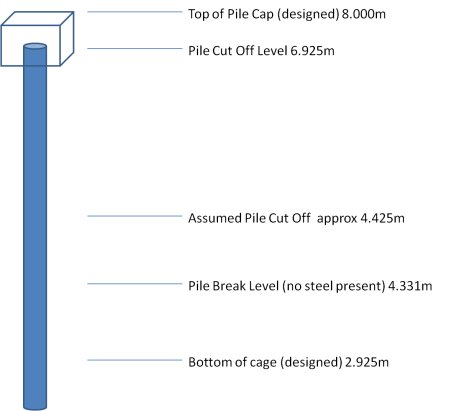

- Pour Day Panic. This is the one that I absolutely know I should have picked up sooner, I had been doing the checks to ensure the drainage was in place under the slab, but I had been guilty of assuming the sub-contractors knew what they were doing and of not thinking it all through. With the concrete deliveries 45mins off I realised that the drainage that was in wasn’t as it had been previously the soil and vent pipes for the foul system and therefore a pipe that continues up throughout the floors but in fact an open top gully that needed to sit flush with the top of slab. Thinking I must be wrong I asked the question about the absence of the gully pots and saw a foreman’s face drop. So disc cutters out, panic ensures and ground workers installing gullies as the concrete is poured no more than 5 or 6 metres away. Rich earns himself a breakfast.
 Holdfast Training Services Trial Blog