A bridge two far!
Having spent most of my time last week getting stuck into the 47 drawings of Dickson Rd Overbridge I Have no switched my attention to another bridge. Kemps Creek bridge is an Underbridge which is the last structure that takes the rail line into the stabling yard. It is a 72m span which is about 80% complete but has sat idle for about 2 months as what I understand to be a ‘spartacus’ bicker occured as to who had the priority. The stabling yard won and so it is now time to crack on and complete the bridge by constructing the parapit walls. This is a view looking from the stabling yard end towards Glenfield with Eastwood Rd Overbridge in the distance. Both end appraoch slabs were cast on Thu and we ended up pouring to about 1755 where all works need to be complete by 1800 so we were cutting it fine – looks a little cloundy but it was still 25 oC. There are 46 precast parapit sections each weighing about 5T to be placed on the edges using angle brackets which bolt into the deck. Once these sections are secured then the walk ways will be poured which will cover the anchor brackets and tie in the parapit sections to the bridge deck. This has also been done on Eastwwod Rd bridge but as the brackets are effectively only temporary they didn’t seem to be strong enough, when the crash barriers were poured we had about 20mm movement on one section due to the weight of the concrete so that the bolts for the traffic barrier railing are now out of alignment.

West approach slab the day after being poured – the gantry’s in the background are the start of the stabling yard.
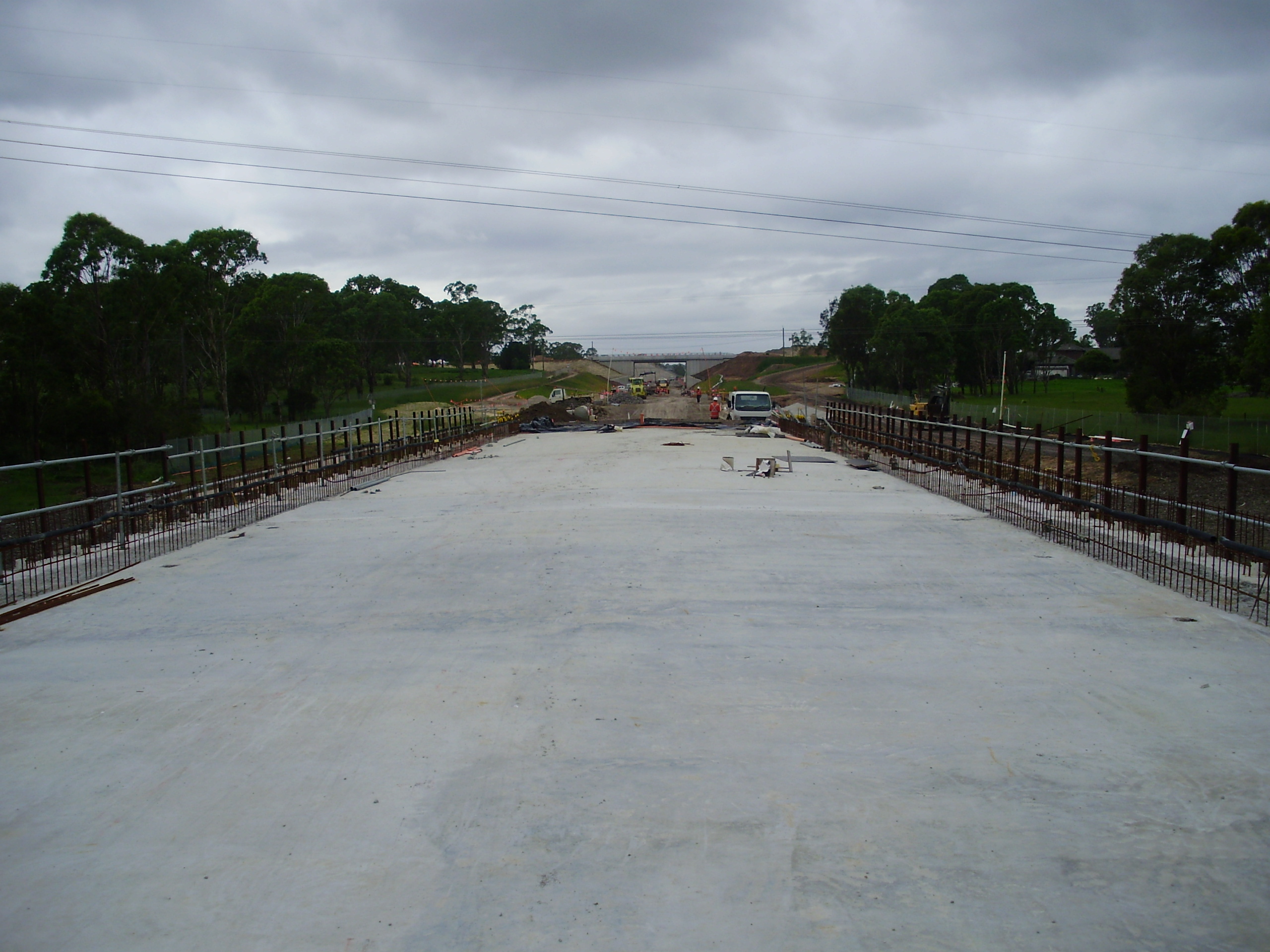
A view looking E from the stabling yard down the alignment – you can see Eastwood Rd in the distance which i near completion and beyond that Dickson Rd is yet to be started.
I have finished the AMS (Activity Method Statement) for the piling which now has a week to be passed around Safety, Enviro the superintendent, senior Project Engineer and Construction Manager for sign off so that the piling contractor can start next monday. The plan is that the piling will be complete within 3 days although we have a 1 day float before the easter weekend to complete. I managed to get hold of the borehole logs which were drilled back in mid april 2011 so fortunately around the same time the piling will take place. They drilled to a depth of 15m but the piling will only go to a depth of 8m and they are 900mm dia. The top of the pile cap will be a metre into the shale and then below there is a siltstone/sandstone mix. No groundwater was encountered which is understandable considering the dry summers here although the supervisor is convinced it will be a wet bore due to flooding they had in the area a few months ago. The rig is a Mait HR 130 which is tracked and due to the existing road providing a firm foundation it all seems to be straight forward with no issues perceived. Once the piles have been placed the civil team takes over for a few weeks to rip out the road and CSR (Combined Services Route) are placed so we will have a min of 2 weeks away from site I believe before we can finally trim the piles.
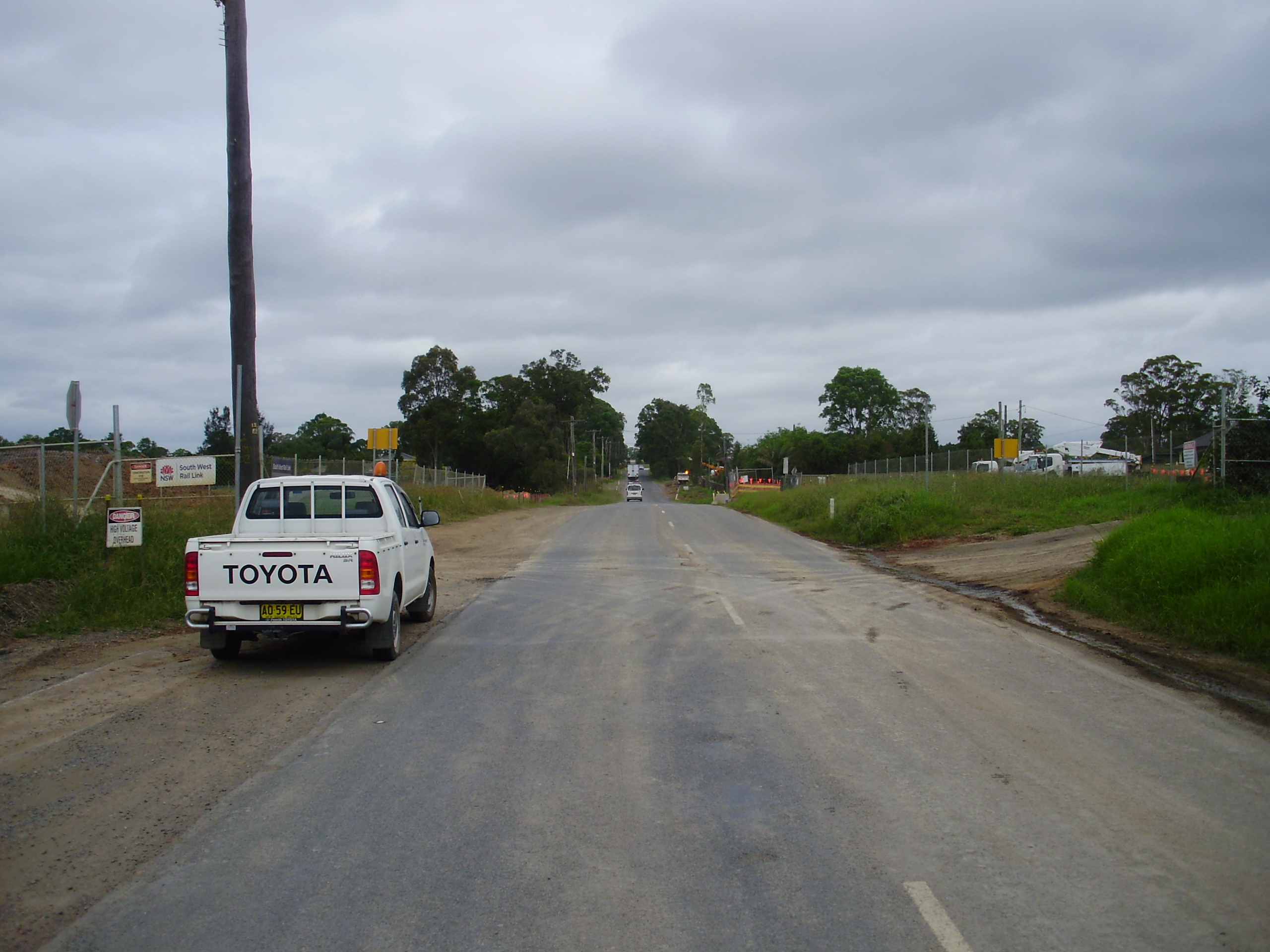
Dickson Rd Overbridge site (and my Ute!) – the bridge deck will be about 7m higher than current road level.
Eastwood Rd still has an opening date of 25 Mar which seems to be ontrack as the asphalt is now laid and they were finishing the walk ways on fri with line marking scheduled for mon. The final issue
that might scupper this date is due to the supplier of the throe screens that need to be erected. We still need to have a closed road in order to fit them but there is currently no work on when they will
be delivered. The supplier is from England and we are not sure if they are even in the country yet. If Eastwood is not complete this pushes back the piling of Dickson as we can not close Dickson as well
as Eastwood.
A big lesson learnt this week is site housekeeping and stores/material areas. We in the army have this drilled into us but by know means get it right all the time but it seems on this site if you you see
some reinforcement lying about and if you don’t get caught in the act you can help your self to a bit of it. I spent a good afternoon counting metal brackets and checking reinforcement deliveries which
we were all short and then learning we were the last in a chain of an organised pilfering scandal which means we are left with re-ordering half of what was ordered last month.
Better late than never
Finally I have reached site. It has taken a fair degree of admin to move countries and a brief period of R&R in the wine region to pacify Nicky; apparently 36 bottles will last until next visit (24 Mar).
I attended a corporate induction at head office Western Australia which was a good welcome to the company but lacked any of the detail that I really wanted for AER 1 and mainly consisted of powerpoint presentations given by people who would rather be doing other things. A fairly standard induction I think. The following day was spent in an isolated cell on the top floor of the building frantically clicking my way through online learning packages that I was assured were essential for site. I was told on arrival at site that 2 of the 3 were not necessary immediately so although I will not have time to do them when required at least I will have done them in order to forget them later.
The site induction was interesting. It actually gave a pretty good background to the project and was pitched at all levels. The team building activity of completing a 21 piece puzzle was my favourite part, though some struggled more than others. I had the corner piece so nailed it early and decided to project manage from the back.
The project is huge and has advanced rapidly since Steve left, as such has been split into North, Centre and South Blocks, with the superstructures well and truly out of the ground. The North is more advanced than the South with the main cores well into jump forming with the decks chasing the cores up rapidly. In the Centre and South the majority of the piles are now capped and columns cast with work well underway on the first slab for the upper car park level. The ground slab has been leapfrogged as the E&M plan was not completed on time and would have held up construction (Proof that E&M’s worldwide are slow and unwieldy). This will be completed once the backprops have been removed allowing work to commence beneath the first slab. (I may delve into this further for a TMR as I am sure it was not a lightly taken decision). I can’t really provide much more detail as yet, as after day 2 my head is pretty much still swimming.
The local schools entered a competition to name the cranes. The winners were:
- Koolangkas
- Kranasaurus
- Magnus
- Sir Lift a lot
- Tall Bert (My favourite)
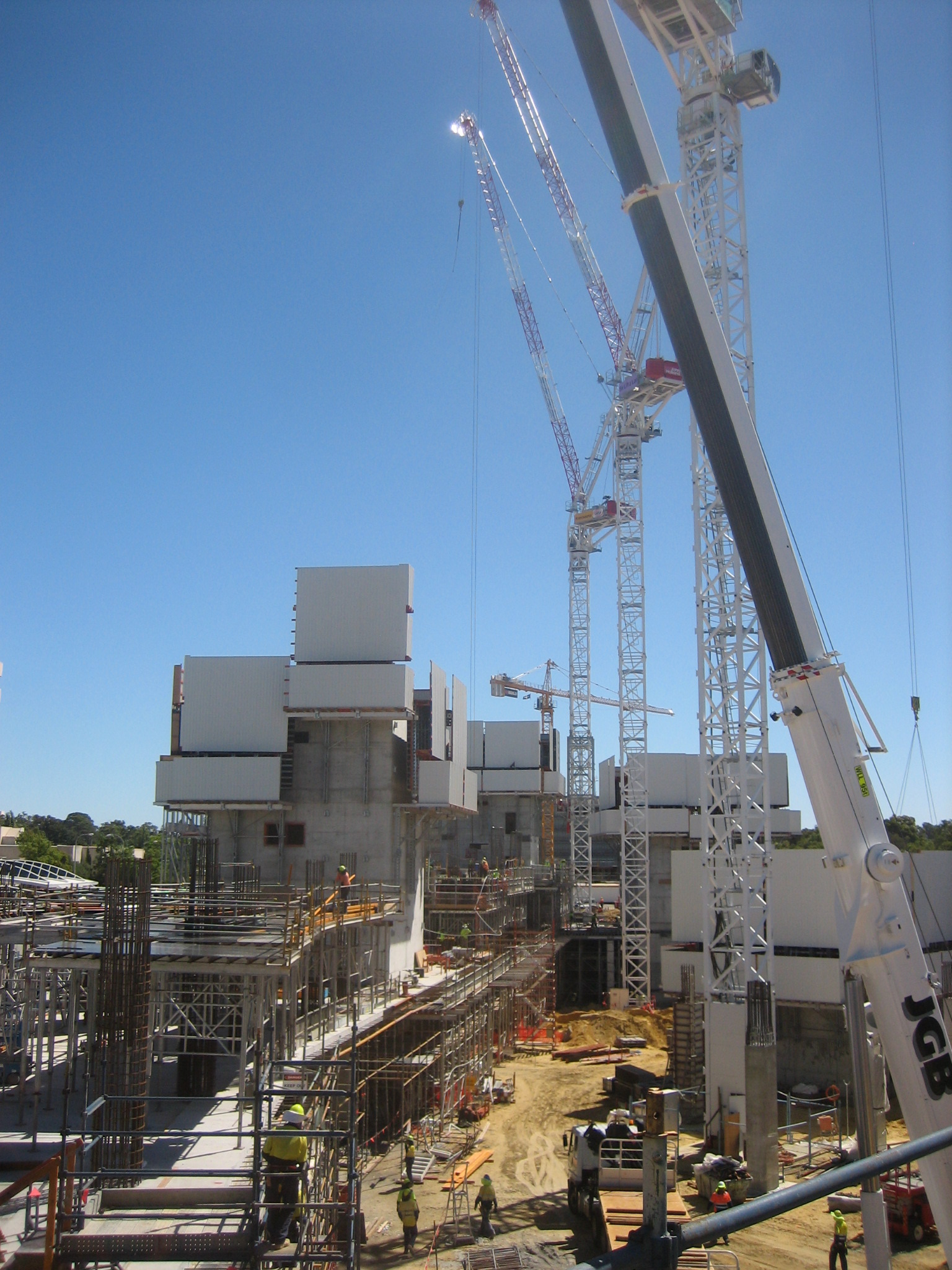
View from Core C – North (Tall Bert in foreground)
I have been appointed as a Project Engineers though I am currently shadowing the Centre and South Engineer until I can take of the training wheels and fly free. Could be a while. Initial chat was that I may take over the as Project Engineer for the Centre block but I am meeting with my PM next week to discuss my objectives and set a plan to achieve them.
My time currently has been spent preparing works packs for column pours and I will soon be looking at preparation of a slab pour. I have been out and about on site whenever possible mainly to bring some of the masses of drawings to life, but also to ask the other Engineers how we have got to where we are and why things have been done as they have to understand the history of the project.
I have been impressed by the quality of engineer on the project. Even the youngest of site engineers is incredibly knowledgeable and luckily, all are quite willing to lend a hand to understanding the processes.
I have only met a few Australians on site so far. In similarity to Rich, everybody else appears to be Irish. It is no wonder the Irish economy is in turmoil, they are all working overseas! Looking forward to Paddy’s day this weekend.
A Building Is A By-Product
|
“The easiest and quickest path into the esteem of traditional military authorities is by the appeal to the eye, rather than to the mind. The `polish and pipeclay’ school is not yet extinct, and it is easier for the mediocre intelligence to become an authority on buttons, than on tactics”. |
|
| Captain Sir Basil Liddel Hart Thoughts on War 1944 | |
After a number of visits to our site this week I’m starting to feel that this quote applies equally to construction, it is far easier to attempt to win a Considerate Constructors award to make your bosses happy than it is to understand what exactly is going on on your site. I’ve said it to a couple of you over the phone, but for the wider audience; I am beginning to truly understand why construction isn’t really profitable.
We poured our first slab and put up the final tower crane this week, which has really changed the face of the site, the first of the core walls has been poured also. The remainder has been much the same as the previous few weeks, pile cap after pile cap, I estimate that we have poured about 25 pile caps so far, approximately 30% of the total.
The main core pile cap on the highest (17 storey) block was due to be poured on Friday however this was postponed due to in complete detailing by the structure designers. What I haven’t managed to find out yet is why we got to 18 hours from pouring before the issue became obvious to the site team of the main contractor. In short the groundwork and RC sub-contractor had done the take off for the core, found that some walls hadn’t been detailed and raised an RFI, this was transmitted via a complicated info management system that doesn’t seem to keep the site staff informed. An incomplete answer was received from the consultants, at this point I believe a notebook, a to-do list and a willingness to be engaged in actual engineering would have been useful. In short the sub-contractor was unwilling (and rightly so) to proceed with incomplete details and when we (I) managed to get the structural engineer who happened to be visiting that day to commit his answer to paper with a signature it was too late and the steel required wasn’t on site. My knee jerk reaction to this is that communication is the key problem I’m witnessing currently, there are plenty of meetings that go on but getting the information out of those meetings if you weren’t there originally is very difficult.
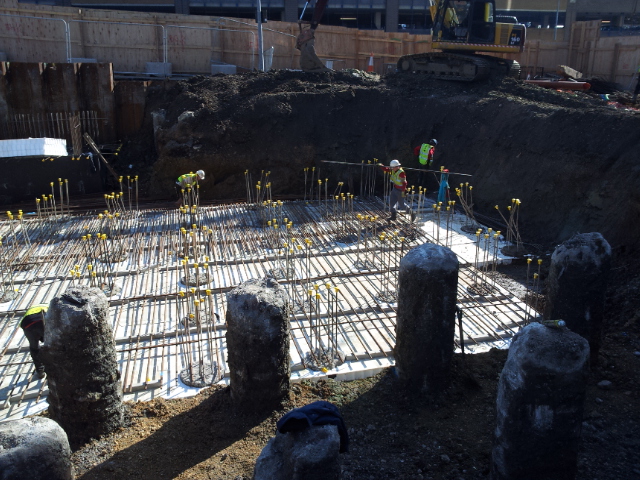
Cell Core laid in advance of steel fixing on the B Block main core
AER 1 is coming along and I think I have an option for TMR 1 but thoughts on a thesis are non-existent.
Tunnelling Medical Passed!!!!
Well its been another week in the office and things are looking good. After my initial medical, drugs and alcohol test BAMNuttal are getting their pound of flesh.
I started off being told I would be working at Farringdon station, then it was Bond St and now it is Holborn station. The good news is my commute has now increased to just over an hour, however it does allow me to get any extra work completed before getting home to a crying baby.
To my surprise the project site isn’t that different to being on tour.
- Crossrail have commandeered an old pub/flats that we are in the process of converting into usable office space. Much like taking over a FOB on tour.
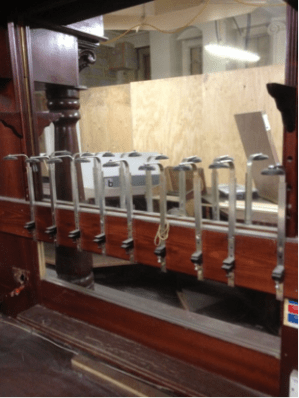
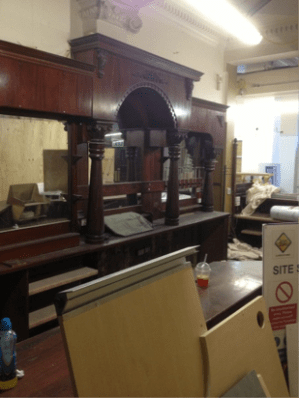
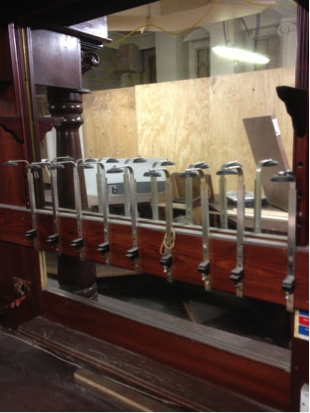
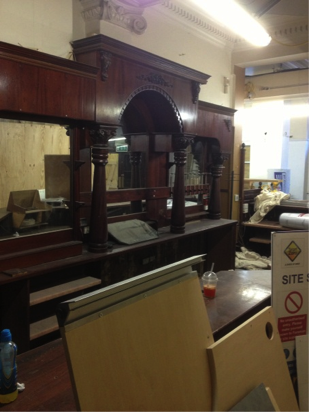
I’ve already managed to acquire the old optics from the bar ready to install at home.
- Like on tour a number of the Engineers seem to have misplaced their razor blades and have been unable to get themselves to a barbers.
- There is just as much un-necessary paperwork here as there was on tour.
- The structure of the organisation is far more complex than initially realised.
The first thing I have been getting to grasps with is where I sit in the Project and the Company, no easy task.
Project
Crossrail are in the process of investing billions of pounds, approx. 18 billion, into the rail network system, in order to connect West and East rail services. As part of this investment, London is benefiting from a huge uplift in its rail network. The upgrades are broken down into 4 main sections, the Western tunnels, Eastern tunnels, Thames tunnels and the Connaught tunnels. Each section comprises of a number of smaller projects. For example the Western tunnel section consist of tunnelling between Old Oak Common and Farringdon. This one tunnel drive takes in Old Oak Common, Westbourne Park, Paddington, Bond St, Tottenham Court, Fisher St and Farringdon.
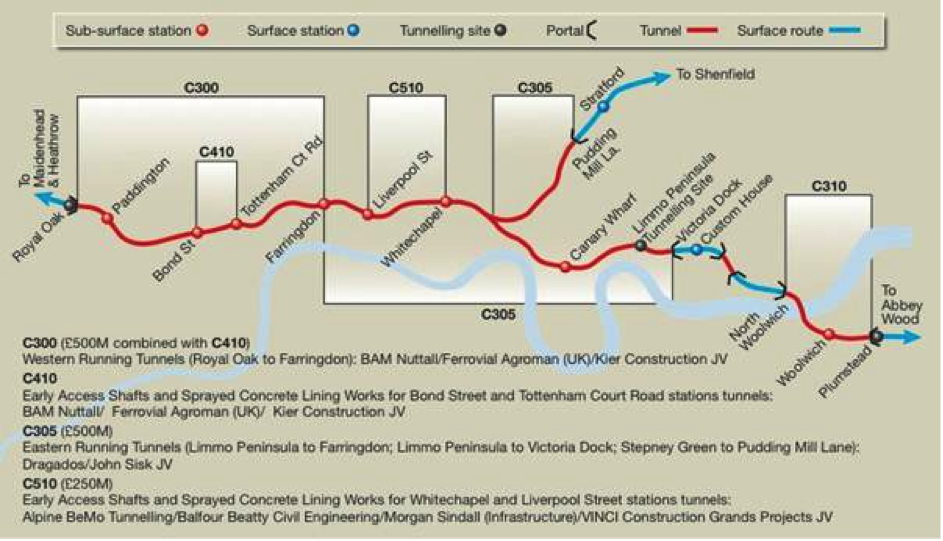
At each one of these sites a number of Works are required ie Enabling/Demolition Works, Piling/Diaghram Wall works, Tunnelling Works and Final fitout works.
BFK has won the contracts for the Tunnelling works on the Western Tunnel Section. These Works are incorporated into the C300 and C410 contracts.
As such, my role is as an Engineer for the Tunnelling Works at Fisher Street, one of 7 sites on the Western Tunnelling Section. Hence the Enabling/demolition works and the Piling works have already taken place, by different contractors, and BFK are due to start tunnelling works in 3 weeks time. In due coarse BFK will hand the site over to a new contractor in order for them to start the Final Fitout Works.
Company
Although BFK’s part in the entire project may appear small, only the Western tunnel section and only the actual Tunnelling Works, it is still such a large contract that one company alone was unable to cope with.
As such a number of construction companies have come together in a joint venture, in order to take on the task. BAMNuttall, Ferrovial and Kier have joined forces to win the Crossrail contract and are known as BFK joint venture.
I have been seconded to BAMNuttall , one of the companies within BFK, as one of 2 Engineers on the Fisher St site. However BAMNuttall is not a company in its own right and is part of the Royal BAM Group. The Royal BAM Group consists of a number of major operations:
- BAM Woningbouw – Residential construction
- BAM Civiel – Civil engineering
- BAM Infratechniek – Utilities
- BAM Wegen – Environmental engineering
- BAM Construct UK – Building in the UK
- BAM Nuttall – Civil engineering in the UK
- BAM Contractors – Building, Civil Engineering, Facilities Management, PPP, Property and Rail in Ireland
- BAM Utiliteitsbouw – Non-residential construction
Induction Fatigue!
G’Day,
My first week at work has come to an end and I feel very Health and Safety conscious! The Glenfield to Leppington Rail Line project at the moment contains no actual rail line and I am part of the structures team responsible for delivering all of the structures along the 11Km alignment. My part in this is working under the Section Engineer where together WE will (he already is) be responsible for the 4 bridges from Leppington station to the stabling yard at the end of the site. The bridges consist of 2 underbridges and 2 overbridges with 3 of these ranging from 70-80% complete. The remaining overbridge at Dickson road is yet to be started and this is what I will be giving most of my attention to over the next 6 months.
Despite the lack of tracks, signals, overhead lines and of course trains the site has kind of, but kind of not been designated a rail site – it depends on who you talk to and what day of the week it is! Despite this uncertainty I have attended RailCorp’s induction which is the ‘white card’ version of rail, along with doing my white card and the site specific induction all of which took a day to complete and all of which issued me with a seperate photo ID card to fill my wallet with. I also have another card to obtain called a Rail Worker Safety card which is again a card but has a chip that says I have the other 3 cards but because the rail safety supervisors don’t have chip reading machines they won’t have a clue what’s on it so we have to carry all 4 cards around with us anyway.
Getting back on point, the Dickson Rd overbridge is a fairly straight forward beast but the Section Engineer is looking at me as the focus for the construction and it seems I have come at a good time so that I will be involved from start to finish with an estimated 5 month build duration. The bridge is very similar to the other overbridge at Eastwood Rd but where that was a pad foundation the design has been made to change to piles in an attempt to reduce excavation works and the amount of concrete in order to speed up the construction and save in the region of $200,000. The project as a whole seems to be doing well and is 6 months ahead of schedule, but the pace is being pushed all the time in a hope to increase this further and receive the associated financial bonus. The bridge is an 18m single span pre-stressed concrete structure which is due to start at the beginning of April. Construction can’t start however until the Eastwood Rd bridge is complete which is on the critical path. We have an unmovebale deadline of 25 Mar to complete this bridge so that the road can open before easter and so we can close Dickson Rd to start on the final bridge.
Overall, this first week has been thoroughly enjoyable but blurry! We have settled into our apartment in the eastern suburbs (exactly 950m from front door to sand on Coogee beach – down from bondi!) and the commute is only 45mins each way or 90 mins if it’s footy night as I discovered last night! I have also found that the last 7 months at Chatham seems to have prepared me well despite feeling at the time I was being punished but I didn’t know why!
Big buildings, banks and basements
Project Armada
I have been assigned to The London Development which is the design and construction of a nine storey, one million square foot Goldman Sachs headquarters building. The project is at stage C-D and I have been tasked with the basement, retaining walls and raft foundation aspects.
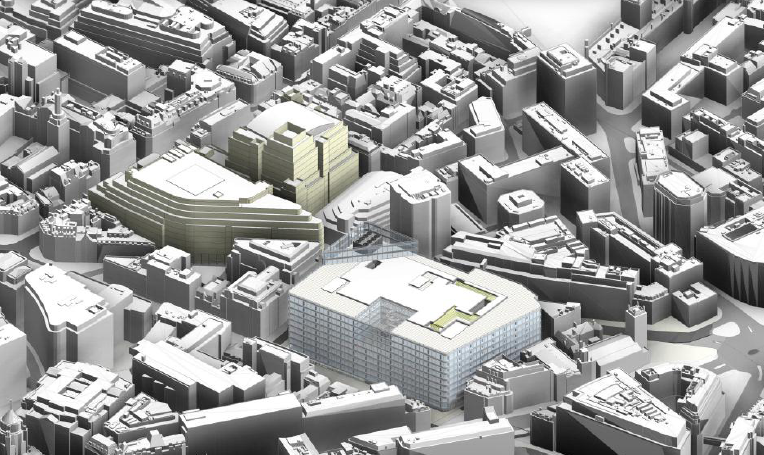
Architects image: the maximum height of the building is limited by the Greenwich Park to St. Paul’s viewing corridor, creating a demand to maximise the floor area .
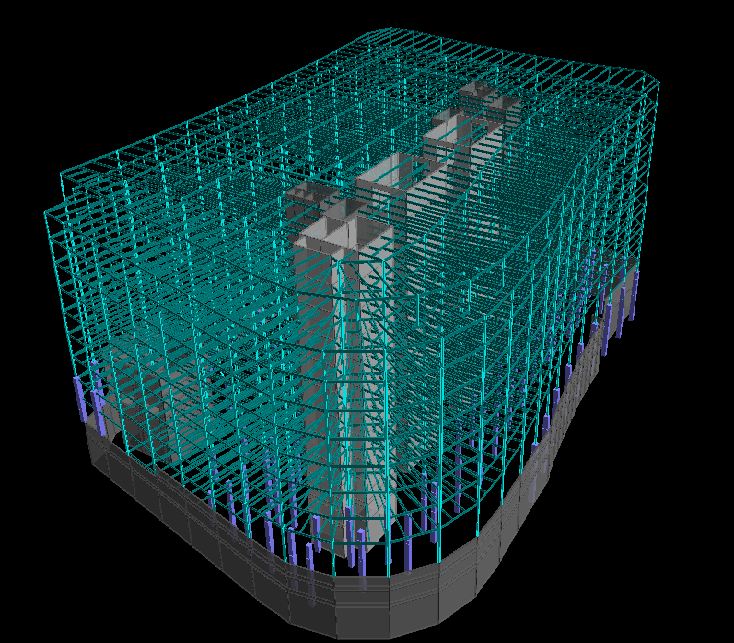
The initial superstructure model with 9th iteration of core walls layout and 4th iteration of column grid layout!
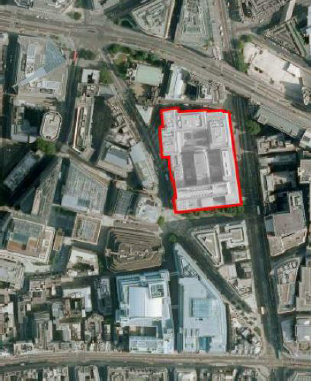
Site on Fleet Street in the City of London currently occupied by 2 buildings.
In addition to the above ground site constraints, The London Development is underlain (aside from the old Fleet River) by several below ground tunnels, chambers and utilities. Of which three substations and a access lift shaft have to be maintained within the basement, making the construction sequencing a critical component to the design.
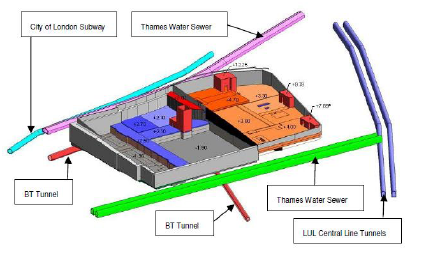
Design Lessons Learnt
Having completed 6 days of Structures Graduate Proficiency training over the last couple of months, it is clearly apparent that aside from the core syllabus of revising first principles and Eurocodes, the priority is to teach graduates how to design to save money and make money! i.e. how to incorporate economy into design and how to get the right answers (to an appropriate level) in as little time as possible! Given the size of buildings WSP Structures department generally deal with, this skill is key to maintaing a profit margin – time is most definitely money all the way to the 70th floor! Perfecting the art (certainly during the initial design phases) as far as I have ascertained, seems to be rules of thumb first followed by optimisation through software. The first comes naturally to those with experience, or eventually with a bit of guidance for graduates or newbees! A few new designers lessons learnt so far:
1. Apply rules of thumb (i.e. quick designers assessments of member sizes and configurations) to the problem first, just to get an idea of what the loads and forces are likely to be so that you know if your answers are at least in the right ball park. These are contained within most guides but do not require trawling through the Eurocodes and should only take less than an hour to produce.
2. Understand the geometry of the problem fully before embarking on any design. I have found drawing lots of sketches and asking colleagues if that is what is required saves a lot of time in the long run. This will firstly ensure your part of the design fits within the overall structure (and you are using the same parameters) but also basic components like the slab is spanning in the right direction for example!
3. Consider construction aspects in the design Intrinsically tied to the cost of materials is the cost of construction. Whilst the consultant does not price the construction, the client will soon establish how economical the design is when the contractors submit their tenders. In my case, I had to give the Client a ribbed slab vs composite slab solution for a bespoke 100 person conference room. Whilst the ribbed slab came out considerably deeper, the additional cost of bringing steel into the construction sequence to maximise clear floor to ceiling height will have to be weighed up by the Client. Another aspect which I hadn’t initially considered was additional opportunities for temporary works savings, for example ensuring the beam is the same height as the ribbed slab, thus increasing the width with a set depth of the beam to reach the required capacity. Where the designer employs these techniques however, it is often then necessary to explain the reasoning to the QS who may only be looking at the cost of materials!
4. Initial design = initial design After spending hours producing reams of detailed designs, the client would then want a column grid change or an adjustment to the proposed floor plan! Whilst this should theoretically stop after the agreed “design freeze” date, either the date continues to slip or it will happen anyway and a concurrent commercial debate about whether it is design development or a change in specification will ensue! The answer at engineer level is to minimise detailed calculations at this stage and maximise use of spreadsheets or software where parameters can be easily changed. This also ensures that unnecessary time is not logged to the project which will be required during the detailed design stage.
Site Visit
I visited the One Blackfriars site, a 170m residential and commercial tower with the geotechnical and structural engineer responsible for the groundworks phase of the construction. Much like the Shard, construction will be simultaneous top down, bottom up construction, hence the requirement to install a series of plunge columns and cast the ground slab prior to further excavation.

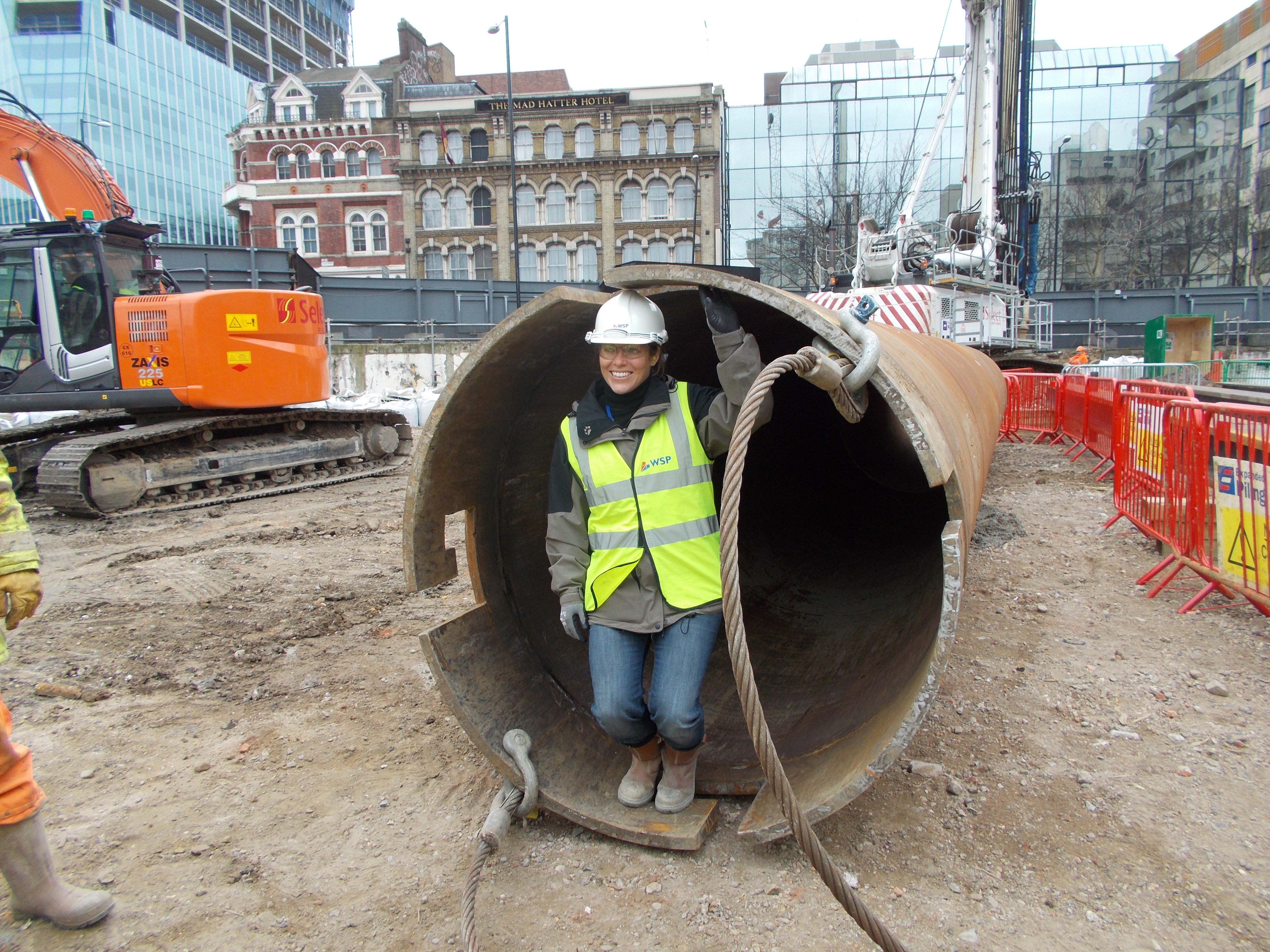
A plunge column casing (of which I was asked to demonstrate how tall is was…almost 6ft…?!)
The contractors were in the process of installing the plunge columns using a best practice technique developed by piling contractors. A bespoke casing was fabricated with guide rails which allowed the column (also fitted with guide posts which can be fabricated to the required length) to be fed into the casing, levelled and hung from a steel beam until the concrete has reached the minimum strength requirement. The size of the columns is dictated by the loads as well as the levels of tolerance required.
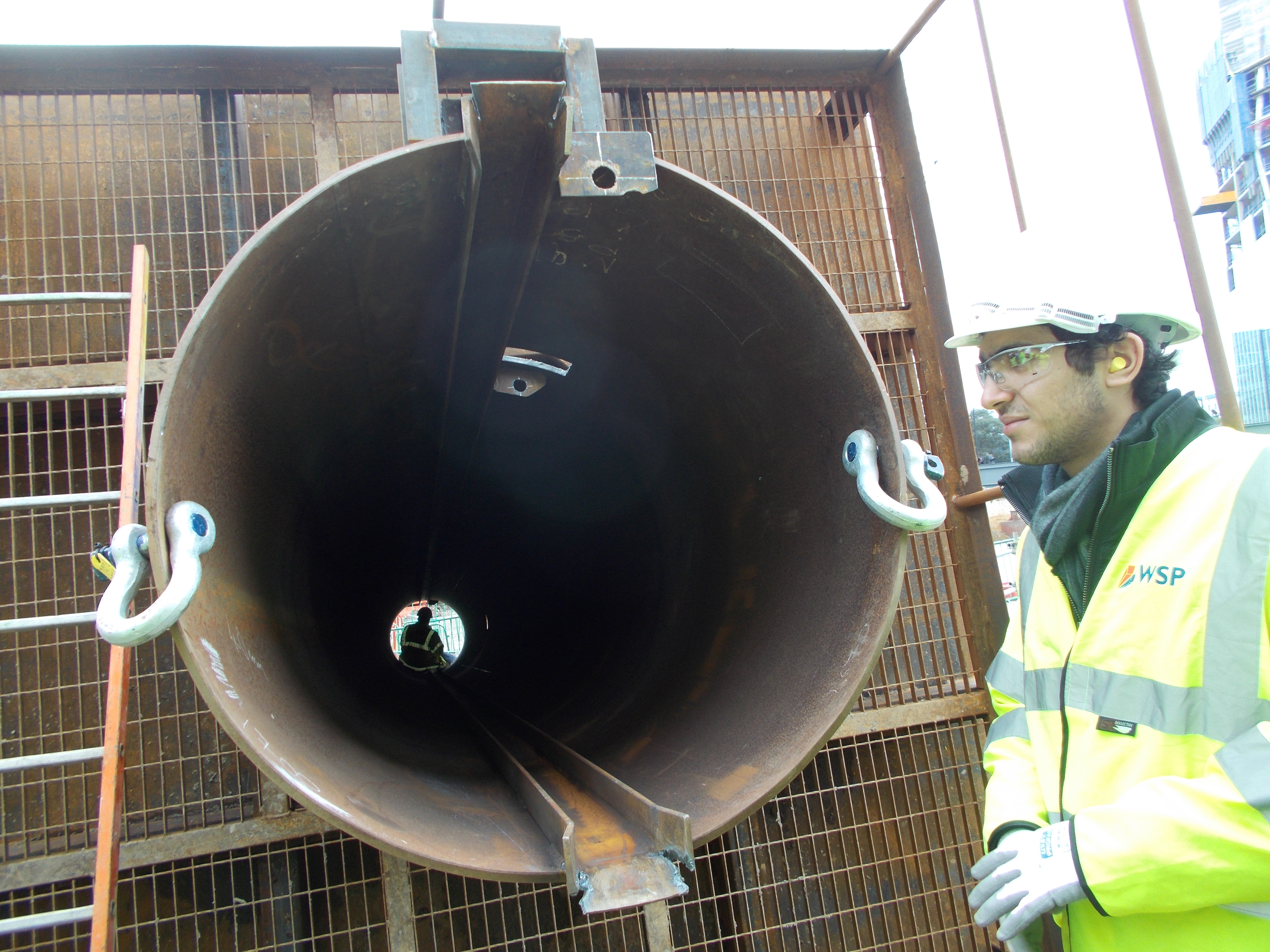
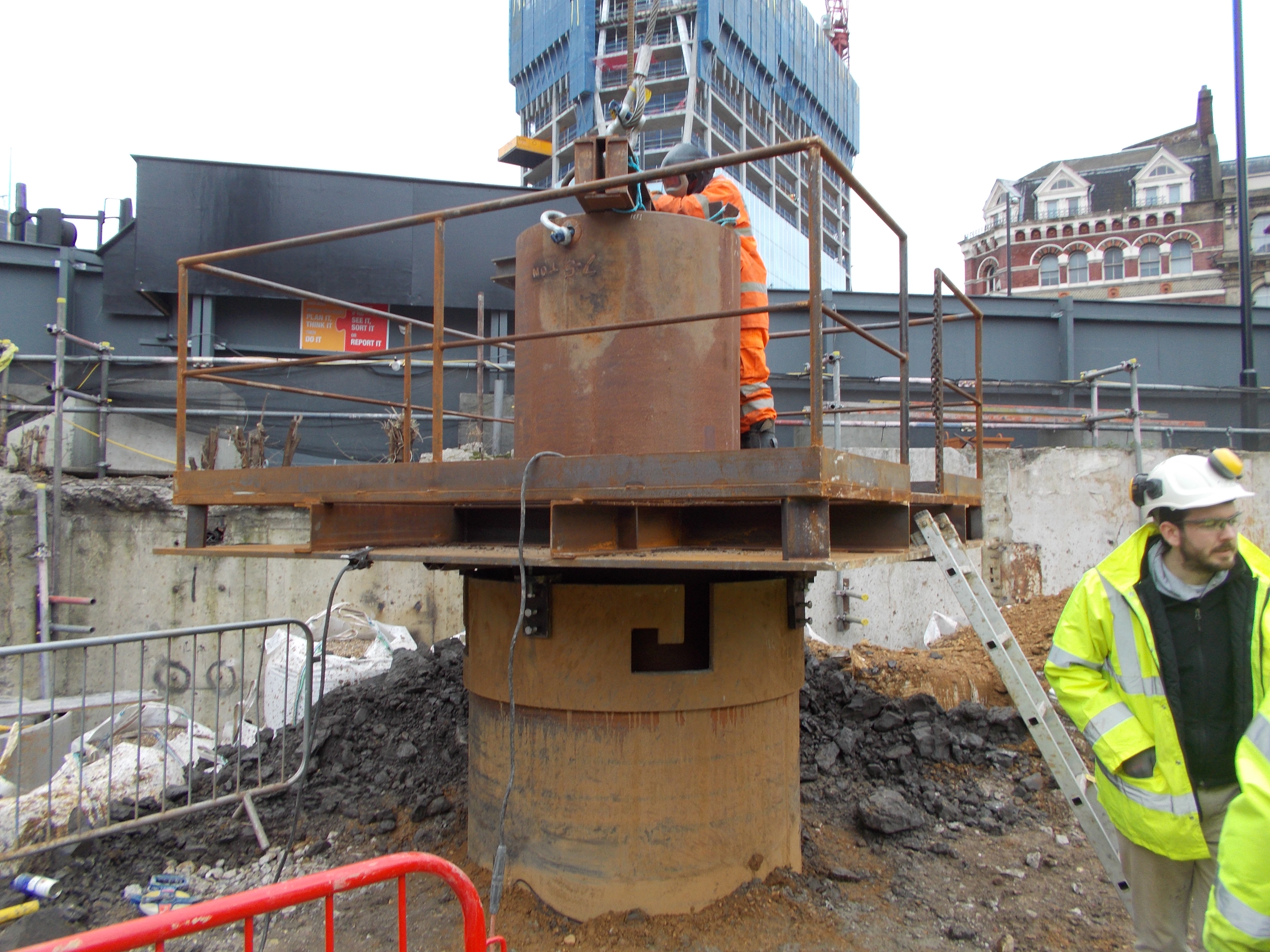
The plunge column installed in the concrete filled pile, hung from the beam shown and welded for security until concrete reaches required strength.
Another best practice technique used on the site was bags of shingle as temporary propping following excavation adjacent to the road, saving on bespoke temporary works and utilising the shingle in the final layer of the plunge column piles. Very Royal Engineers I thought!
Phase Three coming right up…
Phase Three coming right up?
After months of wrangling about me getting some real technical experience (A and B competencies – aka design office experience) to complement the wealth of project management, team leading and communication skills (C, D and E competencies) I’ve amassed over the last 11 months, I’ve finally got somewhere – but a little further afield than working upstairs for WG PSN who are our main contractor for our technical engineering…
The reason? Well, it seems that although WG PSN’s mechanical engineers are incredibly busy, they don’t really have the work here [in Aberdeen] that their Engineering Manager, Ian Maycock (FIMechE) thinks is suitable for me to develop the competencies that I require to be able to sit and pass chartered review six months from now. And my management (the Team Lead, Peter Neilson and our Engineering Guru, Martin Fragell, also a FIMechE) agree.
But what they (BP and WG PSN) do require, is someone to go and work alongside one of our suppliers, Flowserve, who are currently falling behind on a rather large and quite expensive, produced water re-injection (PWRI) pump. It’s not completely clear what my ROE are just yet, but it seems like I am to go and work with them at the factory/design office in Breda for a few days a week, analyse the problems, and then come back to communicate these problems with the BP management and WG PSN engineering team in Aberdeen, with a view to being able to resolve the problems quickly and effectively back in Holland the week after. I’m told that it is excellent engineering, very mechanical and really technically detailed and complicated, so it does tick the A and B boxes – mostly because I will have to get well and truly immersed in it to understand, and develop, the damn thing! From what I understand, this is one of ETAP’s big process concerns right now (and notably, will be one of the biggest pumps in the North Sea upon completion), and there is plenty of engineering to see me through til Phase Four.
Good thing or bad thing?
Well, if I’m honest, Liz and I do quite enjoy living together, so starting the weekly commute in March rather than August is going to be a bit of a blow, but the hard facts are that working on my jobs hasn’t (in my eyes) given me enough technical clout to sit chartered review right now, nor by July. Could I have done things differently? Well, I’ve worked well (by all accounts) on the jobs I’ve been given, it’s just that BP don’t do the detailed engineering themselves, we just assimilate the information from our teams.
The technical piece is something I’ve been pushing since November, and pushing strongly since January, but with changes of management it has fallen by the wayside and I’ve let it go on, so maybe it’s just me to blame (sob, sob). The weekly commute will be a pain in the arse, as will living out of a hotel week-on-week, but hey I’m not here for an easy ride, I’m here to become a chartered engineer! Hua!
Anyway… other jobs as follows:
ETAP ALQ: Getting handed over to Cat B projects this month, or possibly next, on completion of a structural engineering review by AIG
Bunkering Lines, Cold Boot and Post-TAR decommissioning: Getting handed over this week
Decommissioning, DBBs/SIRPS compliancy and Glycol Balance Line – I’m keeping these as I just can’t let go! This way, I will see them from Appraise through to Offshore Execute. (Well, not decom as I inherited that, but it’s been my most hassle-free project, so I’ll keep the coals burning til offshore execute and “tick off” three TAR jobs).
And in other news:
Liz and I went out with REMEC last week to their Winter Meet based near Fort William. As well as outstanding conditions, it was also good to meet up with Lachlan Robertson and Paul Golding, who are both due to assume STRE command this summer. With the meet being an informal part of the Himalayan expedition selection (Sept – Oct 13) it was good to chat to them about my odds of being able to get away from work to be a part of the expedition; clearly, a lot depends on being in the ‘right’ STRE – and not theirs, as they want to be going away too! Fingers crossed…
Oh, and Dougal the “wonder pup” has passed 30kgs. He’s going to be a machine…
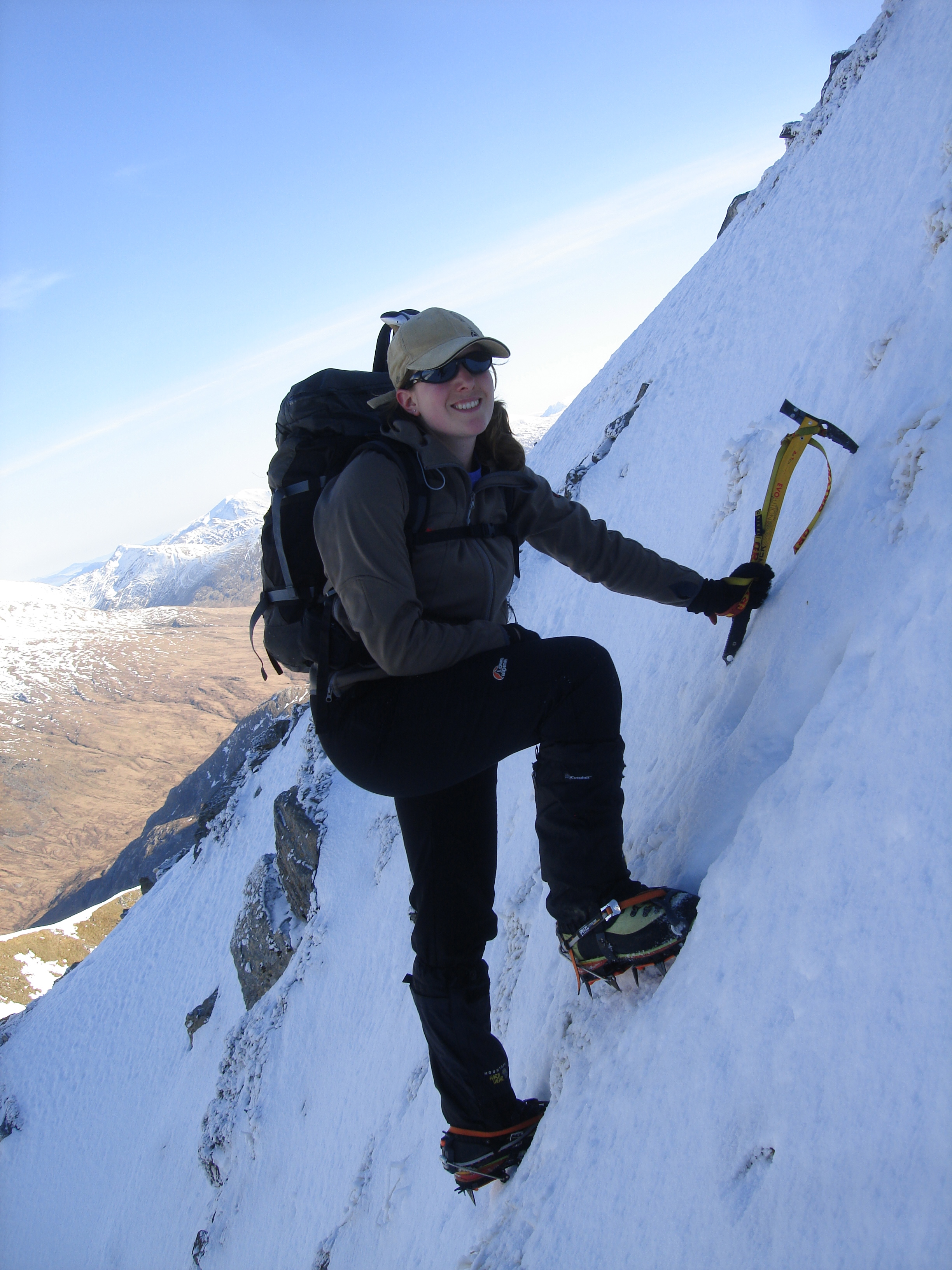
Liz climbing onto the Sgurr a Mhaim as part of the Ring of Steall (eagle eyed viewers will noe the angle of the sky…)
New Boy on the Blog
Pretending to be a real person is pretty easy, bluffing your case on a building site isn’t that hard (it helps if you’ve done it before) understanding an Irish Foreman who is as unintelligible as a Ghurka on a radio isn’t quite so easy.
I have been installed as an Assist Site Manager on the Mayflower Halls Site for Osborne in Southampton. As facebook followers will know I have discovered that this title is a little over-inflated; as such on a site that currently only has about 33 people on it there are 2 Assistant Managers (including me), a Site Manager, a Senior Site Manager, a Senior Project Manager, a Design Manager and a Construction Manager. So as an Assist Site Manager I started with less power than 2Lt ETS Officer. However, armed with nothing more sophisticated than a notebook, pencil and a 7 month crash course into how to pretend you know what you’re talking about I have already managed to avoid the other Assistant site Manager shedding the plant ticket checking folder onto my to do list and stopped a pile cap pour that was missing not only the drainage runs but the ground beams that tied into it. Being a real person isn’t that hard.
Things I have learned so far:
· Shaving is optional, even for quite senior managers.
· Civvies measure work in time not output.
· Bullshit still baffles brains. Signs, signs and more signs!
· Reinforcement drawings are nowhere near as simple as the ones they showed you in the lessons.
· Civvies find your use of ‘Roger’ quaint, look at you blankly when you say ‘Diffy’ and call you on the radio more than is really necessary because they like to laugh at your voice procedure.
· Contractors will wilfully do something that is wrong just so that they can be doing something.
· A ground worker who has done his SMSTS course suddenly becomes and expert on everything and the civilian equivalent of a barrack room lawyer.
Joking aside, there are a good many things that I just don’t ‘get’ yet, there has been a number of times I have found myself actually knowing more about stuff than those around me and fearing that I had a bit too much of the classroom about me. Osborne have so far been brilliant and very welcoming.
Stop Press – British Army Officer Barred from Salsa Club for Coke Related Incident!
Building 45 – Seismic Analysis:
Some really good progress was made on this one. We had an ’emergency’ meeting with the architects, fire safety guy (who fell asleep), electrical engineers and ‘the plumbing guy’. It turns out the scope of works has turned out to be way more costly than the Client anticipated. Gone are the heydays of bottomless Government coffers and it seems that people actually have to think long and hard about what they want nowadays…….still, completely undeterred by this the Client wants USACE to find the savings (of about $1M) whilst still hitting all of the criteria within the scope of works. I got the distinct impression that people have not been completely forthright with the Client as we appear to be continuing ‘at risk’ but with no defined boundaries. I am now very unpopular with the Architects from asking them to confirm exactly WHO is carrying this risk and what are the consequences of that risk. The vague response is that we’ll try and do what we can until the money runs out….well why wouldn’t we?
Some initial ideas for reducing the costs have been to re-use some old fridge doors instead of buying new ones as these will make an attractive ‘historical’ reference, a new boiler system has been canned and pipe dream of having a freight elevator to the basement has been dropped. As you might imagine – these amount to nowhere near the $1M target. Some more sensible ideas involve ‘packeting’ the works into discrete units that can be undertaken in individual chunks and funded separately. The whole of these packets make up the full scope of works, but will theoretically allow the client to undertake the work in stages, although I find it hard to believe given the complexity of Federal Acquisition.
From a structural perspective this really sucks because the building is so old – but still in use (thus limiting what I could actually get to see). It has been chopped and changed so many times and has suffered significant water damage in the past. Only partial areas have been uncovered for inspection and some significant defects are manifest. Therefore the full extent of the defects can not be fully ascertained – nay – will not be fully ascertained until the contract is in full swing, which will likely lead to additional costs….which the Client does not have. My report will have to contain strict caveats to that effect and I just hope they manage to iron out the colour of their money soon. On the plus side I will get a chance to go and work with the budgeting guys to learn how to make a million dollars disappear.
As for the seismic analysis itself – that was fairly straight forward but required a lot of interpretation and judgement. The only areas that it really falls short on (other than water damaged and rotting floor joists of unknown magnitude) is the fact that there are no ties for any diaphragm members to the masonry – which should theoretically be a fairly simple fix. I have a nice pile of calculations and codes to wade through which should keep me quiet for a while now.
Dam Structural Issues:
It seems the structures department is bracing itself for an inbound Request for Equitable Adjustment (REA) where a contractor tries to tell the evil government that they were diddled out of cash and that they want it back. I had some fairly extensive exposure to this side of life on Phase 2 and so I had a lots of suggestions for them based on this experience. The structures department tends not to get too heavily involved in these but this particular one involves a contractor specifically going against their recommendations – incurring extra costs and now they want to try and turn it around. Whilst I’m happy to get involved – I’d rather not as I’m kind of treading old ground and would rather seek pastures new for Phase 3.
On a related note – the REA I was involved in has been progressed using the tools I developed. The contractor is attempting to claim $3.2M – but the Government reckons only $500k is valid. I will try and get to sit in on the negotiations when they happen.
Happy C-Bomb Day
In Phase 2 I whinged about a particular member of staff in the Huntsville office who’s general attitude to work and responsibilities was stopping my team from being able to do their jobs effectively (and she earned the accolade of ‘C-Bomb’ from my guys). I was continually having to scour the USACE procedures and quote from the Federal Acquisition Regulations (FAR) to continually justify the roles and responsibilities of my staff (We don’t normally have to do this – but because the project was a joint effort – responsibilities became a bit blurred at the edges). Anyway – I singled the lady out as being the single biggest risk to the project and complained for ever to my line manager to get him to tackle the Huntsville office about it…..and he tactfully avoided the issue and left us to run the gauntlet. My parting comment was that if a cog in the machine is broken – then we need to fix it or replace it. Meaning we either need to train this person or move them on. My ConRep and Labour Rep both called me on the same day when they discovered that the C-Bomb has been sacked! Not that this had anything to do with me you see – she clearly upset everyone. The real surprise is actually that it has been proven statistically that here in the US you are more likely to die of natural causes whilst under Government employ than to ever be sacked – so this is kind of big…….although this news is not engineering-y in any way – it did cheer me up….I also know it wasn’t just me.
CPD:
A company called CINTEC (who also has a UK base) delivered CPD for our entire department on their masonry anchors and reinforcement systems. They have a ‘sock’ sheath around steel reinforcement that allows them to create custom anchors by pumping grout into the socks. Good simple stick and string engineering.
Structural Framing:
One of the junior engineers had produced some loading data for a new design which was to be sent out to a contractor to run computational modelling for new roof trusses on a building that I am not allowed to know about (for security reasons). The chief structural engineer was checking it over and was not happy with it and asked me to go through a last.minute.dot.com framing exercise with him to ensure we have sensible numbers. At first I thought ‘what would bat man do?’ but punching him in the face and diving out of the window didn’t seem the right option, so then I thought ‘what the the Farmer do?’ and a cunning scheme was developed on the whiteboard. The only thing that was missing was Steve Dollimore to sit at the back and nonchalantly inform us of any several mistakes….but i think it was sound. Our structures guy was complaining that many graduates do not have a good understanding of structural framing and thus – it drove home the importance of the exercise we did on the PET course…..even if I did curse it at the time.
Structural Canopy:
A design has been produced in house for a canopy above a series of guard booths at the (shhh don’t tell anyone) NSA at Fort Meade. In order to get some more money type questions buzzing in my head I asked if I could help with the take offs and subsequent costing etc. First phase is done – will go sit with the bean counters afterwards to see what they do. First observation is that there is an awful lot of assumption going on as to who is meant to be providing what information. I imagine that if the bean counter is not on top of his game then we may be missing big chunks out of our initial cost estimating process….which might explain why every single project we do seems to go over budget. Will report more next time.
….And in other news:
I have been interviewed by the Public Affairs Office so they can run an article about those dapper chaps that are floating around the office. (Conehead Jim – this refers to Ben and I before you hit me with bouts of sarcasm!). I kept telling the lady to ask Ben about his very British pass-time of ‘Dogging’, as this would make for interesting reading amongst our audience. Unfortunately she looked up the word dogging on google and has decided that this is not a suitable topic for USACE to promote – although she has offered some good advice on a park and ride near Westminster, Maryland.
And finally – if you were wondering about the heading of this week’s blog – the wife bought us Salsa lessons on Groupon for Christmas. We went back for our second of six lessons and whilst I went ahead to use the bathroom, Ulli took a swig from a bottle of coke (outside the establishment) before screwing on the lid and putting it in her handbag. The manager saw this and confronted her upon entering. After going through several variations of bull**it about it being illegal he physically went into her bag and confiscated the bottle (even the security staff in our Government building aren’t allowed to do this). By the time I returned from the bathroom Ulli had come to the conclusion (rightfully) that the manager was going to ‘get it’…….we were invited to leave and never return…… I know America is a big place, but we need to pace ourselves for fear of running out of drinking holes before July.
Update from Brisbane
G’day all,
Just dropping a line to update on progress in Brisbane – not sure I can compete with invitations to teh Shard or pictures of enormous plant moving stuff…but I have been involved with a number of projects both online and offline.
1- Design of a portal frame structure has been an interesting experience…supposed to be a small task which ahs now groen arms and legs. Wind loadings aaaaghhhh blooming frustrating but fortunately not dissimilar to our PEW teachings or our own code. Definitely not the most fun job in the world but it seems to be progressing well. Next job – sizing columns!
2- Enoggera Army barracks…ironically working with 2CER (combat engineer regiment) on their new barracks facilities, checking the design, andwering RFI’s, following variations and generally watching JHG mess up the construction. Its been good working with the contractor first so as to have some knowledge about what is likely to be asked for next…it seems we have a lot of power!
3- Design of bridges – I’ve been looking at some pile design, and redesign because the original designs didn’t take into a water pipe and various vibration issues…so it’s nice to get into some geotech as well as grillage analysis on the bridges.
4 – Offline I have been ‘doing a bit on the side’…. 😉 I’ve been assisting a friend on an enormous wharf job where a 300t silo has to be transferred from a heavy lift ship onto a barge in the harbour…the lashings, vehicle specs, additional stiffeners on the barge deck, connections and logistics are complex….it may warrant an appearance on Megalifts!!!
Once it’s on the barge, a vehicle drives under it, jacks it up on hydraulics and drives off…on a specially designed ramp. I’ll be popping to Gladstone in May on some leave to see the operation….
Attached are some screenshots – the first is an example of one of the vehicles used- these can be joined up like trains as they’re modular…our one will have 200 wheels!! I love it that the wheels can go in different directions.

These are just some images of the silo – 11m CofG is not funny!
I’ll try to attach some better photos – computer has just said no.
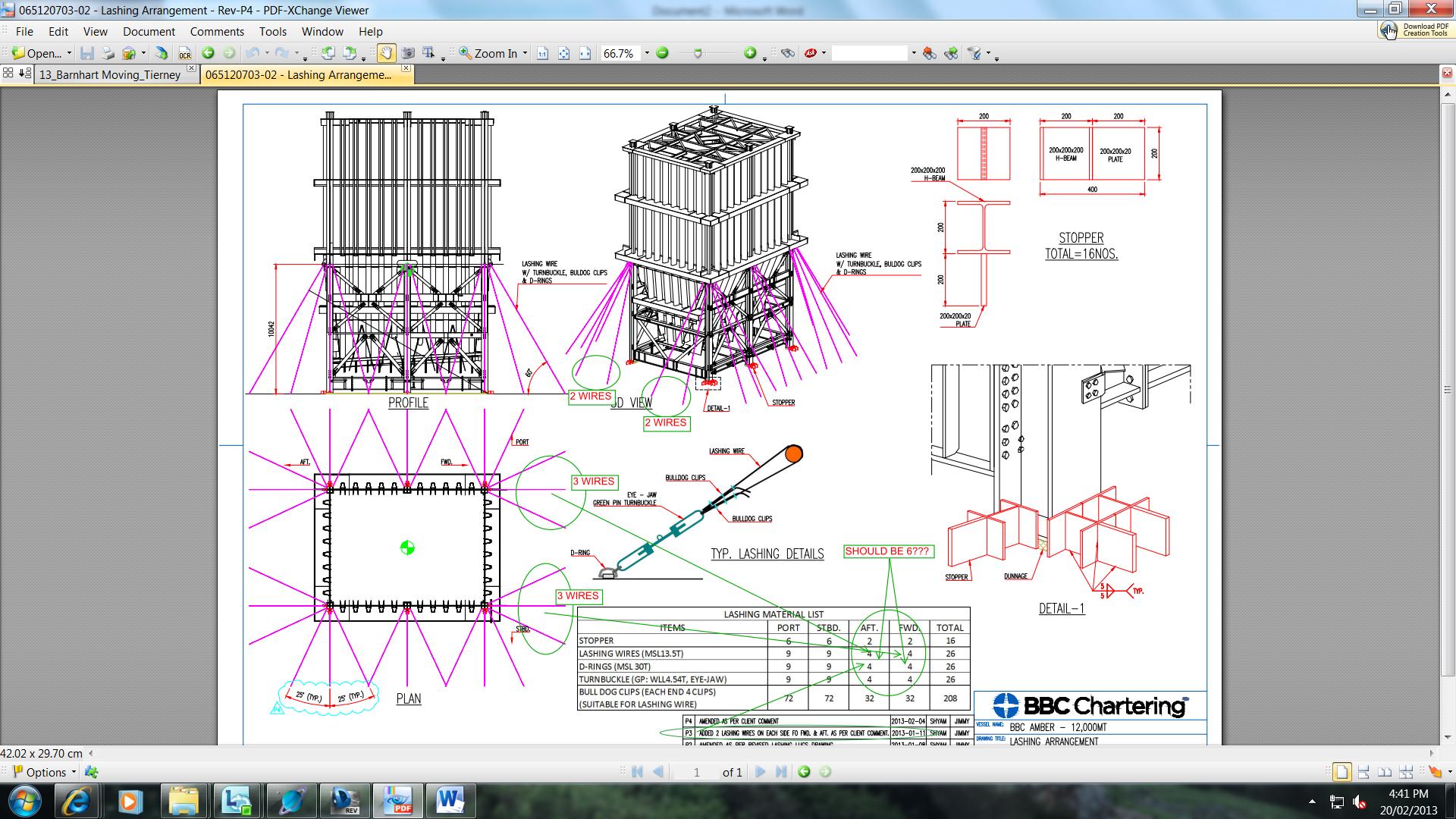
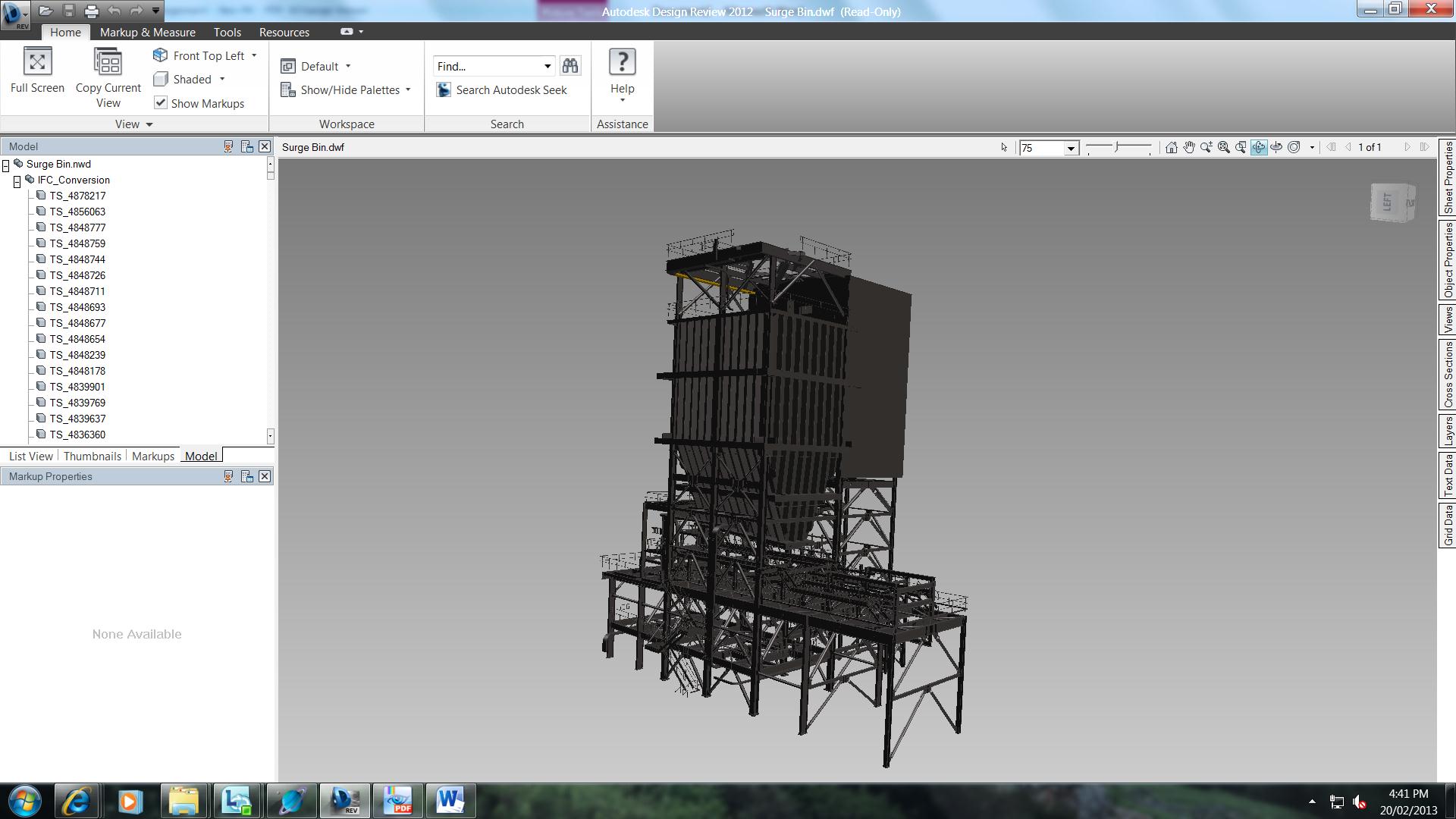
Back to the portal frame..remembering to use a UB for a column….
Best wishes,
R
 Holdfast Training Services Trial Blog