Mendeley Desktop…it’s free!
Whilst writing my thesis I have found Mendeley Desktop to be an excellent reference management system and the citation plug-in for Word is well worth downloading as well. I only wish I had listened to Mark Hill and downloaded it before starting TMR 1!
Check it out – https://www.mendeley.com/
British Airways Medical Facility
As my Phase 3 placement progresses I am getting used to the systematic way that the design office undertakes a building services project. This blogs aims to describe the process using a small task I am running with (it is related to aeroplanes – exciting).
The Project:
British Airways have a flight training facility at Heathrow centered around a hanger with a row of articulated flight simulators. The surrounding building contains the plant to operate the machines and a number of offices.
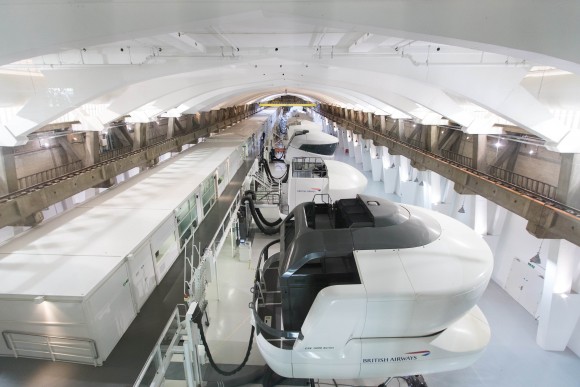
Flight Simulator Hall. I wasn’t allowed to have a go in one.
One office has fallen into disuse so BA has decided to convert it to a medical facility with the following spec:
- Waiting area with seating for six.
- Three conditioned treatment rooms.
- Tea point and unisex toilet.
- All spaces are to be cooled or heated as necessary, supplied with ventilation, hot and cold water and electrical power.
The area is currently used as a storeroom and janitors office – it is unheated and has a number of bits of old air conditioning plant running through it.
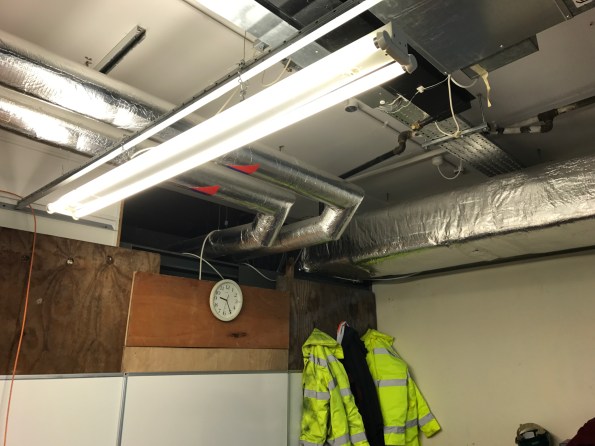
Medical facility – current state. Some homeless facilities manager has been squatting here for a few months, hence the PPE.
Design Process:
The M&E design process at Bryden Wood is almost identical regardless of the size of the project. However, a bit like the combat estimate the cycle is scaled to the time and resources available to the task …. smaller project = less money = less detailed design. With the very small scale of this task the entire plan has to be completed in about a week, giving it the feeling of a Phase 1 design project. Generalised steps to the design are included below:

Schematic of the existing plant room space. Note the Air Handling Unit at the bottom right that the new ventilation design aims to tap into.
Step 1 – Fix the Spec. Meet the client and hammer down exactly what they need and are willing to pay for, bearing in mind that these things are usually decided by different people with very different priorities. During this process I listened to the nurse’s passionate pleas for a tea bar with coffee grinder, zip tap and dishwasher. This has subsequently made it into the design as a sink.
Step 2 – Develop Strategy. This is arguably the stage requiring the most engineering judgement. Decide on what systems are needed to meet the client spec – how it will be heat, cool and ventilate the space. As an example, at this stage I decided to use a wall-mounted unit to provide cooling and piggy-back on a nearby air handling unit to provide ventilation. At last I can now sleep at night.
Step 3 – Calculate Room Loads. Work out the worst case cooling loads (people, lights, solar gain, and equipment on the warmest day) and heating loads (empty room on the coldest day). Add 15% extra capacity for future expansion, wear & tear, etc. Follow a similar process for hot water and ventilation rates. This is easy, bread and butter stuff following CIBSE guidance and rules of thumb.
Step 4 – Speak to Manufacturers. Talk to our favorite manufacturers (the ones who buy the best free lunches) and ask them to quote for the systems needed.
Step 5 – BIM Modelling. Model the selected systems in Revit (the chosen Bryden Wood BIM programme) and ensure there are no clashes with the existing sites systems. I usually outsource this step to an apprentice CAD draftsman who uses Revit like he is plugged into it Matrix-style.

New room ventilation plan. This sketch is handed to the Revit techie who turns it into a sexy model for the client to peer at.
Step 6 – Paperwork. Complete the diligence paperwork required to provide we have met the Principle Designer responsibilities and manipulate the Revit model to produce the final design drawings. Sit back and enjoy tea and medals.
Open Doors
Just been told about this. Might be an interesting visit if anyone wants to wander around a few construction sites. You could potentially argue that it’s CPD at a push or steal a good idea from one of these sites, apply it on your own, and look like a hero!
IStructE guidance
Writing AER 5 has prompted me to signpost some guidance for the Phase 1s as they move to their site attachments. It would also be useful for the next batch of phase 1s but I doubt they’ll see it unless one of the lecturers can pass it on.
Join the IStructE as a student member. I don’t think it was covered except for some structures ninjas attempt to charter with IStructE. Maybe I slept through that advice in Phase 1 (my fault) or maybe it wasn’t covered (it should be).
It’s free, you get access to their online library, learning resources, student groups and talks, essential knowledge series, “Brohn” online modules, “The Structural Engineer” (online only), you can join their working groups (good CPR evidence)…….and most importantly it’s actually a navigable website unlike the ICE one. I feel they support learning in the way that the ICE should be doing (clearly not a point i’ll be making at CPR).
Join here:
Specifically:
The essential knowledge series is really simple introductory reading.
The level 1 technical guidance notes would be useful pre-reading before the corresponding lectures on phase 1 and as a refresher when you come back to that topic on phase 2.
The level 2 technical guidance notes are a good starting point for any phase 2 or 3 design you need to do in that subject area and they all highlight recommended further reading, generally easily understood IStructE design guidance. These are still being written.
Level 3 notes looking at complex design issues will follow during 2018.
I plan on coming back to them as a handrail after i’ve finished the course as well.
ICE CPR Written Exercise
Last night I attended an ICE event on the Written Exercise (WE) portion of the CPR. It was not a technical seminar or anything of the sort. It was one reviewer, Ian Jenkinson, giving us his opinion and guidance on the CPR in general, but focussed on the WE.
Ian Jenkinson has been an assessor for over 30 years and at some point or another has sat reviews with over 25% of all current reviewers. So his opinion on the review carries a bit of weight and shows a good spread of the opinions of most reviewers.
After the talk I felt much more at ease with completing the WE and taking the CPR on a whole. One of his key points (in the slides) was that the CPR is not an interrogation or a discussion between two adults (reviewers) and a child (us), it is a discussion between three engineers.
The slides you might find helpful, but I will summise a few of his key points here:
- The questions will be picked based on what you say in your report – through this you can essentially set your own questions.
- The reviewer will check you have some knowledge on the subject during the review, if they believe the question is unfair or they have not understood your report, they can still change the questions before you sit the WE.
- When answering the question:
- Do an essay plan (If all else fails and you have cold sweats and palpatations – people have still passed the WE based on a good essay plan
- Tell a story – this is not a technical paper
- They are looking for a good first draft (not polished ICE Journal submissions)
- Use minimal direct quotes and reference them properly – plagiarism will fail you
- Better to use your own thoughts, reasons and communicate them succinctly
- Some examples he gave had typed essays in the region of 1000-1500 words
- Well laid out but no unnecessary formating, front pages etc
- Another key point he made was not to get wound up about the essay. You won’t fail CPR based on a shocking essay, if you fail CPR it is because of the interview session.
- Alternatively, if you have a shocking interview, the WE might turn it around for you (on one attribute…maybe).
- Less than 0.5% of people fail CPR with the WE stated as the reason.
The marking rubric consists of three pairs of characteristics of the WE:
- Knowledge and relevance
- Grammar and syntax
- Clarity and presentation
Questions asked:
- What if the questions you get you cannot answer – Speak to the invigilator and they will help as best they can – he implied that there is always a way to answer the questions they set.
- What attribute do most people fail on – Independant judgement and responsibility. Ian spoke about taking responsibility and saying “I” and what the outcomes and consequences were to your actions. Secondly he said commericial awareness lets people down, but having a base knowledge of the contracts your projects were under would get you 90% of the way there.
His last point, and a slide that isn’t included in the pack was that they are not looking for the ultimate polished engineer, but an engineer who has the potential and drive to become a good engineer.
I hope this helps and sets a few minds at ease about the CPR process as a whole. It would be interesting to hear some of the guys opinions who have been through CPR last year?
Thesis: Information Overload!!
I’m sure all but the most organised of you have experienced something similar, even if you’ve subsequently solved the riddles and moved on!? I was hoping to get some advice that might help me make better use of my time over the coming two months.
Having extended my TMR4 deadline, then had the audacity to take a weeks leave at the end of February, I’m now beginning to feel the thesis crocodile circling closer and closer to the canoe. I’m extremely conscious of upcoming deadlines, but having gone out and collected as much data as I can, I now think that I’ve got too much and I’m struggling to refine it into useful material of the right academic level.
My thesis is on the structure of the Royal Engineers, and how we might consider re-structuring ourselves in order to better deliver effect on Operations. My basic premise is that the current historic structure (Platoons, Companies, Battalions, Regiments etc.) was/is fine for fighting wars, but pretty useless for undertaking construction tasks, not only does it seem to be an ineffective way of managing skilled tradesmen, but it also appears to leave managerial skill gaps within the command structure.
My main issue is that having obtained no less than 20 PXR/POR/PERs from the TICRE (luckily there was plenty of stuff they didn’t have or I’d have ended up with even more), together with the latest Project ANEMOI Lessons Learned document, I’m currently sitting on hundreds, probably thousands of pages of text (of varying quality and command level) that I’m attempting to evaluate in order to find reoccurring themes and patterns. I was keen to avoid any kind of selection bias by simply choosing the reports I liked the best, but in doing so I’m finding it almost impossible to pick out the most useful (and relevant) lessons learned. I could write a whole literature review on just three or four of the reports on their own, so having complied a spreadsheet of lessons learned from all 20, I’m struggling to condense them into useful (academically sound) results. So far, all I seem to have done is hand select obvious anecdotes with little further analysis. It’s like finding passages in the Bible or Koran; search long or hard enough and you’ll find something that backs up your opinion. The rest can just be discarded, even if there are a similar number of anecdotes contradicting the first. It feels like I’ve almost gone the other way and that having too much information is creating its own bias by allowing me to pick and choose what I want rather than what is actually relevant or meaningful.
Did anyone else have similar issues with regards to information overload, and if so what strategies did you employ in order to focus your efforts and obtain useful, valuable data from the sea of literature available?
PS: Please no “I’ve almost finished my thesis you should have started earlier” comments!
A really big crane.
I thought this may interest a couple of the civils.
Keltbray have just erected the UKs tallest land based crane. The crane is to be used for the demolition of Market Place Station at Earls Court. The demolition requires the removal of all the station buildings (simple enough) and also all of the portal beams that span the underground lines running underneath the site (not so simple). There are 61 portal beams in total with weights varying between 200 tons and 1400 tons. The original plan was to break out each beam by cutting them into 20 ton sections and then lifting each section out. This would have taken up to two years to complete the beam removal and would have also resulted in numerous rail closures (in London’s current strike-riddled system this would have heaped even more misery onto commuters). The demolition plans were nearing approval when some bright spark decided to ‘go big early’ and suggested using a massive crane instead. The plan would be to make a cut at either end of a portal beam and then lift it out in one piece. This idea would shave years off the project program and was selected as the method for removing the portal beams.
As a result the crane has just been erected at Earls Court:

It stands at nearly 120m high and has a counter balance weight of 12000 tons.
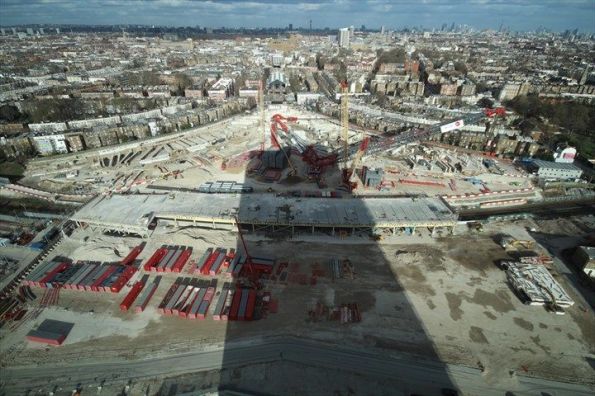
Everyone at Keltbray is very excited about it.
HELP
Does anyone know anything about HV installations in Camp Bastion and/or Camp Leatherneck?
A Channel 4 documentary reliably informed me that the ES compound had a HV system, but TICRE has no info on it. So if anyone can point me in the right direction, or even just make up some thing that I can then reference that would be great. Thanks.
Agora Tower, Taipei, Taiwan
Check out this building!
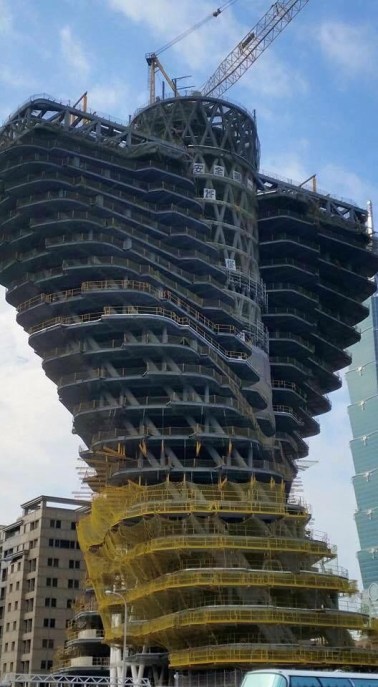
http://en.prnasia.com/story/126403-0.shtml
http://www.designbuild-network.com/projects/agora-tower-taipei/
http://www.designboom.com/architecture/vincent-callebaut-architectures-agora-tower-taipei-taiwan/

Gloucester the building not the place
Introduction
Whilst working on HPC has been interesting, there is a limited amount to learn from the experience so I have negotiated severing my involvement in the project. I have recently been working on an electrical study for a security clearance “building” located in Gloucester.
This building has critical equipment and therefore employs an Uninterruptable Power Supply (UPS) to guarantee the power supply to the data load and the cooling plant for the equipment. Unfortunately there was an electrical fault (exact cause are unknown) which caused a fire – damaging the UPS system and a distribution boards. The building is still operational utilising the UPS bypass as a temporary solution.
Replacing the damaged system, presents the client with an opportunity to increase the capacity of the building, therefore Atkins have been employed to conduct an electrical study.
A site investigation by the DV cleared electrical lead, gathered a snapshot of the electrical loads and the maximum recorded kW for each system.
Electrical Supply
Transformer 1 (TX1) – 11kV/400V rated at 800kVA
Transformer 2 (TX2) – 11kV/400V rated at 800kVA
3x Combined Cooling, Heat and Power Load (CCH) – 310kVA (N+1 configuration therefore 2 in use and 1 as backup)
Reflection
Designing a system from the start is straight forward because the designer can use design loads of the equipment and make assumptions based on justification. Making recommendations on replacing equipment without the design loads of the equipment or data of the electrical demand profile is a difficult situation. Using the maximum recorded loads identifies the worst case scenario, however combining all of these maximum will significantly reduce the extra capacity for expansion. Whilst using the electrical loads from the survey provides a more realistic figure but the survey could have been conducted during a low demand period. Therefore all the recommendations made by Atkins are caveated by “the recommendation for energy data loggers to be installed for a month to give an indication of the current kW on the system to confirm suitability prior to installation of a new load”.
It comes back to T/C/Q. The client Interserve want a quick solution – the UPS is a critical part of the system therefore its quick replacement is essential. Whilst Atkins focus on a quality product in the hope of winning more work off the back and building their reputation/relationships with the Client.
Spare capacity
Using the electrical demand provides the following spare capacities:-
TX1 –427kVA (53%)
TX2 –264kVA (33%)
2x CCHP –239kVA (38%)
It is important to understand the system operation before making recommendations on expansion. In the event of total failure of the CCHP, the load would be switched to the TX2 and the UPS would provide the supply during the transition. Therefore the potential increase of the data load by 239KVA supplied by the CCHP will limit the potential capacity of TX2.
TX1 –427kVA (53%)
TX2 –25kVA (3%)
Further Analysis
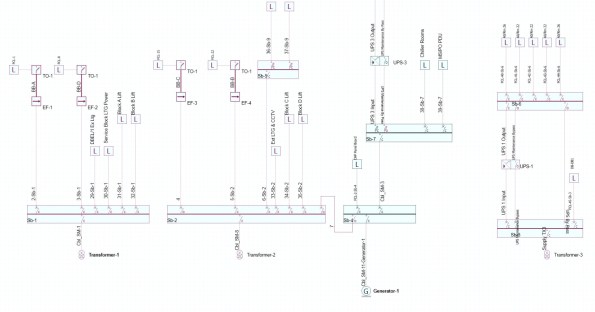
I am currently modelling the building in AMTECH (similar to Hevacomp) see picture below, in order to conduct further analysis on increasing the electrical demand and the potential limitation due to current carrying capacity of the sub-main cables and potential changes to fault protection.
 Holdfast Training Services Trial Blog