Captain Britain
So I’ve been slightly ‘under the RADAR’ since we arrived Stateside I guess. That has absolutely nothing to do with my work – more lack of it. Since we landed we have been through many a bureaucratic system which, when meeting the stupid foreigner, is akin to the unstoppable force meeting an immoveable object. Not a lot happens fairly slowly. However – I am now a fully fledged member of the office, with photos in the foyer to prove it and a modicum of responsibility to keep me out of trouble. I also have a Nickname, ‘Captain Britain.’
I will echo Henry in saying that this is fairly light on the engineering because, being a foreigner, I am still not allowed to go on site (an issue which is currently being resolved) however what I have been given will still be a fairly important piece to the overall programme.
The Programme – East Campus.
There is a lot of work in the area of camp which used to be a golf course, but is now known as East Campus. Currently there are 3 separate projects going on which are in various stages of construction, from 7 % – 90% complete. The largest of these is worth around $650m and the smallest is around the $50m mark. There was a contract awarded last Friday for another project, again at the $50m mark which makes the current programme close to $1Bn…so far. The interesting thing about all these projects is that each one is completely separately funded, procured and built. The reason being that government can’t politically allocate enough money in one funding cycle to build a whole campus. The overall strategy to mitigate this has been to procure each project separately and bid on separate funding cycles to senate for more money once it has been proved that the last chunk of funding has been properly managed and spent. This means that although there is an overall vision for what the campus will look like, there is really no way to say that it will all receive funding and be completed as imagined. This way of working has also led to huge issues with scheduling. With three large projects in various stages of construction in such close vicinity (one project also structurally ‘ties in’ to another) there have been inevitable conflicts in space and resources.
There is currently a ‘Master Integrated Schedule’ (MIS) which is supposed to help identify cross project conflicts before they happen, however much of the information is out of date and individual project managers are reluctant to release their un-approved schedules. The other issue is that the contract for provision of the scheduling service is due to expire shortly.
What I have been asked to do.
I have been tasked with getting the MIS running as it should, ie as a useful forecasting tool, and to deal with the issue of the expiring contract. What I proposed is that there be some more engagement with the Area Office (who are separate to the office I am working for, although still the same organisation. Think 2 Sqns in one Coy) and that the product be given grace to undergo a few iterations in order that tweaks can be made and input gained from the end users so that an accurate and, more importantly, useful tool can be produced. I also got someone with more clout than I to request the individual project schedules be released to the contractor so that a rough integrated schedule can be produced. I have called a meeting next week to discuss inter project logic ties so that any changes to one project will highlight impacts to neighbouring projects. I am hopeful that this will nudge the MIS in the right direction and that in a few iterations a useful forecasting schedule will drop out, rather than a few disconnected, out of date and inaccurate reports which the Project Managers view as an embuggerance to contribute to.
The other piece is to extend the contract that is used to produce the forecasting schedule. The contract itself is a Task Order (one of many), which is a part of a base contract for ‘scheduling, estimating and programmatic support.’ The base contract was for 5 years. The desire is to extend it although there is no specific clause to allow this (however the missing clause is referenced elsewhere in the contract). This issue has been referred to the Policy Department for a decision. If it can’t be extended that leaves until 25 May to push a new Task Order through. This will be a clever move because although the Base Contract will have expired, if a Task Order under the Base Contract is enacted prior to the final date of the Base Contract the Task Order and all money allocated to it is still usable until the Task Order itself expires. The money still remaining on the Base Contract is around $2m so I have drafted a Statement of Works for scheduling, estimating and programmatic support, under the provision of the base contract, and attached the $2m to it. This will accompany a Request for Proposal (like an ITT, but to the Contractor named on the Base Contract. Essentially asking the Contractor if they would like $2m to continue what they are already doing) to the Contractor who will then submit an estimate based on what I have asked them to do in the Statement of Works. I am also required to complete an Independent Government Estimate which needs to be within 10% of the contractor estimate in order to progress the application. More on this at a later date.
So what was all that about?
With the Base Contract expiring it appears to me that USACE wants the provision of service to continue, but a) missed out a clause allowing the extension of the base contract or b) forgot to put another Base Contract out for tender. Essentially, what I am doing (all legal by the way) is exploiting a technicality which will allow for the provision of services to USACE by the Contractor even though the Base Contract under which the services are provided has expired.
Other Stuff.
A letter, stating that I am a good egg, is in the pipeline which will hopefully allow me access to site. From there I will be able to start getting some more engineeringy posts up. Photos might be an issue. If I don’t get on site then you will all know that I am not, in fact, a good egg.
For Ollie’s Infantry shooty delectation; today I have been shooting with a buddy. He bought along a nice selection, including an FN SCAR and AR-15. Ages on the range varied from 8 – 68yrs. All good clean family fun.
Truck MPG – TBC; suspected low. Am hopeful it won’t be a DO 7.C fail in CPR.
Photos.

Pile Breaking
Site Two Fifty One
It has been the subject of many a previous blog but perhaps the reality of breaking C37 concrete away from pile reinforcement is only just becoming obvious now I see it first hand.
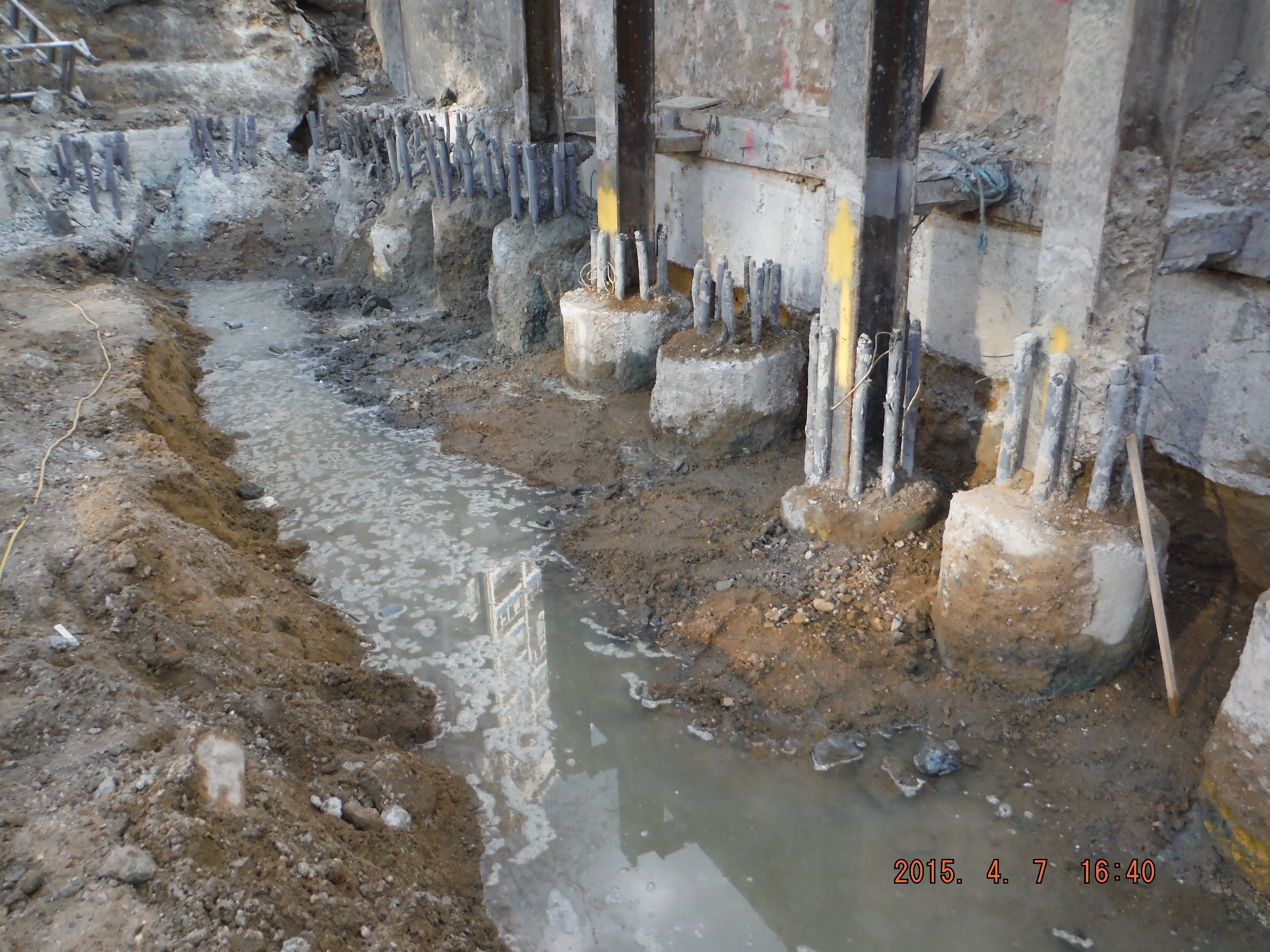
Male piles protruding well above cut-off level (see yellow spray bottom right).
Rotary bored piles which are cased allow piles to be cast to a cut-off level pretty closely. The secant pile wall must embed 75mm into the capping. This is a cut-off level of -1.105m AOD. The pile method was changed from rotary bored to CFA because CFA would enable deeper piles to be constructed. The deeper piles are tower and office bearing piles, not secant wall piles, however due to the constrained site size not all of the perimeter wall could be exposed to do the secant wall with the rotary method.
So what? The secant wall is being done with CFA. The problem? The pile platform level is at +0.150m AOD. This means piles are being cast 1.255m higher than is required because CFA piles can only finish at ground level. The consequence of this is that over a metre of concrete is having to be broken out.
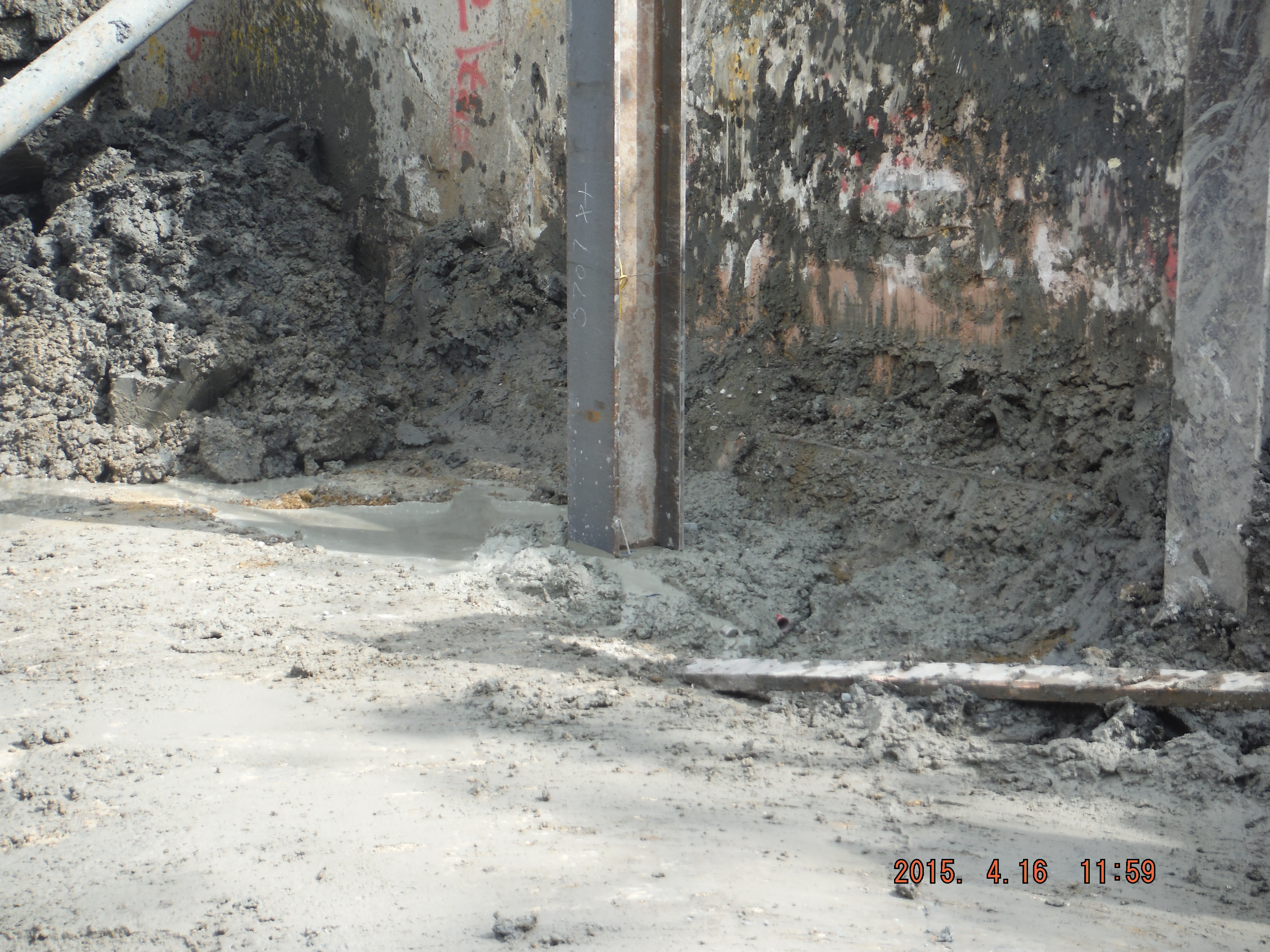
CFA pile with king post (embedded 3.5m into pile), cast at the pile platform level (1.255m above cut-off level).
I started the capping beam on 7 April with a foreman, mini excavator, 2 labourers and a carpenter.
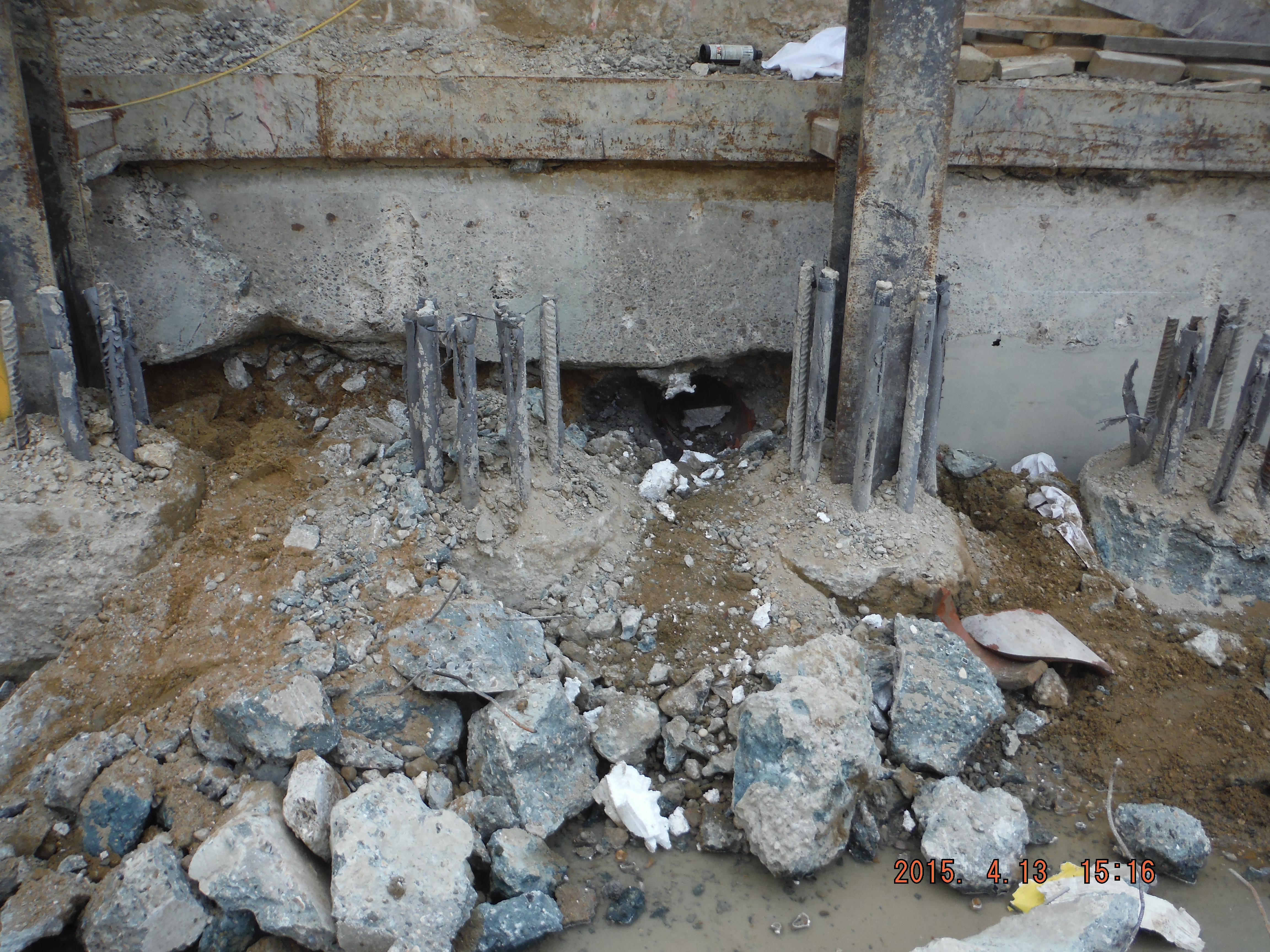
Task 1: removal secant pile guide wall, Task 2: underpin existing retaining wall, Task 3: break piles to cut-off level. Excavator used to remove bulk of concrete.
2 weeks on we have prepared a section about 30m in length, and have not started steel fixing, formwork or concreting. The capping beam length is 180m long, therefore this could take some time (12 weeks, programmed for 7 weeks, albeit not on the critical path). The options are plentiful but what is becoming more apparent is the consequence of what seemed to be a sensible decision (change from rotary to CFA piling method) is now only fully realised and understood.
Further complications: Temporary Works versus permanent works.
The Designers (Waterman) have designed the capping beam for the permanent case (mostly bending vertically). Clearly they know we are going to excavate down another storey, but the reinforcement for the temporary props is not down to them to design.
The Temporary Works Department have added significant extra side bars to account for the props. In some cases this amounts to 8 x H32 compared to 6 x H16.
The temporary works situation (king posts propping old retaining wall) sees the vertical column sections (king posts) embedded into the piles within the pile reinforcement. This is to prop against the wall behind to act as a cantilever retaining wall.
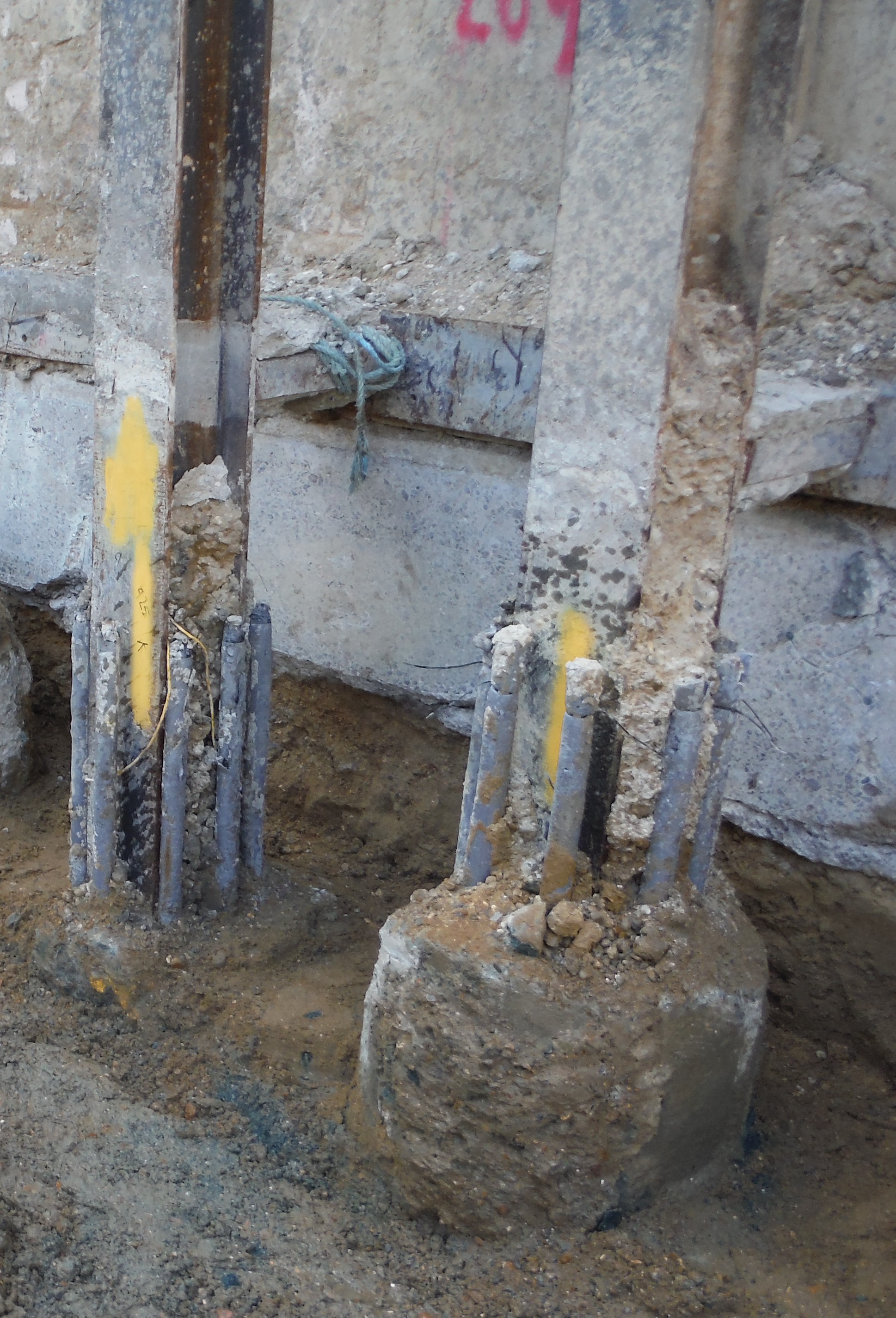
King post embedded into male pile adds to the difficulty of removing concrete.
Now break concrete from the piles with column sections and pile cage reinforcement in the way! This is all doable and I have been careful in selecting a tool which does not give you white finger after 5 minutes use (such as air compressor type breakers). This has included finding Hand Arm vibration limits for the Hilti TE1000 breaker and use of the HSE website. Turns out that the action limit is 4-hours 44 minutes trigger time. So what – a minimum of 2 people have to do the breaking. Add in some rest periods and only account for actual “trigger time” and that specific piece of equipment is fine to be used each day.
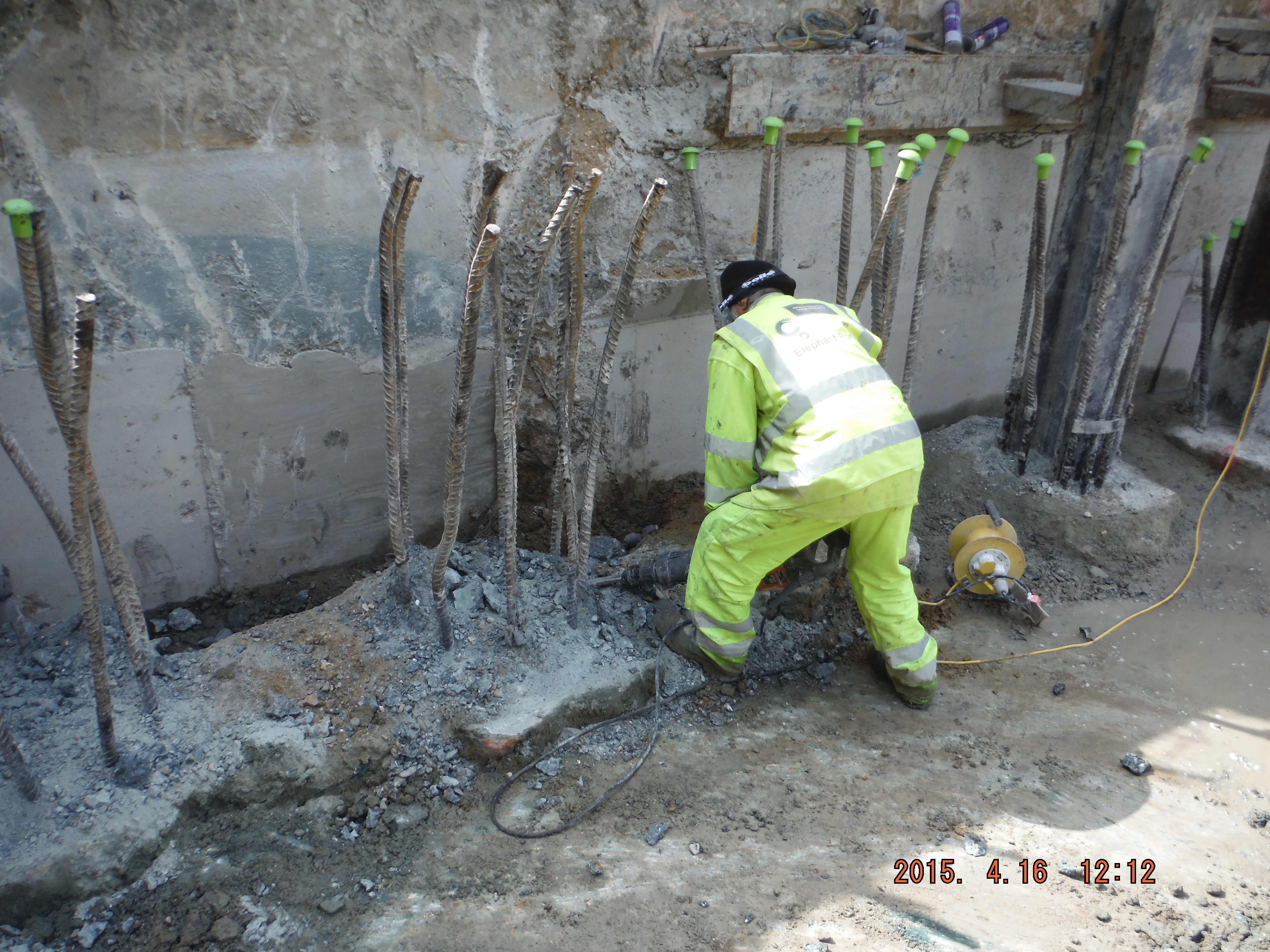
Breaking down the piles with a Hilti TE 1000.
Luckily the problem has become apparent before all of the secant pile wall has been completed. Therefore we will try and do something to reduce the utter nause of pile breaking.
Options:
1. Dig/ladle away wet concrete before it cures – sensible but that means putting 2 labourers close to the pile rig auger as it moves onto the next pile and as I have commented before the whole area is flooded in a slurry of wet concrete and clay.
2. Attach void former to web of king post to stop concrete even forming in the web.
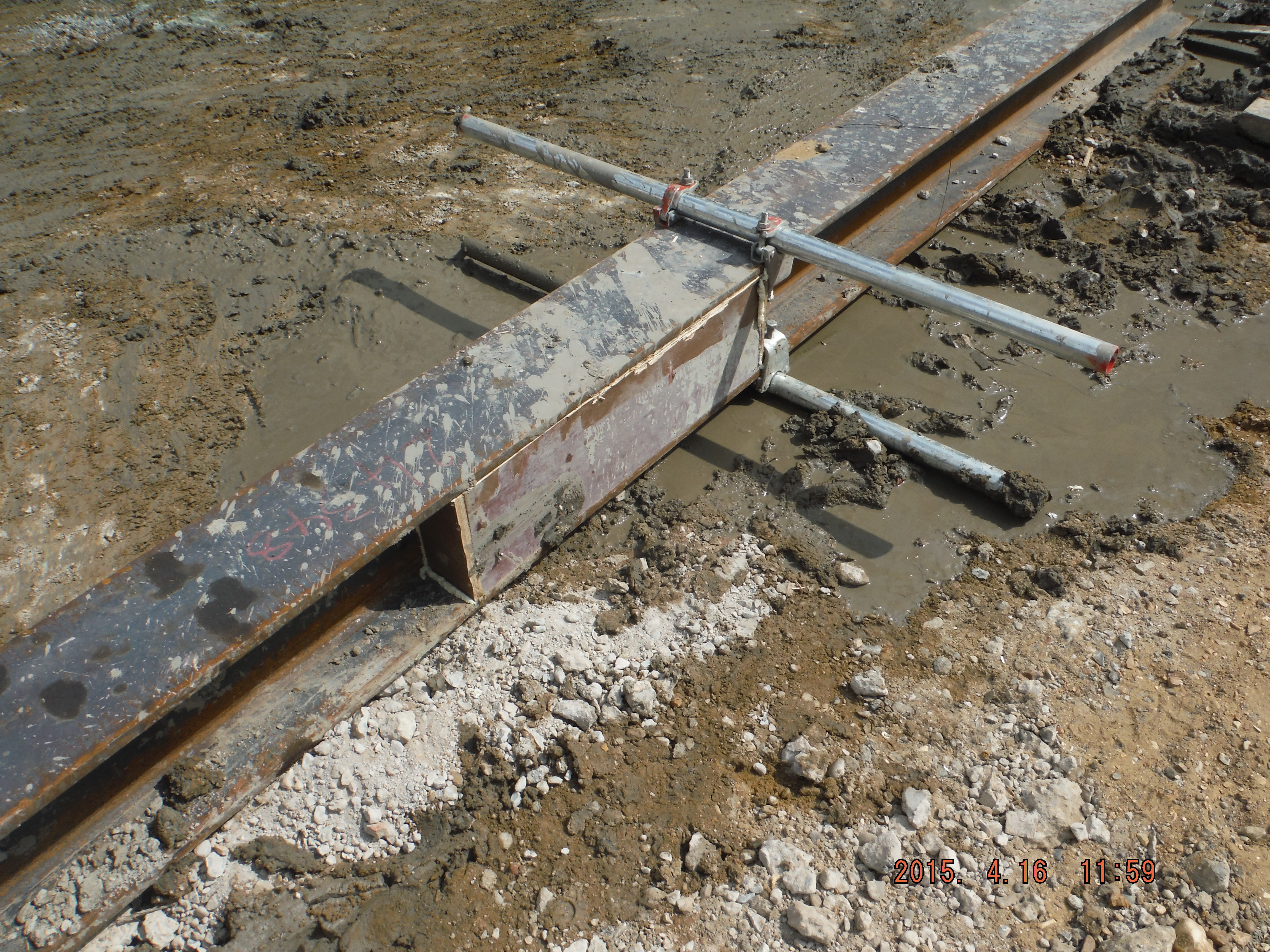
Void former to reduce amount of concrete to be broken.
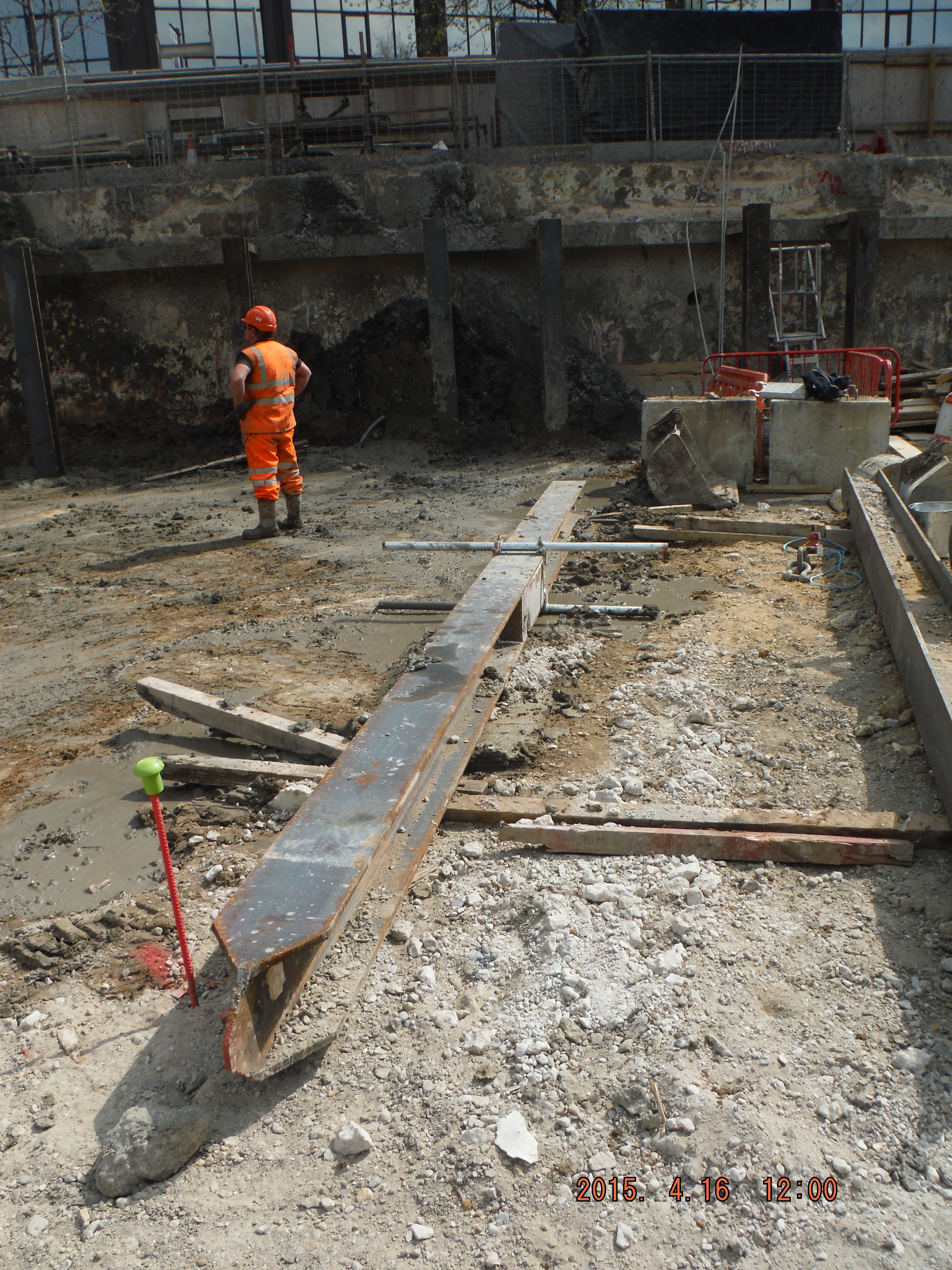
King Post with void former.
3. Suck out the concrete from the piles with a special concrete Hoover (apparently they exist).
4. Do nothing and head for the HAVS assessment.
Clearly the post pour options that exist are a bit trial and error and will involve an element of faffing about, however 20 minutes ladling some concrete out of the top of a pile compared to 2 weeks of chiselling it out is much preferred.
What I will take away from this is firstly to explain the importance of designing pile cut off levels and the consequence of not being able to execute the design. This might be to communicate the hazard through drawings and possibly the specification so that the contractor may mitigate the hazard before it is too late and the piles are cast.
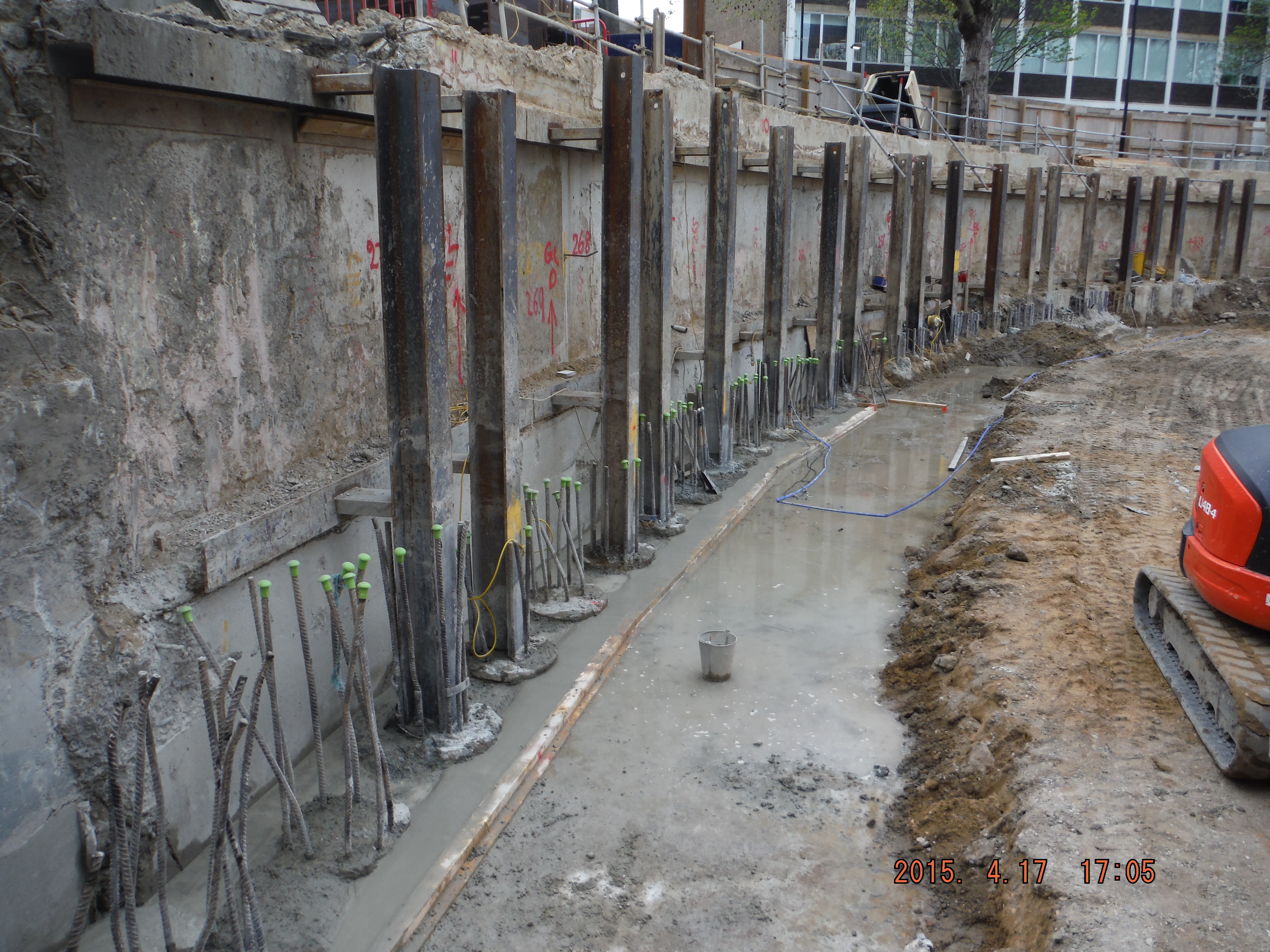
Slow progress – Piles broken to cut-off and blinding concrete complete 10 days after starting.
This blog subject will re-emerge in about July 15 when the excavation of the basement is complete and the ground bearing piles need to be broken down (hence submerging pile cage reinforcement).
Now for steel fixing and remembering what Richard taught use about steel reinforcement schedules!
Oz – The West Side Story
No, not the tale of the musical dance battles between the Jets and the Sharks, although I am trying to stay clear of the latter when swimming in the Indian Ocean, but my initial blog on the Perth Children’s Hospital Project.
After arriving in country three weeks ago, settling into hotel life and acclimatising to Western Australia’s (WA) so called ‘chilly’ autumn (29 ºC is not chilly!) I started work eager to get stuck in and put my newly learnt theory to the test…that was until I was told my White Card was not valid and I was unable to access the construction site (more on this later). I will post another blog next week focusing on aspects of the attachment other than the project but wanted to gather a bit more info first. So, on to the project…

Project Logo
Commercial Detail
Before I dive into the Project Overview I’ll get the commercial side of things, as I currently understand them, out the way. The Minister For Works (State of WA) being the Client have appointed John Holland Pty Ltd, referred throughout as John Holland Group (JHG), under a Managing Contractor (MC) Contract to perform the design, construction, commissioning, completion and 24 month post completion maintenance of the New Children’s Hospital; Perth. Essentially, JHG are the Main/Principle Contractor on a Design & Build Contract.
Construction started in Jan 12 with an estimated practical completion date of Jun 15. Is Jun 15 realistic? Thankfully (for me) it’s looking more like Dec 15. The project is awarded liquidated damages of $180k (approx. £100k) per day with the defects and liability period of 24 months starting after the actual practical completion date.
JHG have numerous contracts in place with; Building Services Design Consultants, Norman Disney & Young (NDY) (my potentially Phase 3 attachment) and other Sub-Contractors/Specialists. Specialists of note include, Cundall, who are employed as commissioning management consultants whose role it is to aid JHG to integrate all the different E&M services so they work as designed/intended.
Organisation
The Building Services Department is made up of the Building Services Director, 2 x Building Services Managers, a Building Services Commercial Manager, a Testing & Commissioning Manager and a Project Administrator/PA to the Building Services Director. Each of the Services Managers has 2 x Coordinators/Administrators and a Site Engineer. I work in the Testing & Commissioning Team which comprises 5 personnel; the Manager (with 18yrs experience, currently working towards Chartership with MCIBSE); a Principal Engineer (CEng MCIBSE & MIEAust & CPEng); an Electrical Engineer Associate (CEng MIET); a Commissioning Programme Engineer and finally myself.
Project Overview
The new child specific hospital is being built on the existing Queen Elizabeth II Medical Centre site costing the State $1.2 Billion and is intended to replace the aging and dilapidated Princess Margaret Hospital for Children some 4km away. This hospital will be the first of its kind in Australia with elements being at the cutting edge of technological innovation in the world. Key features include; 298 beds, increased isolation rooms and outpatient and day-stay capacity over the Princess Margaret Hosp, integrated research and education facility, dedicated parent accommodation suites, 12 multi-use theatres including an intra-operative MRI and two interventional theatres, a 10 bed high dependency unit, child-care facility for up to 80 places for children of shift-workers, Helicopter landing pad for the QE II campus, centralised sterilising unit for the QE II camps, the first single state inpatient mental health unit for under 16s, Automatically Guided Vehicles (AGVs) and of the 26,737m2 land area (foot print) 3,500m2 of which is green space including roof gardens. If you imagine the analogy between an Aston Martin Vanquish and a Reliant Robin – Medway Maritime Hospital being the Reliant Robin then you’re on the right track.
Due to the scale of the project, the works are broken down into four structures – East Block (EB), West Block (WB), Centre Block (CB) and South Block (SB).
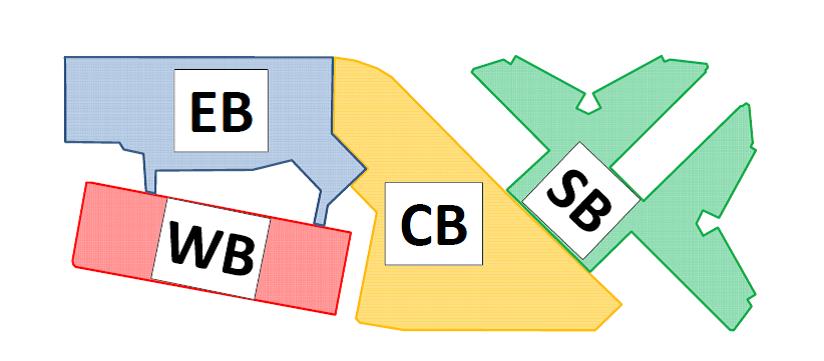
Project site split down by blocks; East Block (EB), West Block (WB), Centre Block (CB) and South Block (SB).
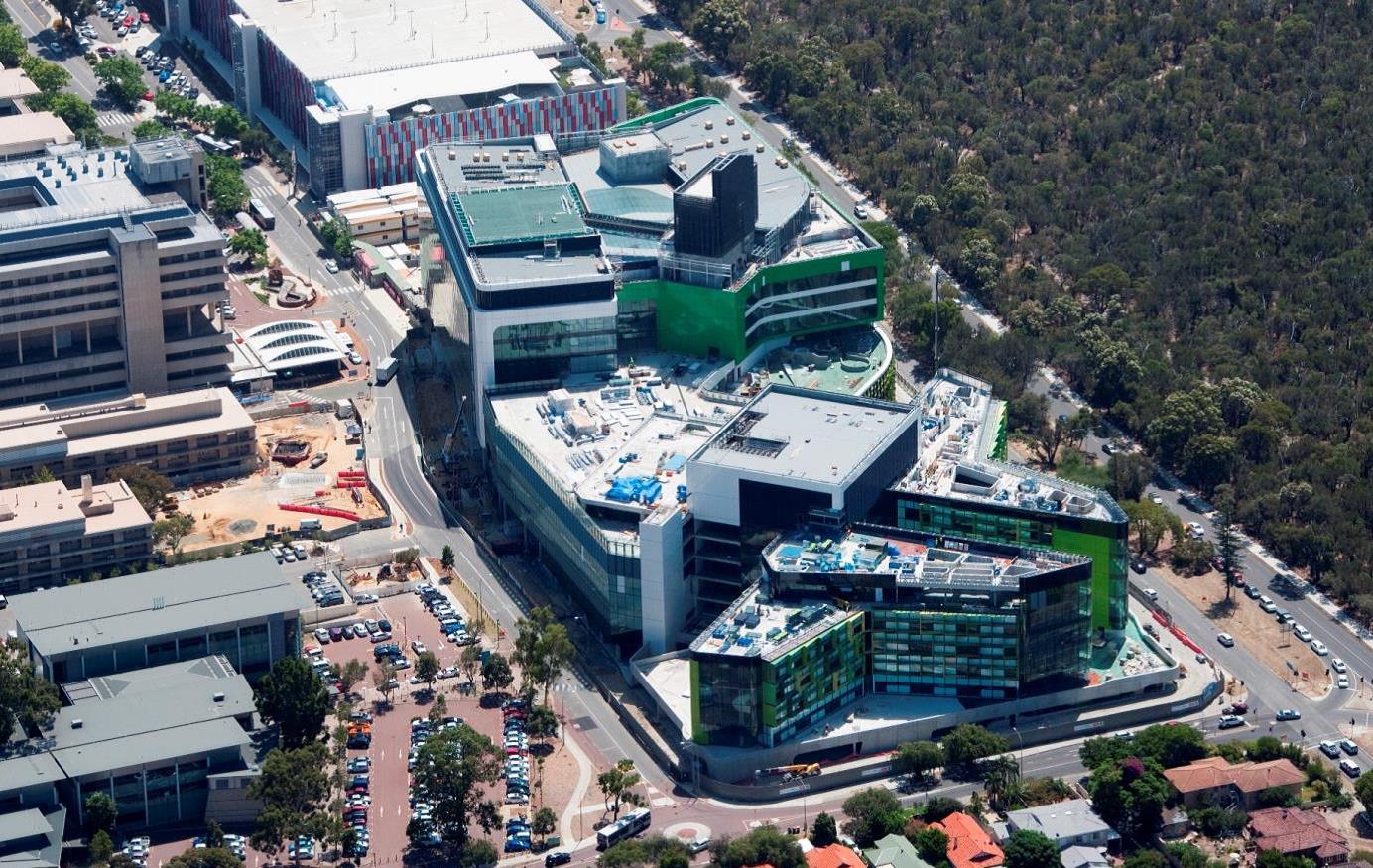
A bird’s eye view of the site – Feb 15.
The construction update as at Mar 15 gives; 57,000 drawings produced, 1000s of meters of electrical cable, pipework and ducting installed and to get the civils salivating; 2,000 piles installed, 11,332 tonnes of reinforcement installed, 122,000m3 of concrete poured; with the overall structure 89% complete.
Completion Delays
There are numerous reasons why the project has been delayed and in time I will no-doubt learn more about the finer details but for now the key known factors are the following; The Client (State) wanted to increase the bed capacity by 48 over the initial design requirements, this had the obvious knock-on effect of having to find the space needed and resulted in completely redesigning rooms and parts of the floors. With the complexities involved with the numerous services required in a hospital you can immediately see why this has a huge impact on time and consequently cost; One of the features of the project is the Central Sterilising Store Department (CSSD) which was originally design to a certain size to accommodate servicing all Units on the QE II Medical Centre Site. The requirement then changed as it was decided the CSSD would also service a future women’s hospital (decision still not made) which meant that it had to expand, again having similar knock-on effects as above.
Although there was a Client requirement for the design of the project to be ‘future proof’ (exact contractual wording) I don’t think the finer procurement detail was ever nailed down and thus JHG and the Client are in dispute as to who should pay for the resultant increase in associated costs. There are many other examples of unquantifiable/ambiguous wording used in the contract which are giving the commercial team a lot of headaches – like ‘fit for purpose’, ‘best for project’.
The bulk of the remaining work is Testing & Commissioning and 2nd Fixes and Finishes but there are still a number of construction tasks remaining; for example the bridge structure link from the CSSD in CB which will sweep toward and connect to G Block (the existing theatre building within the QE II MC site) that will cross over the road below that will house the track for the AGVs to move between buildings. However, the AGVs will initially only circulate within the project building until fully proved.
My Role
My main role as a Building Services Project Engineer is looking likely to aid with the Testing and Commissioning Plan by working closely with Cundall (the two CEng personnel mentioned above) and includes understanding the technical side of the design (by NDY) for various services. No doubt in time the role will grow/change especially as I start to tick off my UK-SPEC requirements and look to seek out specific work which will enable TMR and Thesis input. During my office meet and greet I had a brief chat with the engineer whose job it is to integrate BIM 360 with the other Autodesk products/packages used who is essentially tasked with getting the project completely BIM(ed) up. Thinking back to our BIM presentation by Cross Rail during Phase 1 – this level of integration is JHG’s goal and is using this project as the guinea-pig. This is therefore the first major project where JHG has used BIM to this extent which was a requirement set out by the Client in the initial tender. More on this in subsequent blogs but safe to say from the weekly BIM meeting (my first mtg on day 1) it is interesting to see just how many clashes there are between different services – the air-conditioning sub-contractor getting the brunt of the hammering (possibly as there is ducting literally alles uber der platz).
Occupational Safety & Health (OSH)
As alluded to my UK White Card was not accepted for me to gain entry to site so I had to complete the WA version which was, shock horror, basically the same (I’d argue easier than the UK version) – an outsourced online eLearning package with multi-choice questions but slightly different in that once completed you only passed when you were called by the company’s auditing team to verify it was you that took the assessment and you had to answer a few more questions over the phone. I have already checked if Matt was in the same boat and was surprised that he was allowed on site without having to conduct his states version – I know state-to-state requirements may differ slightly but I would have thought JHG’s OSH Policy would be the same across all projects???
JHG’s ‘No Harm’ safety slogan.
In other news
On the 8 Apr 15 the Australian Treasurer approved the foreign investment proposal by China Communications Construction Company International Holding Ltd to acquire JHG – They are the 4th largest construction company in the world by revenue.
My wife and I are getting into the Oz spirit of ‘loving fitness’ by joining the local swimming and triathlon clubs – I feel another Ironman coming on…
USACE – not a place in China
So, blog 1 and I’m already going off-piste. If you are looking for engineering please wait for the next one. If Admin isn’t a place in China it is certainly a place somewhere in the USA where they eat forms in triplicate and proof read with the accuracy of Rain Man. Having been in country for nearly a month I have phonetically spelt my name enough times that Gandhi would have lost his patience; Guz I now understand your pain – never come here!
The aim of this blog is to highlight a few admin points about the US Army Corps of Engineers (USACE) placement for the prospective Phase 1 students when choosing attachments; but written now whilst it is fresh in my mind. Be aware this is me pointing out that there are some challenges worth thinking about. However, they are all surmountable and don’t detract from the obvious benefits of being in the USA which, as we are already finding out, is an awesome country full of travelling opportunities.
Foreign Country.
So firstly it should not come as a surprise that this is a foreign country and I now truly understand the phrase ‘divided by a common language’. Our cultures have many things in common, but just as many things not in common and it varies from state to state. I can see why most Americans don’t have a passport, with such variety in their own country, but it does limit their perspective on many issues.
Locations.
My work location for Phase 2 is the Harrisburg Area Office; just outside of the town itself as for the last 3 iterations of USACE attachments. I, like my predecessors, am living in Hunt Valley making it an hour drive each way to work for Phase 2. Unlike the UK the driving is a breeze, there is hardly any traffic and it is a dual carriageway (Interstate) all the way. So set cruise control and go. There are other project locations around the Baltimore District AO and the option of moving around to wherever the work is which Brad and I will research after the summer. Brad for example is working to the South, but I will let him comment on this.
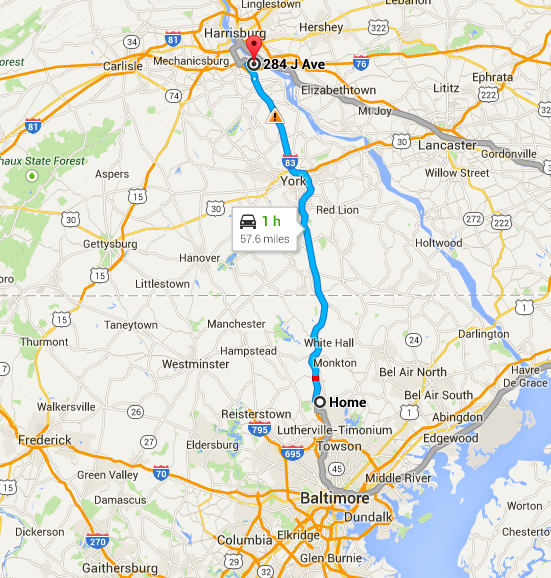
The Harrisburg commute
For Phase 3 I will be working right in the centre of Baltimore (10 S Howard St), about a home run away from the Baseball stadium. The commute for this is a short walk/drive to a station before hopping on the light rail for £1 each way. At about 45 minutes it is comparable with a London commute and shows the logic of Hunt Valley as a location.
Cars.
I was naïve enough to think that my wife and I might be able to get away with one car for the whole attachment; we can’t! Over here you drive pretty much everywhere, even if you want to go for a run, because the sidewalks just stop for apparently no reason. So with the need to commute to work for the site attachment if your partner wants to do pretty much anything, then a car is required. That said, for Phase 3 I am planning on selling the second car. So if you fancy a Golf GTi (highway miles) I’ll keep you posted! We all know that fuel is cheap out here (about a third of UK prices) and it’s actually a pretty good opportunity to buy a car you wouldn’t dream of fuelling in the UK. I get a respectable 28 miles per US gallon (33 mpg in UK gallons) and I’ll leave Brad to reveal what his Nissan Armada pushes out.
Housing.
Probably the biggest stress on arrival is housing. It is mind boggling to start off with and the time period given is tight. That said everybody out here now, and for as far back as I’ve heard of, lives in places far superior to anything in the UK SFA portfolio. The Embassy, if a little slow and authoritarian at times are supportive and will ‘screw the nut’ to ensure you are well set up on time. Hunt Valley has become the standard for the last few iterations as it is a nice town and central, based on commuting times, to the two work locations however variations are certainly available.
Aliens.
As a Gurkha 2IC I have had an understanding of some of the difficulties that arise from having a different passport to everyone else; but here as a legal alien I truly empathise. For those with wives who have an intention to work be aware that extra paperwork will need to be completed upon arrival to get authorisation. It is just a matter of filling it in and waiting but it is something to be aware of. It turns out getting a Social Security Number is pretty easy and certainly makes administrative dealings a lot more straightforward; because it fills a box in someone’s spread sheet. As for everything else, just be prepared to stand patiently in line and produce plenty of paperwork to prove your identity.
Defence Engagement.
This is very much a part of the job and the effects are very real. Not to steal his sandwiches but Brad’s attachment actually getting off the ground has come about, in a large part, as a result of his boss working with someone on the PET course 20 years ago. The impression that he gained of the officer as a ‘good bloke’ has resulted in him bending over backwards to get Brad through the administrative challenges he has faced.
That said, the act of ‘doing’ defence engagement is predominantly being professional and interacting with the people out here who are literally fascinated with you.
The Work
I can’t really comment at this stage as I haven’t done anything of note yet, but it’s here and there is a diverse range of things to get involved in.
Further info.
For the Phase 1s, Brad and I are more than happy to chat through questions or general information about the placements out here if you are interested and need more information to make a decision. Probably the best way of making contact is to drop us an email to hhcrosby@gmail.com or brad_southall@hotmail.com with your mobile number and we will give you a call back from the office.
Sort your admin out!
Our structural concrete package includes all drainage, waterproofing, slip forming, RC and post tension design and construction. This package was let to P C Harrington (of Southbank tower “worlds slowest slip form” fame). On Wednesday P C Harrington went into voluntary administration. On Friday the plumbing sub-sub-contractor, Salmon Plumbing, pulled out of the job and the concrete gang refused to come onto site until their boss assured them they would be paid.
This was considered a breech of a number of sub-contract clauses and McAlpine have now hired their own plumber to complete the drainage works. We have also had to procure all the rebar and pay for PCH’s skip hire and waste service.
By entering into voluntary administration PCH have bought themselves 10 working days to sort their finances. If they’d waited for the banks to step in their assets would have already gone into liquidation and they’d have had to cease trading. They’ve been clever on the timing too. Many sub-contractors don’t expect to paid the week following a bank holiday.
PCH have a large crane division reportedly worth around £50million. They aim to sell that quickly to correct their cash flow, appease the banks and stay in existence.
In the meantime we now have to closely control the two subcontractors working in the same area, using the same assets in an attempt to get closer to program (we’re currently 4 weeks behind and growing)!
Stay tuned!
Site Two Fifty One – General Update
Site Two Fifty One – General Update
This week I thought I would blog generally about site activities taking place to give a feel of what I am doing. Main activities are: sub-station demolition, preparation for the capping beam installation, office ground bearing piles (CFA), pile mattress construction for a small section of sheet piling and the most laborious task of all, welfare establishment. My focus is on the capping beam, although when the project manager and project engineer are off-site my responsibilities tend to extend a little further, in fact, I am not sure where they stop!
All the activities themselves are fairly low level (no multi-span bridge beams for example) but the planning, co-ordination, resourcing and commercial aspects as a whole make for a varied experience.

Old sub-station at top of access ramp
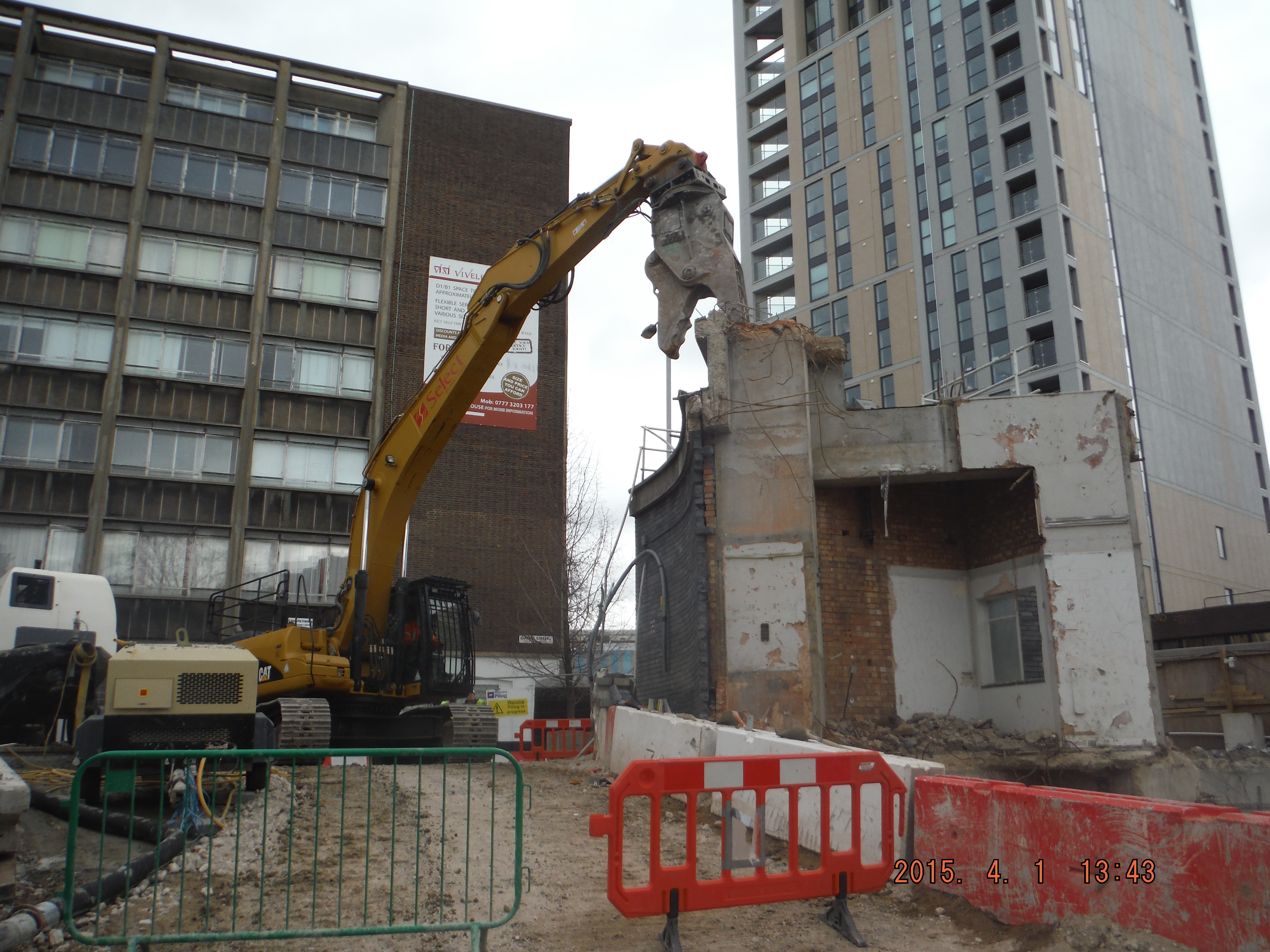
Demolition of the old sub-station begins
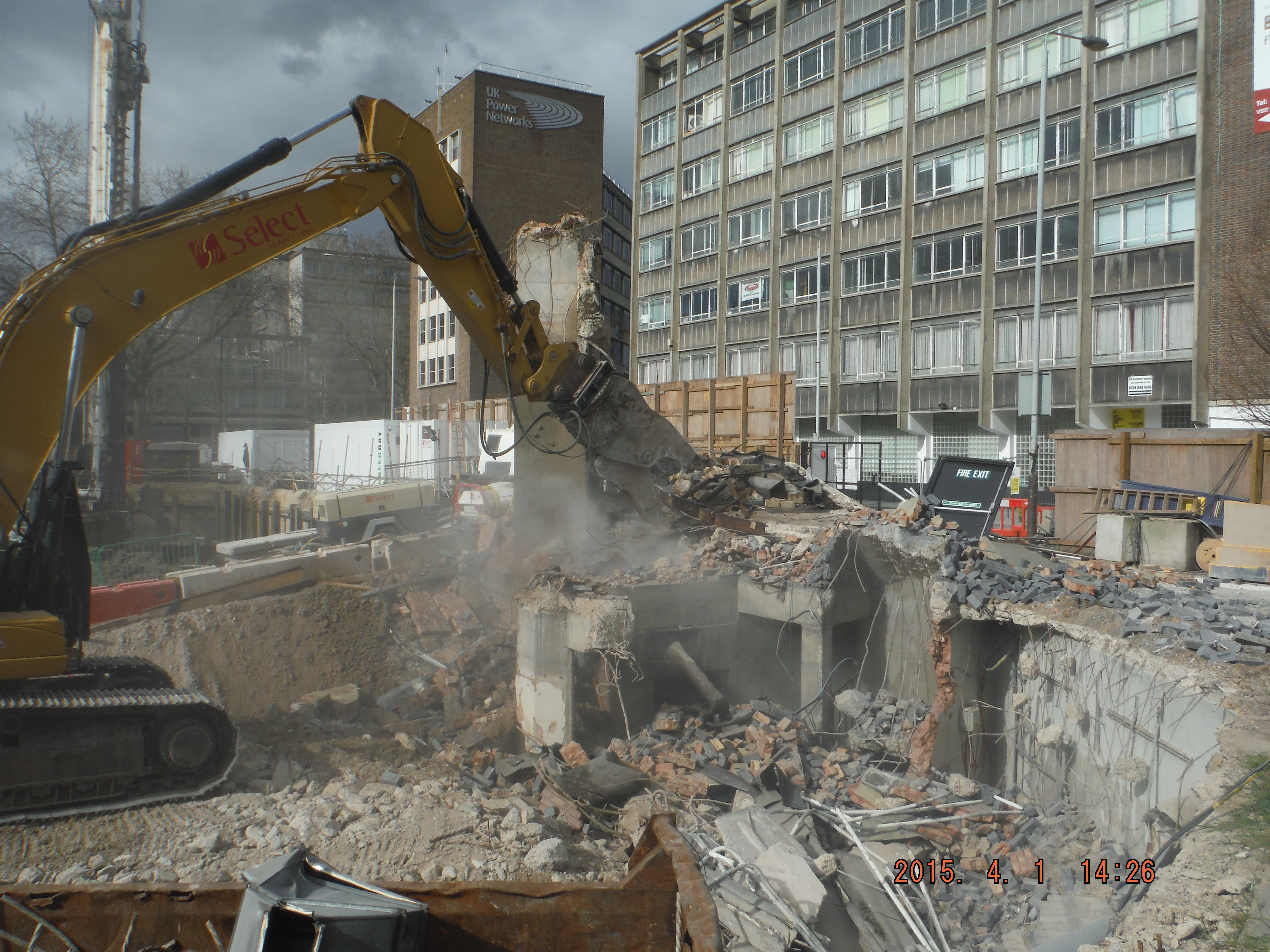
and finishes pretty soon afterwards

Breaking of piles to cut off level

Underpinning the pre-existing wall
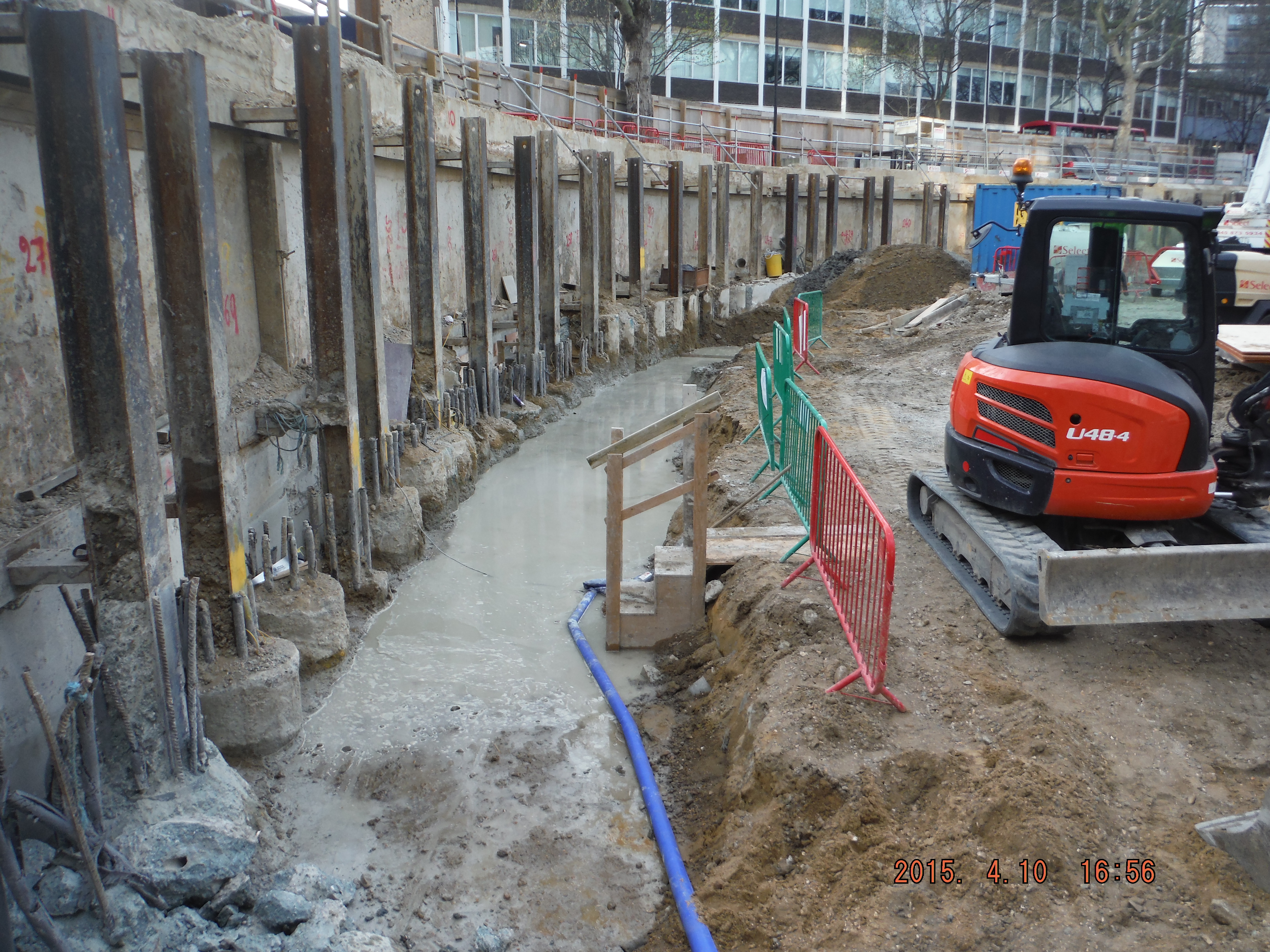
Preparation for the capping beam
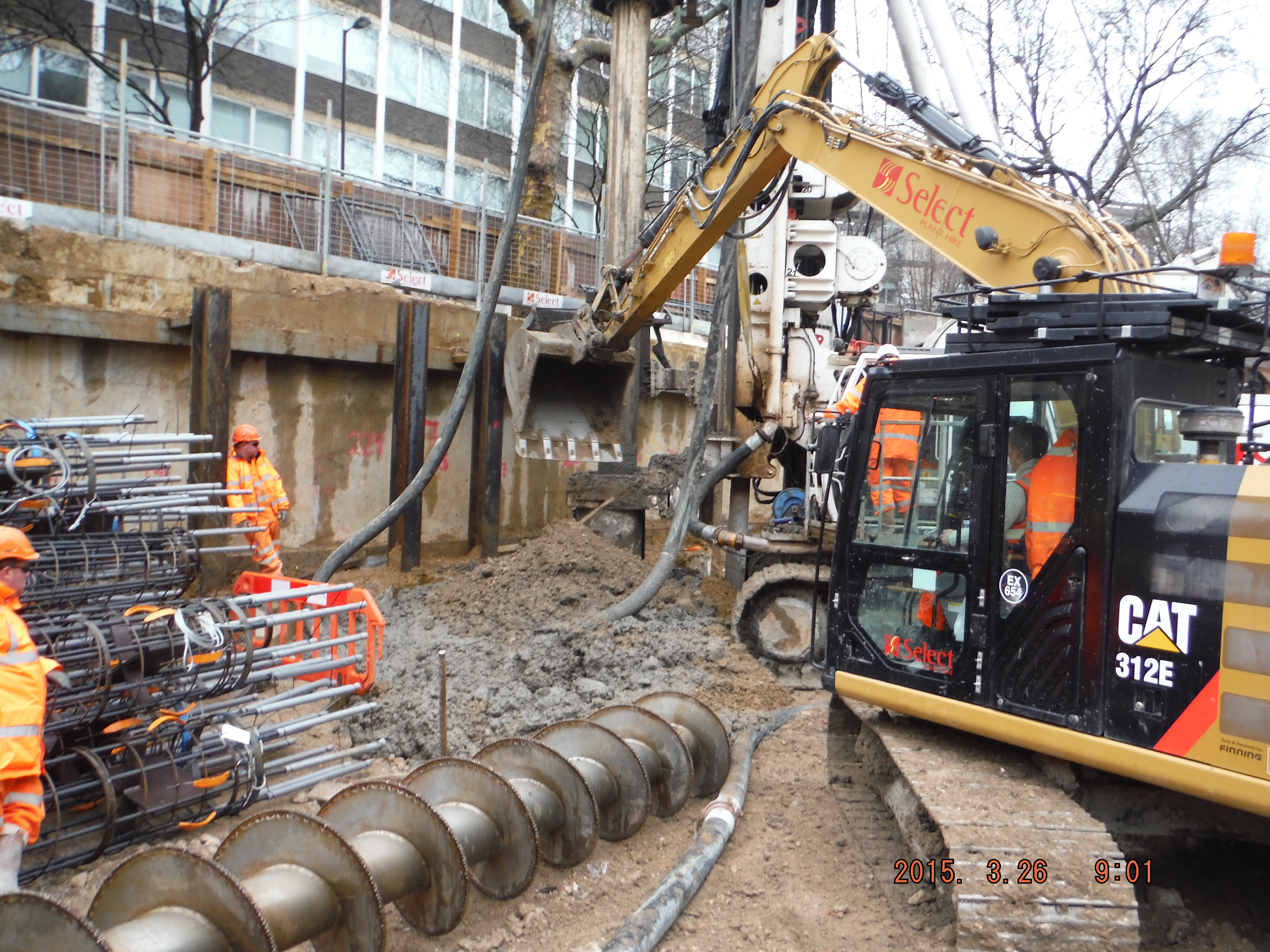
Piling continues at much improved rate
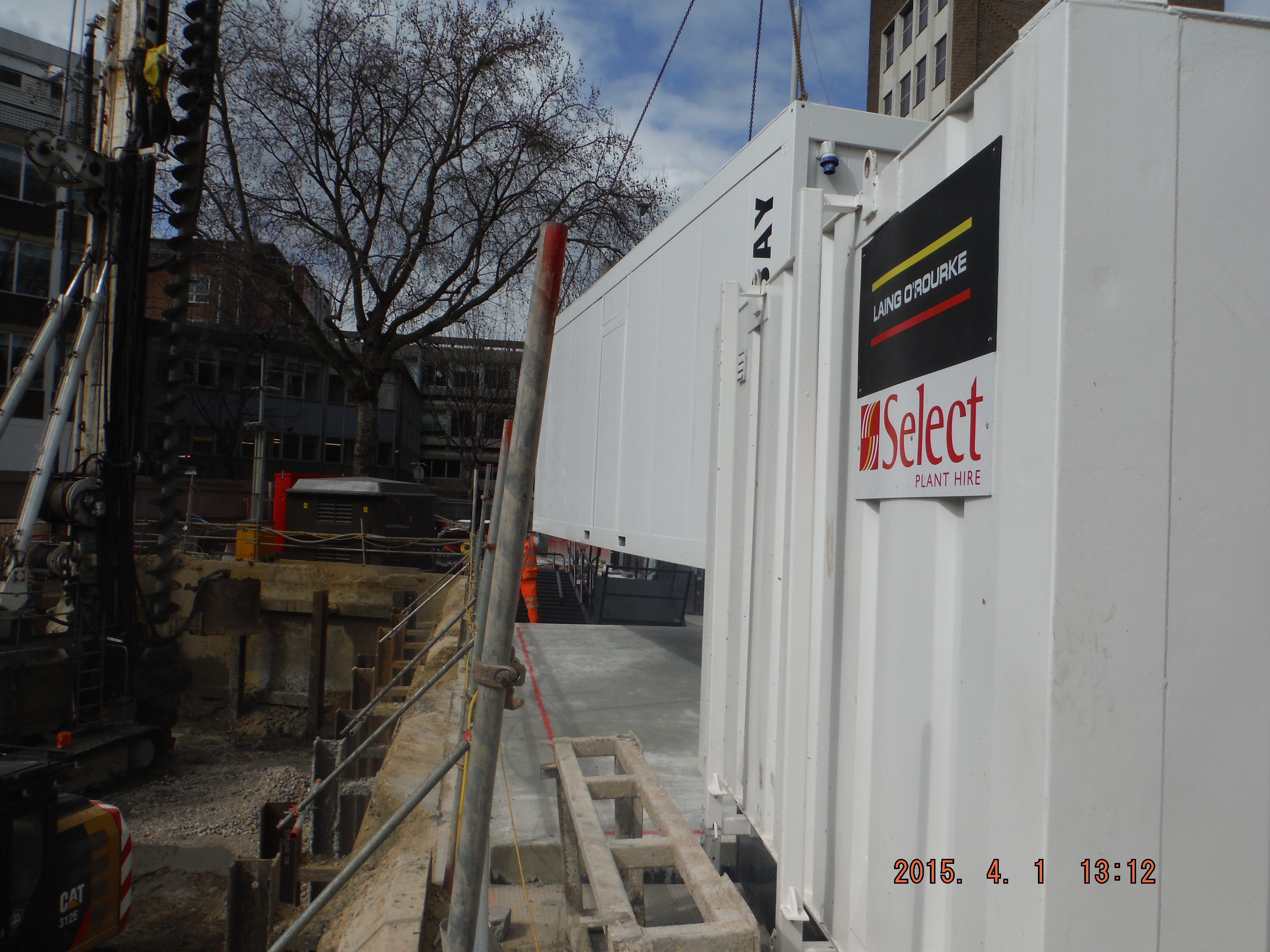
Welfare cabins arrive.
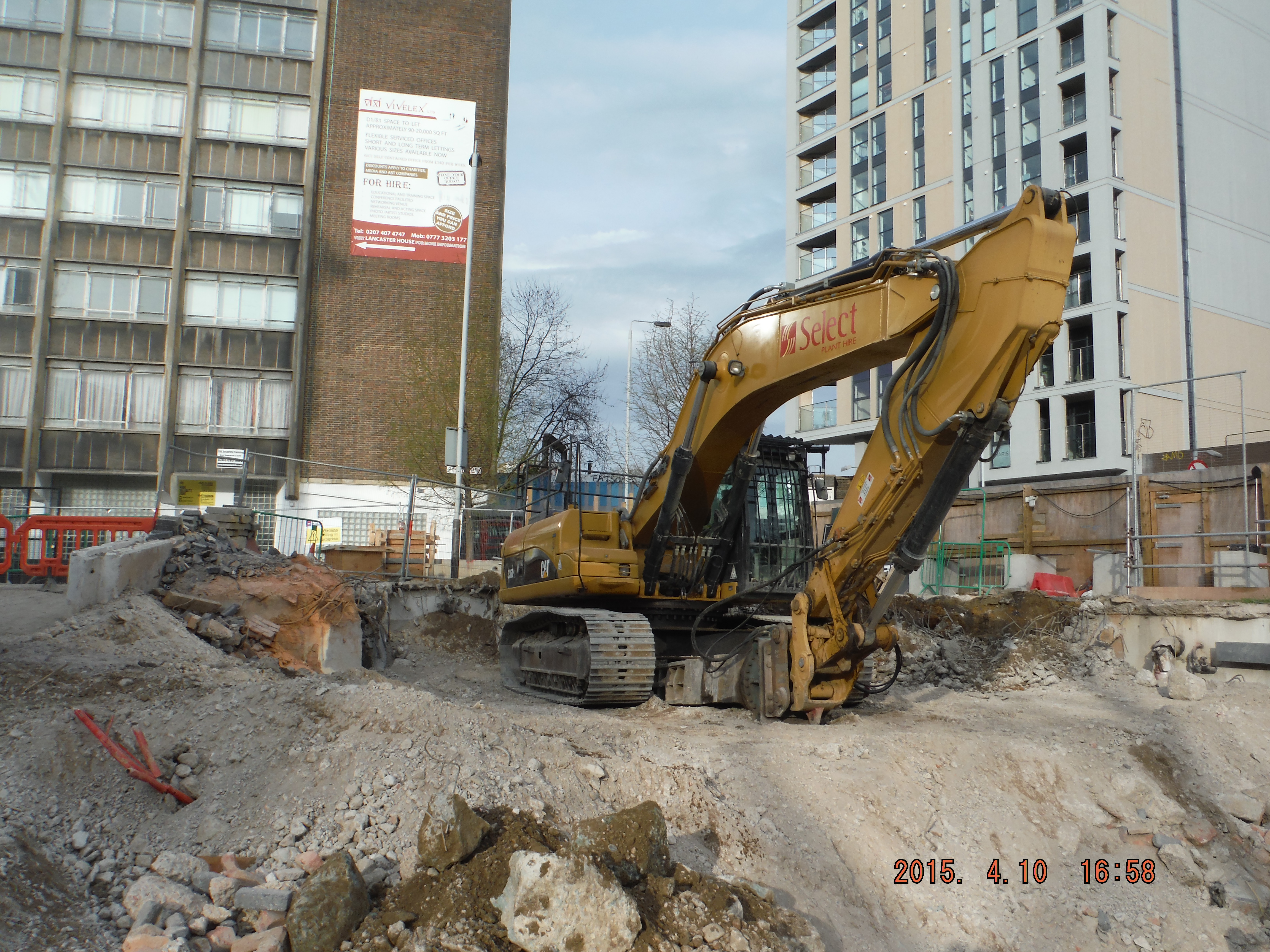
Excavator sitting on pile mattress where future sheet piling will take place.
Progress. We are currently about 3 weeks behind schedule, mostly due to pile rig breakdowns, a few unforeseen ground conditions and a bit of a few things just taking longer than planned.
Foreseeable practical issues.
1. Sheet Piling – I can see that preparation for the sheet piling is going to be difficult – we have potentially struck a fibre optic cable (green pipe sheath below) and there are many other cables which led into the old substation. How to resolve – careful hand digging and attempting to recognise if cables were part of the old substation or not. How to resolve cutting a fibre optic cable – I am holding my breath.
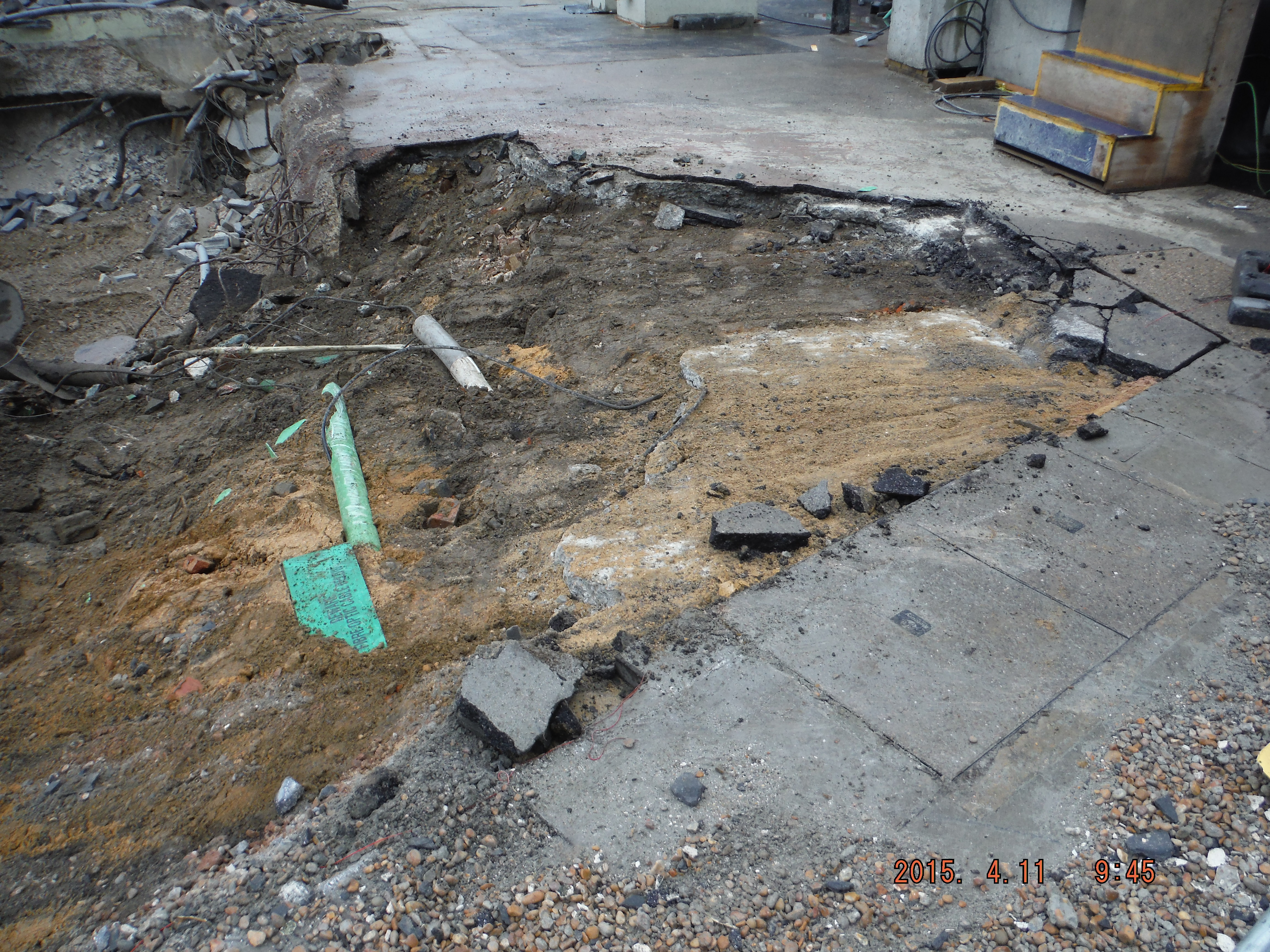
Fibre optic cable strike? If the IT companies all arrive on site on Monday, I have a problem.
2. Capping beam – as you can see there are male pile tops to cut, king post (vertical steel columns) and a complicated as you like “shear stub” connection (Richard – this may ring bells from my questions away-back in December) for the ground force props to enable excavation of one further level. This is surmountable but is going to be painstaking threading re-bar through the stub as well as lifting them about (each way in excess of 200kg).
3. Ground water – the ground water level is about at bottom of blinding of the capping beam. We cannot drain the bath that is the entire site because the secant wall is not finished. Current method of resolution: Effectively at the moment we pump water out for it to recharge into the hole, albeit giving us long enough to work for the day. Should it rain heavily for days there will be a problem.
Other points:
ICE webinar brief on CDM 15 on Monday for those interested!
Another cyclist was killed by a construction vehicle in London this week. Laing O’Rourke are a Construction Logistics and Cyclist Safety (CLOCS) Champion but do all vehicles that deliver to site comply with the minimum safety requirements… to be continued!
Initial blog from Battersea
After three weeks leave, I have now arrived on site at phase 1, Battersea Power Station and started working for Carillion. This blog will outline the scope & set-up of the Battersea development and identify what seems to be the most significant M&E elements to phase 1 in order to set the context for future blogs.
The entire power station development will be split into 7 phases, phases 1 – 3 of which are now up and running. I’ll expand on phase one in the next paragraph. Phase two is the development of the power station which is being carried out by Skanska, phase three is just beginning and will be an extension to the Northern line. The entire development is scheduled for completion in 2025. The client is the Battersea Power Station Development Company, which is a Malaysian consortium investing approximately £8bn into the redevelopment. The client’s architect is Ian Simpson Architects, structural advisor – Burro Happold, M&E advisor – Hoare Lea, Quantity surveyor – Gardner & Theobold and Project Manager – Turner and Townsend. The client’s team has designed the project up to RIBA stage D.
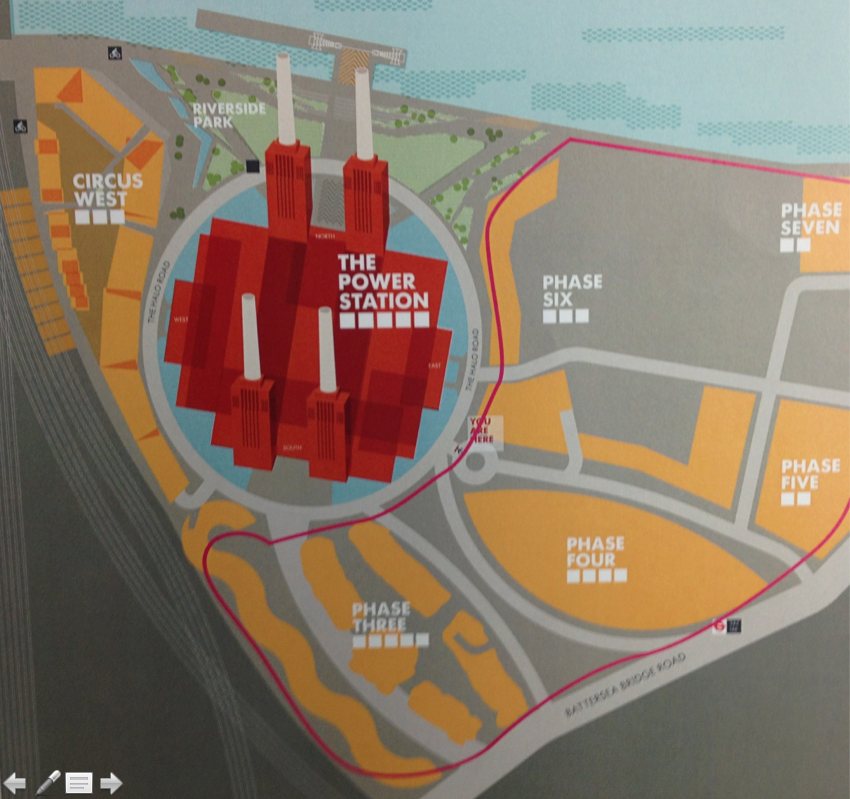
Overview of the Battersea Power Station Development. Phase 1 is labelled as Circus West.
Phase 1 consists of 866 luxury apartments located in the North West corner of the Battersea site; between the railway line into Victoria, the river Thames and the power station itself. Carillion are the principle contractor working under a JCT design and build contract to take the project from stage D to completion. Apartments range in price from £800k for a studio apartment to £4m for a four bed. The build is split into seven cores (A to G) which form RS1A, with a further five cores (H to L) which make up RS1B. RS1A is 14 stories tall with two basements and RS1B eight with two basements. Phase 1 is currently 74 weeks into a 148 week schedule, although this is likely to be extended.
The heating & cooling to the apartments will be provided by mechanical ventilation with heat recovery linked to a communal energy system. The most significant M&E engineering element associated with phase 1 seems to be the construction of an energy centre in the basement of core G. This will involve the installation of 2 x 4.2 MW boilers & 1 x 7.2 MW boiler, and 2 x 1.5MW & 1 x 3MW chillers. The original concept design saw this energy centre (which supplies services site wide, not just to phase 1) being constructed as part of phase 2. It appears the client is unable to complete this work prior to phase 1 & 2 being handed over and occupied. Therefore a variation has been made to phase 1 to install the energy centre in the basement of core G. This variation looks as if it will bring significant challenges with it. The current building design does not incorporate flues for the boilers that will be in the energy centre. This means a solution to take the flue gases across to phase 2 and up one of the power station stacks is having to be explored. The space available and limiting factors of working in the basement of block g means that certain elements of the energy centre will still need to be located remotely. This currently looks like it will involve the build of a remote cooling compound incorporating two cooling towers (let’s hope we don’t get legionnaires) for the chillers and life safety system generators. The remote cooling compound will be located somewhere on phase 4’s real estate and cross phases 2 and 3 to connect it, which will bring its own challenges. This remote cooling compound will bring about significant costs, effort to construct and is only temporary. The long term plan is build the original energy centre at the front of phase 2, connect it to the energy centre in the basement of core g, allowing the remote cooling centre to be removed in time for construction on phase 4 to start.
The Carillion M&E team currently consists of 6 personnel; head of M&E, 1 x design , 2 x commercial, 1 x delivery and myself. My role is looking like it will focus on the basements and the energy centre in core g, which should provide plenty of opportunities, but will involve working in a damp dark basement for a large portion of my time.
That should do for setting the context of the project. I’ll aim to provide another blog next week which outlines a little more of what my role will be and more details on the challenges / risks associated with the project.
Just Give It Time
Last week work started on the east bank crane jetty. The ITP requires that the first four piles are to be tested to ensure they will resist working loads. The working load per pile is 2000kN and FOS of 1.5, therefore each pile is required to resist 3000kN (or so we thought, I’ll come back to that later).
The west crane jetty piles were 18m CHS. The east crane jetty piles are the same tubes however they are 20m in length. The east side of the river has a thicker top layer of alluvial deposits and a thiner layer of terrace gravel which provide a lower shaft resistance through the first 9m than the west side. Below this level is Gault Clay which carries most of the load hence the requirement for a longer pile on the east.
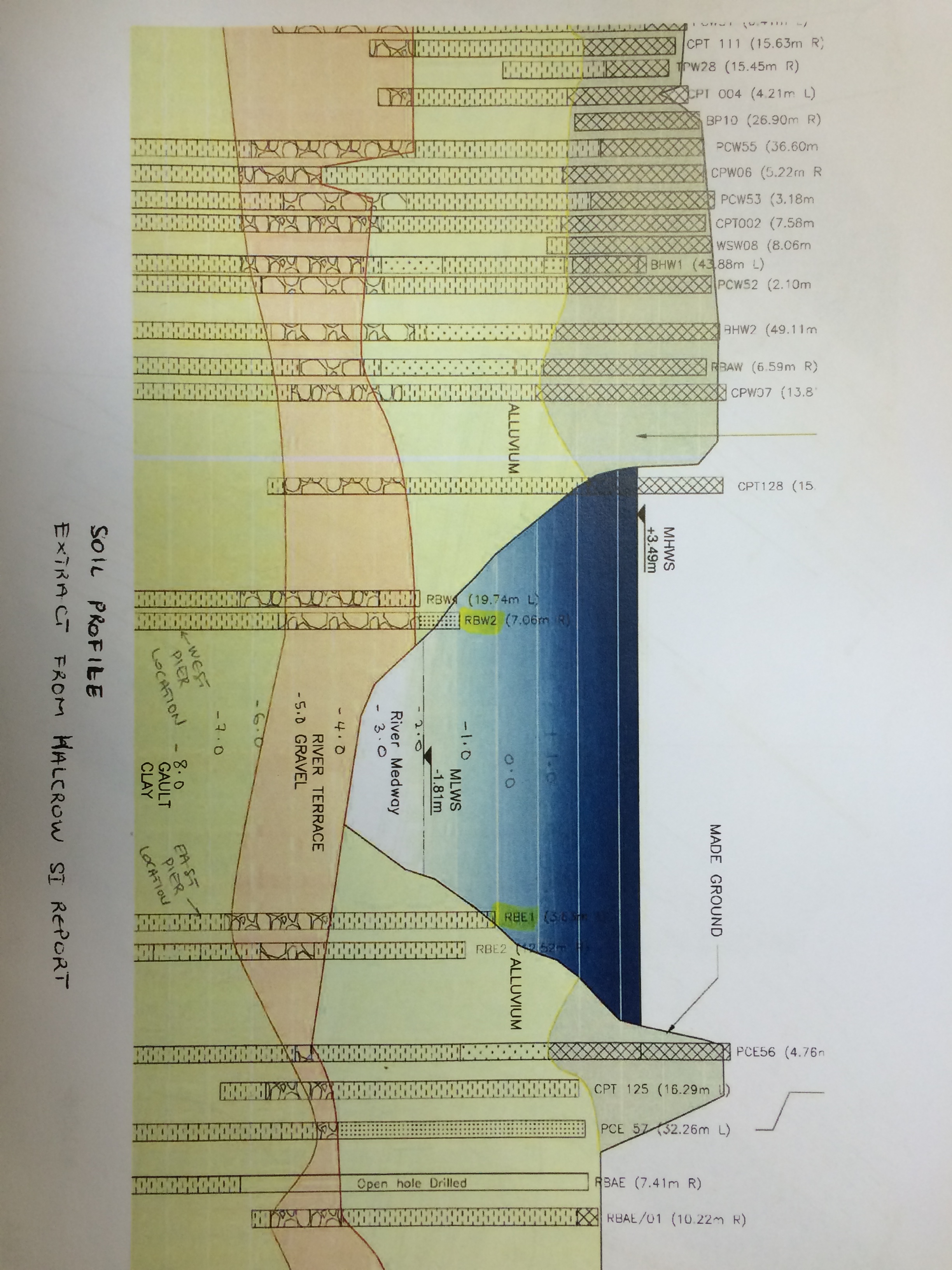
The piling gang were ready to start but the 20m piles hadn’t arrived, direction was given to use some 18m ones we had on site. This decision was based on the fact that the edge of the river is higher and therefore more of the pile would be supported. In reality all the piling gang did was hide steel under some alluvial soup that offered no support.
Once the first four piles were within approximately 600mm of their level a Dynamic Pile Test (DPT) was instructed. This consisted of two sensors being rigged to the pile (see below), the smaller sensor is an accelerometer and the larger a strain gauge. Once set up the pile is then driven further by the hammer. The pile dimensions and the hammer speciation are input into a Pile Driving Analysis (PDA) terminal which then records the results from the sensors whilst being driven. This then produces a window of pile resistance. Our first pile registered between 2700-2800kN, not the required 3000kN furthermore we only had 300mm of pile left before we hit our level.

The technician recommended that we should stop at this point and continue the test the following day. The next day the test was then carried out again on the first pile and it reached 2980kN…accepted! The three remaining piles also passed.
Cue Terzaghi and Mohr-Coulomb
When the pile was driven is caused the pore water pressure to rise. This created a hydraulic gradient. With the gravel the short and long term states are the same however in the Gault Clay they are not. The clay has a very low permeability so on face value I wouldn’t have expected much change overnight however the borehole data from the GI identifies veins of coarse sand and gravel with in the clay and also irregular fissures (although it is hard to know if these were caused by the boring process). The reduction in pore water pressure increases the effective stress and ultimately increases the strength of the clay.
These ‘Case Data’ results were then sent back to the office and run through CAPWAP software. This is a post processing tool that analyses the data from the PDA and refines the results with data from modelling and empirical evidence. The technician suggested we should expect upto a 10% increase in the capacity.
The Game Changer
This whole issue is now almost irrelevant; when the designer was called he informed us that the working loads were only 1000kN per pile so we only required 1500kN. This should have been blindingly obvious. The piles work in pairs and support simply supported beams. So four pile support the 110T crane, its load and the self-weight of the jetty deck. Based on the initial 2000kN per pile that would be in the region of a total load around 800 tons and alarm bells should have started ringing at this stage but everyone just got on and tried to achieve the results required without question.
I’m sure I’ve been told a few times to take a step back, look at the fundamentals and question the obvious before getting too involved……phuf, what did they know!
In other News
Guz – I can now join the ‘what’s the best thing you’ve found in your 6F2/5’ game. Today I found some super squishy foam, a glove and what looked like action mans left arm!
Still not talking…
My site will have one gigantic basement raft slab that covers the entire site. There is a podium slab 6 metres higher then the buildings above that.
The basement raft slab is built in sections of varying depths. There’s an 800mm deep section of C40/50 with 75mm cover. There’s a 500mm thick section of C50/60 with 40mm cover (shown by shaded area below). There’s bit with steel orthogonal to the western line of sheet piles, and there’s bits with steel orthogonal to the eastern line of piles. There’s areas with steel at 150mm centres, there’s areas with steel at 75mm centres. There’s steel ranging from 32mm diameter bars down to 20mm diameter.
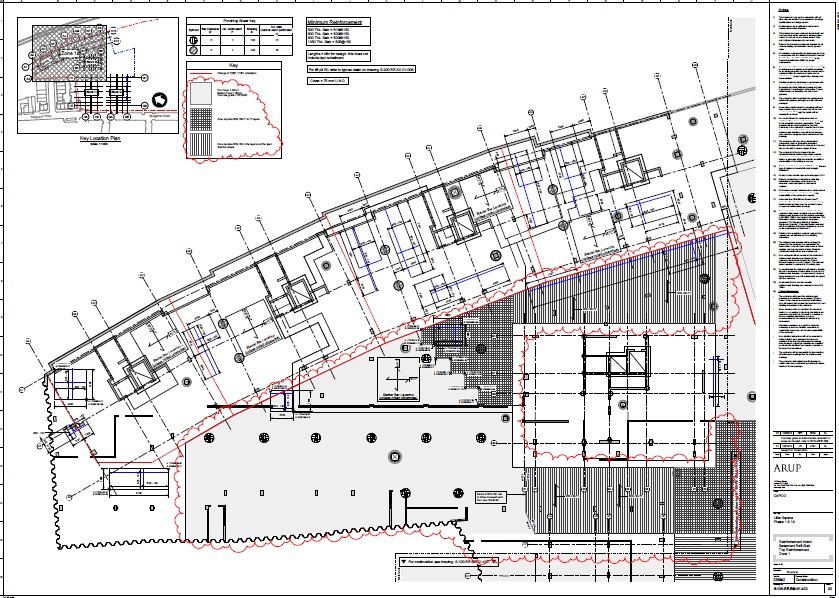
The drainage is no better. We’ve had a nightmare with clashes between the bottom steel and the drainage runs. There are also areas where the drainage runs for several metres into a manhole, only to turn around and run back the other way (shown by the brown arrows). Why doesn’t it run along the black arrow?

Believe it or not, our project was subject to a significant value engineering study where some of these issues were designed out, only to be put back in again due to continually changing client requirements.
The Arup design is a “reinforcement intent”. The detailed design is done by the sub-contractor. The detailed design showed the reinforcement around an ACO drain like this:
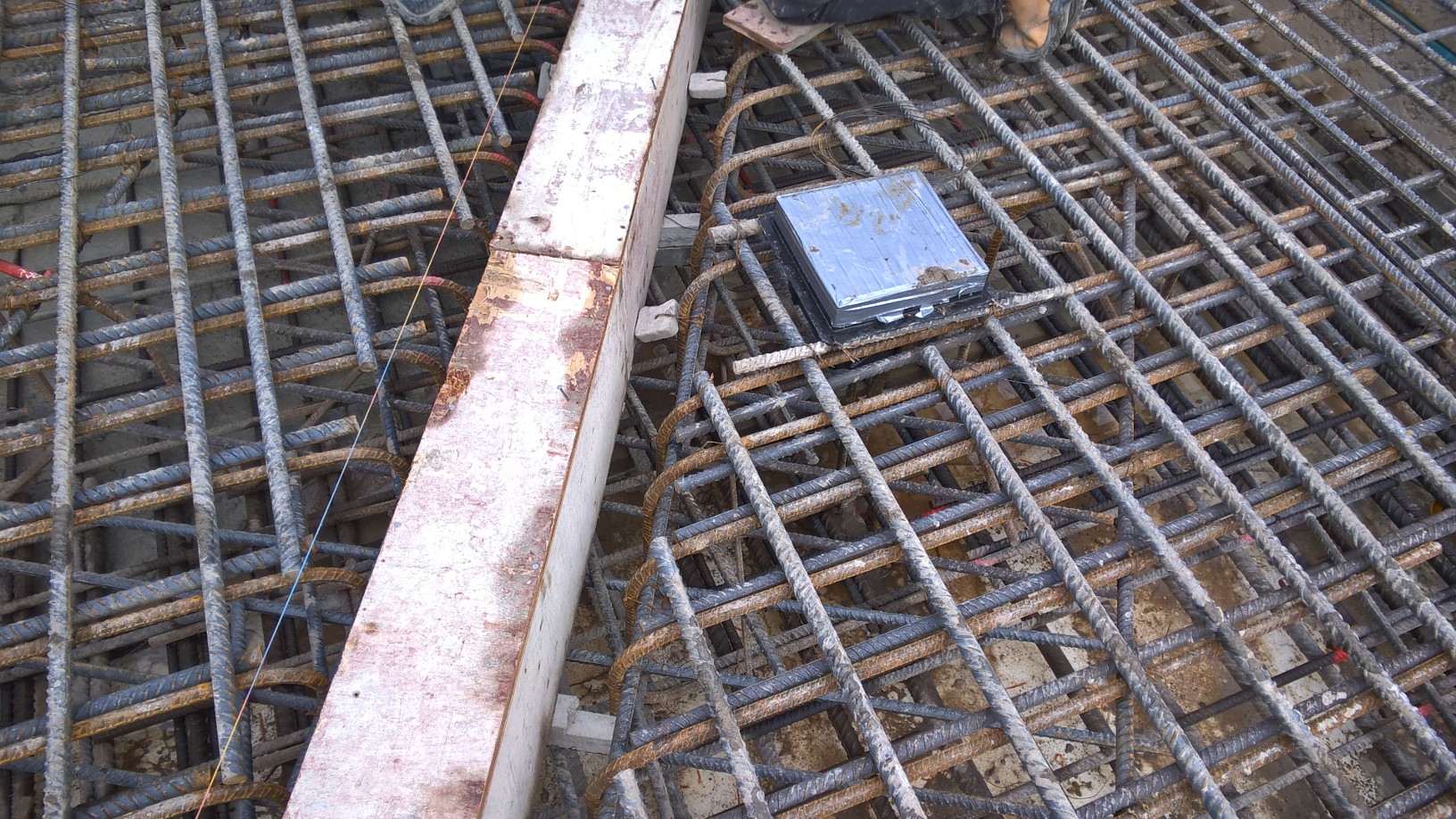
Arup OK’d it, but on seeing it built decided it wasn’t ok and made them add in additional bars. Which they had to do around the rapidly approaching concrete. Timely!
The drainage designer is a bloke with a beard at Arup. The structural designer is a bloke with a beard at Arup. The reinforcement detailer is a bloke without a beard who doesn’t work at Arup (you can’t have everything). And they haven’t spoken to each other, thus the clashes. We’re on a design and build JCT contract. So all the structural designers and architects were novated to us when the contract was signed. Therefore all of these things are our problem to solve.
We have a design manager on site. In fact we have three. But ultimately the drainage in the responsibility of the drainage package manager, the steel that of the structural package manager and so on. And they haven’t spoken to each other.
To link back to a previous blog… Communication is key is this situation. And we’re lacking it.
So what are we going to do about it? Well this is where I’m not too sure. McAlpine SOPs seem to be to let them fail and say “I told you so” later. Not sure why. I’m sure I’ll work it out in time.
Do they REALLY mean it?
As of next week I have to start conducting site inductions. So I’ve started getting my head into McAlpine’s Health and Safety policy.
Obviously they induct everyone on their first day, insist on CSCS cards and SMSTS trained supervisors. That’s the norm. But McAlpine are attempting to go further…
McAlpine have the” Work Safe, Home Safe” tag line, and claim to be attempting to change the culture of construction by pushing Health and Safety to the fore. They conduct workforce engagement session each week and everyone who works on site must attend one within two weeks of starting.
But do they follow it through? Do they really mean it?
How much does all this cost? There’s the cost of the materials, facilities and training courses. And there’s the lost hours which impacts on the program. And program = money. Particularly when the subcontractor is currently 3 weeks behind. McAlpine must think it’s worth it in the long run. So where are they making that money back?
A couple of weeks ago I posted this photo and learnt the lesson of “It’s all about money”.

That happened because a tipper was driving onto a pile of spoil to dump more material onto in. The pile hadn’t been compacted and there were no stop blocks or banksmen to stop him. He drove onto a loose area, it gave way, dumper at funky angle. But prior to the last trip, he must have driven onto the pile 5 or 6 times.
In my mind each of those trips was a near miss. It was an unsafe practice that could have resulted in injury – proved by the later incident. So what did McAlpine do? Did they report the incident internally as an accident? Did they scorn the sub-contractor? No. They recorded the incident as a near miss and cracked on.
Prior to any work being conducted on site risk assessments and method statements must be completed by the sub-contractor. John and Harry would hate them. They’re full of stuff about slips, trips and falls and make no consideration to how the tasks relate to each other. They don’t require a real consideration to the risks involved or what the safest way to conduct that activity is. There is one method statement for steel fixing and another for drainage. Nothing on how they interact though. Which led to this:
![WP_20150327_08_29_51_Pro[1]](https://pewpetblog.com/wp-content/uploads/2015/03/wp_20150327_08_29_51_pro1.jpg)
In case you’re wondering a large non-return valve should fit on that pipe. A lot of rebar had to be cut to get it in. And for each bit of rebar they cut, they have to put an additional area of steel back in, including a full anchor length. So they’re really not helping themselves.
![WP_20150327_12_43_39_Pro[1]](https://pewpetblog.com/wp-content/uploads/2015/03/wp_20150327_12_43_39_pro1.jpg)
So I ask again: Do they REALLY mean it?
I sense a TMR coming on…
 Holdfast Training Services Trial Blog