Free Software – Phase 2 its out there.
After completing my last TMR which was based on the performance of solar thermal systems and the comparison of land cost. Before I started this TMR solar power to me was simply Photovoltaic (PV) cells, but after a lot of research it was evident that this was probably the worst type of harvesting of solar energy. The main problem I had with my TMR was the systems themselves are extremely complex, for example a Parabolic trough which heats liquified nitrile salts, to a working temperature of around 1500 deg C and running a Rankine cycle steam turbine combined system is rather complex. To compare these systems would be far too much work to be able to fit within one TMR.
This is where free software is the key, I personally have found getting enough raw analysis within a TMR has been hard at times, some times due to the complexity of the subject which I have chosen to discuss and sometimes lack of knowledge and capability. However using free software this can be alleviated, you can complete great research and using such a tool as the American Government package called System Advisor Model (SAM) which the National Renewable Energy Laboratory (NREL) have developed (https://sam.nrel.gov/content/sam-publications) you can use such packages to do the raw theoretical analysis which is required and this leaves you to draw the key information and complete true analysis of the data.
There is tons of free software out there and in terms of renewable stuff the NREL is great and if you need any other help with this subject Mark Hill is the man. I hope this helps Phase 2 a little as I know I was stuck a couple of time of how I can do a real comparison of different systems.
Heat Loads
I have had some technical issues with my work lap top which has stopped linking to the internet and the work internet protocols not allowing me to get on the word press portal. After a couple of packets of biscuits to the NDY IT guru he has solved the issue and put me on a different internet to everyone else!!
Frederick Irwin Anglican School New Chapel, Mandurah.
The NDY experience, the first project which I have been working on is a heat load calculation for a chapel in Mandurah which is an hour south of Perth, so very similar dry and wet bulb conditions to Perth.
 The Chapel is a very modern design as can be seen from the images below. The volume of air within the space is extremely large due to the high ceilings, which architecturally most chapels have the same features, however the building fabric of the UK chapel is very different to here due to the potential of thermal energy being built up during the day and stored over night because the temperature differential is not sufficient enough for it to be rejected. The resultant is lighter building fabric which heat up quicker but can also reject heat at a fast rate also.

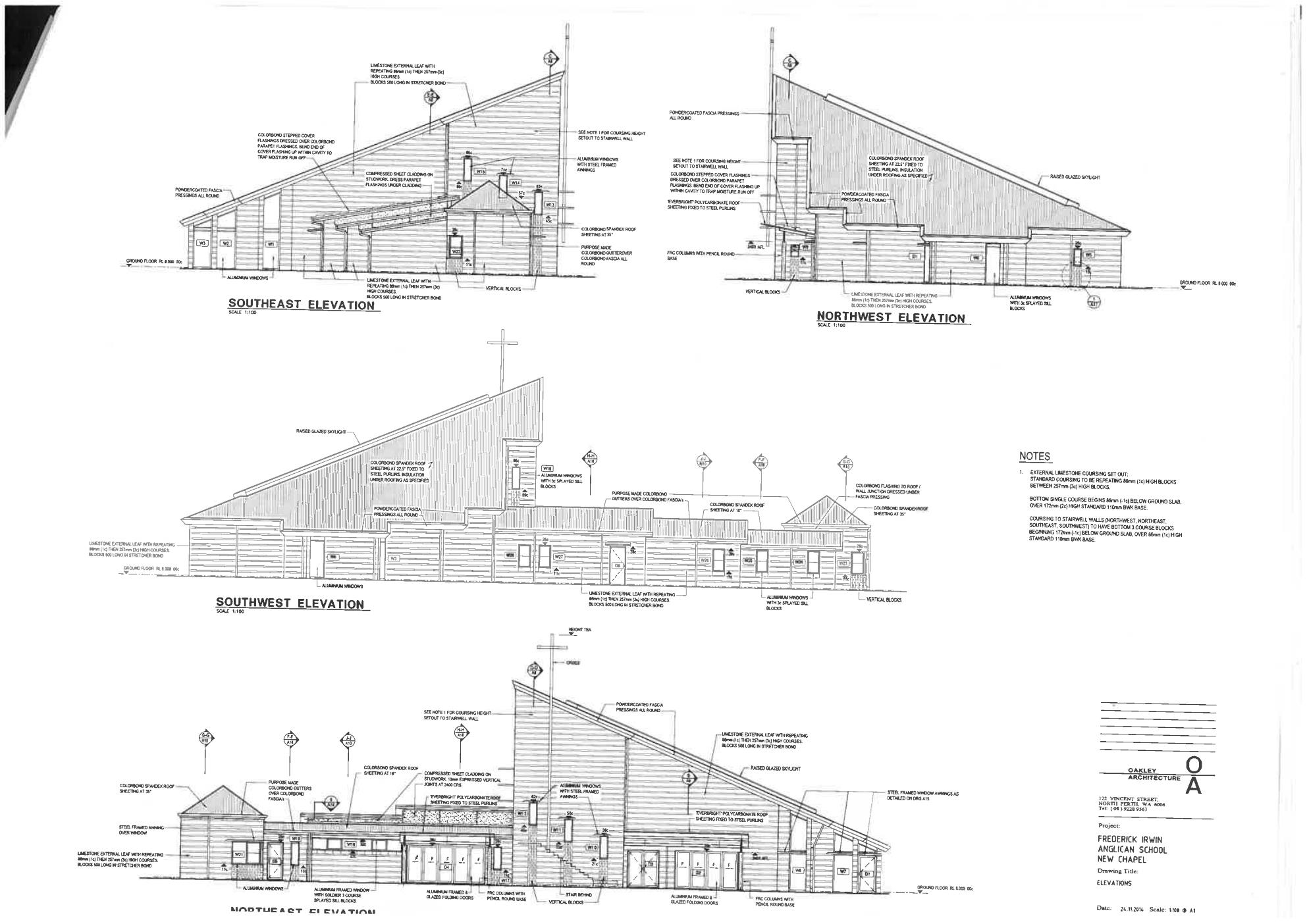 The heat load calculation was completed using a stratification methodology therefore only cooling from floor level to 3m and the remaining airspace heat being exhaust at the zenith. This was fairly straight forward however the program which NDY use TRACE does not have any modelling capability so its quite difficult to see if you have all the geometry correct. The next challenge was dealing with an architect which did not understand for a building to be functional it requires some mechanical cooling and the space which was allocated was vastly too small, so after doing 10 different designs demonstrating that the space was too small we finally came to an agreement. I believe architects here are still 10 years behind and drawing pretty pictures and have no idea of safety in design or engineers working in conjunction with architects!
Karratha Quarter, Karratha.
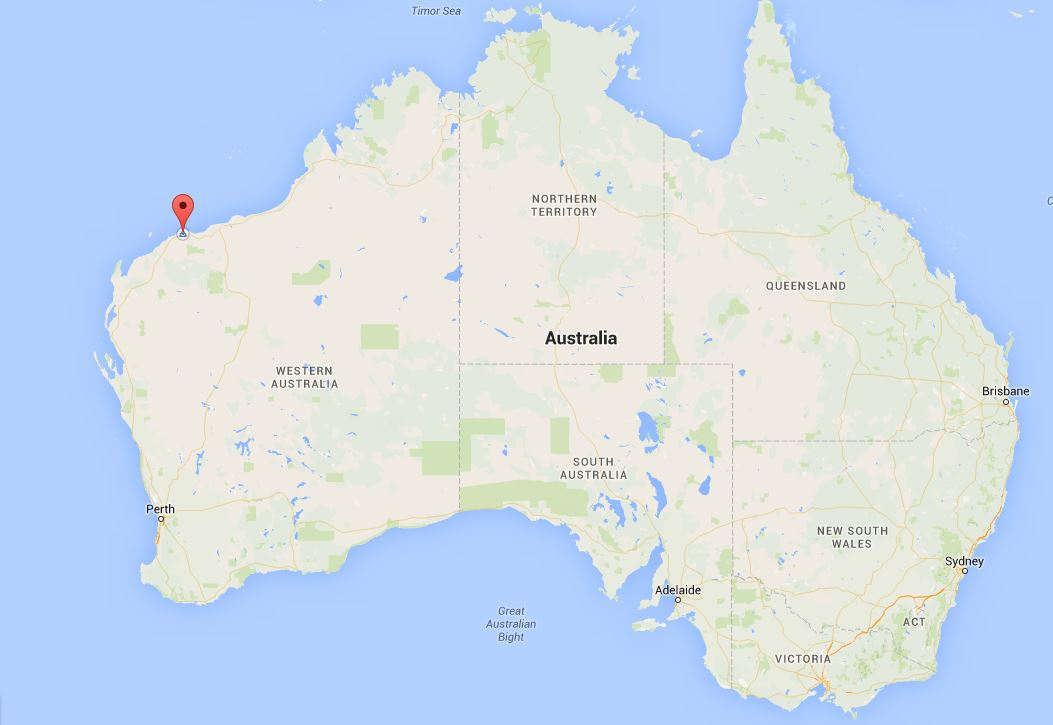
Karratha Quarter is a combination of residential, office space and amenities. Karratha is in the North of Western Australia, as can be seen from the image below and this has a very different envirnoment compared to Perth. The main work which I completed for this was checking tender documents, this was for all disciplines which has given me a broad spectrum of experience. This task was meant to be completed by Christmas and this is something which I have noticed since I have been with NDY is that dead lines are often missed and there seems little structure in the company on who controls which projects. The result generally is people being dragged from one job to another and being very ineffective.
Capital Square Tower 1, Perth.
Using my experience from site running BIM model clash detection meetings I have been asked to do the clash detection for all the services for tower 1 of Capital Square a new river side development. This is initially completed with a clash detection run by a program called Navis works, then me looking at all individual clashes and coming up with a solution which I feed back to the Revit 3D modellers. This is done in an iterative process completing all the clashes for Hydraulics initially especially drainage, then Mechanical etc etc. This is a long process but one which I can directly influence design and ensure the model reflects something which can be built which I have experienced first hand from Perth Children’s Hospital.
Life outside of work.
I have last minute been called up to do the Rottenest Swim as part of a team which is a 21km swim from Cottesloe beach to Rottenest Island, which is going to be a serious challenge with limited training, I also have swimming State championships coming up and then Hannah and I are off to Hobart, Tasmania for the swimming National Championships. So keeping fit and wet!
Engineering Management
The management of civilian engineers is really quite different from that of managing Royal Engineers. In twelve months as a project engineer, I have managed teams not only on diverse engineering projects but the people who make up the teams are potentially even more diverse. As a result, I have had to hone my soft skills to get the job done.
Military Culture. When I was a brand new troop commander I heard the term FIDO. I’d be surprised if anyone reading this blog hasn’t heard the term but for clarity I will explain the acronym. It means f**k it, drive on. It succinctly encapsulates the military ethos where the mission always takes precedence and the will to succeed despite shortfalls of manpower, time or resources means the job usually gets done. And credit to the Royal Engineers, in my experience the final job is usually more than fit for purpose. However, this inculcated culture could lead to a potentially one dimensional leadership philosophy where the commanders just shout louder and get angrier until they drive their subordinates to complete the job. I’d like to think I wasn’t one dimensional but I have certainly had to adapt and develop whilst on attachment. A single leadership approach can work in the Army because of the hierarchical structure, the discipline instilled in basic training and the excellent NCOs that enforce it. It also works because the people in the Army are generally different and more robust than their civilian counterparts.
The Army attracts a certain kind of individual, one who is comfortable with straight talking and potentially being told off if they’ve messed up. Also, the average age of a British Army soldier is 20 years old. There is a natural tendency for these younger soldiers to follow the instructions of older and therefore more knowledgeable soldiers. This discipline, understanding of straight talking and hierarchical structure means that when an order is given, even if not completely agreed with, it is usually followed. This means that things tend to move on a bit quicker.
Oil and Gas Culture Differences. I imagine that some of this will resonate with those in design offices in different industries but I have kept it to my own experience. The oil and gas industry has a very risk aware culture and in particular BP PLC’s top priority is safety first. Their mantra is “No accidents, no harm to people, no harm to the environment”. The average age of the oil and gas sector is between 46 and 49 years old. In the design office, they are nearly all qualified engineers, most will be at graduate level as a minimum. And, at age 46 to 49 there is a tendency to think they know best. Sometimes they do and sometimes they don’t. These engineers are often members of engineering institutions with clear codes of conduct regarding making decisions within the realms of one’s ability, they tend to seek a higher degree of assurance and as such they take their time.
Also, there is a functional structure to the organisation which means that the balance of power is held in different places. For example, and in military speak, the discipline engineers are OPCOM to their principal discipline leads but they are TACOM to the project engineers. (For those of you who don’t know OPCOM and TACOM you should be ashamed of yourselves. OPCOM means they get given the mission statement and can be broken down or asked to do anything – essentially the highest level of command. TACOM is what RE CS squadrons are to the BG. They are given tasks and priorities and can’t be broken down further). This confused split of power exacerbates the situation because with two bosses if an engineer doesn’t like a decision they can trade one boss off against the other.
Consequences
Consequently, if you ask someone to do something in the Army they will generally get it done. This is providing you don’t ask the bottom third LCpl or Sapper who’s been in for 20 years and passed over quite some time ago. It doesn’t even matter how you ask, it can be the politest “I’d like groundworks for the LSB complete by COP Friday, please” because this actually translates as “the groundworks will be complete by Friday unless you know of a good reason why they won’t be then let me know right now”.
In BP it seems that unless you get something it writing it is a bit hit and miss whether it will happen or not. The amount of people in the design office who are happy to agree with something to your face and then not do what was asked of them caught me out at first. For example, I might ask a vendor “I’d like all long lead materials ordered by Friday, please”. And what they seemed to hear is “if you can find the time and as long as it’s not too much trouble try and order the materials by Friday. However, this is very much a target and not a deadline”. This actually happened to me and the materials had a 20 week lead time and if they weren’t ordered soon then the job was unlikely to go ahead. Everyone was aware but the materials hadn’t been ordered because it was not the next step in their process. Don’t assume common sense will prevail, even with bright people, they like to follow a process. In my early days, I would naively believe that people would do as they say; nowadays I follow everything up with a desk visit and then an email. Just sending emails is too easy to ignore.
Continue to be polite and friendly (even if you don’t feel like it). It is important to be polite for two reasons. The first is that the people in the office tend to be nice individuals and they respond better to being spoken to nicely. The second is that as a project engineer I am not directly empowered to get them to do everything I am asking. Being polite and friendly gives the impression that you’re friends and it’s harder for them to refuse a ‘friend’.
Finally, be ready for the confrontation. Officers tend to be quite good at confrontation and you should be ready to use this line of action if required. Be prepared to stand your ground but have the technical, financial or project detail handy to back you up. You can usually tell when a conflict is coming, try and work round it with a smile but make movements early to have all you ducks in a row. A confrontation without evidence is at best unhelpful and at worst undermining. I successfully, and publically, argued with a process engineer about the sizing of a shell and tube heat exchanger. He was trying to throw a spanner in the works and was being particularly obstructive. So in a meeting I produced evidence from the design report from a process engineer stating that the STHE was fit for purpose. He was promptly told to get on with his job. Without the evidence to hand, he’d have tied my in knots and would have shouted me down.
It goes without saying that you need to be firm and as a leader you need to be strong willed. As any kind of successful leader clear and concise communication is important as well. These are skills that come more naturally to us. However, working in BP has definitely honed my soft skills when it comes to leadership and management. Some top tips are:
- When you say deadline they hear target.
- Use explicit language and ask for exactly what it is you want and don’t think you’re being patronising.
- Follow up any agreement with desk visits and emails.
- Be polite and give them no excuse to put your request to the bottom of their to-do list. Also, get round and ask people’s names, know their interests and ask about their weekend. It is hard to refuse a friend.
- Continue to use common sense. Understand the project lie cycle and when the engineers would normally complete steps. If required, intervene and make sure the overarching aims are borne in mind. As military leaders, we tend to be quite good at this anyway.
- Be ready for a confrontation with evidence. Do not think you can argue your way out of something with platitudes. Only use as a last resort.
On your last day at work you can tell people what you really think of them if you so desire but I would’t advise it.


First Impressions: Muddy hole!
Prior to Christmas the Groundworks contractor took the level down to 150mm above formation and handed over to concrete contractor (PC Harrington of Southbank slipform fame). Concrete contractor took down to formation level, but had no intention to blind for an additional 3 days, despite direction to cover within 4 hours. Shear vane tests had been directed by the designer (Arup) which could not be conducted immediately, thus the contractor’s reasoning for the delay. Due to concern for the quality of the surface material at formation level – it’s London clay and tends to suffer from surface cracking if left to dry out and turns into an ice rink when wet – the contractor was instructed to blind immediately but leave holes for the test to be conducted. Seems strange that a specific test was specified other than “test for this property”, but it’s my first day and what do I know? I haven’t got a computer or a log on yet, let alone a clue what’s going on!
![IMG_0667[1]](https://pewpetblog.com/wp-content/uploads/2015/02/img_06671.jpg)
A real digger!
Day 2 and I witnessed a group of hairy Irishmen with their asses hanging out of their trousers (one for John) attempt to put a very large, prefabricated RC cage into hole. It didn’t fit. For 2 reasons: the hole was square, the cage wasn’t; and when the piles were cut down all the rebar was bent all over the place and wouldn’t fit through the spaces between the rebar. They got it in eventually but if Harry had seen how he’d have probably had kittens! It’s led to some cover issues. The rebar is touching the blinding round the hole in places, this probably isn’t an issue since it’s a tower crane base, therefore temporary, therefore the durability is unlikely to be a problem. But PCH are the problem children on site so we’re not given them an inch at this early stage. So the contractor will have to do some localised breaking out of the blinding to ensure correct cover, mostly since they have no idea what strength of concrete was used when they poured the blinding! They’ve learnt from it and the steel fixers will make the other 4 in the hole – sensible!
![IMG_0669[1]](https://pewpetblog.com/wp-content/uploads/2015/02/img_06691.jpg?w=300&h=224)
Tower crane footing
Today (Friday) I was sent onto site to hold the hand of a Geo Engineer from Arup (they must have heard of my fondness for quiche). He came to observe some shear vane tests on the foundation level clay prior to the blinding being poured. The minimum required value was 40kPa. The very lowest of our results was 120kPa. Does this mean the basement slab, sheet piling, pile shaft resistance and anything else that might have been based on cu is massively overdesigned? I tried to gently probe the area by asking questions, but didn’t get very far, the bloke looked about 12 and a bit scared that anyone had asked him a question with the word “overconsolidation” in it, all I got was that c’ was taken as about 25 (comment John?). Afterwards the Chartered Engineer on site asked me how I’d remembered things like Atterburg limits, I told him what we did last week and he looked horrified. I think I’ll be babysitting the Geo bloke every time from now on. Ahh well, at least it’s not making the brews!
![IMG_0660[1]](https://pewpetblog.com/wp-content/uploads/2015/02/img_06601.jpg)
Shear vane test
By the end of the week I finally have a computer, a log on and a McAlpine fleece, but still no clear idea of what I’ll be doing. Very TBC but it looks like I may be responsible for QA on Tower cranes, basement raft slab and, most excitingly, slipforming! Looks like I’d better dig back through Rich Hall’s blogs!
Bahrain progress Feb 15
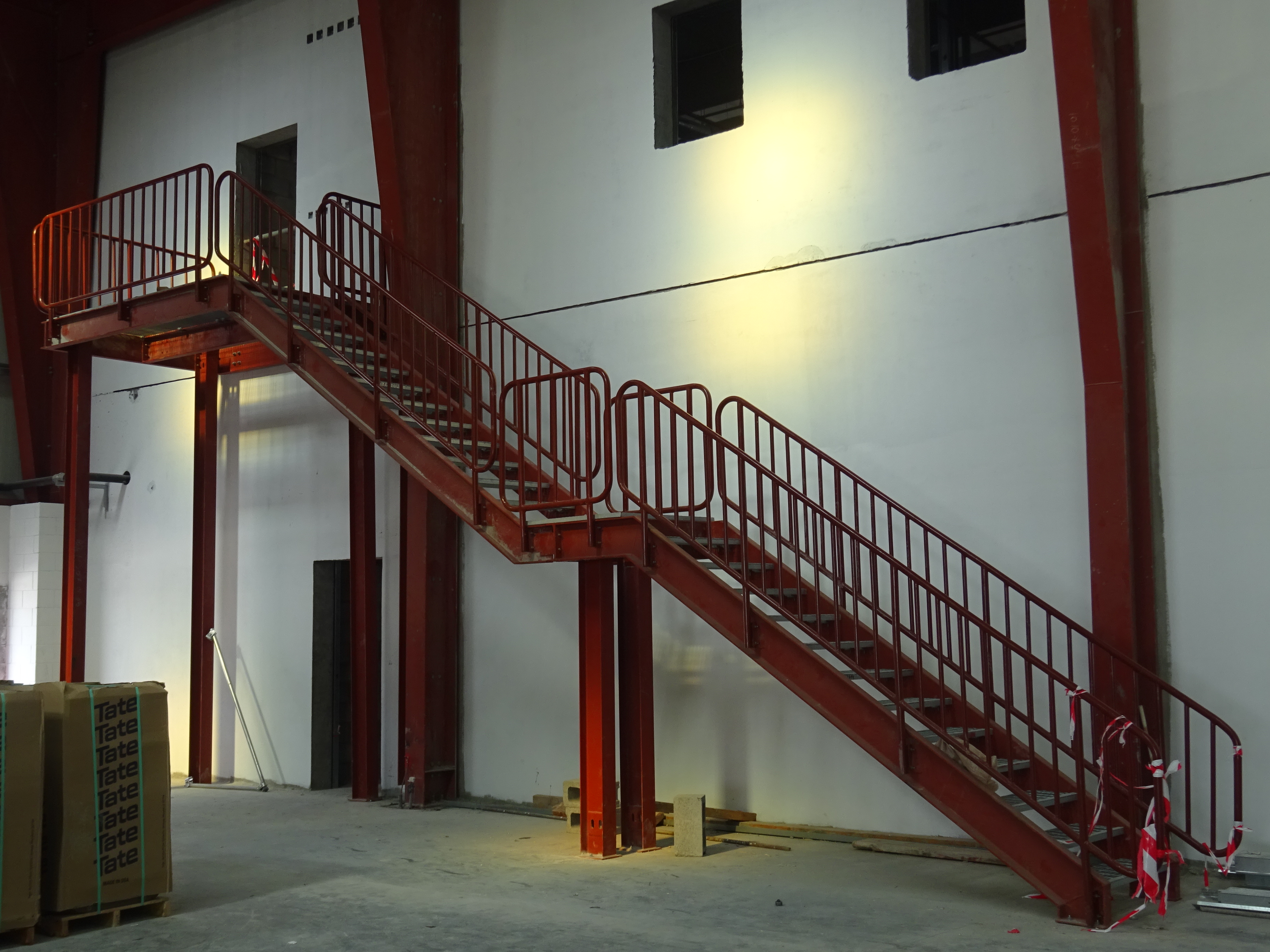
All – I’ve added some updates from UKMCC Bahrain – Namely the roof, services, internal and external shots. Lots of photos for interest!
See roselliott.wordpress.com
Ros
UKSPEC and E5
All
I thought I’d share this little document with you for anyone looking at competence E5 and thinking ???. Don’t worry – some of the PEIs aren’t exactly sure however this competence is based around the Engineering Council’s statement of ethical principles (2014) so that’s the place to start. The document is a good read (E&Ms will know where the car chase is likely to be) and can be found at http://www.engc.org.uk/engcdocuments/internet/Website/Statement%20of%20Ethical%20Principles.pdf
Hope that helps those pondering this competence.
Design office blog 3
Submitted a tender to ICC (that I was bid leader for)
This was a request for tender that came through from a panel agreement that Jacobs have signed up to. The proposal was a fairly small one, with fees in the region of $30,000. It involved the checking of a preliminary design that the council had completed themselves, including some computer modelling, plus the design of some discrete elements in the stormwater harvesting scheme. This all sits within a larger flood mitigation project (outside of the scope). It was nice to be given this to run with as I’ve worked on a number of proposals now, but only concerned with the civil aspect of these larger projects. It allowed me to go through the review process and complete the tender documentation, helping to understand the elements that I’d only read about previously. This included everything form assessing the brief to submitting CV’s of the team that would complete the work, arranging the insurances and finally getting sign off from 2 of the directors (plus lots of other tasks).
I looked into the panel agreement a little further, as I’ve not encountered it before. The Local Buy panel is essentially a 3rd party organisation that matches clients (from local government) to design services and other service providers. There is a list of agreed rates that exist between Jacobs and the panel. In practice they just send out the requests for quotation to the companies on their list. Then they add a 5% fee. I can’t really see what value they add in the current market. The rates agreed were far above what is currently the market norm.
Completed stormwater sizing for the 50% design on Amberley RAAF base.
This was a small bit of design work to help out the engineers working on this project. First I worked out my design storm and the rainfall intensity, the Qld Urban Drainage Manual (QUDM) was the local standard to follow (as the land is owned by Defence they don’t have to adhere to local legislation, only federal, but they tend to follow it out of courtesy). I calculated my run-off areas from the CAD sketches, and picked some inlet positions. I took the design through to the sizing of pipes and inlets (this involved checking the flows captured in each inlet and what would carry on to another inlet).
Cost estimate for accommodation relocation.
This involved the client relocating dispersed accommodation assets to one location. The location to be removed has been sitting empty for some time. The new location was originally planned to be much larger, but was scaled back prior to completion. However all infrastructure was sized for the full camp (2500 men). The camp bore many similarities to expeditionary infrastructure, as each location had their own water treatment and sewerage treatment plants. Power was from the main grid and stepped down to 33KV where it came on site. There were then a series of HV and LV loops around the camp. The water and sewer mains were fairly simple to tie the new accommodation units into. I then received a rapid lesson on the comms and electrical infrastructure that would be needed from the team downstairs. I was just able to follow the lingo with the electrical kit, but started to get a little lost when it got to the comms. It turns out that each 4 man “donga” has fibre to it. It is then converted to copper for the individual rooms. I scribbled down lots of notes about the number of head end FOBOTs required and how the 144 core cable ran in a big loop from the main comms room. Each laundry unit was where the 12 core loops to the dongas were split out (there was another FOBOT here). All very interesting stuff I’m sure.
I got one of the drafters to put some quick sketches together on CAD. (see below)

The client was keen to know the cost as if it was below a certain value the move could be done as part of their operational budget. If it was too expensive it would fall to capital works and wouldn’t be possible in the current economic climate (commodities are currently suffering).
Recce to Melbourne (Puckapunyal) for a crossing design/assessment.
This turned out to be both a very frustrating project and very informative. At the start this sounded like a great little task, involving a free trip down to Melbourne. However I only saw Melbourne airport before heading North to Puckapunyal Training Area. This is the home of the Australian Army school of Artillery and their school of Armour. There is also an experimental weapons range tagged on the side for good measure. The background to the project is that Jacobs are managing the maintenance contract for the range. This year there was an underspend in the budget, so they are looking to squeeze in a number of tasks that were further down the priority list. On the training area are a number of crossings that have had their MLC downgraded significantly, see the photo below (looks suspiciously like a non equipment bridge). The aim is to install some new crossings to MLC 110T (wheeled). There is an existing design template that they want followed for these new crossings. Three existing crossings have already been built following this template on the training area and the client is happy with this style.
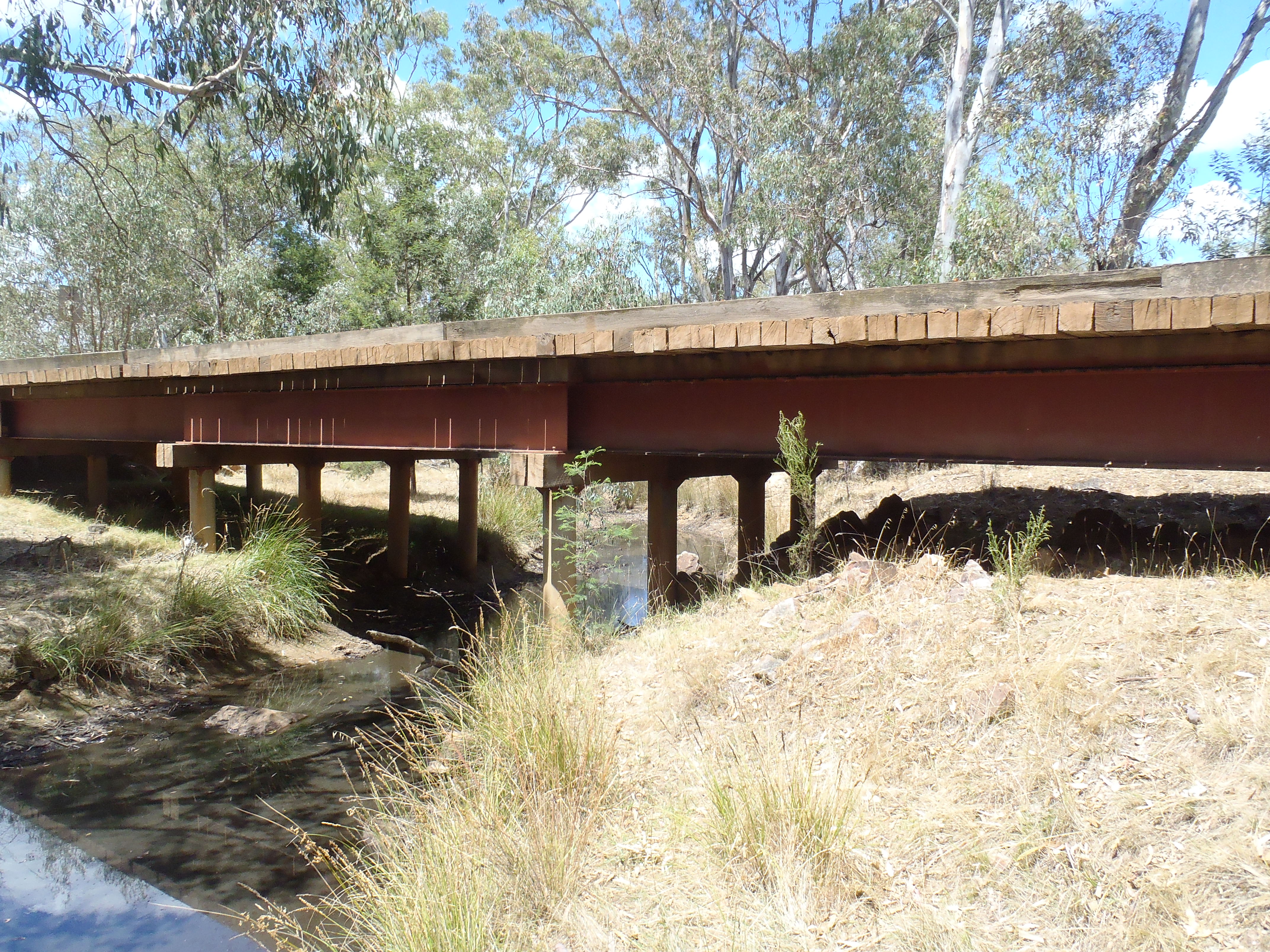
I was given the previous crossing drawings and the calculations that went with them. My task began as a review with some sizing of the culverts within the design (after finding the catchment size and calculating the design storm flows at the crossing points) On return to Brisbane I confirmed what I would be able to do for the team in Melbourne and set about deciphering the calcs. I completed my own check calcs in parallel to AS5100 (the Australian Bridge standards), the pavement was designed to a technical note published by the Cement and Concrete Institute of Australia.
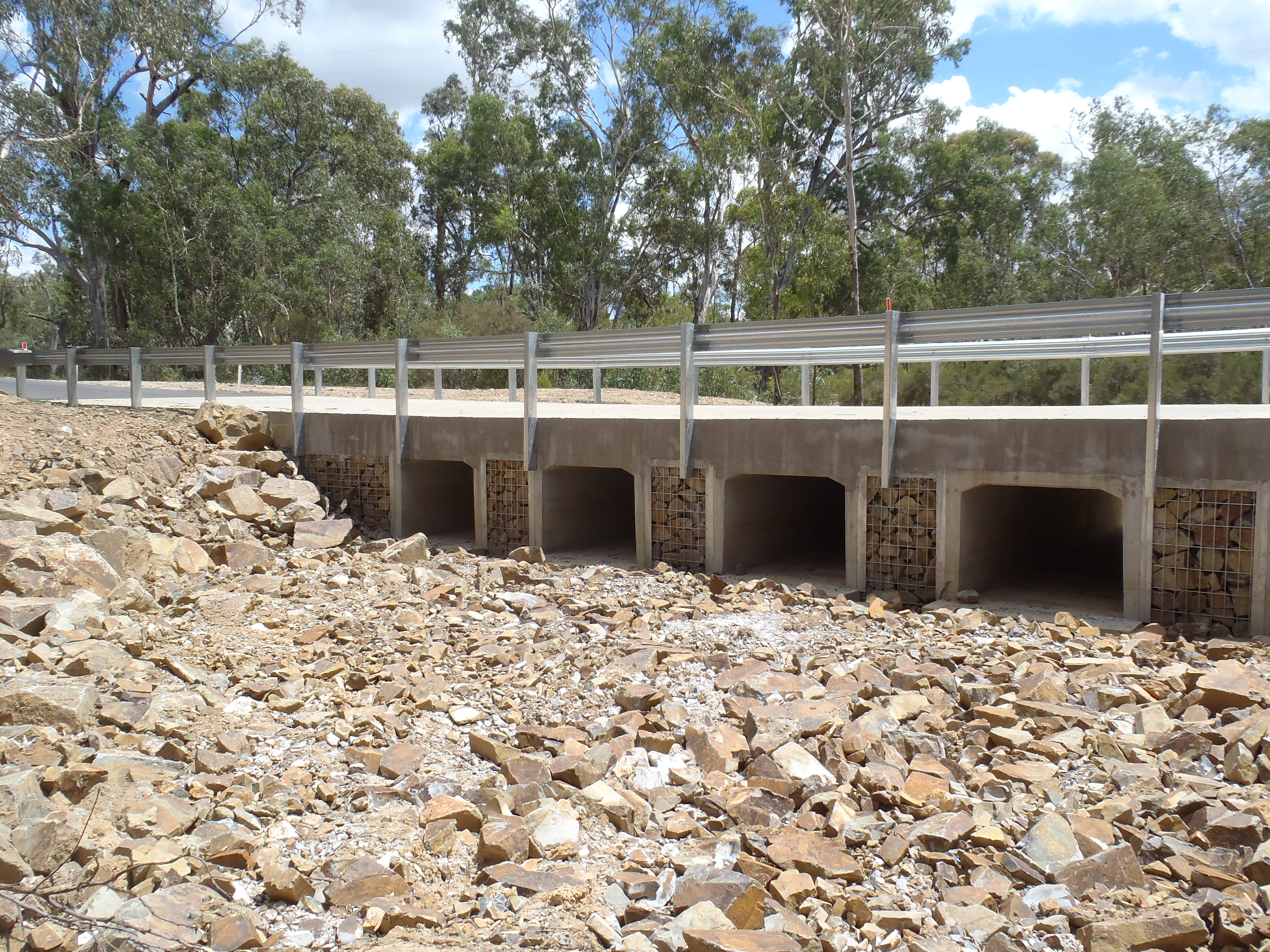
Lessons learnt
Write down all thinking when doing calculations. It was really difficult to interpret this other engineers thought process. I am using educated guesswork to figure out why he selected a specific span to design to – it doesn’t match with anything in the design. It could also be old calculations from a previous job that were never updated – I just don’t know.
Understand clearly what you are being asked to do before starting a project. If the aim had been made clear form the outset, that a set of design drawings that could be issued for construction (IFC) were required, time and effort could have been saved. While I clarified what I was doing with the team in Melbourne on my return, they never stated their need for IFC drawings, or for any material to go outside of the company. This could be my own ignorance, but with hindsight I think they were after a quick and dirty, “she’ll be alright, just go build it”.
Unwillingness to move outside of comfort zones. This could be interpreted as people adhering strictly to the codes of practice and only working in areas that they are competent in. I see it as people not wanting to make the effort and take responsibility for a project. Going to other specialists for help when those unknown areas arise. This was put in the “too difficult” file by many until I pushed for the job to be taken. This could be due to the narrow field, but depth of knowledge many seem to develop. Only a few of the older engineers seem to have much in the way of cross discipline experience. Has anyone else encountered this? Is it more prevalent in the larger consultancies?
Transformer Blast Overpressure
The electrical team have a project to upgrade the electrical infrastructure within a communication network data center. Part of the scope of works is to create a new substation on level 10 of the building and install 2 new 1000kVA natural, air cooled transformers in separate fire rated compartments. The actual design and installation of the transformers will be the subject of a future works package.

I have been involved in the project both in the design of the ventilation system for the new substation and in checking the proposed design for compliance with Australian Standard (AS) 2067-2008 Substations and High Voltage Installations Exceeding 1 kV a.c.
The main cause for concern in the AS is that “where transformers are arranged in banks they should be separated by a fire barrier wall designed to withstand impact and blast forces in addition to its fire resistance”. The requirement to mitigate against blast is mentioned a further 2 times in the AS, but no detail as to how to mitigate for blast is provided. What we do know though is that if an explosion on one of these transformers knocked out the other, then the costs to the company in question would be in the millions of dollars per hour. One way or another we need to be certain that we have appropriately mitigated any risk.
Hoping for a quick fix, i trawled the internet for a blast over-pressure calculator. This wasn’t going to be that simple. I could find only one calculator that had been developed by Connell Wagner (Connell Wagner Arc Pressure Calculator), but the internet would only provide me with an image, so none of the calculations hidden behind. Furthermore, Connell Wagner were bought out some time ago and so I cant approach them for advice. I also found two UK Power Networks Engineering Design Standards which suggested the substation structure needed to be designed to withstand a blast over-pressure of 10kPa in a switch-room, and 5kPa in the transformer room.
In this case the transformers and their switch gear are co-located, suggesting a requirement for 10kPa. A quick check with the structures guys revealed that the existing slab on the 10th floor could at best support a dividing wall that can withstand 6kPa when the weight of the transformers was considered. We needed a more precise calculation.
I decided to set about producing my own calculator.
I found several useful documents that I used as the basis for my own calculation. Each of which appeared to base their work on a method developed by someone called Pigler back in 1976. Pigler was a much brighter man than I am but the general principles are as follows:
- The arc releases a certain amount of energy (Q), the proportion of which actually impacts the surrounding air depends upon a factor which accounts for the energy absorbed in melting the conductors and other losses.
- The arc energy causes an expansion of the room air (the first law of thermodynamics).
- That expansion increases the pressure on the structure.
Whilst this sounds simple, there are all sorts of factors to consider, such as the following:
- Is the transformer in a case or enclosure, and how does the expanded gas within that enclosure transition into the room?
- The transfer of energy to the air from the arc will not be uniform, and the subsequent rate of expansion will depend upon time and distance from the arc.
- The release of air from the transformer enclosure will either be through a vent or by a fracture in the enclosure.
- The impact of the arc energy on pressure is dependent upon where the arc occurs and what might obstruct air movement between the arc and the walls.
- Is there a vent provided within the room to release the pressure?
- A pressure distribution within the room will not be even, and there will likely be hot-spots as shown in the image below:
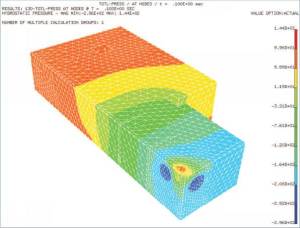
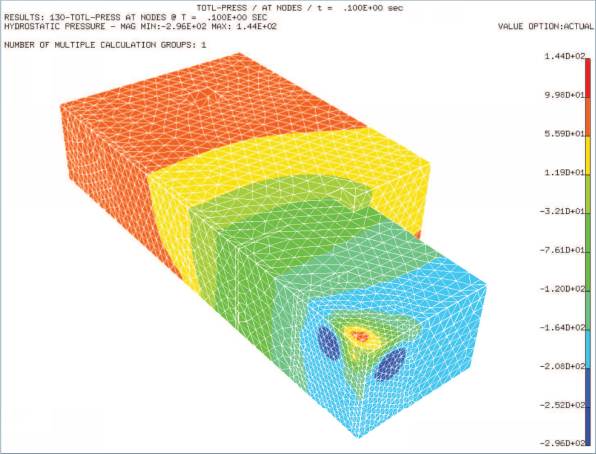
So, whilst Pigler’s method for determining over-pressure requires a PHD in maths and some computer programming skills, i recognized that I didn’t so much need an accurate answer, as an answer that proved that a 6kPa pressure was a worst case scenario. I went back to basics.
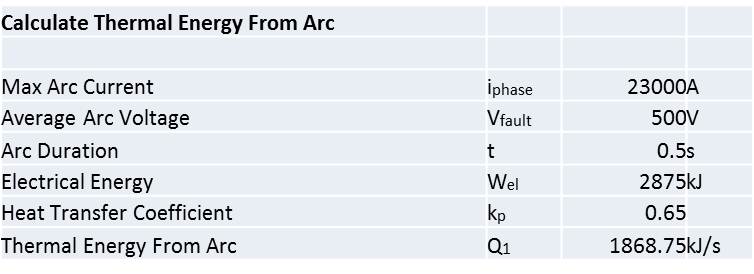
Where:
 and
and Then, for a perfect gas:
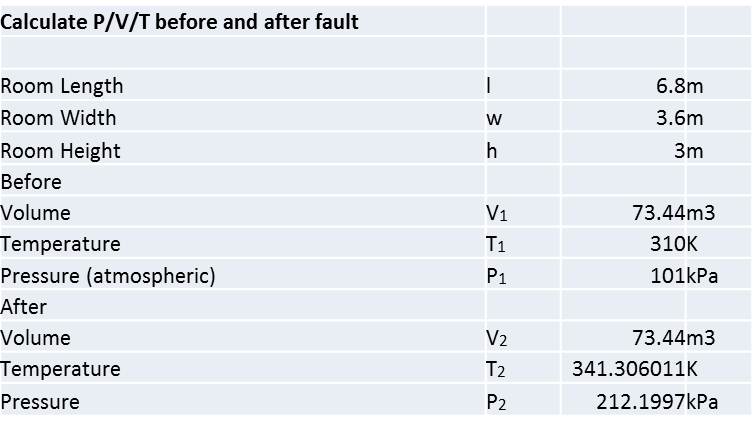
Where:
Using
These results suggested an increase in pressure of 111 kPa which was a lot more than the 6 kPa I had to play with so I thought i would see what impact a pressure vent would have in the room.
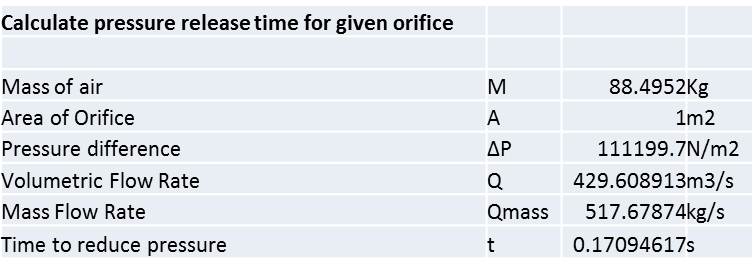
Where:



This suggested that the increase in pressure could be dissipated by a 1m2 vent in 0.17 seconds.
Essentially though, the process above only served to prove that this sort of calculation needed to be done properly, rather than assuming the arc energy influences all the air in the room at once, which it wont.
I called Siemens and persuaded them that they were in the running to supply the transformers. They modeled the parameters I gave them in some computer software and provided the following:

The result here was a pressure peak of 1.58 kPa with a 0.2 m2 vent (provided for by the ventilation duct in this case) which is comfortably acceptable in the substation.
What did I learn?
The chances of an arc fault on a dry transformer are very small, so small that this modelling would not be done for a dry transformer.
The chances of an arc fault on switch gear are also very small (approx 1 in 10,000) but the possibility is enough to model blast over-pressure.
The risk of explosion only really exists where the transformer is enclosed in a case. A sealed case, such as that on an oil cooled transformer allows the build up of pressure in a relatively small space, which can lead to an explosion. In a dry transformer open to the air in the room, the air will heat gradually and there is a much larger mass to absorb the heat. A small vent is sufficient to allow the dissipation of expanded air.
An explosion in an oil cooled transformer carries a high risk of fire. A dry transformer has nothing to burn.
Only use dry transformers inside buildings.
Pigler was a mathematical ninja, even surpassing the intellect of Brendan (I recon). Whilst I am sure even I could significantly improve upon the basic spreadsheet I produced, the array of factors involved in calculating blast over-pressure from an arc fault lead me to recommend that anyone who comes across this in the future just calls Siemens and you’ll get something back in a couple of hours.
ST Vincents and the DUCTULATOR
After a blogging space I thought I’d let you all know what I’m up to. Shortly before Christmas I finished with John Holland and moved across to the Sydney office of Norman Disney and Young, Norman Disney and Young are a services design consultancy that cover the full spectrum of services consulting (hyd, Fire, Mech, Elec, Comms etc…) and employ 600 employees spread over about 13 offices worldwide. For the time being that includes Ollie in Perth an Me here in Sydney.
My main project at the moment is the Mechanical Services design development of an extension/newbuild and refurbishment of a private hospital in Sydney. The refurbishment includes 5 floor of wards with some 40 beds per floor in an existing 70s built hospital, upgrading the existing to ensure the design is code compliant. The seventies seem to have been a laisse faire time over here with respect to building design and the upgrade includes upgrading of the fire and exhaust systems, as well as upgrade of all he Mech plant. Staged in such a way that the hospital can remain open while the work is done, taking out 2-3 floors only at a time, which poses SIGNIFICANT design constraints. The slab to slab of the existing hospital is 3 metres, with the slab 300mm ‘waffle’ type construction. The ceiling heights are required to be 2.4 meters which gives only 300 mm ceiling void to run all services.
The second part is the construction of a new 14 storey hospital extension. which I am currently developing the Mechanical design for. The building has a number of different uses, all of which help make the design a real headache. The basement is a Laundry, the floor above is a canteen, then office space, operating theatres and the associated sterile spaces, wards, and the top 3 floors are consulting suites for private consulants, all on a floor print of less than 100 square metres.
The design development is due around April which should keep me busy, and NDY is also leading on Electrical and Fire design for the same project, so i’m intending to get some experience in both these areas as well.
Duct Design
For all you E&M 56s out there, I wanted to let you know about the Ductulator! Having struggled to get to grips with the constant friction loss method of duct sizing, I wrote a TMR last year going into detail of Friction loss duct sizing approach verses static regain, so I fully understood the process. It turns out there is an easier way:
Step in the duculator:
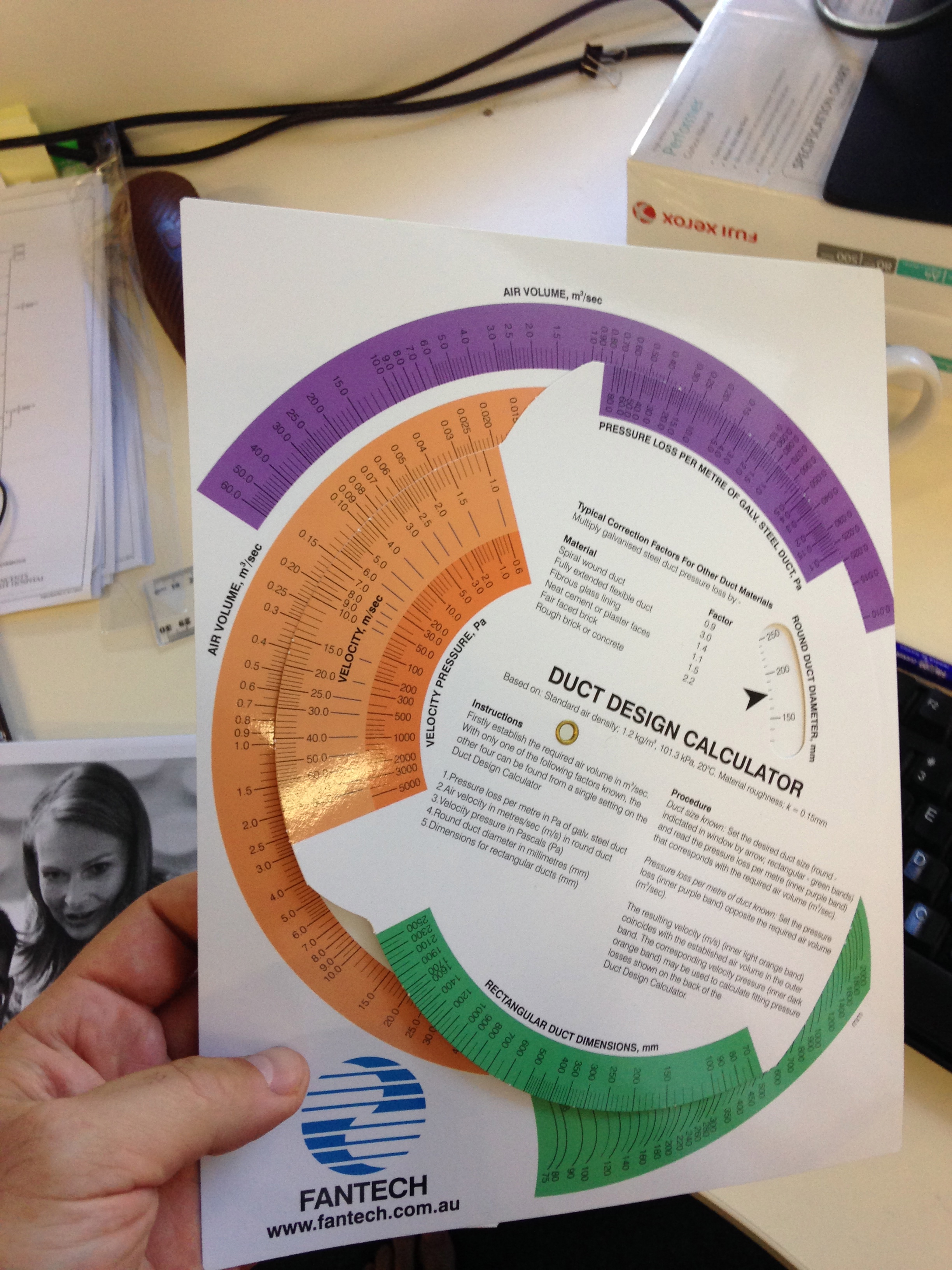
This simple but effective bit of kit is, apparently an essential on any self respecting Mech designers desk. As I’m not a self respecting Mech Designer I stole this one. It uses the friction loss method for duct sizing, to give rough duct sizes. how it works –
1. Rotate the dial to compare velocity verses volume flow rate – The orange part of the dial,or pressure loss per metre against volume (Purple)
2. Read off the associated rectangular duct size (green) or circular duct size (white)
3. Go make a coffee, you’re done.
Design calcs may be required further down the line but for design in principle this works a treat. available from all good TECHnical FAN suppliers.
In other news
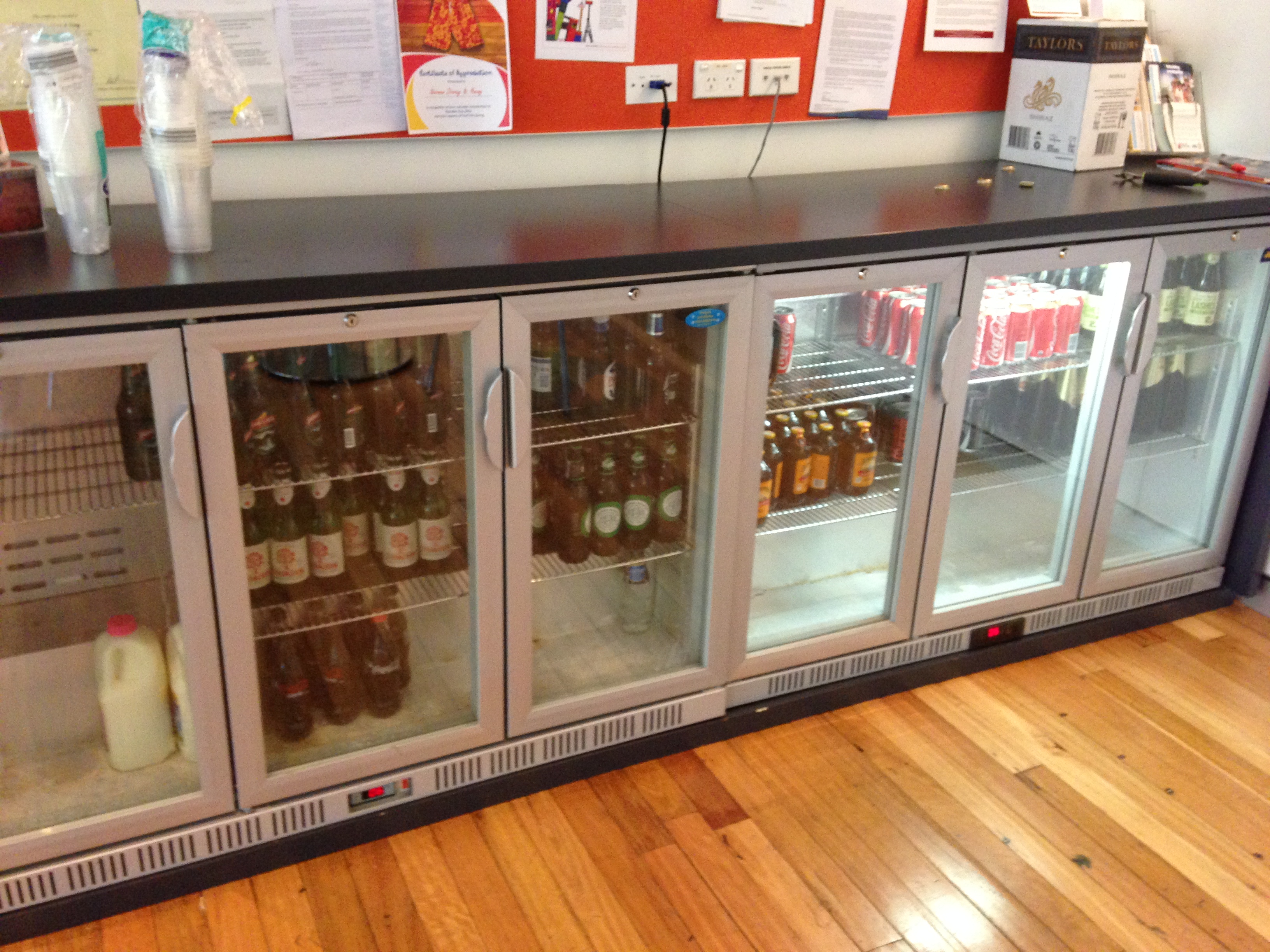
Australia is still awesome. And the consultants here have a friday afternoon beer fridge.
Job cuts in the North Sea
I thought I’d spend a few moments putting pen to paper on the recent announcement by BP to cut 300 out of 3,500 jobs in the North Sea. (This note only refers to BP North Sea Global Operations Organisation.)
This was formally announced last Thursday in a Town Hall, i.e. get yourselves to the Gym for a centralised briefing (except this wasn’t three line whip). Whilst not directly influenced by this announcement I had a certain amount of interest, having been an observer during the recent military job cuts.
The Town Hall was delivered by the Regional President of the North Sea, Trevor Garlick, supported by the VP of HR, David Conway. In contrast to the military redundancy briefings it was not delivered from a script, however, it was clear that the brief had been prepared and was supported by a handful of slides. As can be expected the tone of the brief was also considerably different, in that it was softer and laboured on the fact that the decision to make the cuts was not linked to the cut in the price of oil but is a measure that had been under review and developed since Q4 2014.
So how did BP come to the number 300? The business driver is a simplification and efficiency agenda. In recent years BP has seen a 50% reduction in production, with an increase in costs of 37% and personnel by ~20%, all leading to a level of efficiency that is not competitive in the North Sea. Therefore in an effort to improve efficiency BP has scrutinised the activities in 2014, as it is the engineering, design, fabrication and execution of the activities that is costing the money, not the employee head count. With the activity set reduced the corresponding reduction in associated employee and contractor headcount was calculated. The 300 is split into 200 employees and 100 contractors, though the final numbers and split is still subject to consultation.
The execution of the redundancy programme itself does bare some similarities to the military redundancies. BP is openly inviting those that will take voluntary redundancy to come forward, through a process called expression of interest. It is not guaranteed that an individual will be selected, but it is hoped that it will reduce the number of compulsory redundancies. This process in open for a few more weeks and will close in February. After this point the VPs of each function will conduct a selection process and identify those individual that will be given voluntary redundancy and those that have been selected for compulsory redundancy. It is expected that the selection and announcements will be early in 2015 with those selected for redundancy leaving by end of Q2 2015.
One of the points laboured in the townhall was safety and how that will not be compromised during this process and this has led to certain trades being ‘ring fenced’. In simple terms all offshore worker have been excluded from the redundancy process as a cut in the offshore workforce was considered detrimental to safety. The impact of this is that half of the 3,500 is exempt from redundancy with the remaining pool approximately 1,750 strong. This relates to a 17% cut in the eligible workforce.
How does this affect me in the Project and Modification Team? At the moment I haven’t seen any direct impact in BP, though I expect that in the coming months the team will see some people leave as 80 of the 300 job cuts will occur in the Operations function, in which Projects and Mods sit. Some of this will be through redundancy though I expect some contractors will walk before being pushed as they look for other opportunities before the axe falls. Where these opportunities might be I don’t know, as many of the other operators and service companies are cutting jobs with considerably more gusto.
In terms of activities, I have seen little change in the desire to execute the work that I am responsible for as a significant amount of it is safety related and therefore tied to consent to operate. The remainder of projects have comparatively large operation efficiency impacts and so the business case that supports them remains valid, even with the depressed oil price.
Outwith BP I am starting to see some impact in the delivery of my projects. A number of senior Projects Engineers and discipline engineers in WGPSN have already made the jump and more are preparing to move on. The resultant churn as WGPSN attempts to balance resources will undoubtedly place pressure on the project schedules. In the coming months it will be important to spend more time with the Project Teams, which are unfortunately geographically remote, to keep the delivery on schedule / mitigate any impact that the churn has.
In closing this note I thought I would share Bob Dudley’s (BP CEO) comments at the World Economic Forum in Davos, Switzerland. He said: “We have got to plan on this (the oil price) being down for certainly a year, probably two and maybe three years.” Difficult times ahead for the oil industry and I expect that we will see more in the news.
 Holdfast Training Services Trial Blog