Archive
NLE Project Introduction

I started on Monday this week on the Northern Line Extension (NLE) at the Battersea Site. The project is a JV between Laing O’Rourke and Ferrovial Agroman known as (FLo).
The project client is London Underground (LU) tho
ugh the extension and stations are heavily integrated into the whole regeneration of the area. So Battersea Development (who are part funding the NLE along with 41 other developers) are leaning quite heavily on London Underground. Phase 3 of the Battersea development will sits on top of the station box. A big change to the structure caused a change to the design of the station which has resulted in an 8 month delay, and the design for the station is still being finished. Regardless, the political pressure (Boris Johnson’s office) would still like the development to be finished for 2020. I believe the commercial teams are still debating who will pay for this. The change to the structure caused the design to be changed delaying and extending the project length.
The Project
The project is a 3.5km extension of the Northern Line which will continue the Northern Line from Kennington with two new Stations at Battersea and Nine Elms. The line will have 100m overrun tunnel (under the cats and dogs home) which will serve to store two trains over night for morning service. That tunnel will eventually connect the line to Clapham Junction. The value of digging just 3.5km with two TBMs is apparently justified. Clapham extension too can’t be done now as there are no funds and apparently Clapham junction cant take the additional capacity just yet.
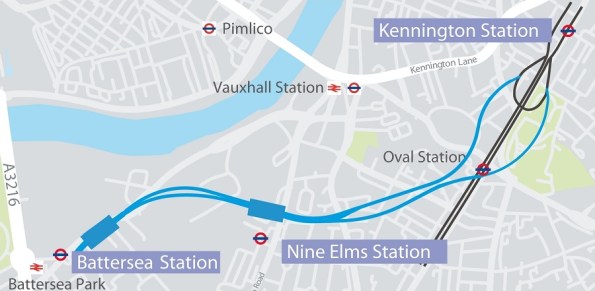
In outline, the project is split into four sites. Two stations at Battersea and Nine Elms and two shafts at Kennington. The box at Battersea will consist of the station box and a crossover box. The crossover box (space for trains to swap sides before they return) will be used as the launch tunnel for two TBMs (Tunnel Boring Machines). The station at Nine Elms is relatively independent other than they must be at depth before the TBMs arrive. The last two sites are the shaft that connect to the existing line at the Kennington Loop where the TMBs will be lifted out. The shafts will then remain as ventilation and emergency escape for the tunnels.
Joint Venture.
I understand that Ferrovial were brought onboard primarily for their tunnelling experience where as Laing are taking the lead on the station boxes and the shafts. Despite this the site office is a 50/50 mix from both companies. I understand there is a slight friction with the Spanish side of the team as they are very commercially savvy but see the role of a site/section engineer in a very different way. Commercially sensitive material is apparently spoken in Spanish which makes by ability to speak the lingo quite helpful.
At least they got the specification of the biscuits sorted…
As promised last week, this blog will aim to outline what my role will entail, detail the main challenges associated with the project and highlight some issues that I’ve already come across.
Job role
I’ve been given the job title of Building Services Manager and as I mentioned last week I am being given responsibility for the services in the basement; although it looks like I’m going to be shadowing the principal building services manager whilst I earn my spurs. The M&E services within phase 1 are being delivered by one main sub-contractor, Skanska. My role will involve setting benchmarks for different areas / services within the basement and ensuring these are complied with, reviewing & approving risk assessments and method statement (RAMS) and conducting Inspection and Testing Plans (ITPs). There will also be an element of facilitating Skanska’s work within the basement and coordinating with Carillion’s project manager for the basement. Any feedback from the PEW staff or cse 55 on whether this seems like a sensible role for working towards passing professional review would be greatly appreciated.
Project Challenges
The most significant challenges on the project appear to be logistics, the programme and design.
The logistics issues with the site are caused by the lack of available space on site for storage, the size of the build and limited hook time (despite there being 10 tower cranes on site) available. The service risers, corridor modules (horizontal pipework distribution), bathrooms, apartment utility cupboards (consumer unit, DHW and MVHR) and plant rooms are being pre-fabricated and brought onto site as modules for final connection. Byrne brothers, the concrete contractor, have priority on hook time, so Skanska are having to move their stores onto the appropriate floor between 1730 and 2200. The demand on lift is also stopping waste material leaving the site promptly and is having an impact on housekeeping. The logistic issues look like they will be a challenge throughout the construction phase although I am looking at options to alleviate this in the basement by getting round the reliance on the tower crane.
The programme has had to change for various reasons and is becoming more aggressive as acceleration is used to try and claw back the 22 weeks of delay. Work is regularly being carried out until 2200 during the week and the site is open on Saturdays. Hopefully a final version of the programme will shortly be agreed when the client and Carillion come to a consensus on how the existing delay and future variation that I previously mentioned will be dealt with.
The final challenge is the design, which is still evolving as the client varies his requirement. Again it is hoped that this should be finalised shortly. There does appear to be some method in the client’s madness to changing their mind constantly; there is a general push to complete the entire redevelopment as quickly as possible to capitalise on London’s high property prices. Therefore phase 1 construction was started before the remaining phases were designed and this is causing issues and additional costs where there is inter-dependency. At least it looks like there is no inter-dependency or requirement for change when it comes to biscuits. Whilst wadding through reams of project documentation I came across the following clause in the employer’s requirements:
The Contractor is to ensure that…a selection of biscuits is to be provided at all times which should include but not be limited to chocolate digestives, chocolate bourbons and ginger biscuits. Cadbury’s chocolate selection and pink wafer biscuits or similar is to be provided for Principal and Project meetings.
The story so far.
To date I’ve generally been shadowing people around site and reading into the project documentation. A recent walk-around produced an interesting turn up for the books. Skanska had been craning some of the pre-fabricated service risers into position. Due to their allocated hook time this was occurring late into the evening. During a walk around on Friday morning the following was found:

Service riser with non-RAMS compliant edge protection.
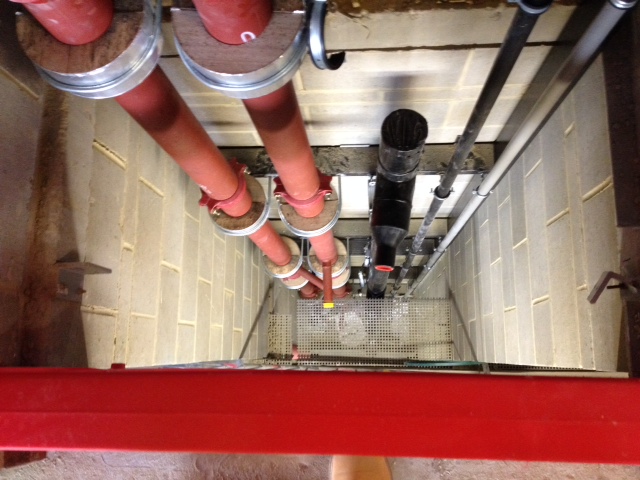
3m fall behind flimsy plastic barrier
Essentially the service risers had been left without Dura grid in at each floor, the protection in front of the riser was not as per the RAMS and was deemed to be unsafe. The immediate solution was that works were stopped until Skanska had rectified the issue, which was achieved within a couple of hours. This final solution was the installation of anchor bolts on each side of the riser to which ply board was bolted and the appropriate warning signs attached. What I found particularly interesting was that initial discussions were that a near miss should be created for the issue, despite the fact that nothing had fallen down the riser and nobody had come close to falling down the riser. However, as soon as the Integrate Systems Management (ISM) manager highlighted that a near miss would need putting on AIRline and impact on Carillion’s Key Performance Indicators the situation was de-escalated. A decision was instead made to produce an internal report rather than a near miss. My conclusion is that safety is taken seriously but so is performance and reputation. It also ties in with what Guz mentioned with regards to the five times the tipper truck on his site could have rolled but wasn’t recorded. The real cause of the problem is undoubtedly the time the work was carried out. Skanska’s hook time is in the evening, but their operatives work throughout the day as well. It is more than likely that it is guys from the day shift who are working overtime in the evening and an attitude of let’s just get the job done and get home is what led to it not being finished off properly. The programme does not allow for evening works to be cancelled and so it looks like the solution will be to employ additional supervisors specifically for the evening to ensure RAMS are being adhered to.
Initial blog from Battersea
After three weeks leave, I have now arrived on site at phase 1, Battersea Power Station and started working for Carillion. This blog will outline the scope & set-up of the Battersea development and identify what seems to be the most significant M&E elements to phase 1 in order to set the context for future blogs.
The entire power station development will be split into 7 phases, phases 1 – 3 of which are now up and running. I’ll expand on phase one in the next paragraph. Phase two is the development of the power station which is being carried out by Skanska, phase three is just beginning and will be an extension to the Northern line. The entire development is scheduled for completion in 2025. The client is the Battersea Power Station Development Company, which is a Malaysian consortium investing approximately £8bn into the redevelopment. The client’s architect is Ian Simpson Architects, structural advisor – Burro Happold, M&E advisor – Hoare Lea, Quantity surveyor – Gardner & Theobold and Project Manager – Turner and Townsend. The client’s team has designed the project up to RIBA stage D.
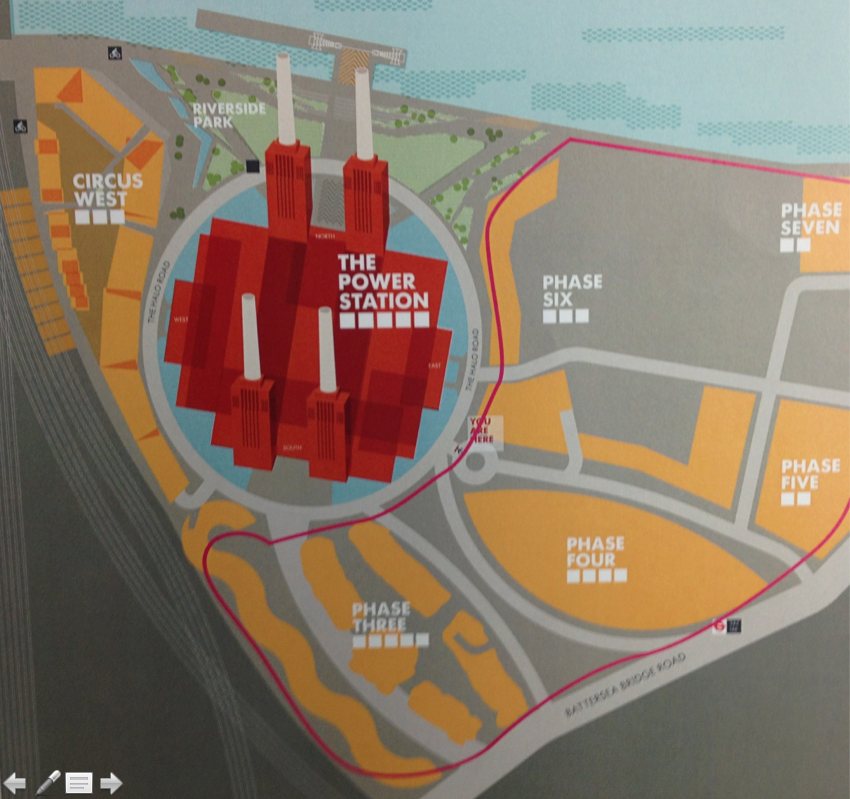
Overview of the Battersea Power Station Development. Phase 1 is labelled as Circus West.
Phase 1 consists of 866 luxury apartments located in the North West corner of the Battersea site; between the railway line into Victoria, the river Thames and the power station itself. Carillion are the principle contractor working under a JCT design and build contract to take the project from stage D to completion. Apartments range in price from £800k for a studio apartment to £4m for a four bed. The build is split into seven cores (A to G) which form RS1A, with a further five cores (H to L) which make up RS1B. RS1A is 14 stories tall with two basements and RS1B eight with two basements. Phase 1 is currently 74 weeks into a 148 week schedule, although this is likely to be extended.
The heating & cooling to the apartments will be provided by mechanical ventilation with heat recovery linked to a communal energy system. The most significant M&E engineering element associated with phase 1 seems to be the construction of an energy centre in the basement of core G. This will involve the installation of 2 x 4.2 MW boilers & 1 x 7.2 MW boiler, and 2 x 1.5MW & 1 x 3MW chillers. The original concept design saw this energy centre (which supplies services site wide, not just to phase 1) being constructed as part of phase 2. It appears the client is unable to complete this work prior to phase 1 & 2 being handed over and occupied. Therefore a variation has been made to phase 1 to install the energy centre in the basement of core G. This variation looks as if it will bring significant challenges with it. The current building design does not incorporate flues for the boilers that will be in the energy centre. This means a solution to take the flue gases across to phase 2 and up one of the power station stacks is having to be explored. The space available and limiting factors of working in the basement of block g means that certain elements of the energy centre will still need to be located remotely. This currently looks like it will involve the build of a remote cooling compound incorporating two cooling towers (let’s hope we don’t get legionnaires) for the chillers and life safety system generators. The remote cooling compound will be located somewhere on phase 4’s real estate and cross phases 2 and 3 to connect it, which will bring its own challenges. This remote cooling compound will bring about significant costs, effort to construct and is only temporary. The long term plan is build the original energy centre at the front of phase 2, connect it to the energy centre in the basement of core g, allowing the remote cooling centre to be removed in time for construction on phase 4 to start.
The Carillion M&E team currently consists of 6 personnel; head of M&E, 1 x design , 2 x commercial, 1 x delivery and myself. My role is looking like it will focus on the basements and the energy centre in core g, which should provide plenty of opportunities, but will involve working in a damp dark basement for a large portion of my time.
That should do for setting the context of the project. I’ll aim to provide another blog next week which outlines a little more of what my role will be and more details on the challenges / risks associated with the project.
Found it: My arrival at the Power Station
Well I have found the draft of my first blog attempt so here is take 2!
Firstly this project is HUGE!!! Carillion are the lead contractors for Phase 1 of the £8 billion project to regenerate the power station and surrounding area. They will be building 2 apartment blocks between 8 and 18 floors in the sliver of land between the power station and the railway line. A good picture of it and explanation are here: http://www.costar.co.uk/en/assets/news/2012/December/Battersea-first-phase-powers-up/
They are going down 2 floors behind a cofferdam made from sheet piling hopefully without disturbing our neighbours-Network Rail and Mace in the power station. It is basically Ex COFFERDAM on a massive scale! (John you would be in heaven here!) They have finished the cofferdam which is made of sheet piling to provide a cut off 1m into the London Clay which is around 8m below ground level and they are now welding the seams. The main activity at the moment is piling the 1700 piles that will make up the raft of foundations! They have around 3 piling rigs and a lot of excavators dancing around each other on the pretty confined site.
Here are some pictures of what is going on:
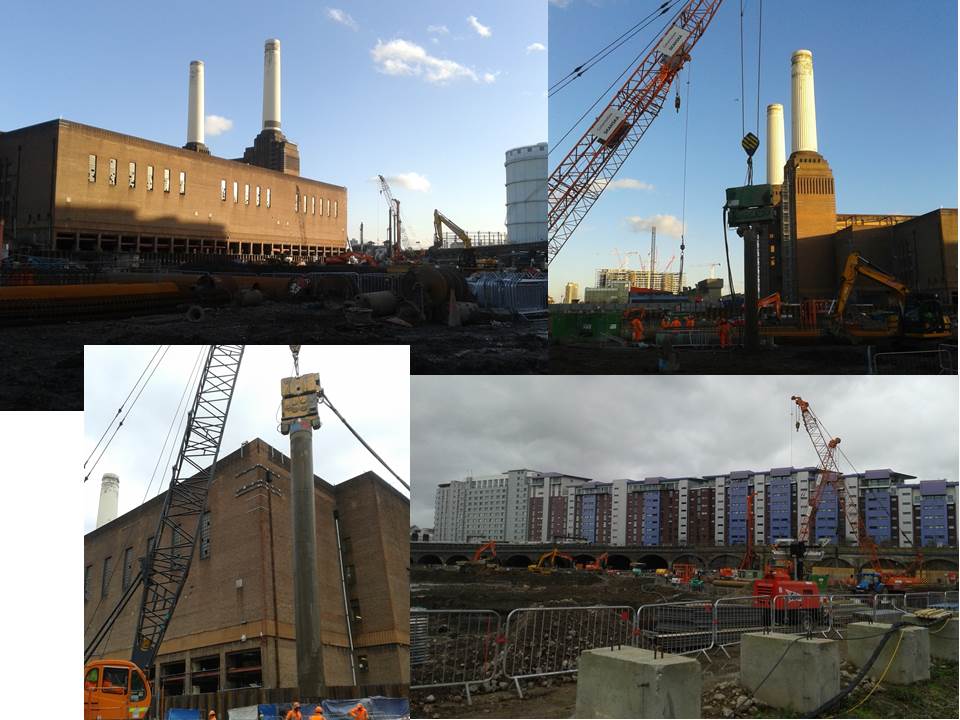
There are 3 main sub-contractors working on site: Appleton doing the sheet piling, Skansa Cementation doing the piling and O’Keefe seem to be doing everything else including excavations and drainage. It is quite an unusual set up as there is another company Elliot Thomas who run the site allocation as it is such a large development and Mace are already working on Phase 2 which is the redevelopment of the power station itself. We also have London Underground conducting borehole testing for the new station that will be built in the later phases. As the lead contractors Carillion seem to be more of the project managers of the site at the moment.
So far it looks like I am going to take on the role of one of the Section Engineers and I get to look after Utilities going out/into the site (aka OIC power and shitters!). We are looking to pipe jack a 375mm dia foul water pipe under Battersea Park Road into Thames Water’s existing sewer (and I need to get it adopted-glad I listened in the drainage lecture!). I also need to get our high voltage cable hooked up to the mains by the 1st April otherwise we have to pay for the generators for longer.
So far they have had big issues with the weather on site as it is turning into a nice muddy puddle-including the piling mats. They have had issues with the 6F2 material they have been using and the fines have been becoming a muddy slurry rather than a solid platform. There is potentially some scope for a TMR along those lines. I also attended a 4C’s meeting (something about Collaboration, Co-operation and some other C’s no-one seems to remember) which is basically a daily O Gp between the main contractor’s Foremen and Carillion. I could not believe the amount of whinging they made about not having a smoking shelter down in the main working area and then the logistics and temporary works design (TWD) that went behind putting one up! They even need to get a TWD to put up a barrier! It is really Health and Safety to the max and I now really respect the fact that we can trust our soldiers not to throw themselves off the top of the excavation they have just dug. I think they need a Sgt Major on site just to do the H+S patrol!
Anyway that is enough for my week 1 excitement I will attempt to put a few photos up and I will continue to chat up the guy from Mace to get a tour of the power station and trip up the chimney!
Where did my blog go?
Well I have just wasted about an hour and a half writing my first blog all for it to disappear into the ether despite saving the draft! So if anyone knows where it has gone please tell me where to find it! It isn’t saved in my blogs and I can’t find it in the HTS part-it seemed to disappear when I previewed it.
Anyway here is the truncated version:
I am working on this part of the project which is HUGE!! http://www.costar.co.uk/en/assets/news/2012/December/Battersea-first-phase-powers-up/
It is basically Ex COFFERDAM building 8-18 floors with a cofferdam right next door to the power station and the railway lines running into Victoria. It looks like I will be OIC HV cables and the foul water main (yeah sewers!). I did write a whole page about who was doing what and how surprised I am about the amount of hoops that need to be jumped through to get stuff done but that has disappeared! So I will keep this short and hopefully find my old post or learn how to use this stupid site before next week!
 Holdfast Training Services Trial Blog