Archive
At least they got the specification of the biscuits sorted…
As promised last week, this blog will aim to outline what my role will entail, detail the main challenges associated with the project and highlight some issues that I’ve already come across.
Job role
I’ve been given the job title of Building Services Manager and as I mentioned last week I am being given responsibility for the services in the basement; although it looks like I’m going to be shadowing the principal building services manager whilst I earn my spurs. The M&E services within phase 1 are being delivered by one main sub-contractor, Skanska. My role will involve setting benchmarks for different areas / services within the basement and ensuring these are complied with, reviewing & approving risk assessments and method statement (RAMS) and conducting Inspection and Testing Plans (ITPs). There will also be an element of facilitating Skanska’s work within the basement and coordinating with Carillion’s project manager for the basement. Any feedback from the PEW staff or cse 55 on whether this seems like a sensible role for working towards passing professional review would be greatly appreciated.
Project Challenges
The most significant challenges on the project appear to be logistics, the programme and design.
The logistics issues with the site are caused by the lack of available space on site for storage, the size of the build and limited hook time (despite there being 10 tower cranes on site) available. The service risers, corridor modules (horizontal pipework distribution), bathrooms, apartment utility cupboards (consumer unit, DHW and MVHR) and plant rooms are being pre-fabricated and brought onto site as modules for final connection. Byrne brothers, the concrete contractor, have priority on hook time, so Skanska are having to move their stores onto the appropriate floor between 1730 and 2200. The demand on lift is also stopping waste material leaving the site promptly and is having an impact on housekeeping. The logistic issues look like they will be a challenge throughout the construction phase although I am looking at options to alleviate this in the basement by getting round the reliance on the tower crane.
The programme has had to change for various reasons and is becoming more aggressive as acceleration is used to try and claw back the 22 weeks of delay. Work is regularly being carried out until 2200 during the week and the site is open on Saturdays. Hopefully a final version of the programme will shortly be agreed when the client and Carillion come to a consensus on how the existing delay and future variation that I previously mentioned will be dealt with.
The final challenge is the design, which is still evolving as the client varies his requirement. Again it is hoped that this should be finalised shortly. There does appear to be some method in the client’s madness to changing their mind constantly; there is a general push to complete the entire redevelopment as quickly as possible to capitalise on London’s high property prices. Therefore phase 1 construction was started before the remaining phases were designed and this is causing issues and additional costs where there is inter-dependency. At least it looks like there is no inter-dependency or requirement for change when it comes to biscuits. Whilst wadding through reams of project documentation I came across the following clause in the employer’s requirements:
The Contractor is to ensure that…a selection of biscuits is to be provided at all times which should include but not be limited to chocolate digestives, chocolate bourbons and ginger biscuits. Cadbury’s chocolate selection and pink wafer biscuits or similar is to be provided for Principal and Project meetings.
The story so far.
To date I’ve generally been shadowing people around site and reading into the project documentation. A recent walk-around produced an interesting turn up for the books. Skanska had been craning some of the pre-fabricated service risers into position. Due to their allocated hook time this was occurring late into the evening. During a walk around on Friday morning the following was found:

Service riser with non-RAMS compliant edge protection.
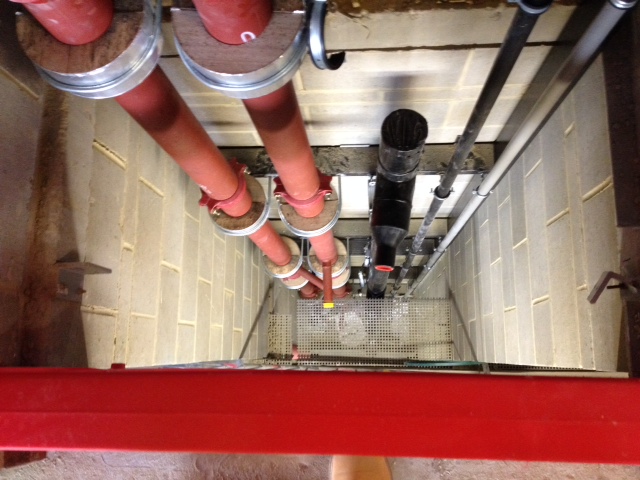
3m fall behind flimsy plastic barrier
Essentially the service risers had been left without Dura grid in at each floor, the protection in front of the riser was not as per the RAMS and was deemed to be unsafe. The immediate solution was that works were stopped until Skanska had rectified the issue, which was achieved within a couple of hours. This final solution was the installation of anchor bolts on each side of the riser to which ply board was bolted and the appropriate warning signs attached. What I found particularly interesting was that initial discussions were that a near miss should be created for the issue, despite the fact that nothing had fallen down the riser and nobody had come close to falling down the riser. However, as soon as the Integrate Systems Management (ISM) manager highlighted that a near miss would need putting on AIRline and impact on Carillion’s Key Performance Indicators the situation was de-escalated. A decision was instead made to produce an internal report rather than a near miss. My conclusion is that safety is taken seriously but so is performance and reputation. It also ties in with what Guz mentioned with regards to the five times the tipper truck on his site could have rolled but wasn’t recorded. The real cause of the problem is undoubtedly the time the work was carried out. Skanska’s hook time is in the evening, but their operatives work throughout the day as well. It is more than likely that it is guys from the day shift who are working overtime in the evening and an attitude of let’s just get the job done and get home is what led to it not being finished off properly. The programme does not allow for evening works to be cancelled and so it looks like the solution will be to employ additional supervisors specifically for the evening to ensure RAMS are being adhered to.
Initial blog from Battersea
After three weeks leave, I have now arrived on site at phase 1, Battersea Power Station and started working for Carillion. This blog will outline the scope & set-up of the Battersea development and identify what seems to be the most significant M&E elements to phase 1 in order to set the context for future blogs.
The entire power station development will be split into 7 phases, phases 1 – 3 of which are now up and running. I’ll expand on phase one in the next paragraph. Phase two is the development of the power station which is being carried out by Skanska, phase three is just beginning and will be an extension to the Northern line. The entire development is scheduled for completion in 2025. The client is the Battersea Power Station Development Company, which is a Malaysian consortium investing approximately £8bn into the redevelopment. The client’s architect is Ian Simpson Architects, structural advisor – Burro Happold, M&E advisor – Hoare Lea, Quantity surveyor – Gardner & Theobold and Project Manager – Turner and Townsend. The client’s team has designed the project up to RIBA stage D.
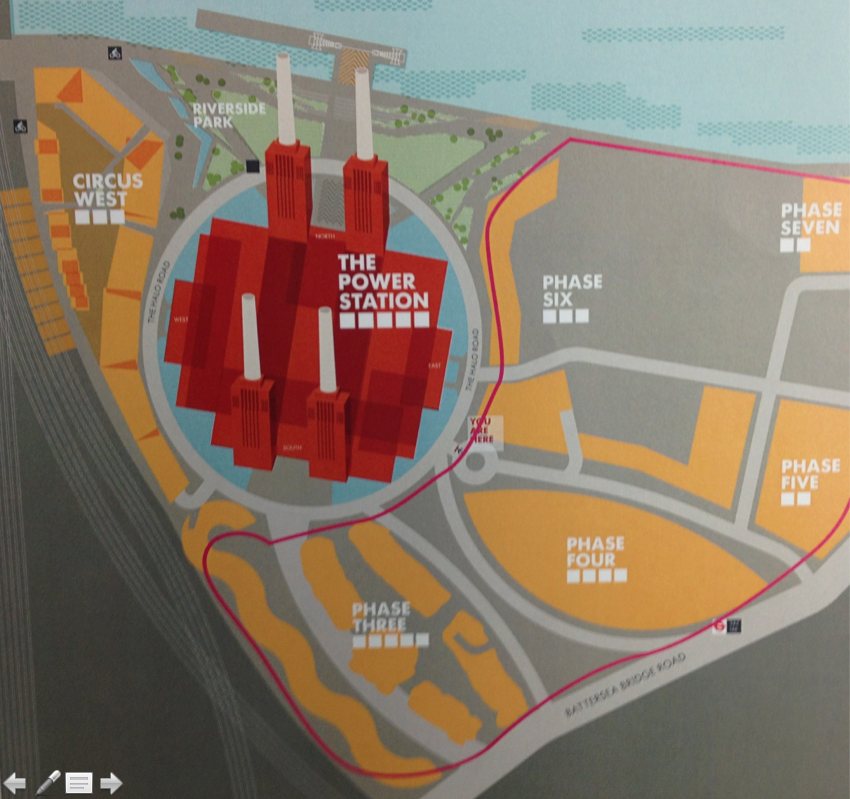
Overview of the Battersea Power Station Development. Phase 1 is labelled as Circus West.
Phase 1 consists of 866 luxury apartments located in the North West corner of the Battersea site; between the railway line into Victoria, the river Thames and the power station itself. Carillion are the principle contractor working under a JCT design and build contract to take the project from stage D to completion. Apartments range in price from £800k for a studio apartment to £4m for a four bed. The build is split into seven cores (A to G) which form RS1A, with a further five cores (H to L) which make up RS1B. RS1A is 14 stories tall with two basements and RS1B eight with two basements. Phase 1 is currently 74 weeks into a 148 week schedule, although this is likely to be extended.
The heating & cooling to the apartments will be provided by mechanical ventilation with heat recovery linked to a communal energy system. The most significant M&E engineering element associated with phase 1 seems to be the construction of an energy centre in the basement of core G. This will involve the installation of 2 x 4.2 MW boilers & 1 x 7.2 MW boiler, and 2 x 1.5MW & 1 x 3MW chillers. The original concept design saw this energy centre (which supplies services site wide, not just to phase 1) being constructed as part of phase 2. It appears the client is unable to complete this work prior to phase 1 & 2 being handed over and occupied. Therefore a variation has been made to phase 1 to install the energy centre in the basement of core G. This variation looks as if it will bring significant challenges with it. The current building design does not incorporate flues for the boilers that will be in the energy centre. This means a solution to take the flue gases across to phase 2 and up one of the power station stacks is having to be explored. The space available and limiting factors of working in the basement of block g means that certain elements of the energy centre will still need to be located remotely. This currently looks like it will involve the build of a remote cooling compound incorporating two cooling towers (let’s hope we don’t get legionnaires) for the chillers and life safety system generators. The remote cooling compound will be located somewhere on phase 4’s real estate and cross phases 2 and 3 to connect it, which will bring its own challenges. This remote cooling compound will bring about significant costs, effort to construct and is only temporary. The long term plan is build the original energy centre at the front of phase 2, connect it to the energy centre in the basement of core g, allowing the remote cooling centre to be removed in time for construction on phase 4 to start.
The Carillion M&E team currently consists of 6 personnel; head of M&E, 1 x design , 2 x commercial, 1 x delivery and myself. My role is looking like it will focus on the basements and the energy centre in core g, which should provide plenty of opportunities, but will involve working in a damp dark basement for a large portion of my time.
That should do for setting the context of the project. I’ll aim to provide another blog next week which outlines a little more of what my role will be and more details on the challenges / risks associated with the project.
Quick the HSE are coming-go and paint that mud brown….
….wait no, paint any undulating piece of ground yellow just in case you might trip over it!!
The first half of this week was spent making sure you could walk round the site blindfolded without tripping over, getting hit by a piling rig, falling in a hole or snort asbestos. The HSE were coming to visit on Wed morning and it resembled a visit from the CGS or the Queen. On Mon we had a management walk around with our H&S Advisor to pick up on a list of improvement points which were mostly just site tidiness and pedestrian segregation. For such a big but also constrained site it wasn’t too bad.
I finally got my fence moved 3m and the GPR Survey team arrived to survey as much of the embankment as they could. This week I was able to get them in the gate I wanted to and I even organised somewhere for them to park which was an improvement on last week’s fiasco. We also made some progress with the second mystery pipe however not as much as we hoped. The Carillion Utilities team came out to tap the pipe on Thursday so on Wed afternoon I requested the contractors uncover a straight part of the pipe. Unfortunately they encountered a second bend and then ran out of trench box to dig further. The utilities guys decided to have a go at tapping it anyway but in the process they broke their drill! So that left us with a mystery pipe with the start of a hole in it, 6m down in a trench box, 3m away from the Network Rail fence and 1m from our access road. Why are things never easy? Hopefully tomorrow I will find out that they fixed their drill and came back on Sat to show that it was empty?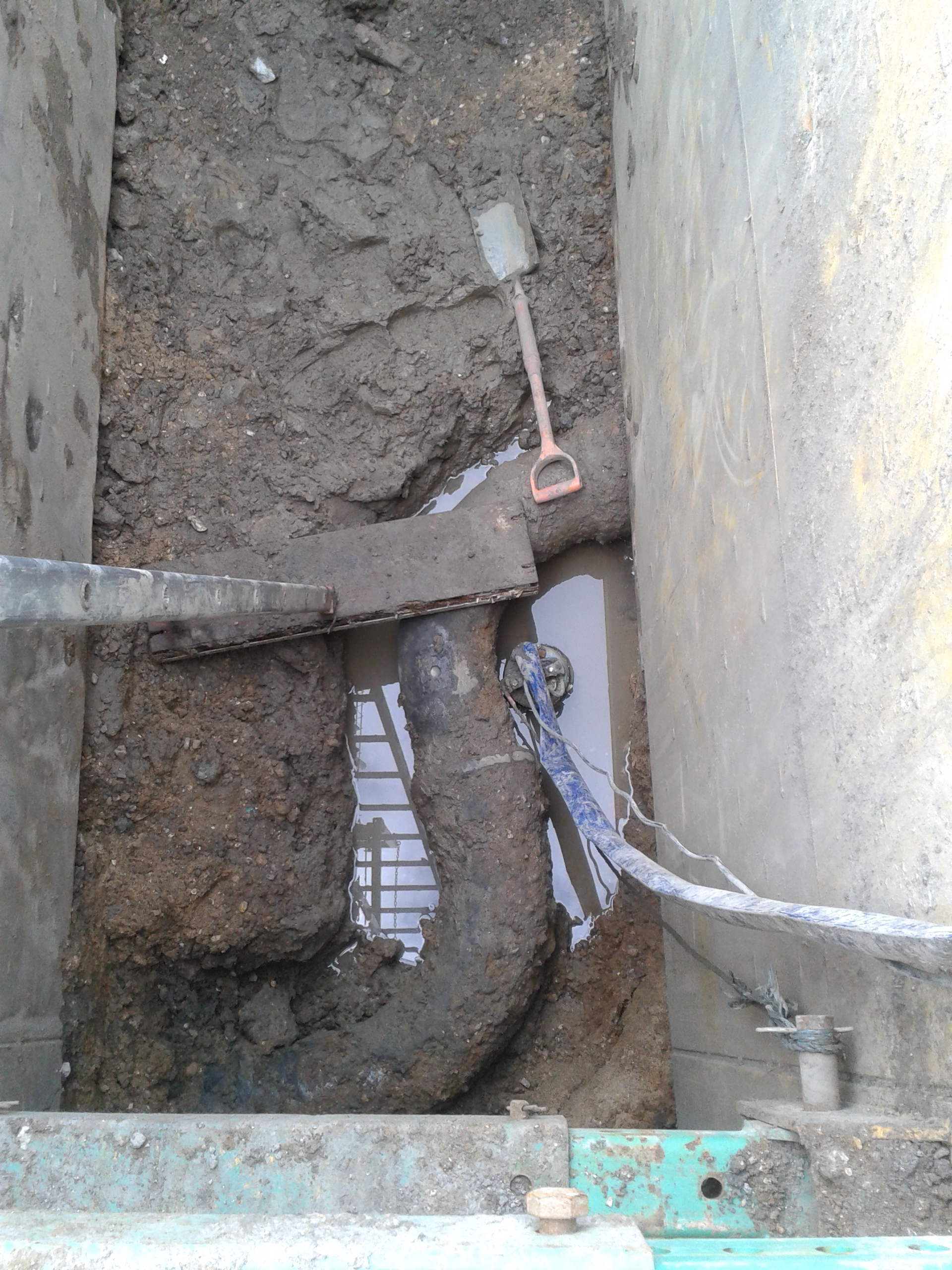
I am also in a similar position to Rich Hall working for the management contractors rather than the sub-contractors on the coal-face. At first I thought the closest I was getting to technical engineering was building my Ikea bookcase and installing mud-guards to my commuting bike. However I have taken on the role of being the Section Engineer in charge of utilities and the Network Rail Access Road and I am now starting to ‘identify and solve engineering problems’. I have already found a problem with my second HV substation and I will probably write more about that the end of this week. My role also includes checking Risk Assessments and Method Statements (RAMS) and Inspection and Test Plans (ITPs). Again I feel a bit like the Sqn 2IC who is collecting and checking the Troopy’s paperwork and regularly inspecting their work on the ground. I was due to sign off and inspect the HV substation during the pre-pour checks on Fri afternoon but they weren’t ready in time and I had to catch my lift to Bedford to finally rescue my van from the garage it had been at for 2 months. Hopefully I will get to do the other concrete pour next week. I am also planning on spending a bit of time on the ground with the sub-contractor’s engineers to do more of the detailed engineering on the ground.
This week I did have another ‘debate’ with the site management company about whether I was working on their land or not. This time they told me that we needed to make part of it a pedestrian walkway even though that was what they stopped me doing last week. Apparently it is clearly on the drawing that I have never seen before! I can see I am going to have some fun over land management! One of them also advised me that I needed to keep an eye on the contractors working safely. He pointed out that there were no mushroom caps on the protruding parts of the clamps holding the formwork together even though the guys were still building it. He also said that there should be edge protection on the shuttering as they were climbing onto the 1.2m high formwork whilst still building it. How on earth you are meant to edge protect something so low I am not sure and seeing as falling from it wasn’t in the RAMS I don’t think anyone saw it as a risk. In my eyes they were not doing anything wrong or putting themselves in danger so without covering every labourer in cotton wool or body armour I am not sure how far we are meant to go! I am now slightly concerned with my approach to digging up the tree trunk in my garden, I might install edge protection to the 50cm excavation (that is battered to a safe angle) to ensure that the neighbours cat doesn’t fall in over the week!!
Get off my land, you can’t park here and what’s this big pipe?
This week I have established that the crux of this construction project will not be the temporary works designs, rubbish ground conditions or water, it is going to be one of frustrating logistics, the snakes nest of buried services on the site and getting in each other’s way! Due to the number of different phases of the Power Station Redevelopment there is an unusual hierarchy of contractors working on the site which I have likened to a Regiment in PPP with Holdfast:
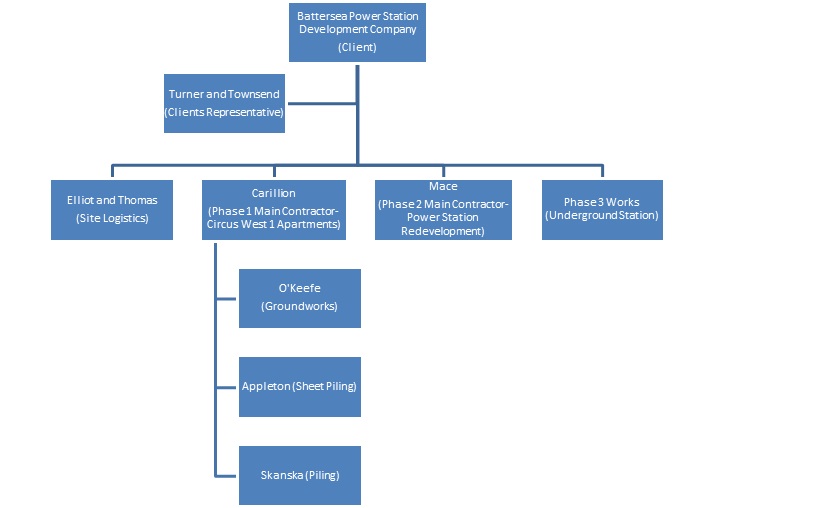
So I see ourselves in Carillion as a Squadron HQ working to achieve the Regiment’s (Client’s) main aim of the development of the power station and surrounding area. As the main contractor for phase 1 we employ a number of sub-contractors to complete various elements of the tasks. I liken these to the Troops in a Squadron and the site engineers and project managers are like the Troop Commanders. We tell them to do something, they then fill out loads of paperwork (risk assessments and method statements) that I check and send back to them red-penned, they get the go ahead to do the job and I check it-just like being a Sqn 2IC again! They have Black Hat Supervisors who are like the Troop Staff Sergeants, the Banksmen are like the JNCOs and the labourers are the Sappers. The Contractors (Troops) try and pull the wool over Carillion’s (Sqn SHQs) eyes to get away with minimal work!
The unusual part about this project is that Carillion are also part of the big picture that I class as the ‘Regiment’. We are just the 1st part of the redevelopment that will include renovating the power station into retail, offices and residential and the building of an underground station on site. Therefore the client employs Elliot and Thomas to control site logistics. They man the security gates, control communal areas of the site generally manage the land. I liken these to Holdfast for two reasons: the first being that they seem to do all the odd jobs that we used to get soldiers to do; the second being that to get them to agree to anything requires a ridiculous amount of paperwork and they are about as flexible as a piece of concrete! My Monday morning started with me spending 45 mins trying to negotiate where I could park the vehicles of my GPR surveying team. Despite me asking nicely they were not allowed to park in the space nest to the gate they were surveying near, instead they got sent about 1km around the site, into the muddy groundworks box, through the wheel wash back to 50m from where they started. Two days later I got a call from their boss to say that we had put a pedestrian barrier ‘on their land’ that I had not filled out a permit request for and London Underground wanted to put a borehole there. Today I found out it was my land and I was well within my rights to be there!
The rest of this week seems to have been spent organising moving a fence back 3m to fit my HV substation in. This requires a GPR survey, Network Rail Approval of the risk assessment and method statements, confirmation of Japanese Knotweed removal and the moon to align with Venus and some other stars before it gets done!
And the most exciting part of the week was the unearthing of the big fat f-off pipe. Shown as a ‘faint’ signal on the GPR survey the boys uncovered this 900mm diameter cast iron pipe:
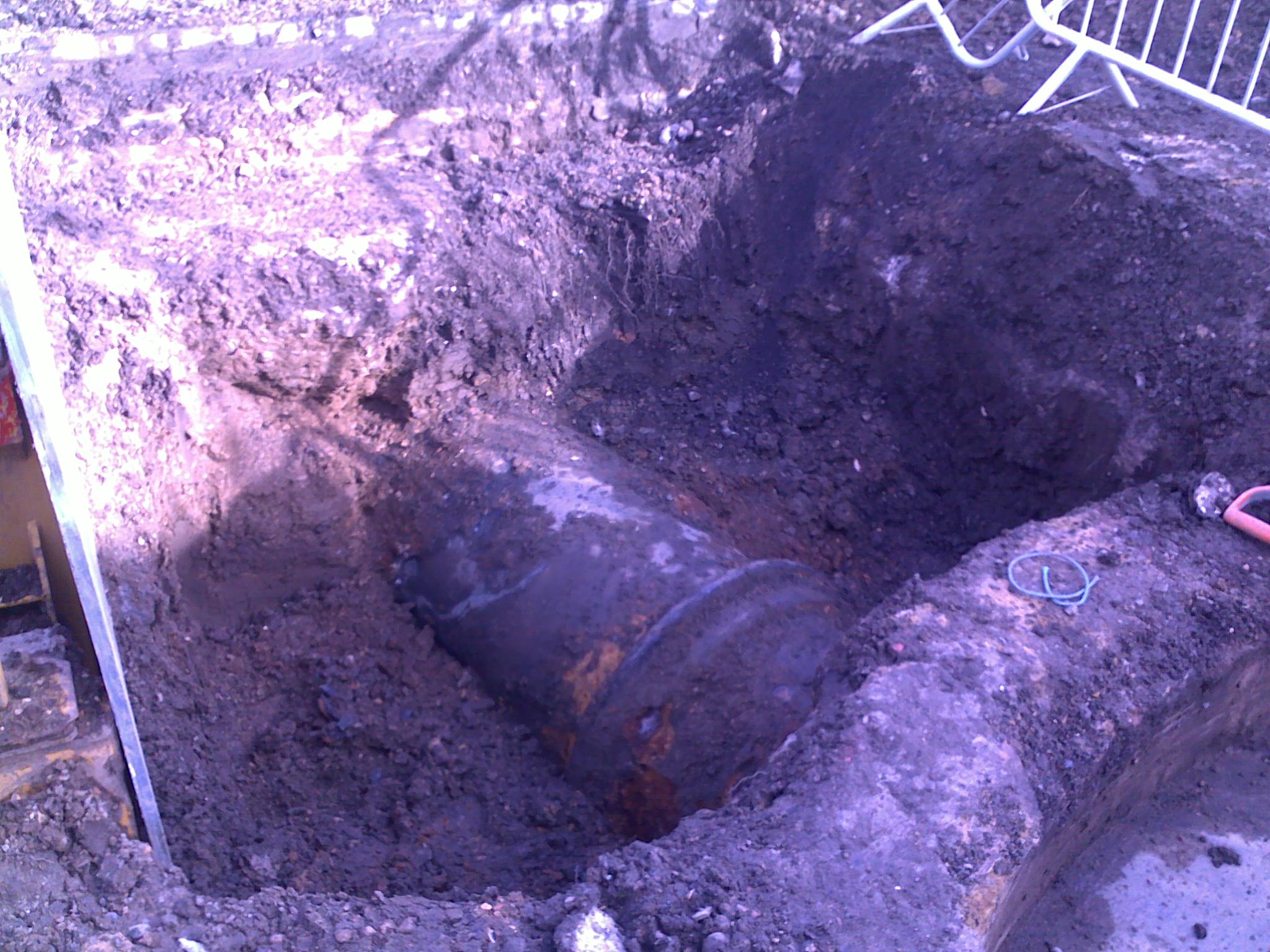
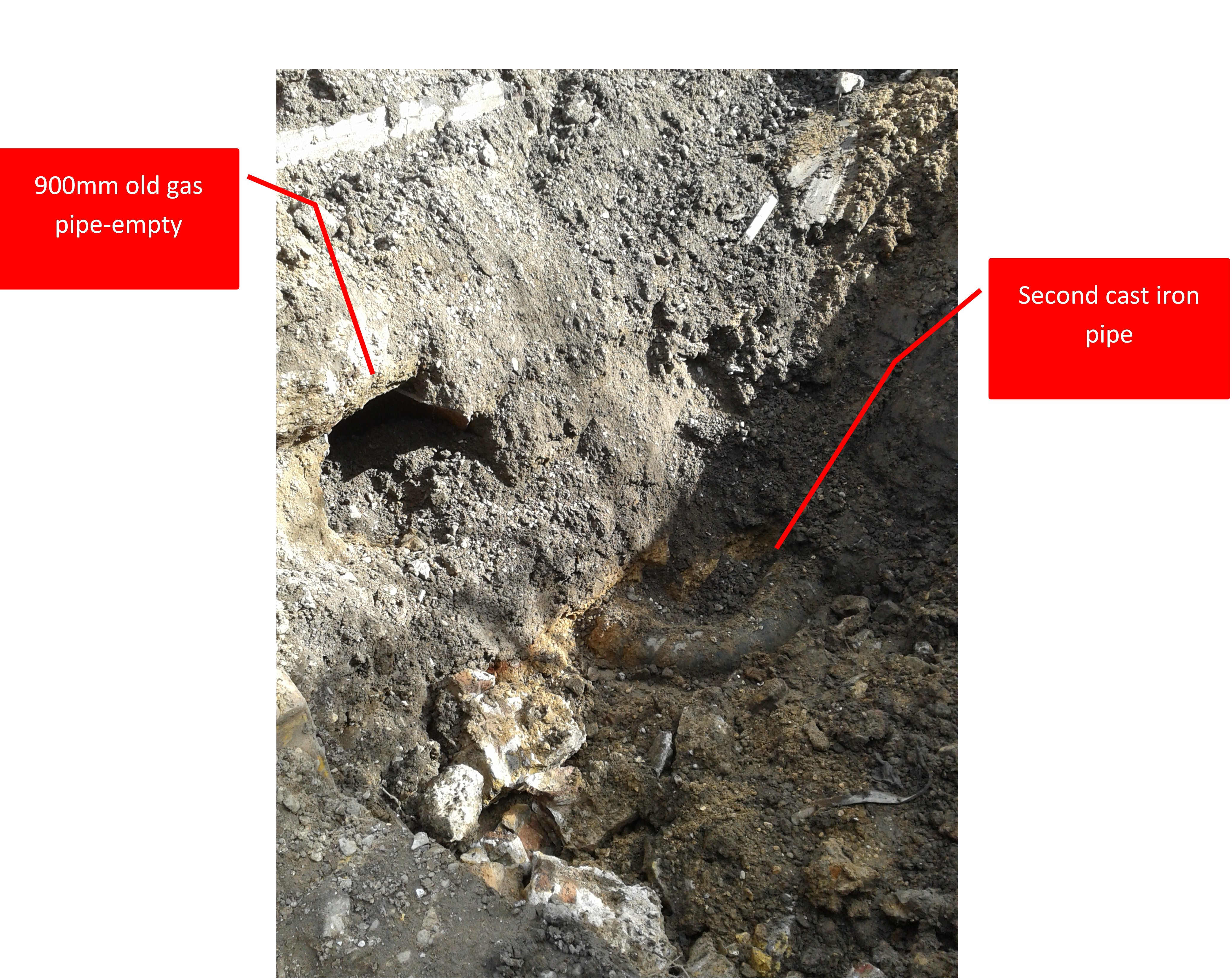
We then had to wait for Carillion Utilities to come and tap the pipe. This involves strapping a device which adjusts the pressure to ensure that whatever is in the pipe doesn’t leak out when they then hand drill into the pipe. This pipe proved to be an empty gas pipe probably from the old gas works the other side of Battersea Dogs Home. Now able to progress with the already 1 week behind schedule drainage they broke through the old gas pipe shown in the left hand side of the picture just in time to find his little brother hiding underneath! My money is on another disused gas pipe but we will have to wait and see what the experts say as the clock ticks and the drainage slips even further behind time!
P.S. My other key learning points this week have been:
-No longer can you trust people to not get hit by a big truck even though you got taught how to cross the road at around age 5. Pedestrians must be enclosed in steel barriers that need calculations to ensure they don’t get blown over in the wind, tsunami or other predicted natural disaster.
-Workers will mutiny if they don’t have the following: a smoking shelter within a 5 min radius of their work area (which also required temporary works design and a lift plan despite being a 4 man lift), a toilet with hot running water also as close and a moon on a stick.
-I should set up some kind of testing and inspection business because you can make a lot of money out of it. So far I have 3 different people getting paid to come and look at the foul water drains we are installing, all doing exactly the same thing!
 Holdfast Training Services Trial Blog