Archive
Ticket to Ride
Funny how when you are waiting for a project, 4 come along at once.
While the work all seems quite bitty, there is a common theme running through everything and all of the systems that I have worked on are interconnected in some way. I’ve found that while I am developing my understanding of how the assets work I am simultaneously trouble shooting issues and developing my ability to use the BP project management systems. I’ve built up a good network of contacts in my previous project work and am starting see the fruit of this as I now know who to go to when I need to discuss a particular issue with a project.
All in all it has been a challenging few weeks and I am really looking forward to my site visit and intend to get a lot out of it. Not least 5 clear days for phys and TMR work!
Clair Coolers
As I mentioned in my last post, this TAR job is now on the critical path thanks to the ineptitude of the piping fabricator (SeaFab). Despite now being directly managed by both WGPSN and BP, with the BP North Sea head of Procurement making weekly visits, Seafab are still falling futher behind schedule! They are running a truly farcical operation with spools being sent for NDT with the wrong documentation, the office being too disorganised for the 3rd part verifier to be able to sign off on the release of apparently completed spools. Unfortunately I have had to take a step back from the daily management meetings due to other work, but I still get the feedback when the project engineer returns each day.
I am still chasing up the IVB process with Lloyds Register, but this really doesn’t account for much of my time.
Clair Manifold Piping Support Bracing
This is part of a project that was executed last year. The main thrust was to standardise the pipe supports on the gas production manifold skid. As a platform develops new wells, it also develops new production lines and for some reason there is no set method for arranging the supports for near identical piping configurations. This project set about to standardise the supports on the 8 production flow lines. I have been given the final part of the project to execute which is to add lateral bracing to the new pipework to eliminate vibrational effects. Everything is fabricated and the work packs are complete, the project just requires organising to take off shore. The show stopper I have found is that because of the of the new bracing, 8 temperature sensors need to be removed and replaced with slightly longer ones. The asset can’t flow these lines while the sensors are removed and this will result in a 3.5 days lost production. The project won’t go ahead with this metric, so I need to find a solution whereby the instruments can be replaced one by one, this would effectively reduce the outage to 0.5 days. I have 10 days to find this solution or the project hits the 12w gate and stalls. Such fun.
Bruce Caissons
This is still chuntering on in the background, but I am still awaiting input from a couple of sources. On a far more interesting note, I may be taking on this whole scope as SPA (i.e. the £26m programme). It wouldn’t mean much for me as the C13 project goes cold at the end of this year (seeing as I made the case for the deferment), but it means that the next two secondees might well be in a position to pick it up when it comes back on line. I need to discuss this with BP, but the Caissons SPA seems to see a lot of possibility in the idea. It would provide some real continuity to a programme that sorely needs it.
Bruce P60 Bridge
Not much to say here other than I will be flying out to the Bruce on Monday for the construction survey. I am very much looking forward to getting off shore for a week, especially as the Bruce is the subject of my next TMR! Winner!
Bruce LPBC Exhaust Mods
You may recognise this project from other well known SPAs such as Capts. Adrian Ishwaria and Warner…
…’you’ll just need to read through the files and close out the project’ he said as he walked out of the office. To be fair it is not much more than that, but the electrical workpack was missing, unbeknownst to everybody involved it seems. However, after some searching Woodgroup have found it and so I will review and sign it off if everything is in order.
Magnus Fire Main Overpressure Protection Mod
I have spent most of the last two weeks writing the Decision Support Package (DSP) for this projects. Despite it already being in Execute, the DSP needed producing to retrospectively prove that it has been sanctioned. You really can’t make this up. I’ve reviewed the project information and submitted my first draft of this document. I look forward to getting some feedback.
In short, the project aims to replace some manual butterfly valves with automated ones that will open when the fire main is brought up to design pressure from its normal operating pressure. The new valves need to open in such a way as to negate about 7 bar of overpressure caused by the pump start up. The DSP breaks down the financial, technical and safety aspects of the project so that the budget holder can sanction it. It feels a little nugatory to be writing a DSP after the decision has effectively been made, but at the end of the day it needs doing and I am hoping that it will raise my profile with this particular Asset Program Lead.
Magnus Cold Boot Relief Upgrade
This is a brand new scope to me and so I will be reading up on it whilst I am off shore. Again this is a project in execute with no DSP, but this time I really have to work the DSP up from scratch. There is certainly more opportunity to get involved in the project engineering too as quite early in the execute phase.
In Other News…
I gave a presentation to Engineering Services today outlining who I am and why I am working at BP. I got some nice feedback and I quite enjoyed getting into barracks dress and wandering around BP.
Got to Turn Around
After a busy week last week, things have continued to pick up pace. I am now supporting two projects as well as managing my own little one and developing my understanding of how BP conducts off-shore business. It is quite clear to me now how crucial good risk management is from an early point in project life as my involvement in the Clair Coolers project is showing.
P60 Bridge Access Platform
This project has gone quite at the moment, there are no milestones looming (the first one is in July) and the team in Runcorn is on the case. I had a project review meeting planned for last week where I was to discuss with the JRE (Andrew Dickinson) and the senior structural engineer (Ian Hartley) where the design was and identify any sticking points. But due to picking up some last minute work, this has now slid to the right and will take place this week. I’m looking forward to finding out where Ians design work is leading as his initial drawings showed the steelwork being welded in place. The key issue in this design is avoiding hotwork if at all possible so that it can be carried out outside of a TAR (even during a TAR the asset is really not keen on hotwork) and so I am interested to see how he proposes to attach the inspection platform structure to the asset.
Caisson Re-placement programme
My visit to the Bruce ACE turned out to be less exciting than I imagined. It was a completely on-shore meeting, for some reason I thought that the Area Engineering Support Team Lead would work off-shore, but I will put that down to industry naivitiy, I expect everything to be off-shore. In reality, as you would expect, everything that can be done on shore is done on shore to protect the bottom line. In the end the meeting took place between the caissons team from Projects and Mods (Kerry, Craig and Myself), the AESTL (representing the business end of the asset), Colin Wilson (representing Discipline and the caisson integrity case) and one of the Bruce mechanical engineers (representing the asset in terms of process and mechanical engineering). I made the case for the delay of the Caisson 13 until 2015 on account of it being a new scope that would not fit around the 2014 TAR due to the requirement for a good weather window (project team requirement), the reduced water requirement of the asset against the figures cited in the safety case (asset/process requirement) and the fact that while structural failure in one of the other caissons was relatively likely, it did not present a threat to the export/import risers and the repair process was a proven technique that could be worked up in a short period of time . This was essentially the fruition of the stakeholder/technical authority engagement I had conducted in the previous week and (with the support of the stakeholders who were actually there) the result was that the AESTL supported the move to delay the project execution. It was a good meeting but while the decision was made, none of the paper/electronic work that will ultimately provide a coherent background to the decision has so far appeared, so this week I will try and chivvy that along. The hardest part of this industry seems to be getting people to front up and write down their reccomendations after they have verbalised them and therefore take on some of the risk!
Clair Coolers
I got involved in this on Wednesday last week and it has since given me an excellent grounding in the risk analysis procedure used in the eMOC (electronic Management of Change) system. The project is in the process of going off shore, but it is unusual in that it has not followed the BP Capital Value Process and therefore has several substantial residual risks attached to it.
The coolers are shell and tube heat exchangers used for cooling produced hydrocarbon gas as it is compressed to around 250 barA. In October 2012 gas was found to be contaminating the coolant fluid and upon inspection internal corrosion of the coolers was found to be the cause. The coolers were repaired sufficiently to be put back into service and a plan was initiated to install like for like replacements. Simples.
Since then a whole raft of side issues have caused this to be anything but a like for like replacement. As changes have been signed off and deviations agreed the risks have mutated. This was the third eMOC risk assessment designed to capture and treat all of the remaining risk. Present where the contractors representatives, the asset and various disc lines from within Engineering Services. In the end it was a little like herding cats, especially as the chair refused to admit she was chair (even though she clearly was), the SPA remained steadfastly silent and implacable throughout and any argument that could be made circular was. Lesson learned and if I am in that situation again I will have no problem in volunteering to chair. I understood pretty much everything and the areas I didn’t people were happy to explain. What should have taken a day took the better part of two days, but conclude it did with a list of 18 risks requiring action at either pre or post implementation. I’ve got the job of ensuring that these risks are captured in the electronic system and so I’ll spend the next week reviewing the supporting technical documentation, summarising it and, more than likely, chasing it up in the first place.
It is an excellent example of how a project can be forced through a change managment process, but at the penalty of significantly increased cost and complexity. Every day the current coolers are down is a loss of about £500k so it is not surprising the decision was taken. Had this project been Appraised properly at the start many of the problems encountered would have had early solutions, but then the process would have taken 2 years instead on 9 months.
 One of the most striking aspects of this project is the sheer complexity of removing and installing the coolers. BP commissioned a construction animation (at a cost of around 25k) from which the pictures were taken as screen shots. As a tool for educating all parties it clearly show the removal and replacement procedures with incredible clarity.
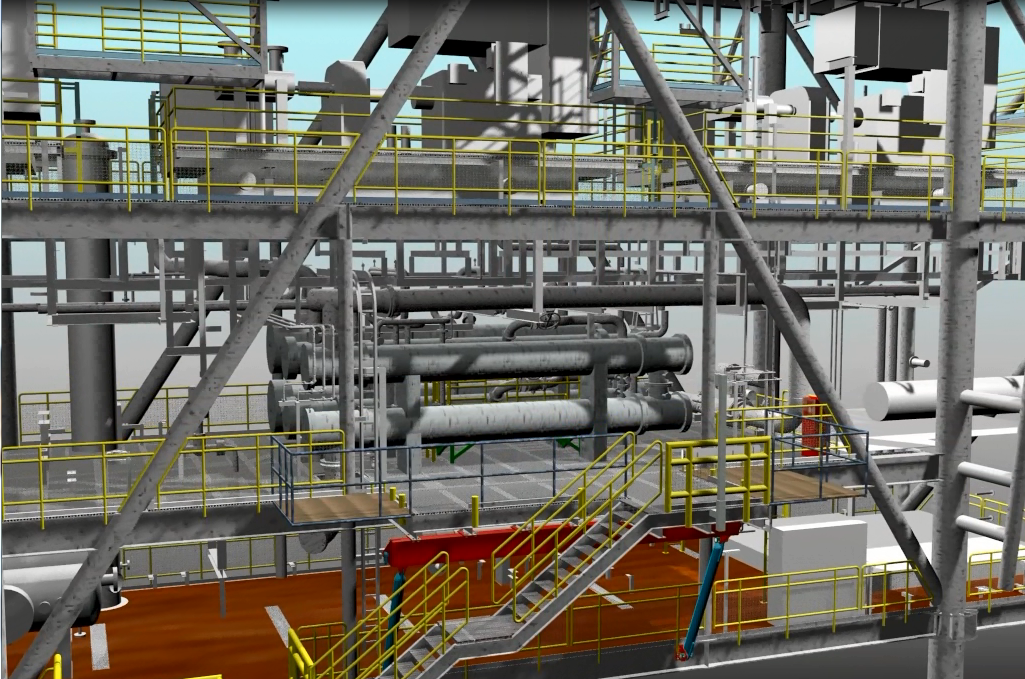
At this point the pre-TAR shutdown on Clair has begun, the original coolers failed last month and the project is now underway. Initial work-scopes have begun with the installation of the new coolers to take place in three weeks and it is all hands on deck to get the project risk conveyed and agreed by the Clair Engineering Support Team Leader so that it can be effectively managed into the future.
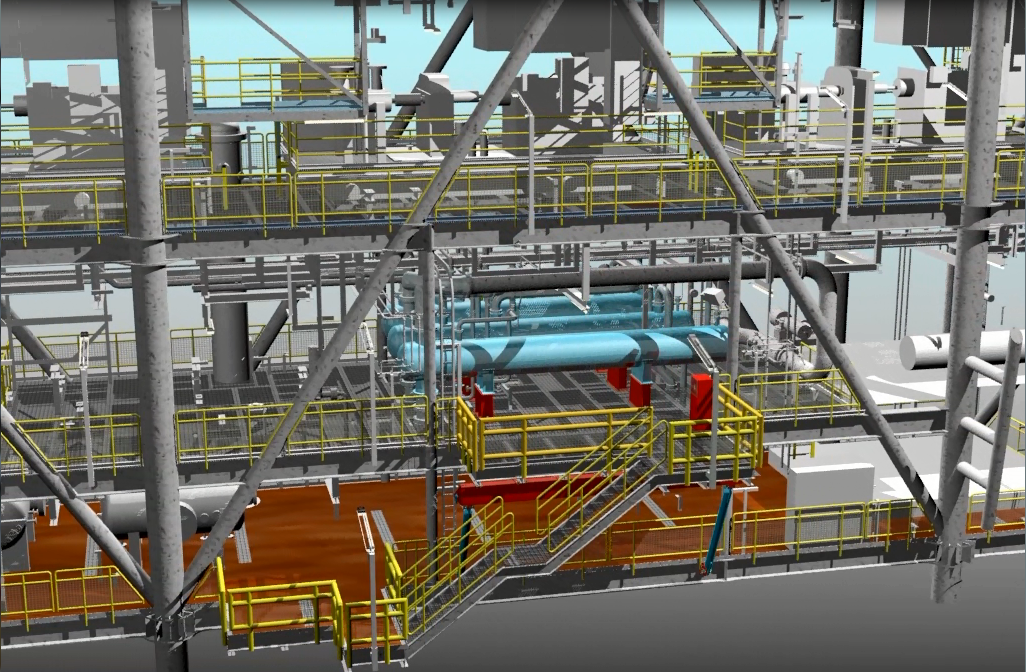
The reference to my TMR is that this began as a simple like for like replacement that has grown arms and legs. When the design contractor was completing the calculations for re-installing the existing pipework it was found that the pipe routes were under designed to meet the stresses imposed by the process pressures and temperatures. It seems that the original design failed to take into account the change in conditions induced by the recycle line from each compressor at each stage of the three stages. With this included in the calculations the temperature in the flow lines was capable of reaching a maximum some 50degC above what had been designed resulting in potential over stressing of the system. Now it is unclear to me how often the operating conditions achieve the design conditions, but judging by the colour of the assets process engineers’ face after the realisation dawned it was often enough. He was quite clear that had he known this before, the gas train would have been shut off much earlier.
In Other News
I feel really left out in the America stakes, I often see wild animals (deer, rabbits, hairy coos and even an Osprey), but despite riding as quickly as I can they remain steadfastly alive. Hugo will be starting at a creche in about two weeks and Corine will be starting with Grampian shortly after that. Summer has arrived (two days so far) and cycling in to work is very pleasant, especially when I get to detour through the local woodland. Chris has got Dougal with him this week and so I accompanied him for a lunchtime walk. It is amazing at how alike dogs can be to their owners, Dougal was consummately happy crawling through the mud at the bottom of every ditch , although I thought his chat was better than the average Commando Engineer.
 Holdfast Training Services Trial Blog