Archive
Smiling Assassin or Shrewd Business Practice?
After several months and now experience of several sub-contractors (and then sub-sub, sub-sub-sub ad infinitum…) I thought to reflect on a few observations I’ve found from the world of civilian business practice. As graduates of the esteemed RMA Sandhurst , we live by the Values and Standards, drilled into us from day one to the point that personality is surgically removed and replaced with a code of conduct – I find it strange that it seems such a code of honour can be more negotiable in industry.
Now to be clear, I have not witnessed anything outright illegal or amoral but perhaps a few instances of “collaboration” which appears in conflict of the NEC approach where one party may mislead another through varying versions of the same truths, revealed at carefully stage managed points in time. This has come at increased surprise to me as any contractor on site must be, as a minimum BPSS vetted if not SC, and so come withs a modicum of implied trustworthiness.
An example –
During Client inspection of concreting works where tolerances were tight (-0/+5mm on plan). It was known by a subbie (and sub-subbie) that they were just over, by 1mm. The decision was made, through some implied comms and impressive framing of the problem that we were all better off if the client was led to believe that the slab was on tolerance and the offending non-conformity was shaved off by the night shift to achieve tolerance – as if it had never happened. My question was this;
“Why not declare the non-conformity in good faith but also how you plan to remediate and keep the client happy that we’re a diligent contractor?” (Or words to that effect…)
The answer, whilst simple, seemed almost a lie of omission;
“Paperwork”
I can see the pragmatism of such an approach where hours have been saved by removing the need to submit TQs or NCRs and the bureaucratic process therein. Does integrity have a price? My gut tells me no – one must always do right by the plan and contract, less you end up tangled in a web of lies. Apart from patting myself on the back for the DS answer, it did raise another thought – at the root of this, is it not a slippery slope where there may be other dangers lying beneath? Errors compounding errors (think of the Swiss cheese risk model). Thoughts that were shrugged off by the majority of project staff.
Perhaps I have been lost in the woods too long and suffer from institutionalised naivety but I wonder if others have experienced similar?
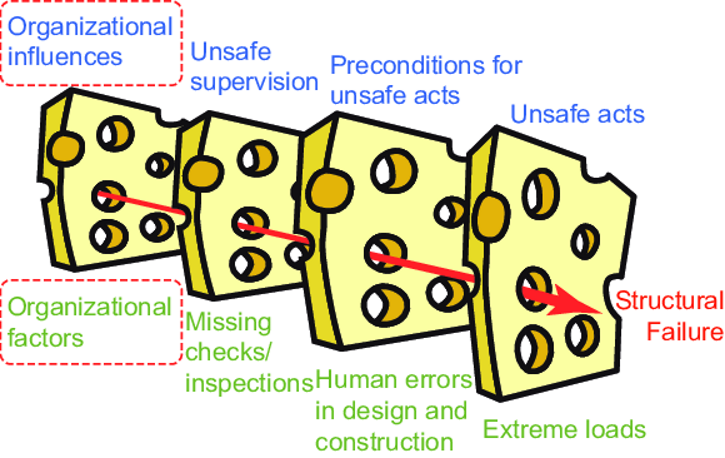
(Image From: Ren, Xin & Terwel, Karel & Nikolic, Igor & Gelder, P.H.A.J.M.. (2019). An Agent-based Model to Evaluate Influences on Structural Reliability by Human and Organizational Factors.
Conference: Proceedings of the 29th European Safety and Reliability Conference
 Holdfast Training Services Trial Blog