Archive
The invention of looking
Another day another project. I have started to become increasingly involved in ‘Building 2001’ in Harrisburg, which is the home of the enormous Eastern Distribution Centre (EDC). I say increasingly involved, though yesterday I narrowly avoided arrest, more about that later. The building is pretty large, mainly dominated by a warehouse but with an admin section about twice the size of Denison strapped to the side. The current contract is to replace the roof, change some lighting, improve the ventilation and replace, more or less like for like the HVAC system. And so far the most important lesson I have learned is: Avoid dealing with refits wherever possible! I will expand.
To follow on from Guz’s theme of invention and Rich’s point on people actually leaving their desks to look at stuff. Two things this week have lead me to believe that the designers didn’t actually bother coming to do a detailed survey of this huge building before cracking on with their designs and just assumed the as built drawings were complete and correct.
The building has three plant rooms. The main plant room has the steam distribution and the main elements of the chilled water distribution. The other two smaller plant rooms each service their respective admin floors with an Air Handling Unit (AHU) and some minor switchgear. As it begins to get warm here we are starting to cobble together a temporary system whilst we wait to get the main cooling system on line. So as we were talking through the system in a meeting, so at least better than a chance conversation, the contractor stated that the plant room housing the ground floor AHU was getting really hot; suboptimal in cooling season. We asked why and he said it was obviously because of the two condensers that were stationed in there from some retrofit air conditioning systems.
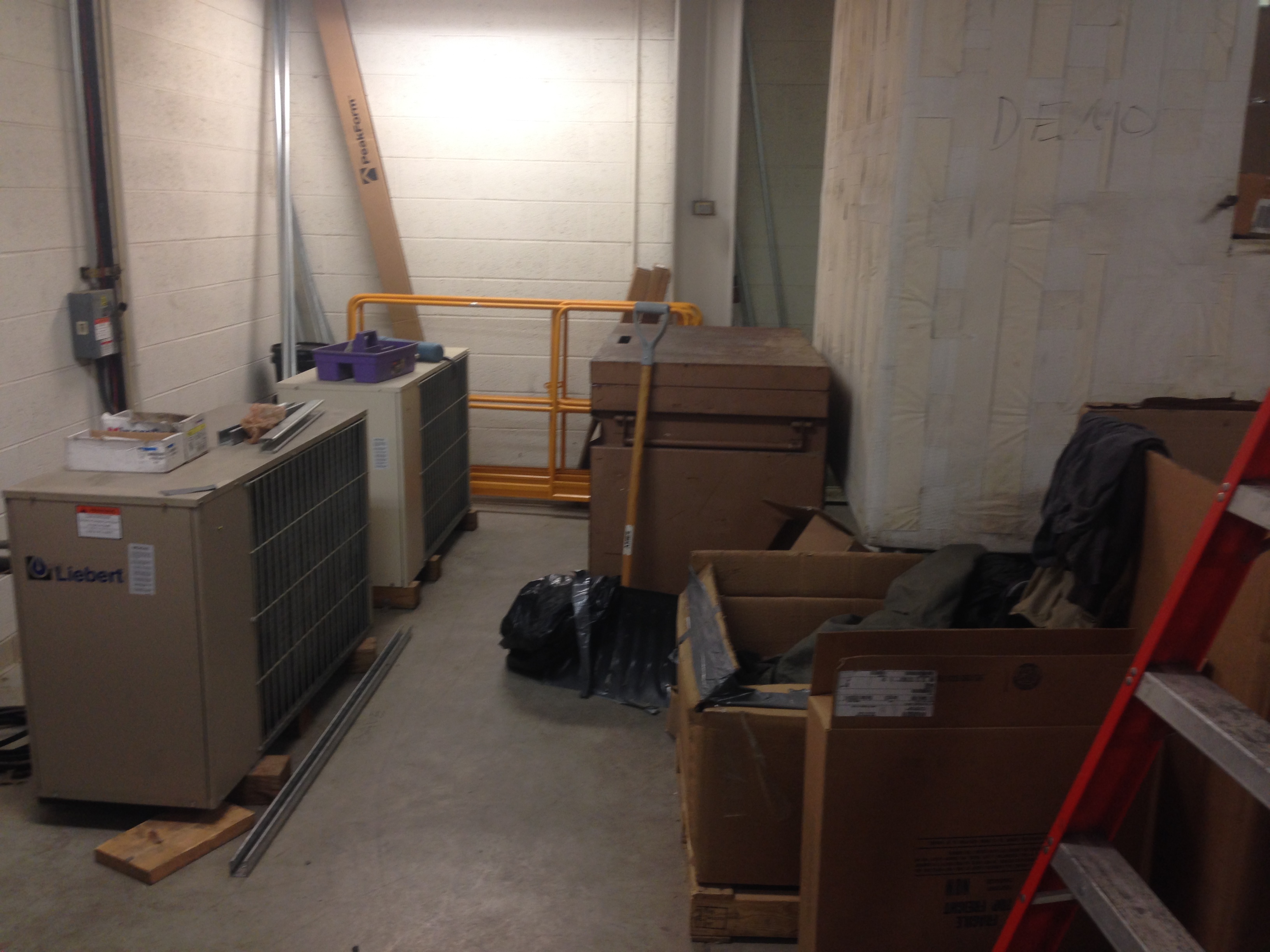
Just heating the room that is trying to cool the rest of the floor. Outside is a mere 20′ away.
Some pipe hunting later and we found that these fed two computing classrooms that had obviously required extra cooling at some point in the last 10 years. Checking the contract these aren’t to be replaced. Now I haven’t checked the as built drawings, but I don’t need to because the photo above clearly shows exactly where these condensers are. So my question is, which idiot put them there and which idiot decided to leave them there in a comprehensive refit of the building’s mechanical equipment. My conclusions are that it comes down either to incompetence or money. But, based on the next example, it is difficult to say it was just a cost saving measure as incorporating a couple of extra outlets into a room to increase the cooling capacity would have been pretty cheap in the grand scheme of things: I think the designer didn’t know they were there.
So to observation two. The biggest reason the air conditioning system is not running is that the cooling towers (condensers) on the roof aren’t connected. This is because someone forgot to design the structural steel to hang the pipes from. So due to the rising mercury we have hired a trailer mounted condenser, complete with pumps. So the question is merely what size?
After a chat between the contractor, mechanical engineer and myself we decided on 500 tons, ordered it and it arrived. When it turned up we proudly went out to observe our $40,000 a month lease and the installation electrical engineer asked when the other one was coming? And that was when email tennis started.
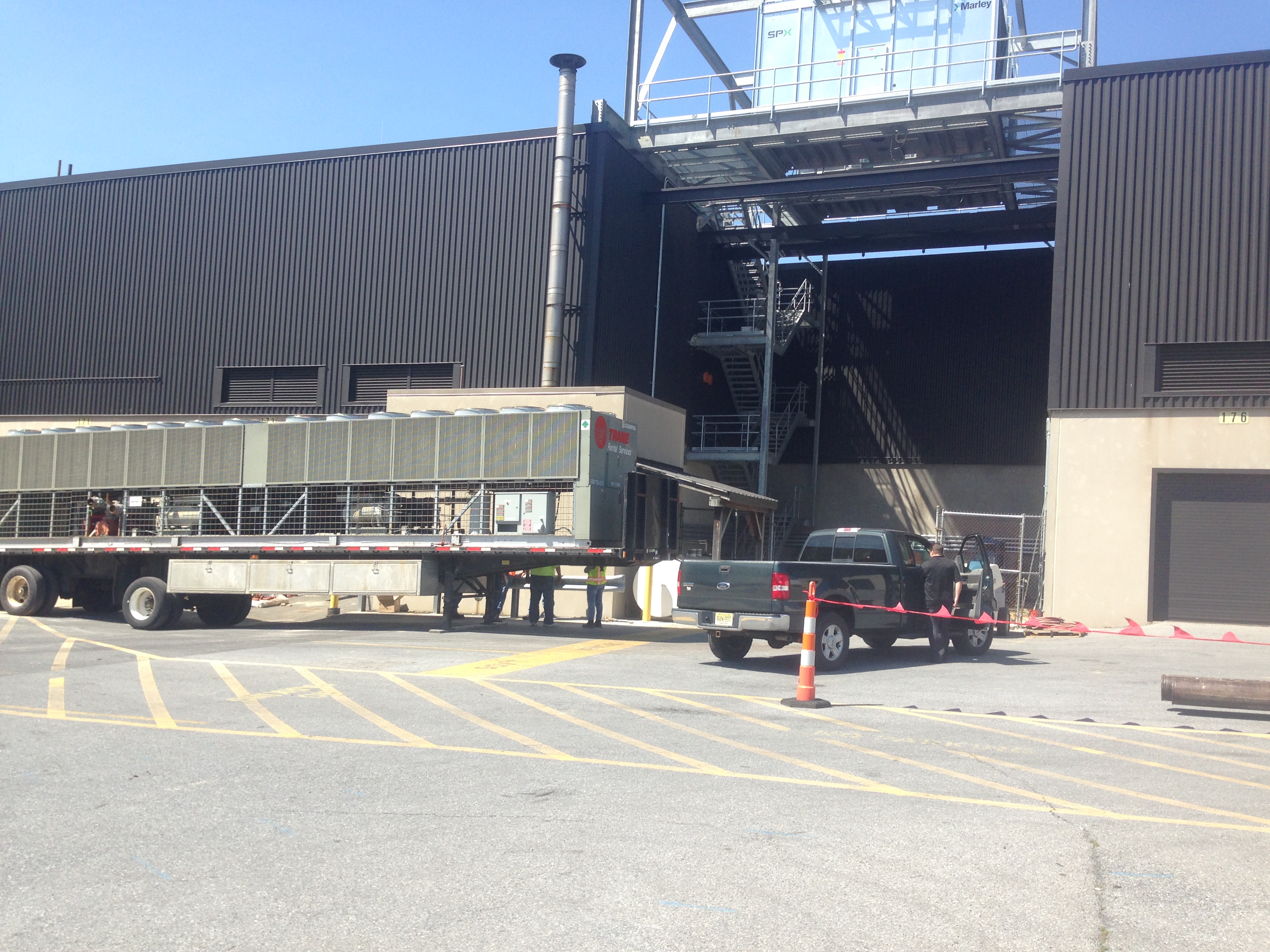
The 500 ton temporary system in the foreground. The new chillers (1300 tons) up high.
The original system was designed at 1800 tons (2 x 900 ton cooling towers) and in the design guide produced by the design consultant there was a magical figure of 1220 tons as the load. The new system is designed at 1300 tons and so the installation decided 1000 tons was the minimum possible. The installation engineers therefore stated that our temporary chiller would simply not be large enough and kicked up a stink with explanations of the old system working flat out and hardly being able to keep pace.
So the proof will clearly be on Tuesday when the system is turned on and the temperature is set to be in the high 80’s for the week. However, I will justify our decision now. The contractor has worked on this building for the last 2 summers and swears that there has only been one cooling tower operating at a time; indeed last year one of them was out of service. He also said that when he removed the old cooling towers he’d called the manufacturer with the serial number and asked the size: 600 tons (for some reason it wasn’t on the nameplate). Additional factors are a number of smaller AHUs have been removed and the temporary power supply wouldn’t run a 750 ton unit. When designing the controls, before my time, we had been told the permanent 1300 ton system was to give redundancy, as out here everything has redundancy.
Conclusions
Having read the design handbook for this project nowhere was there actually a calculation of the load, just an assumption with no justification. Remembering back to the design projects writing why an assumption was made seemed frustrating as it got in the way of moving onto the next calculation. However, the reasoning behind these assumptions are vital in the real world for someone to understand your calculations so they can make decisions later down the line; especially if the situation changes. This applies to references too as a reader can understand your thinking better if they can trace it back to source. It the light of contradictory evidence empirical evidence should take precedence.
As built drawings are not 100% reliable. They may be but it depends on whether someone has the time or funding to keep them up to date. In the EDC there are a number of different organisations with little pots of money doing self help projects all the time so some might not even know where to get hold of the master set of drawings; if there even is one. Thinking forward to doing DfID style projects the odds of getting BIM are pretty long! Therefore time spent on recce…
Oh and my near arrest. Well despite having been working in this building for three weeks it appears I don’t have clearance. Yesterday I tried going in through the main entrance and was told my name wasn’t on the list by the DLA Police. The building is about as secure from entrance as a sieve is from water and holds nothing remotely of interest to a thief or spy but rules is rules. It turns out I just need to present a letter that I am not allowed to see the contents of to the head of security and it should be fine! I can only imagine the pain Brad has been through and I’m pretty glad that the engineer I work with is the base commander’s wife as that probably prevented bracelets.
Developing
Being positioned away from London clearly Brad and I will be unable to get to any of the evening Institution lectures to broaden our scope as Engineers prior to professional review. Enter USACE’s Officer Professional Development (OPD) programme to fill that gap. The current programme to gather Baltimore District’s 15 military members is quarterly meetings of a day and an annual 3 day trip. This year’s 3 day bender centred around the civil works programme within the Baltimore District, more specifically on the restoration and maintenance of the Chesapeake Bay. Below is a quick canter through the challenge presented to USACE:
However, before the learning, the programme started with a PFA and Howard had instructed us that it was ‘tradition’ to make sure the superpower was kept in check. So after a nervous start a Brit 1, 3 was achieved; we also managed to avoid embarrassment in the later ‘Ultimate Football’ game; end to end exhausting fun.

After round 1 didn’t go their way we had to play with this funny rugby ball
Chesapeake Bay
When America was colonised the Chesapeake Bay and surrounding area were some of the first places that the settlers put down roots due to the abundance of seafood in the bay and the favourable conditions for shipping of a sheltered deep harbour. As Richard indicated during our river and flooding day in Chatham however, the impacts of firstly the Royal Engineers and later USACE building dams and developing farmland have, alongside over fishing changed the landscape. Now Maryland state must ensure that the bay now supports the industries (shipping and fishing) that have grown up within it as well as be environmentally sustainable.
Shipping is one of Baltimore’s biggest industries as it has one of only 2 ports on the Eastern Seaboard that can receive ‘Super Panama Tankers’ which require a 50’ channel. This is as a result of dredging channels and, despite biting the hand that feeds it; Maryland state law presents some difficulties to the disposal of the dredged material. Dredged material can’t be dumped in the open water of the Chesapeake Bay and new islands can’t be created within the State’s waters. Additionally all the material in the habour is considered contaminated (with heavy metals etc) potentially causing water pollution when disturbed.
Being America clearly the numbers are big: 4.5 million cubic yards (the volume of 1.5 football stadiums) per year of sediment needs to be removed from the bay channels for maintenance alone. It is 180 miles from Baltimore Harbour to the mouth of the Chesapeake and the Atlantic Ocean where the first open water dumping ground would be; this would be expensive so they don’t do it. Instead the solution is land reclamation, either extending peninsulas or enlarging islands, and as the dredged material looked as if it had all the structural properties of a soggy blancmange the land is mainly used to build nature reserves and still isn’t cheap.

The scale of the Chesapeake Bay
The current main destination is Poplar Island, which over the last 20 years has taken approximately 100 million cubic yards at a cost of $1 billion, so $10 per cubic yard, or $50 million a year. The engineering is pretty simple; build berm from sand etc, put in loch gate to drain out water, pump dredged material (80% water, 20% solids), let it settle and drain the excess water. Of greater complexity are getting the water quality to the acceptable standard to drain into the Chesapeake Bay, introducing plant species to be beneficial for wildlife and hold the island together and the liability USACE will have for the island once completed.
They are planning on handing the National Parks Service (NPS) as a nature reserve. However, the maintenance of islands made from contaminated dredged material isn’t the NPS’s Mastermind special round choice and so USACE will still be responsible, and liable, for ensuring the island maintains its integrity. Clearly in the grand scheme of things with both parties being Government departments it is merely the department best positioned to deal with the issue being responsible which is best for the Nation and Government but that philosophy is muddied by departmental budgets and politics.
Other elements of note were the Conowingo Dam on the Susquehanna river is now ‘full’ of silt which is going to result in more being transported down stream and into the Bay. This is again an area of liability controversy as it was built by USACE, in 1926, but is now operated by Susquehanna Electric Company (SEC). Clearly neither want to accept liability and pay the exorbitant dredging costs, though ultimately SEC has the upper hand as if they don’t deal with it behind the dam then the problem will get passed on to USACE when the silt hits the bay. From an E&M perspective, more interesting than the silt was 1950’s style sign, below.
Also the rare forethought of the 1920’s designer who foresaw the increasing need for electricity and built space for an extra 4 turbines over the 7 installed at commissioning. The original 7 turbines produced 250 MW of power, in the 1960’s the remaining 4 were installed with equal power output giving the dam an output of 500MW.

The very 1950’s sign and the 1960’s turbines.
USACE – not a place in China
So, blog 1 and I’m already going off-piste. If you are looking for engineering please wait for the next one. If Admin isn’t a place in China it is certainly a place somewhere in the USA where they eat forms in triplicate and proof read with the accuracy of Rain Man. Having been in country for nearly a month I have phonetically spelt my name enough times that Gandhi would have lost his patience; Guz I now understand your pain – never come here!
The aim of this blog is to highlight a few admin points about the US Army Corps of Engineers (USACE) placement for the prospective Phase 1 students when choosing attachments; but written now whilst it is fresh in my mind. Be aware this is me pointing out that there are some challenges worth thinking about. However, they are all surmountable and don’t detract from the obvious benefits of being in the USA which, as we are already finding out, is an awesome country full of travelling opportunities.
Foreign Country.
So firstly it should not come as a surprise that this is a foreign country and I now truly understand the phrase ‘divided by a common language’. Our cultures have many things in common, but just as many things not in common and it varies from state to state. I can see why most Americans don’t have a passport, with such variety in their own country, but it does limit their perspective on many issues.
Locations.
My work location for Phase 2 is the Harrisburg Area Office; just outside of the town itself as for the last 3 iterations of USACE attachments. I, like my predecessors, am living in Hunt Valley making it an hour drive each way to work for Phase 2. Unlike the UK the driving is a breeze, there is hardly any traffic and it is a dual carriageway (Interstate) all the way. So set cruise control and go. There are other project locations around the Baltimore District AO and the option of moving around to wherever the work is which Brad and I will research after the summer. Brad for example is working to the South, but I will let him comment on this.
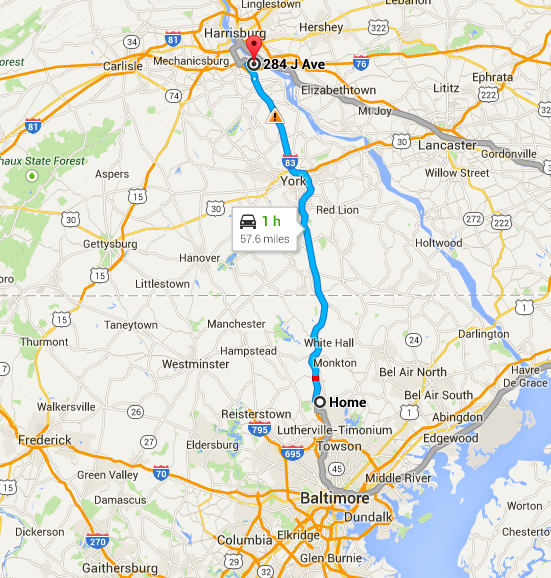
The Harrisburg commute
For Phase 3 I will be working right in the centre of Baltimore (10 S Howard St), about a home run away from the Baseball stadium. The commute for this is a short walk/drive to a station before hopping on the light rail for £1 each way. At about 45 minutes it is comparable with a London commute and shows the logic of Hunt Valley as a location.
Cars.
I was naïve enough to think that my wife and I might be able to get away with one car for the whole attachment; we can’t! Over here you drive pretty much everywhere, even if you want to go for a run, because the sidewalks just stop for apparently no reason. So with the need to commute to work for the site attachment if your partner wants to do pretty much anything, then a car is required. That said, for Phase 3 I am planning on selling the second car. So if you fancy a Golf GTi (highway miles) I’ll keep you posted! We all know that fuel is cheap out here (about a third of UK prices) and it’s actually a pretty good opportunity to buy a car you wouldn’t dream of fuelling in the UK. I get a respectable 28 miles per US gallon (33 mpg in UK gallons) and I’ll leave Brad to reveal what his Nissan Armada pushes out.
Housing.
Probably the biggest stress on arrival is housing. It is mind boggling to start off with and the time period given is tight. That said everybody out here now, and for as far back as I’ve heard of, lives in places far superior to anything in the UK SFA portfolio. The Embassy, if a little slow and authoritarian at times are supportive and will ‘screw the nut’ to ensure you are well set up on time. Hunt Valley has become the standard for the last few iterations as it is a nice town and central, based on commuting times, to the two work locations however variations are certainly available.
Aliens.
As a Gurkha 2IC I have had an understanding of some of the difficulties that arise from having a different passport to everyone else; but here as a legal alien I truly empathise. For those with wives who have an intention to work be aware that extra paperwork will need to be completed upon arrival to get authorisation. It is just a matter of filling it in and waiting but it is something to be aware of. It turns out getting a Social Security Number is pretty easy and certainly makes administrative dealings a lot more straightforward; because it fills a box in someone’s spread sheet. As for everything else, just be prepared to stand patiently in line and produce plenty of paperwork to prove your identity.
Defence Engagement.
This is very much a part of the job and the effects are very real. Not to steal his sandwiches but Brad’s attachment actually getting off the ground has come about, in a large part, as a result of his boss working with someone on the PET course 20 years ago. The impression that he gained of the officer as a ‘good bloke’ has resulted in him bending over backwards to get Brad through the administrative challenges he has faced.
That said, the act of ‘doing’ defence engagement is predominantly being professional and interacting with the people out here who are literally fascinated with you.
The Work
I can’t really comment at this stage as I haven’t done anything of note yet, but it’s here and there is a diverse range of things to get involved in.
Further info.
For the Phase 1s, Brad and I are more than happy to chat through questions or general information about the placements out here if you are interested and need more information to make a decision. Probably the best way of making contact is to drop us an email to hhcrosby@gmail.com or brad_southall@hotmail.com with your mobile number and we will give you a call back from the office.
 Holdfast Training Services Trial Blog