Archive
Ticket to Ride
Funny how when you are waiting for a project, 4 come along at once.
While the work all seems quite bitty, there is a common theme running through everything and all of the systems that I have worked on are interconnected in some way. I’ve found that while I am developing my understanding of how the assets work I am simultaneously trouble shooting issues and developing my ability to use the BP project management systems. I’ve built up a good network of contacts in my previous project work and am starting see the fruit of this as I now know who to go to when I need to discuss a particular issue with a project.
All in all it has been a challenging few weeks and I am really looking forward to my site visit and intend to get a lot out of it. Not least 5 clear days for phys and TMR work!
Clair Coolers
As I mentioned in my last post, this TAR job is now on the critical path thanks to the ineptitude of the piping fabricator (SeaFab). Despite now being directly managed by both WGPSN and BP, with the BP North Sea head of Procurement making weekly visits, Seafab are still falling futher behind schedule! They are running a truly farcical operation with spools being sent for NDT with the wrong documentation, the office being too disorganised for the 3rd part verifier to be able to sign off on the release of apparently completed spools. Unfortunately I have had to take a step back from the daily management meetings due to other work, but I still get the feedback when the project engineer returns each day.
I am still chasing up the IVB process with Lloyds Register, but this really doesn’t account for much of my time.
Clair Manifold Piping Support Bracing
This is part of a project that was executed last year. The main thrust was to standardise the pipe supports on the gas production manifold skid. As a platform develops new wells, it also develops new production lines and for some reason there is no set method for arranging the supports for near identical piping configurations. This project set about to standardise the supports on the 8 production flow lines. I have been given the final part of the project to execute which is to add lateral bracing to the new pipework to eliminate vibrational effects. Everything is fabricated and the work packs are complete, the project just requires organising to take off shore. The show stopper I have found is that because of the of the new bracing, 8 temperature sensors need to be removed and replaced with slightly longer ones. The asset can’t flow these lines while the sensors are removed and this will result in a 3.5 days lost production. The project won’t go ahead with this metric, so I need to find a solution whereby the instruments can be replaced one by one, this would effectively reduce the outage to 0.5 days. I have 10 days to find this solution or the project hits the 12w gate and stalls. Such fun.
Bruce Caissons
This is still chuntering on in the background, but I am still awaiting input from a couple of sources. On a far more interesting note, I may be taking on this whole scope as SPA (i.e. the £26m programme). It wouldn’t mean much for me as the C13 project goes cold at the end of this year (seeing as I made the case for the deferment), but it means that the next two secondees might well be in a position to pick it up when it comes back on line. I need to discuss this with BP, but the Caissons SPA seems to see a lot of possibility in the idea. It would provide some real continuity to a programme that sorely needs it.
Bruce P60 Bridge
Not much to say here other than I will be flying out to the Bruce on Monday for the construction survey. I am very much looking forward to getting off shore for a week, especially as the Bruce is the subject of my next TMR! Winner!
Bruce LPBC Exhaust Mods
You may recognise this project from other well known SPAs such as Capts. Adrian Ishwaria and Warner…
…’you’ll just need to read through the files and close out the project’ he said as he walked out of the office. To be fair it is not much more than that, but the electrical workpack was missing, unbeknownst to everybody involved it seems. However, after some searching Woodgroup have found it and so I will review and sign it off if everything is in order.
Magnus Fire Main Overpressure Protection Mod
I have spent most of the last two weeks writing the Decision Support Package (DSP) for this projects. Despite it already being in Execute, the DSP needed producing to retrospectively prove that it has been sanctioned. You really can’t make this up. I’ve reviewed the project information and submitted my first draft of this document. I look forward to getting some feedback.
In short, the project aims to replace some manual butterfly valves with automated ones that will open when the fire main is brought up to design pressure from its normal operating pressure. The new valves need to open in such a way as to negate about 7 bar of overpressure caused by the pump start up. The DSP breaks down the financial, technical and safety aspects of the project so that the budget holder can sanction it. It feels a little nugatory to be writing a DSP after the decision has effectively been made, but at the end of the day it needs doing and I am hoping that it will raise my profile with this particular Asset Program Lead.
Magnus Cold Boot Relief Upgrade
This is a brand new scope to me and so I will be reading up on it whilst I am off shore. Again this is a project in execute with no DSP, but this time I really have to work the DSP up from scratch. There is certainly more opportunity to get involved in the project engineering too as quite early in the execute phase.
In Other News…
I gave a presentation to Engineering Services today outlining who I am and why I am working at BP. I got some nice feedback and I quite enjoyed getting into barracks dress and wandering around BP.
Keep on Chooglin’
It has been a busy two weeks, but I have seen some real progress at BP. I have two jobs regarding the Bruce platform, both of which have potential to go off-shore next year which means I would see them through to close out, possibly.

The Bruce platform lies about 175 miles North East of Aberdeen and is composed of three platforms as shown above. Processing, Utilities and Quarters (PUQ), Drilling (D) and Compression Reception (CR). It is, as most in the North Sea are, an old platform having been built in the 90s for a ~30 year life of field. The general currency of projects on these installations is Persons on Board (PoB) and as a result, long lead planning with the client (the Asset i.e. platform) and early buy in is critical to the progression of any project as can be seen in my two concerns. Bruce has flexibility to surge around 20 personnel on board over and above the basic off shore staff at any one time and as I am finding out, these precious spaces are always filled months in advance as per the Assets priorities.
P60 Bridge Access Platform – Between PUQ and D.
The P60 bridge is a 47m long bridge with a loading of around 183 tonnes in storm conditions. It has had a long history of bearing issues as they have consistently failed to achieve their design life. This can be put down to lack of design data on how the platforms move during annual weather patterns and it is a common failing on platforms built post Piper Alpha where bridges are used to link platforms and effectively isolate the more volatile on-board processes from the living quarters and bridge.
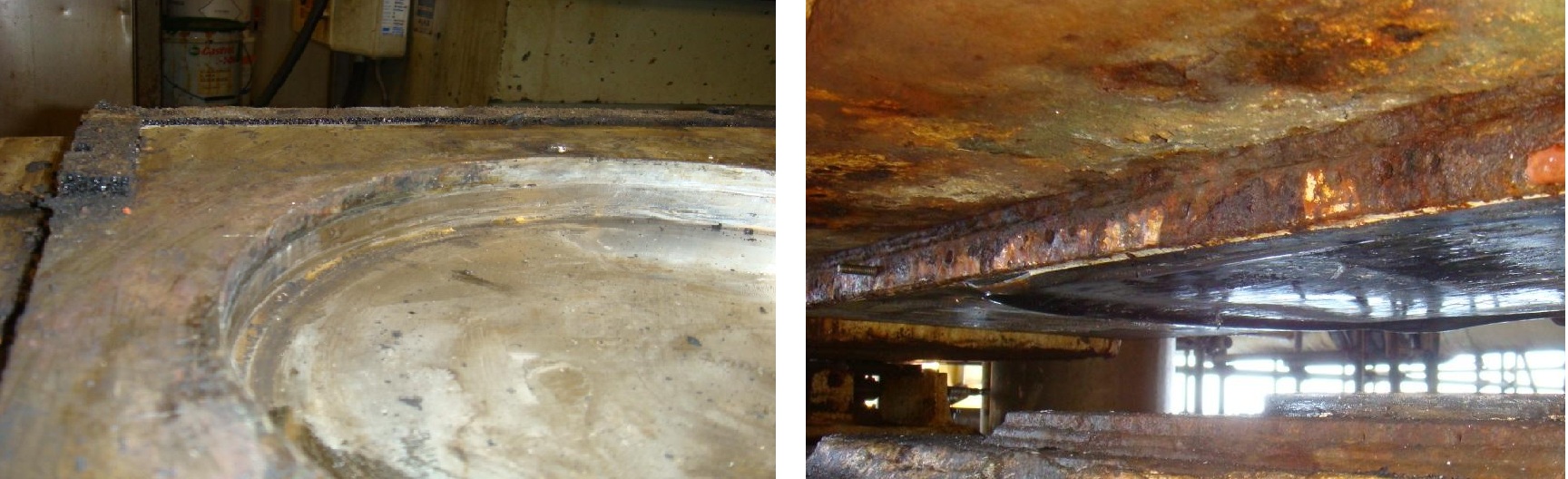
The photo on the left shows slight elongation to the piston plates at the PUQ bridge bearing, while the photo on the right shows damage to the stainless steel runner plate. The manufacturers estimated field life for the bearing pad is 20km aggregated travel and this was not expected to be exceeded with the life of field of the installation. Recent estimates have put the actual aggregate travel of one bearing at 3km in a single month of bad weather! As a result of the manufacturers generous estimates, no method for jacking the bridge up to perform regular maintenance was built into the design and so every quarter an over the side scaffold must be built to allow inspection and maintenance to take place. This is costly, but most importantly ties up bed spaces on board on a regular basis. There is a lot of work going on on this old platform and so simply reducing the PoB burden is quite a significant win for the asset.
I have ~£80k to take this project through the Define stage to gate 3, the beginning of the on-shore Execute. This would see the basis of design complete and much of the risk identified prior to the detailed design. This is the BP practice of Front End Loading to ensure that as little time is spent in the On and Off Shore Execute. From what I can see, this is driven by the desire to achieve effective long lead planning rather that simply moving milestones to avoid missing them (which seems to be relatively common at the moment). A project that is effectively Front Loaded is on the 8Q plan (8 quarter) early, PoB are allocated to the project well in advance and once Execute is reached all of the risks are controlled/mitigated in such a way as to allow the project to progress through to closure efficiently. This is the goal.
The original Kick Off for Define took place in February, but seeing as neither I nor my Job Responsible Engineer (JRE) were actually at that meeting, it seemed sensible to run a Kick Off Review to ensure that all parties in the Define were clear on the time-line, scope and deliverable of this phase. So I will be off to Runcorn on Wednesday for this very reason. My plan has the Define finished in about 3 months, although I am not fully clear myself on the deliverables required and so I will be clarifying this with the Programme Lead, Kerry Scott, before I head south.
Seawater Lift Caissons
I have been asked to review the business case for the ongoing programme to replace the Seawater lift caissons on the Bruce Platform and write a recommendation on its continuing validity by 15 May for presentation to the programme stakeholders. The programme is ~£2 million through a £26 million spend and, while being quite complex in execution, presents no serious issues for BP on-shore. The problem comes back to the Assets priorities and for 2014 this is focussed on the Turn Around (TAR) which will see a major development in the existing delivery infrastructure and an increase in production. No firm decision has been made, but it is likely that the TAR is going to steal the best (forecast) weather window for the first phase of the Caissons programme. This review will look to inform the client of the risk they will be taking on running phase 1 during potential bad weather (think delays and increased PoB thus delays to other work) and the assosciated risk with pushing the programme back a year to de-conflict with the TAR.
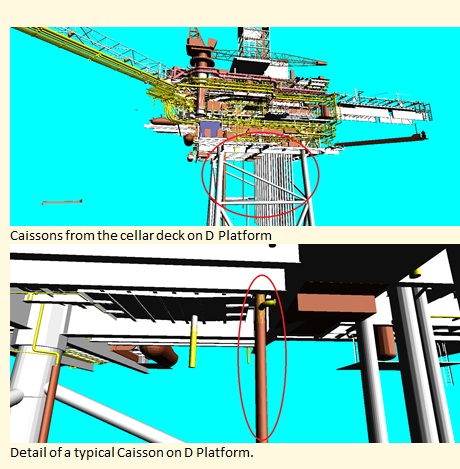
Caissons on oil rigs are not much more than fancy service conduits and are used to protect equipment from the effect of the North Sea. They are commonly used to bring risers off the sea bed onto the installation and in this case they are used to protect large seawater lift pumps that bring fluid on board to cool various elements of the production process. They are called upon to withstand the corrosive effect of seawater and air, attack from marine life such as barnacles and algae and of course the constant buffeting by the waves. These Caissons are critical to the installations’ Safety Case as they also provide back up to the fire water lift caissons. They are around 1-1.5 m in diameter, 75m long and made from carbon steel. They are typically under designed to reduce the dead weight when lifted into place during the original construction. Caisson failures have occurred on a regular basis in recent years and the HSE is particularly interested in this programme. One of the first things I intend to do is examine how many caisson interventions have been required since the initiation of this programme as it may be a good indication of how many PoB have been squandered by not pushing this project forward fast enough. As it is the programme is a year behind where it is supposed to and I have yet to ascertain exactly why. I am keen on the programme not sliding to the right as at present I could be around to see the off-shore execute next year.

The diagram above shows just how close the caissons lie to the jackets (the legs the platform stands on) and many of the supporting struts, the small red circles being the SWL Caissons. Each caisson weighs in the region of 40 tonnes and presents a very real risk to the integrity of the platform, not in the least regarding potential damage to sub-sea piping if they were to come loose and fall to the sea bed.
All in all I am hoping that this is a lead-in to taking on some aspect of the caisson replacement programme as the lead engineer appears to be quite snowed under. The Asset Lead is also under resourced so I think there is a good chance that I will be able to get more work on this and other related platforms in the future.
On Another Note
Hugo has fully recovered from his Bronchiolitis, but unfortunately Corine is now getting over her bout of Sinusitis. Luckily the Scottish summer has finally arrived and so I intend to make the best use of it, who knows how long it will be around for!
 Holdfast Training Services Trial Blog