A Long 4 day Week
After a relaxing, if short 4 day Easter break on Rottnest Island off the coast of Perth I returned to a 4 day week that has felt like a month. Prior to leave a milestone had been missed and it was now best effort to get the South Block Upper Basement Zone 2 suspended slab (320m3) poured by Wednesday and the following Zone 3 (120m3) poured by Friday. Even to my inexperienced eye I could see this was pushing it especially because the Senior Engineer was off for the week and it was down to me to manage.
I was handed control of the pour with about 50% of the Reo on Zone 2 complete but for a first slab it was a bit of a nightmare to comprehend. It was not regularly shaped, it had 3 step ups, 6 integral beams (4 with PT), 2 Temporary Movement Joints (TMJ) (for seismic design), 3 ramped sections, 1 stairwell, and 2 penetrations (one of which was to accommodate the up ramp from Lower Basement). To deal with the more interesting details in a little more details:
The reo schedules and mark-up drawings were fairly epic in themselves and took me a good couple of days to get my head around which was unhelpful as I was being asked questions from the point of arrival on Tuesday morning. This mainly involved multiple trips to the slab deck to identify the issue, to steel fixers (NRG) office to discuss a solution, then to the site office to call the scheduler to check measurements, delivery dates and bar marks to ensure all the required steel was there to complete the task. Having been on the task for 3 weeks at this point with minimal top cover, it was inevitable that there were going to be issues. There were plenty, culminating on the night before the pour, after the structural designer had completed his structural check, that we found we were missing wall starters and were unsure of the wall dimension. After a few frantic emails and an early morning dash around site, the size of the pour became an advantage as after the 0600 pour start we had approximately 3 hours to get it rectified if we poured in the correct configuration. We didn’t pour in the correct configuration but luckily the fixers were quick and it was done in the hour.
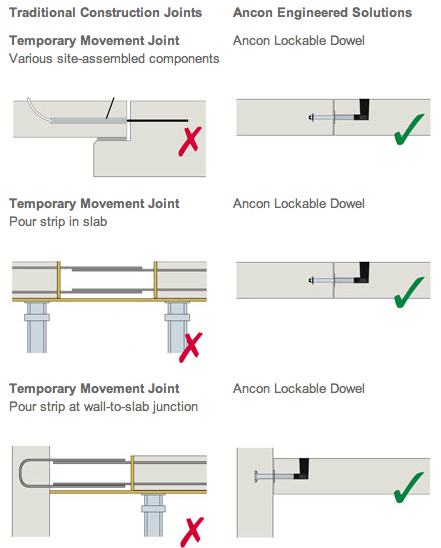
Slab joints are a fairly new one for me, and it seems that the TMJ technique used on the NCH is for a lot of people in Perth. The TMJ’s are designed to give the structure a degree of flexibility between slab edges during construction to accommodate shrinkage due to curing and PT. The project is using a range of Ancon shear connectors that are either locked off after a specified period or allowed to accommodate movement throughout it’s life. The benefit of using the shear connectors is that it speeds up the rate of construction as it reduces the requirement for complicated or additional formwork, and only leaves a small joint and connector that required grouting to finish the connection.
Post Tensioning in the beams is quite an issue, it appears that the structural drawings when sent to the contractor to produce shop drawings get changed ever so slightly that they always clash with the top reo. There has been several issues with the lateral placement of the ducts as many are detailed to pass through columns, but as the PT shop drawings were not complete at the time of column pour the bars were cast in the standard positions, therefore requiring bars to be removed and replaced by drilling and epoxying new starters in place. The issue that I have now found to be the biggest issue is the lack of any consideration in programming for the lag that occurs in construction due to tensioning. The initial stressing can occur at 24hrs post pour (concrete approx. 9MPa), however as per the structural specification the final stress can not occur until the slab reaches 22MPa and 5 days post pour. This builds in an additional 2 days per slab to each pour date. I have looked at the sequencing of the slabs and think there may be a more efficient way of doing it, but I need to speak to the programmer to ascertain the assumptions behind the decisions.
From a RE background of pouring a maximum of 5m square flat slabs, the idea of moulding the concrete into ramped sections concerned me a little – it turns out to be pretty much by eye. Pouring 320m3 of concrete in one hit was pretty hectic considering steel was still being fixed at the other end of the slab. This was the last ‘easy’ pour as the truck mounted pumps will no longer have access to the bottom of the hole. From now on concrete will be pumped from the access slip lane into a standing boom pump, which will pour to the final destination. The complication comes in the fact that the agitator trucks will not have the space to wait in the slip lane, where all the other deliveries arrive, so coordination is vital. This will be yet another task for the site engineers but in my view is so crucial it should have a single responsible person as there is so much scope for errors and with the prospect of turning concrete/reo away due to lack of space it could get pretty costly.
One of the overarching issues for me is the complication that so many contractors on one job creates. Not just the usual issues of construction but also the issues between themselves (Rivalry, Unions). I realise the intent of employing workers and sourcing materiel separately is to cut the costs of the project, but it appears that the time taken to liaise between the various consultants (architects, structural, services), the individuals who are doing the work, and those sourcing the materiel takes the vast proportion of the engineers day leaving only a small element for actual forethought and fault finding prior to construction. I don’t think that many sub-contractors makes light work and cost effective construction, quite the opposite actually.
 Holdfast Training Services Trial Blog
Hi Nik,
Ancon detail is interesting – the conections are necessarily not cheap but I wonder, after grouting them to fixed do you not then also have to fill the contraction void, which is what a pour strip does automatically?
Think you are right about the resources/space mangement being a probable pinch point. Have you raised this concern and proposed an ownership solution? If it doesn’t end up with single point of responsibility and issues start to arise have you considered your mitigation plan?
Management perspective – Many contractors is excellent – they can be managed by the engineers who are generally quite capable, can be flogged hard and don’t cost much!
Just for the record, we have now had an offline discussion about duct alignment and chopping out 18% of column steel (or not) to accomodate it. Also a brief discourse on concrete strength vs PT losses as a time dependent variable. Anyone else with experience or questions relating to steel fixing/alignments and PT losses please wade in here.
Nik, I still want to know about the Ancon void filling and resources/space mangement issues raised above!
Regards,
Richard.
Richard,
Apologies I don’t check this daily, and it has been hell of a week (see future blog).
The Ancon system we are using involves 2 types of connector. The DSDQ150 Beam connector and the ESDQL20 Slab connector (shown above). The process for each system is practically identical, and involves:
1. Formworkers setting out and nailing the unit onto the side formwork
2. Steel fixers placing the the U bars in the correct configuration, placing the dowel bars through the formwork and running the corner bars through.
3. Concrete slab poured and stresses as necessary.
4. Stripping formwork and exposing where necessary the tops of the ANCON unit.
5. Set up of next slab reo and placing the male end of the ANCON unit into the cast in female.
6. The formworkers applying a ‘bond breaker’ along the face and placing a sheathing duct over the exposed end of the dowel bars (sheath includes a duct for subsequent grouting).
7. Next slab poured
8. slab allowed to cure, TMJ allowing shrinkage without damaging structure.
9. At 60-120 days keys placed in female access point and grouted with epoxy.
They do cost alot, for a fairly simple 930m2 slab I am currently preparing I just spent A$14,000 on ANCON connectors. The advantage of using these over the standard pour strips or cast corbells is that it uses less concrete, reduces the requirement for complicated and additional formwork, and increases safety by reducing trip/fall hazards.
The grouting of the void is conducted by injecting grout into the TMJ dowel ducts and into the void.
The resource/space management is an issue and has potential to get worse. The hole is almost sealed off now with limited access to the basement levels as the ramps to GL are slowly being removed. This will free space but only for it to be roadbased and built upon. Mechanical loifting erquipment in the hoile will be limited to a very small manitou and the 5 tower cranes. We are set to get hoists but they will primarily be for the vertical construction. The additional solution/issue is the construction of a site ring road. It will help with the delievery of resources around site but will erode the precious storage space that we do have. The management of the space on site will be broken down as follows: The slip lane and surrounding areas – Tony (Crane coordinator, started yesterday), Greg (South Site Manager) – South superstructure, Tim (Centre Site Manager) – Centre Superstructure. These blokes will coordinate movement and storage in their respective area. This is yet another burden on their time, but I feel that in conjunction with the site engineers this is the only option short of buying up a plot of land outside which has consitently been rejected on the grounds of cost, time and double handling.
What the site needs is an iron fist to control the many subcontractors doing whatever they feel like. Once a formwork shutter is placed in the ‘wrong’ place it will stay there as crane time is short. I think a weekly space coordination meeting will be a good resolution to plan clear lanes and rerserve areas for storage.
Thanks Nik. Good blogg and commentary. I remain unconvinced about the Ancon dowels being so much simpler than pour strips. I’ve had the sales pitch several times and we’ve never used them on site so I am intrigued to know if you feel that they are really worth the cost and effort. Don’t worry about it now but do bear this in mid as a useful comment latter on when you’ve had plenty time to appraise them and are not snowed under with other stuff.
Nik,
You’ll be lucky to get any sort of discipline on a site from my experience. If there is some real estate available for a brief moment you’ll turn around and it’ll be filled with something of someone elses and you’re quickly stuffed up. I also tried to instigate co-ordination meetings but they were only successful if everyone attends and I refer back to my earlier discipline comment, you’d never get everyone you need and when you do they disappear off to take phone calls and do equally as important “stuff”. It’s hard go but stick at it…eventually someone will realise the benefit of a communication forum and embrace the opportunity!
I wish you good luck!