Engineer and Accountant
I declined to blog last week as quite frankly I was too busy learning how to be an accountant coupled with the fact there has been little progress on site due to monsoon rains. It rained everyday last week which meant no work went ahead – the subcontractors seem to be very good at sensing rain long before it actually arrives and will often not bother turning up. One thing I have leant is that the weather forecasters over here are even worse than the UK, not even close at times!
Last week I reviewed the programme of the bridge build as when I arrived it said completion would be the first week of Sept. Last month we revised this to the end of Sept and knowing the FRP subcontractor and what effect the rain has on site progress I think we will be lucky to complete by the end of Oct. In order to keep work continuing at a steady pace I proposed to the FRP subby that we could start on the deck in between backfilling each abutment that way his steel fixers would have continuous work moving from the deflection walls to deck to wingwalls. He has told me that the company has very little work on in the Sydney area and that Dickson Rd bridge along with a few retaining walls at the station is just about all the work they have at the moment. I thought he would be keen to keep his work force going and initially he was. However the company owner came down and sacked half the workforce and so now they don’t have that problem! They say they will not work anymore saturdays – which is fine with me – and I get the impression he wants to delay progress as much as possible to take the job up to xmas. I asked him outright if that was the case and he assures me it isn’t and realistically it doesn’t serve them well to do so as this is a lump sum contract. If his blokes are not working he just doesn’t pay them so the quicker he does this job the quicker he can sack everyone if he wishes!
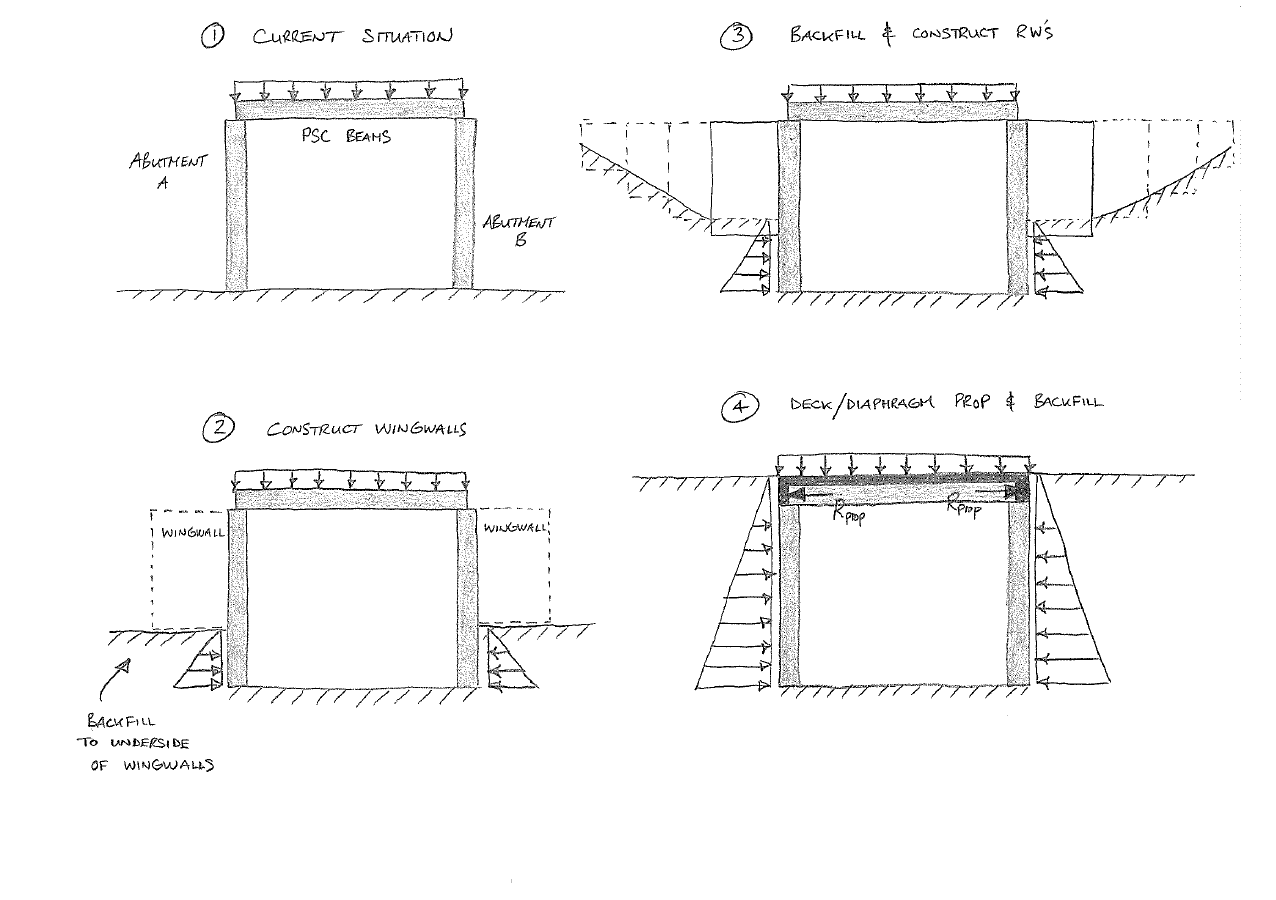
Anyway, I am going to attemp to get a little technical now with regards to the design. At present we are still constructing the inner portions of the deflection walls that butt up against the abutment wall and once we complete these we can then start to backfill material behind them. Depending on the concrete test results we are looking at about 4 days from finishing the walls before we have enough strength so that we can backfill. By staggering the work we can be working on one side while the other is curing and then backfill the first side while the other is curing. The bridge is designed as a propped structure which means we can not backfill the entire height of either abutment until the deck/diaphragm is cast, this then ‘props’ the abutments apart which reduces the bending length of the wall. We can backfill to the underside of the wingwalls without casting the deck slab but once we have backfilled we can then erect scaffolding on either side to access the deck while simultaneously working on the wingwalls. Once the wingwalls are complete we could backfill at a certain batter from the underside of the wingwalls out so that we (structures team) are conducting detailed excavation only of compacted fill for the subsequent retaining walls. This would add a surcharge onto the earthe pressure load although the backfill heigt is not going past the underside of wingwall height, so it may be sensible to cast the deck before doing so. Hopefully the below sketches explain where I probably haven’t:
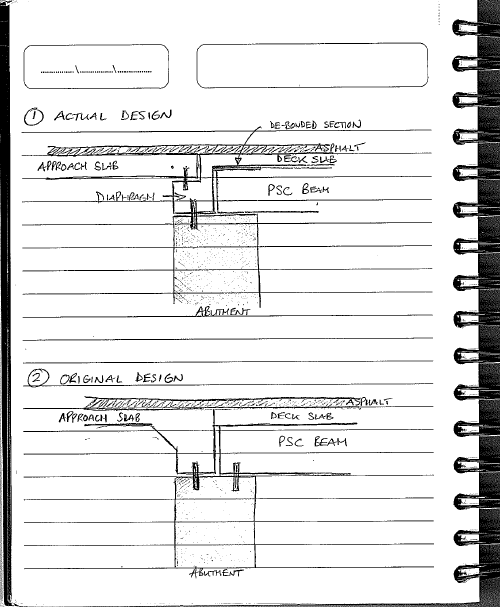
I noticed in the design report for Dickson Rd that the end dowel joint arrangement was different from the AFC drawings and so enquired to the designer about why. He pointed me towards Eastwood Rd design report which has the same diaphragm/deck detail. The original design was for the PSC beams to have a slot for the abutment dowels to sit into with rubber spacer rings around the dowels to allow for movement. The dowels restrain the deck laterally and longitudinally and what I can figure out is that there seemed to be a concern over the combined effects of flexural bending and shear on the dowels. This seems to be why they repositioned the dowels to the rear of the bearing strip and out of the PSC beams. The debonded area at the end of the beams and the 50mm gap between beam and diaphragm means the beams can flex with minimal transference to the dowels. Consequently the rubber spacers have been omitted and a PVC conduit is placed over the dowel with a snug fit to ensure debonding and so taking away any torsional actions that could occur on the dowels.
The past week with the rain has mainly been spent on catching up on QA paperwork and the laborious task of uploading ridiculous amounts of paperwork for eack worklot onto the JH project pack system. I have also spent a great deal of time both work and weekend getting amonst the costing procedures I need to fully understand before next week when I will be the sole engineer on the section. My new responsibilities will include the costing of all four bridges which equate to about 62 cost codes – 15 on Dickson Rd which are all active but quite a few on the other bridges now not. The end of the month comes at about the 15th oddly enough and the forecast comes out a week after. For that missing week when dockets and invoices are not processed by the commercial team I am required to accrue work I know has been done and estimate what I think we will do until the actual end of month including what work the subcontractors may claim for so that JHG can put that money aside in their current account and keep the rest in their savings account! Invariably the estimate is not perfect and so next month you will have to place in the correct figures aginst your estimate. A week before the end of the month the forecast spreadsheets are published by the commercial team usually on a thu evening and by mon morning all Senior Project Engineer’s and me are required to submit their forecasts which shows all cost codes for all the bridges and make that it all adds up. A large part of this and what the Construction Manager is interested in is the cost at completion forecast. If any single cost code varies +/- by $5000 then you are required to explain why and I then produce a summary sheet for each bridge so he can see what state they in! Thi is also the time to ask for the budget to increase if you needed which is what we have had to do mainly because of the very low budget for craneage that was initially set aside at tender. It took me all fri to complete 5 cost codes and sat to do another 5 this month so I am not sure how next month will go considering I will have all 62 to do. Despite the extra work load I have found it surprisingly enjoyable intermingled with massive frustration when things don’t add up but I already feel like I have a very good understanding of costs related to the work I am doing and it has meant I have had to dive into alot of sub-contracts looking for rates which again is improving my contractual understanding. One thing I did pick up from the FRP subcontract is that the deflection walls have not been priced this has been forecast. I estimated the additional cost in the region of $150,000 but I am not entirely sure the subby knows that this work has not been included. Apparently it was not included in Eastwood Rd either and they have claimed for all their contract work but have mentioned nothing about the deflection walls. It will be interestig to see n a few months time whether they do realise as the commercial manager seems to think they haven’t got a clue and is secretly hoping to pocket a few hundred grand – it will certainly make my costing reports look very healthy if they don’t!
 Holdfast Training Services Trial Blog
Jon,
I have read this several times – please don’t take the late comment as lack of interest, it’s just that there’s very little to say. A good informative and interesting post, thank you.