Self Made Issues
A temporary blip on the blogging last week where I just plain forgot, so apologies all round to anyone that reads them!
A few issues have cropped up over the last 2 weeks in and amongst the frantic push to meet a $20m milestone payment by the end of June. I think my last post eluded to the colossal amount of work that was required to meet the deadline and the equally large chance of a storm pushing through to make meeting it that little bit harder. The long and the short of it is that it was an uber busy week but we eventually poured the 4th slab in 7 days – for those of you who are interested, that’s approximately 100m3 of concrete. Good efforts all round.
The fallout from the epic push is that whilst all attention was focussed on reaching the milestone, very little was actually done to plan for future tasks. The following issues have arisen as a direct result of simply not have enough time/manpower to keep up with construction.
- Stair 9 Internal wall. The initial pours of Stairs 8 and 9 had many errors and were quite out of plumb in places due to an initial rush in the early phases of the project to get them poured. We have reaped the rewards of this by slowly closing out NCR’s with structural engineer input to bring them back into tolerance over the next few levels with no significant effects. The particular issue that could easily have been avoid was a lack of starter bars immediately next to the door (see image). I had a look at the initial setup of the formwork and discussed the missing starters with the steel fixers. I left it that if required, the error was theirs and they would have to drill and epoxy new bars in. As it turns out, they were not missing, the internal door had been set out wrong by the formworkers. By the time I had investigated this the steel fixers, pressured by site managers, drilled and epoxied and fixed the steel in the form. I had to order them to rip it out and cut the bars off when I found out. Sad faces all around. The issue now is who pays for the work conducted by the steel fixers. JHG won’t stump up because the work was conducted without JHG approval, so it looks like the formworkers will pick up the tab. I am speaking with commercial this week to discuss.

‘Missing’ starter bars at the edge of the wrong door set out
- Stair 10 Landing. When stair 10 was poured the couplers/starters were not installed as they were not delivered in time. The decision was to drill and epoxy new starters around the perimeter. A site instruction was written to the steelfixers to conduct the workswhich were detailed as N16 bars to be drilled 225mm into the wall (to internal edge of external steel) at 200 centres top and bottom of the landing. This work was completed and JHG informed that all work was in line with design and standards. On inspection it was noted that the bars were not at the correct spacing (but that could be put down to drilling around wall reinforcement) and also the ends were not aligned. ON closer inspection and a slight tug, a couple of bars came off in hand! To put this in context, the building is designed as a post disaster structure that feasibly could have a large imposed loading if people are rushing to evacuate the building. The landing is solely held up by the drilled and epoxied bars. This negligent work could have potentially caused additional collapse of the building. We are currently awaiting the outcome of a further investigation to ensure the work is completed adequately. To me this highlights the lack of personal pride in ones job and a complete lack of understanding of why they are doing something. It further highlights the problems with hiring 3rd tier contractors and the lack of any checks to ensure competence when hiring.
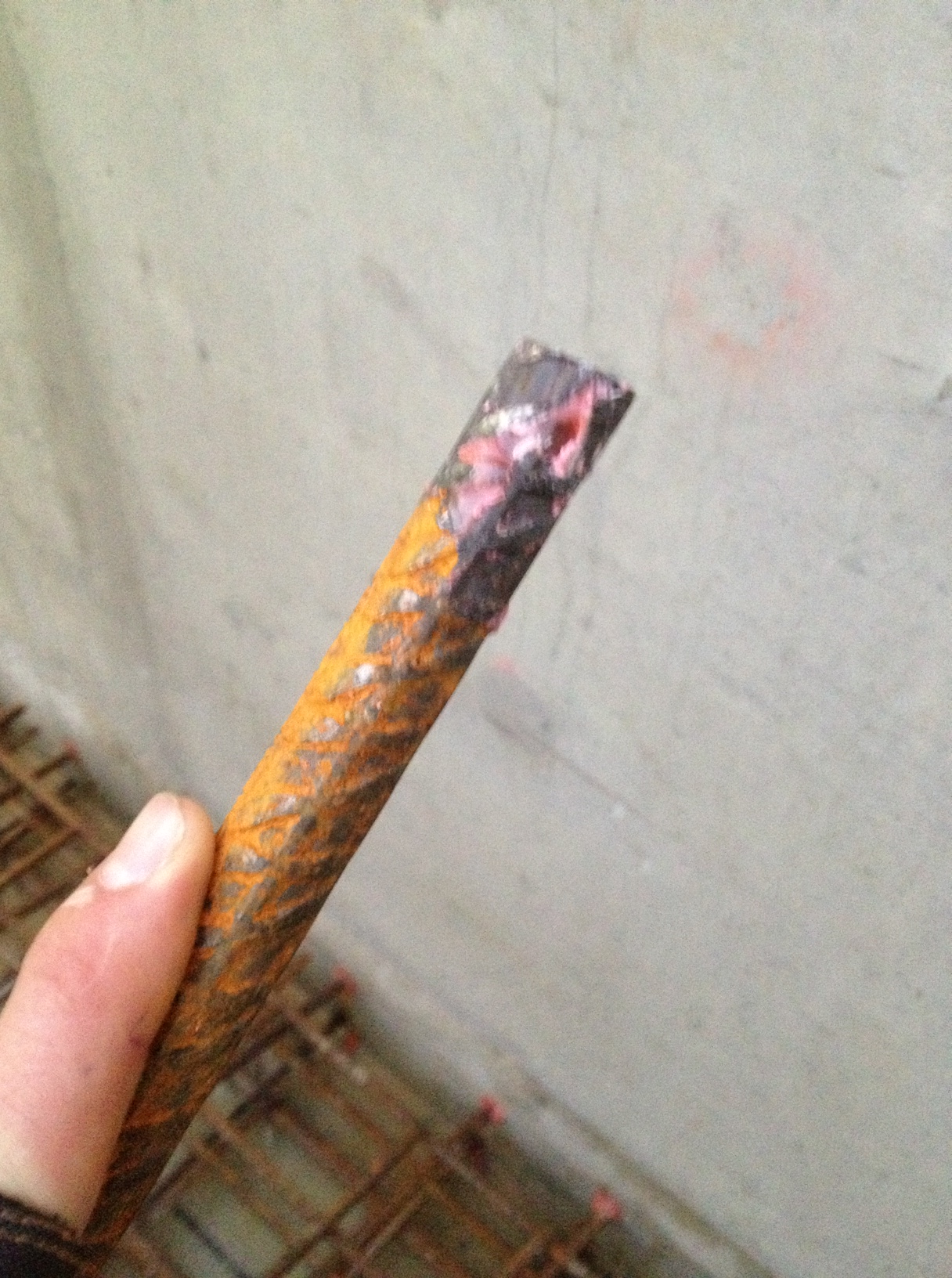
The hand removed N16 starter. Now I’m no good at estimating length (Nicky tells me) but that ain’t 225mm!
- West Block column. After the long drawn out negotiations with the client to decide the method an of pouring and finishing columns the following occurred 1 week afterwards. To top it off the Clients representative was at the stripping of the formwork with his Ipad looking for the density of blowholes in the surface finish – he got a bit of a surprise! It is assessed that the concrete was not vibrated adequately and the consistence was not sufficient. Therefore both JHG’s quality assurance and the concrete contractor for not carrying out the task correctly. The issue was escalated by the state to the WA Ops Manager who personally emailed the site engineer to express his dissatisfaction – not I would argue good management. A suggestion that it would be a good feature column in the X-Ray department was not taken well.
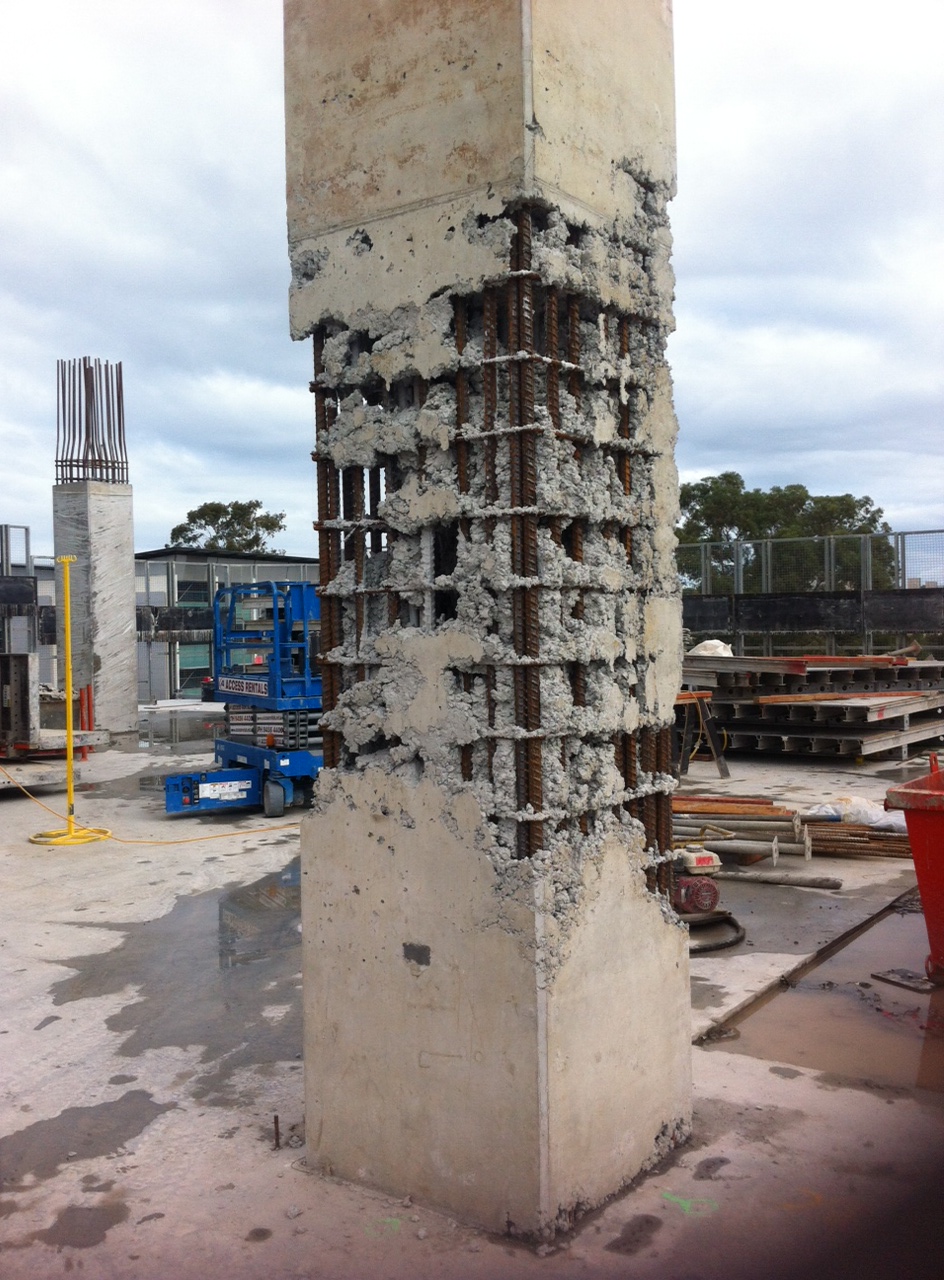
The X-Ray Column
What this highlights to me is that a project must be adequately resourced to match the construction programme in both management and workforce. To not resource a project effectively is to delay the decision making process which will have a detrimental effect on progress.
The Construction Director who was pushing the programme (I think his job may have been on the line) has finally accepted that 2 engineers for the whole of the South block is simply not enough. A new engineer started who will be solely responsible for the Core C riser and jump form, and the rumour on the jungle drums is that a further engineer who was destined for the basement may be poached temporarily to reinforce the South team until the basement kicks off. Time will tell.
In other news, we had the Dollimore’s over for their last night in Australia this weekend. We had a fun night out with a few guys from the NCH to say goodbye, and a final breakfast at the beach in Cottesloe. Then it was time to head back to AER for me so I had time to finish in time for the Lions game. We set up the projector in the house and had a few mates over for a BBQ – Great game! Actually looking forward to work tomorrow now after the abuse I got last weekend!
Home Cinema – al the better result when surrounded by Aussies!


You must have been dreading going back to work either side of half time; I thought that the Wallabies were going to get on a roll and thump us in the second half until the tries started coming our way.
Nik,
Thanks for the images they will feature in lectures starting this week with the E&M regarding practical delivery of concrete structures 🙂 Does site operate a self certification scheme or does the main contractor take responsibility for overseeing and quality assuring? What QA procedures were theoretically in place for checking the resin fixed starter bars and who specified the depth, spacing and bar size? I’d have anticipated seeing paint/chalk marks all over the slab edge after a feroscan in order to show existing reinforcement locations so that drilling was not hit and miss. Is there a central repository of site QA records which would hold information about who checked the hole depths and agreed to resin fixing starting? Re the x ray column, what is the spec for the concrete, how is it checked and accepted/rejected and what records are kept of batch locations, placing and curing details? Tere was an issue with dubious concrete being used for highway structures here once and the records for several bridges resulted in some being replaced but others being known to be OK , but only because the records exoisted to show that they had not received particular concrete batches. What would eb the issue on your site if it was found that the batchng plant had used a substandard cement for a week and all of that weeks concrete needed to be replaced (at their cost)? Could site identify it?
Jim,
I work on the basis of blind faith until the final minutes. Thankfully this time it paid off. I again wore the shirt into work on the monday. Not quite the same reception this morning – as predicted the Aussie blame the entire test defeat on Broad not walking.
Rich,
I could supply plenty more photos of bad concrete if you wish! One of the main issues is the tier 3 contractors who are too small for the size and complexity of the job. That said, JHG has actually accounted for the time in the management time to mentor the contractors throughout the project!
Site certification is based around the pour card developed by the engineer which comprises all design docs and responses to RFI’s. Essentially it is all down to the engineer to sign off to say that the work is completed satisfactorily, though for the more substantial elements (slabs, core walls) the structural engineer must complete a check. There is a standard detail for tension development lengths for the different bar diameters when using epoxy resin, however I stated that the depth should be to at least to the far reinforcement. Ensuring that the subbie completes the work correctly is down to the engineer. In the case above the contractor swore blind that they were all drilled to the specified depth and it was only an inquisitive tug that found him out. The decision was made to cut all bars drill in off at the wall and re-drill the holes. Future QA measures are to check all drilled holes prior to epoxying. Time consuming but essential. As for accounting of locations of epoxied bars, i keep a record of how many, what size and what spacing are in each area, but nothing more exact than that.
It appears that the site direction for driling and epoxying is drill and hope for the best, but I did use a passing GPR operator to check a column for places to drill today. The quantity of D&E’d bars on the NCH is quite high – not sure if this is a standard thing on sites or just due to the sub standard contractors.
Delivery of concrete to site is monitored by the Engineer but dockets collected by subbie. The engineer then gets the dockets after subbie admin is complete and they are input on a central database that tracks where each mix went. This includes the logging of all test dockets which allows for the accounting of all mixes. As for the exact location of mixes, in a slab for example, it is a little more difficult. The planned pour route is often not followed directly and tring to find a 6.8m3 truck in a slab of 320m3 is pretty difficult. Samples are taken at 50m3 intervals and used to approximate the batch of concrete. The supplier tests the cylinders at the specified periods for their own QA and accountability for the project.
Concrete QA and tracking sounds pretty swept up to me. I’d welcome photograps of typical concrete issues, particularly if they have a simple transpopst, placing, compacying or curing cause and anythng that makes them bring the message alive for those in the classroom here. I guess you’re about to find out why swagger sticks are useful tools if you have markings that allow you to stick them in a hole and know that it is either 5″ deep or it is not!
Thanks for the feedback – good blog!