Archive
The rain may defeat me!
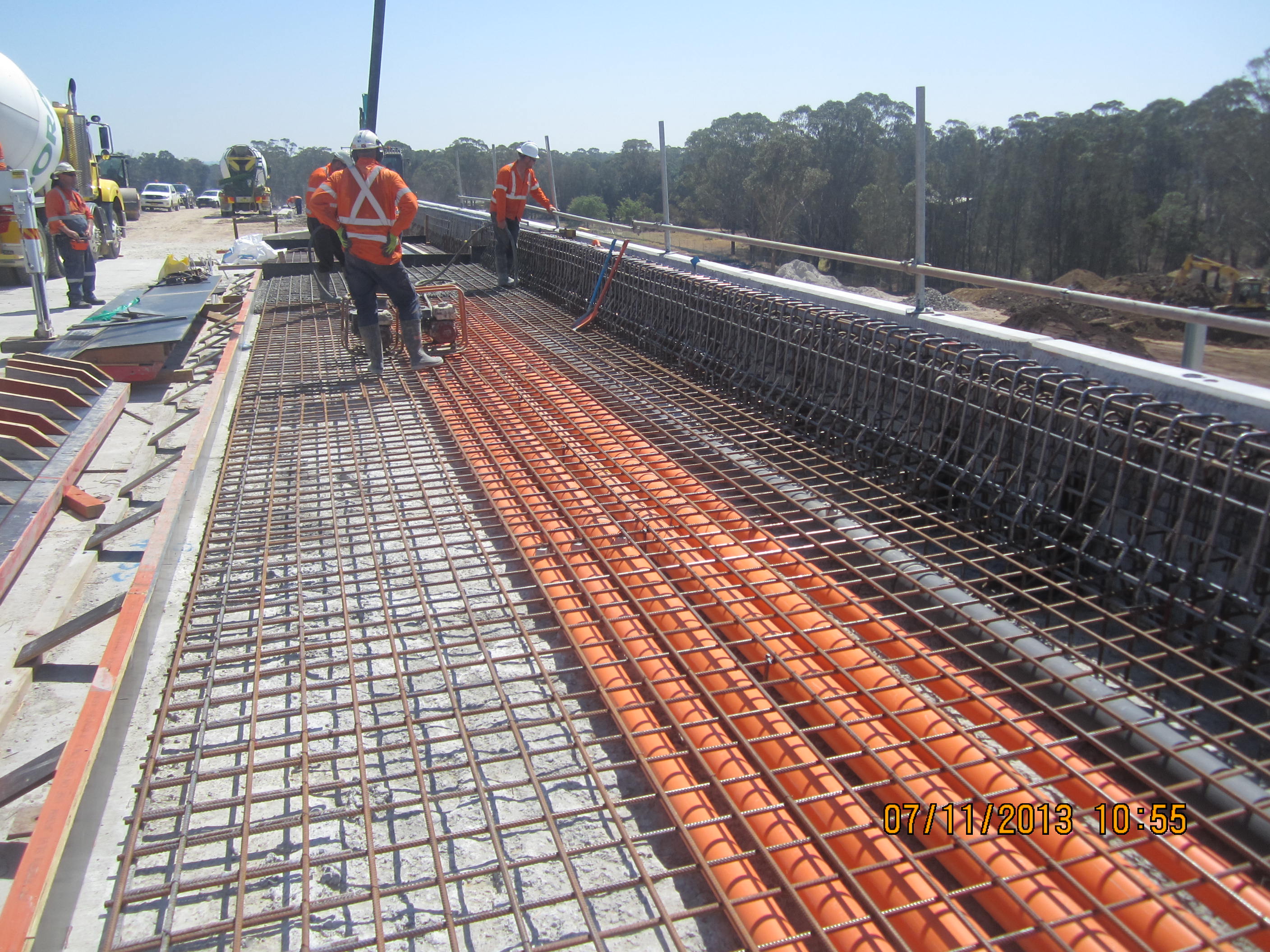
This last week has seen slower progress than I wanted, however we have managed to complete the walkway along the eastern side of the bridge and installed the water main and the six conduit runs. We also managed to pour a total of 18m of traffic barrier out of the 108m along both sides of the bridge, although I was hoping to get 27m complete I had further issues with the reinforcement supply. The steel scheduler rarely seems to get the schedule right which has forced me to check every schedule he sends me to try and spot the error ASAP so I can get a timely resupply. In this instance he forgot the end transition barrier steel completely and some for the barriers on the wingwall but after stressing to him the urgency it still took a week for delivery and what was delivered was about 2T more than I was expecting – at $1123.50 a T I’m inclined to send it back and not pay the invoice or cash it in with the steel bin so we can have a final BBQ!
I have had to move the slipforming to the right by two days due to rain forecast for early next week. Usually the weather forecast is pretty useless and the weather can be very different out in the west than it is on the coast but as we haven’t had rain for a long time the met gurus have put up a convincing argument that Mon will be a washout. I am almost looking forward to some rain as it means I will have a chance to catch up with a large portion of my QA paperwork and load it on to the worklot register to pend to the quality coordinator. The main hassle with trying to close lots is waiting for the concrete test results which almost never get issued at 28 days and often take 40 days+ before they reach you. I am currently badgering the concrete supplier the day the cylinders are tested so they can send me the results so that I can pend as many lots before I go on holiday this sunday.
Another issue that stops worklots being closed is outstanding NCR’s. The RMS spec only allows surface concrete cracks of less than 0.1mm after 28 days which basically means any cracks you can see have to reported as an NCR and an RFI also needs to be raised even though the repair method is always the same. This does generate a lot of paperwork and takes time from the engineer.
I was trying to think back to the issues I have raised through the blogs so far (I could look back over the blogs I suppose but hopefully I can remember the pertinent ones) and it has occurred to me that most are still an issue and have not been resolved as they are either sitting with the designer or we have no resources available to currently do anything about them.
Pile concrete mix. The initial issue was that the concrete did not meet the required strength at 28 days but after applying age correction factors to 56 day results (the concrete supplier argued that it was a 56 day product therefore it may not reach 50MPa after 28 days) and an assessment of – there near enough – the designer accepted the strength results we had. A later issue was that when we looked through the batch records they had actually supplied the wrong concrete mix for two of the ten piles which was a mix that was not even a project authorised mix. This mix had a high cement content, higher than the max allowable limit according to the Durability Assessment Report (DAR) so an RFI was submitted to accept as is. The designer and Project Verifier (PV) had concerns about Early Age Thermal Cracking and that is still where we are. The advice from the designer who produced the DAR was that we conduct a PIT which in theory we could do if we exposed some of the pile and notched into the face of it but that is a lot of effort for potentially unreliable results so our response was no, please review again considering our solution to ‘leave as is’ which does seem to be the default setting for RFI’s at JHG.
Conduit expansion allowance. Scalabrini Creek underbridge had the Combined Services Route cast into the walkways without allowing for expansion of the HV conduits at either expansion joint of the bridge between the deck and approach slabs. After going back and forth numerous times with the RFI procedure I finally managed to get the services designer to agree that simply cutting the conduits flush to either face to create a 50mm gap would be the most practical and cost effective approach. Concerns about damage to an exposed cable at the joint were dismissed once it was highlighted that a steel cover plate is installed at the top of the walkway and along the deck which will protect the cable. Other concerns regarding pulling the cables through along cut and potentially sharp edged conduits were also toned down once reassurance was given that strict operational procedures would be followed to ensure firstly that the conduits would be cut cleanly and the edges smoothed off and secondly the installation would be conducted with care and spotters at each joint to monitor the cable pull. The actual process of cutting the cables was not an easy process and took me about 3weeks to achieve. In the end I had to get in another concrete cutting subcontractor as the two we had been using were useless. The only thing we could do to reach the lower conduits was to stitch core them using concrete core bits – it didn’t look very neat at first but its amazing what a motivated labourer with a file can achieve. The cables are now installed and the client has accepted the work so issue closed.
Settlement issues. I think I have mentioned a few issues with initial settlement at some of the retaining walls and practically all the bridge approaches. I was asked by the Construction manager to compose an RFI to ask for the settlement tolerances expected and request that any movement below this value be ‘left as is’ and I suppose we are just hoping that there is no movement greater than the figure the designer gives us. The initial response came back quoting something out of an initial design report by the JHG design manager but I have spoken to Senior designer at SMEC who had designed the retaining walls and he said he expected vertical movement of up to 100m on some of the RW’s and certainly on two of the walls we have had 80mm movement which has resulted in the corner of the wall resting and crushing against the corner of a bridge pile cap. I haven’t really had time to pursue this any further as I was instructed to focus on completing Dickson Rd and that all defect work will be addressed in the new year. If I have time I may revisit this with the Construction manager to at least close the RFI. Eastwood Rd overbridge settled 5mm over a 3 week period but it seems to have stopped and the cause has be blamed on poor material being used for the backfill against the abutment. It was probably due to poor compaction methods as well having watched the civil team at work at Dickson Rd doing layers much deeper than the specified 150mm, using a pad footed bulldozer to compact and employing a rather dubious subcontractor to conduct the compaction testing at supposedly every 300mm.
There may be more issues I need to close but I think this is enough for now. Richard, I think you are probably one of the few who are still reading my blogs so if you think of any issues I haven’t covered I am sure you will let me know. The monsoon has just started outside as expected.

