Last week of JHG, First Week of BG&E
It happened again!
It has been a ridiculously busy end to Phase 2. The main reason has been another formwork incident in the South Block. During the pour of the last slab on level 1 the deck dropped by about 200mm. I wasn’t looking at the time but heard what sounded like a baking tray warping in the oven (Nicky still baking like a good wife should!), and immediately realised that it was the metal formwork buckling. I ordered all those still dopey enough to be standing on the deck to get off the slab, called the site manager and H&S officer. I then paused the concrete supply in line with the QA procedure implemented after the last settlement. What followed was the usual excitement involving the unions and subcontractors making the incident out to be bigger than it actually was (The ABC news channel quoted one of the concreters who had “seen his life pass before his eyes”).
On closer inspection it could be seen that the aluminium beam, on which the deck was bearing, had fractured causing the load to be transferred to the adjacent beams causing them to buckle. My first assessment was that it looked like a combination of over-loading and material failure. See image and calc sheet for sketch. The investigation found that the falsework was not constructed in accordance with design and the beam fractured because it had been overloaded due to an additional 800mm onto its design span. Though the falsework had been inspected by a 3rd party engineer, it would not have been possible for him to see the error in construction due to a ply sheet obscuring the view. The decision is yet to be made on the responsibility for the incident, but I think it is safe to say that the 3rd party engineer’s indemnity insurance and the formworkers are likely to take the hit.
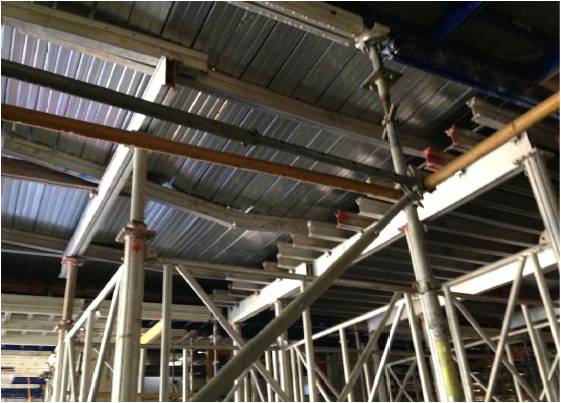
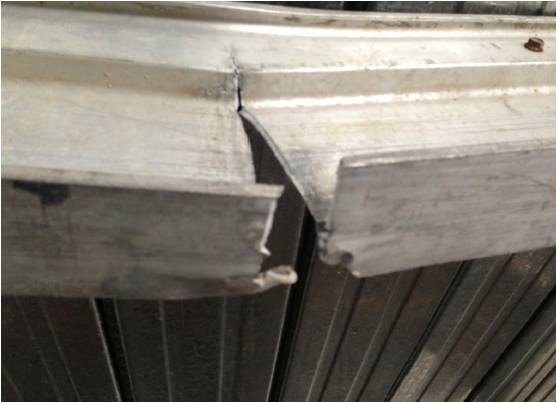
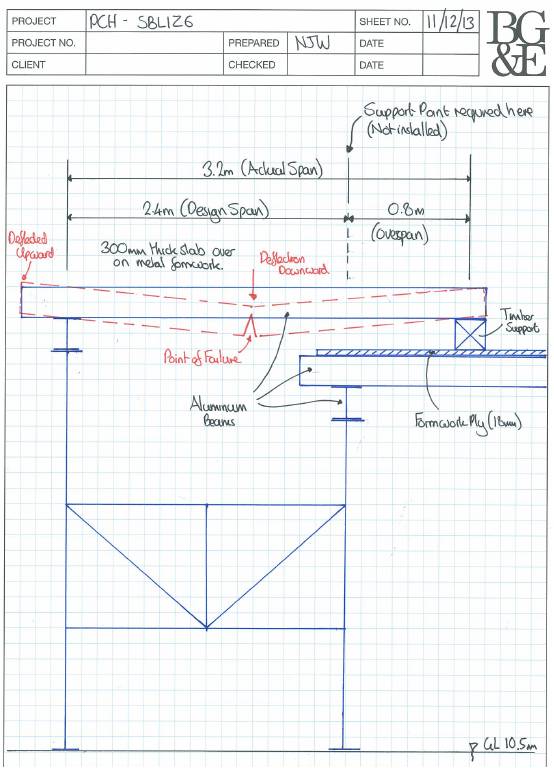
What is interesting about this is the timeline surrounding the pour. The slab was originally planned for the Thursday, but was was delayed to the Friday due to a steel delivery issue, then further delayed to Saturday as the pour clashed with another large pour in the North block. It was then returned to the Thursday at 3pm on the Wednesday, resulting in an incredibly compressed timeline to complete of the slab (Steel was still being fixed in one corner of the pour as the concrete was flowing in the other). In my opinion this should never have happened, once a decision has been made it must be stuck to otherwise confusion reigns. The element being poured should always be ready the night before in order that quality and safety can be preserved (but maybe that is just my military head talking, as it seems to happen quite often here).
Though the incident would probably have occurred even if the pour had been on the extended timeline, it highlighted the lack of resources in the South Block and the pressure to perform to a demanding schedule. The advancing of the slab pour was dismissed as irrelevant in the investigation by the director who ordered it the acceleration – nothing more was said.
We are now left with this……..
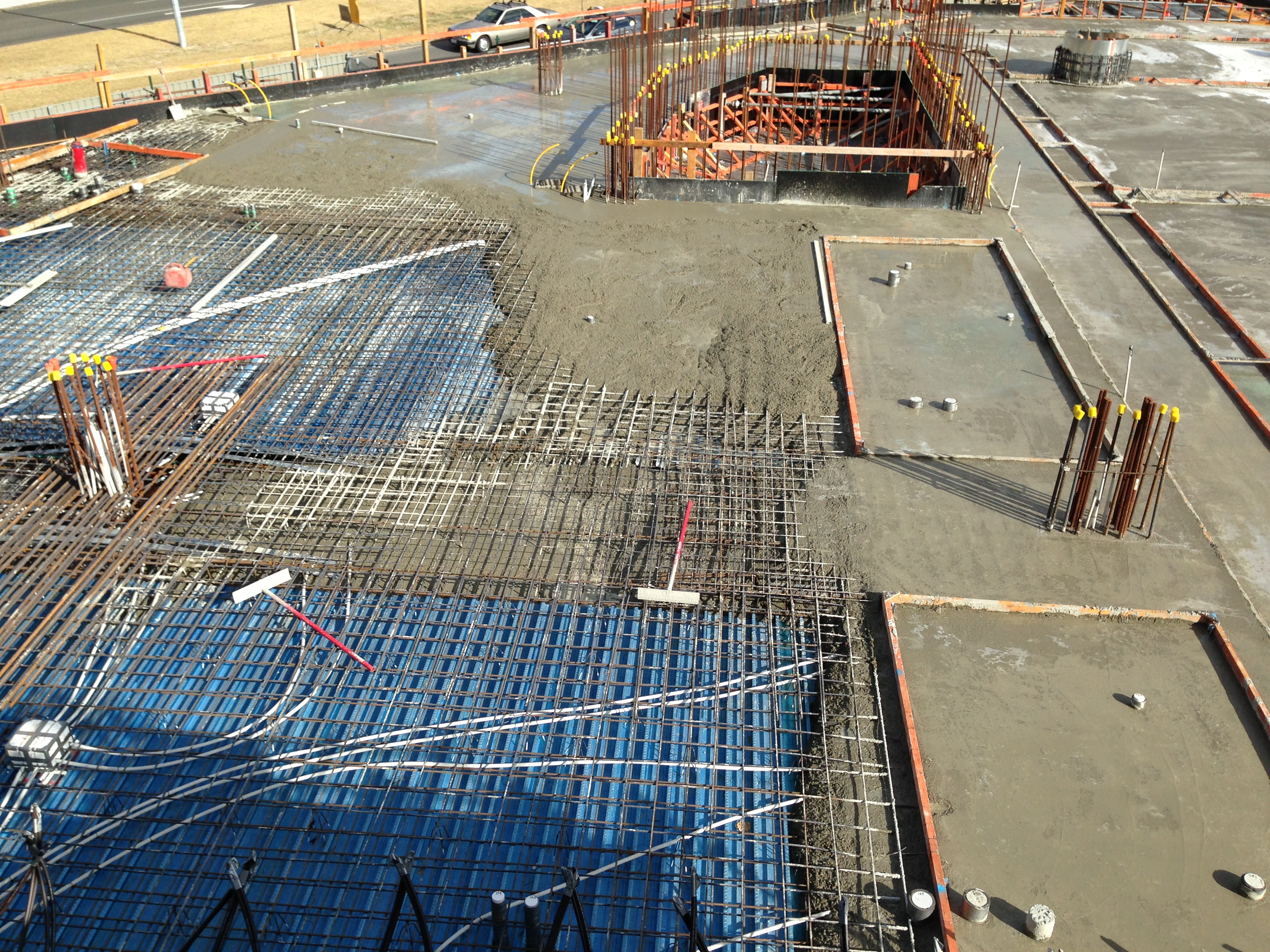
Pretty much everything I feared would be the result of the original settled slab (SBUBZ3) is now hapening to SBL1Z6. Jackhammers have been going endlessly in a vain attempt to recover some of the lost time. Ironically to save 2 days we have almost certainly lost a week. The construction director still wants to complete level 2 by Christmas – lets hope Santas little helpers can break concrete out!
I have been a little more involved with the commercial department recently. Mainly running through the monthly claims and assessing their validity before forwarding to the Project Director for authorisation. PCH has not been the best for experience in this element of professional development due to the separation of the commercial teams from the site team. This has got better over the months but it is still a difficult beast to work with. I hope to gain more contractual experience with BG&E in phase 3.
In my time at PCH, I have been responsible for pouring 42% of the concrete in South block (over 5,000m3), this was mainly used in 14 suspended slabs, but also in 290 columns and various other walls and stairs. I am content that I know how to sequence and construct a building but painfully aware just how much detail is involved in just the smallest element of a structure. It is clear that the devil is in the detail and an engineer must know the structure inside out to ensure it is built correctly. This is a learning point that I will take to phase 3 as minimising the different details is key to simplifying construction and hence improving quality.
I have mixed emotions leaving the PCH project. Whilst excited to be starting the design attachment, I do feel that I am leaving the South block team even more under resourced. Though this has been raised at every team meeting, the PM has been unable to secure the hire of a replacement engineer. Whilst not the most effective engineer in the world, I think the reduction of 33% of the engineer coverage, which can only be a cost saving measure, takes no account of the wellbeing and workload of those who remain and is likely to have detrimental impact on the continuity within the team.
After a brief meeting with BG&E last week, I will be moving into the waterways and bridge department initially, but will be a kind of ‘floater’ with the ability to get involved in anything that takes my interest. I hope to get involved in the city’s new underground bus station design, some bridge maintenance/design and try to get up North to work on some of the mining infrastructure.
In other news, this is the first time in my life that I have not been issued clothes for work, Tesco’s, the Army, and JHG all issued me a uniform. Now going into a swanky city office environment I have had to buy new clothes. It was a little like back-to-school shopping with my mum, but I came away with the obligatory office attire of tight trousers, and pointy shoes. I am not sure how long this will last before I break out a couple of polo shirts and the chino’s!
First week in the design office.
The first week has been a gentle break into the design office life. It is clearly evident that consultancies are scratching around for work prior to Christmas, highlighted by 18 consultancies bidding for a potential A$100k upgrade of a culvert in the Perth Hills. If it is deemed that the structure is already adequate after the site investigation, the contract will only be work A$30k. If it is won by BG&E, it is likely that I will take charge of the ‘Bob’s Crossing’ project (I see it as a warmer in the bank). The tender response is due in prior to Christmas, and I will be reviewing it tomorrow. My thought currently is how to make the tender stand out from the others, which for a simple investigation is fairly difficult, however, a little research shows that the area is used by families for picnicking and kayaks for entry to the river, so potentially there may be an option to provide a simple jetty or slipway at minimal cost.
I am currently working in the waterways department, investigating the flood flows over 9 small bridges in the South of WA in an area called Denmark. The longest of these bridges is only 8m and barely 1.5m off the channel bed, but the flood index flows need to be calculated to design the crossings. My thoughts at the moment are that culverts would be the best solution for these rarely used tracks through the Jarrah forests. They will be quick and easy to install, have a good bearing capacity for large trucks to pass, and will be cheap to maintain. The contract is part of a panel contract with the Main Roads department of the WA government, so there is no competition for the job. It appears that the investigation is completed to size the crossing/barrels and then handed to the MRWA to do with as they wish. Pretty easy for the consultancy really, but done well and they will keep coming. As I understand there were issues with the last set of reports that BG&E submitted; different formats, different headings, elements missed. Most of this was due to splitting the jobs down to individuals and not checking effectively before issue. It appears that the directors have grasped this error and are leaning heavily on the QA and management of work packages within the teams. It seems like common sense to me but maybe I can bring a little coordination and admin (squaring away) to the party.
As suspected, I feel a little like a BeeGee walking around Perth CBD in pointy shoes and tight trousers, but everybody seems to be doing it, so maybe for once in my life I am in what they call ‘fashion’?


This thing called ‘fashion’ sounds a tad uncomfortable. What you need is a good black polo neck jumper, comfortable shoes and garish glasses as worn by all true construction professionals.
It would be good to maintain a watching brief on the claim developments so you can discuss it at cpr, lessons identified etc.
Nice piece – any comment on the failure mode ?- it’s interesting – I can detect a little bit of lateral buckle but it seems it is predominantly flexural stress- It is quite surprising to see something that looks like a tensile flexural stress failure. It is the restraint on the compression flange and the logitudinal stiffner that helps. If you calculate the tensile stress for the loading I wonder if you approach the yield strenght of alumiunimium- the yield strength of pure aluminimu is low ( about 100N/mm2) but this is almost certainly an allow and will have a strength closer to mild steel. Since aluminimum does strain harden ( a little) would you expect to see this failure ? I am certain that there must have been a pre-existing stress-raiser ( crack) One of the leanring points is – inspection of temporary works supports – and KNOWING WHAT TO INSPECT – do you remember the chat on inspection of rc drawings? All good for CPR
ON to smart suits and water- I know nothing about it ….EXCEPT…. I’m sure they go in for floodways in dry dry dry dry dry WEEET! dry dry dry environments becuse culverts tend to be washed away…the CORPS expert is Gary Allen – and I’m sure he’d agree—God help us all!