Train derailment at Stoke Lane on the 27th Aug 2013
This is a very short blog, as I don’t have time to go into detail. Yesterday I had a really interesting presentation on the factors behind the train derailment at Stoke Lane on the 27th Aug 2013.
Incident Overview
Nottingham train station was closed for a 6 week period, in this period company X tried to take this opportunity to lay some cables below the track (that was not operating as station was closed). In order to lay the cables they used some pipe jacking to lay a 1.2 m dia tunnel under the track. This required two shafts to be sunk, allowing the miniature TBM to be lowered into the shaft and jack the pipes in behind it.
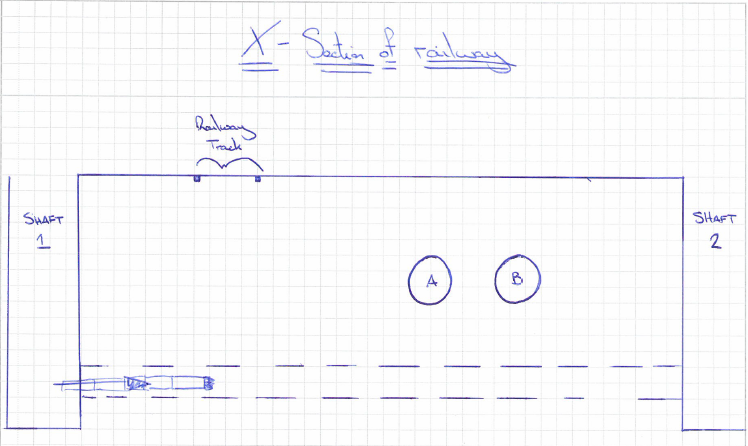
Several weeks later a train consisted of a class 66 locomotive and 30 bogied, tank wagons, loaded with diesel fuel. It was travelling on the up line towards Nottingham at a speed of around 53 mph (85 km/h) when the driver noted an irregularity in the track as he went over the crossing. Shortly afterwards, the trailing wheelsets of the 26th and 28th wagons derailed and ran for approximately 850 metres before the train’s brakes brought it to a stop, as air leaked from a punctured air reservoir tank. None of the other wheelsets were derailed. Both derailed wagons remained upright and there was no leakage of the diesel fuel but the track and some wagons suffered damage
Our involvement
As part of the Rail Accident Investigation Branch (RAIB), Donaldson Associates were asked to look into the method statement and design of a 1.2m diameter tunnel located directly below the area effected.
Findings
The findings are due to be released to the RAIB next month or so, however the preliminary findings are quite shocking. It appears that there was a number of factors that caused the derailment. I will try to explain just a few.
1) Most surprisingly, it seems that no one recorded the amount of spoil that came out the tunnel. It is now understood that twice as much spoil was removed compared to the volume of the tunnel. Where was this soil coming from? How did the contractors not understand that this was a serious concern?
2) The designers were not aware of the main line sewer pipes running above the tunnel until much later, after the tunnel design was completed. These sewer lines were carrying 4m3/sec of sewer, hence some substantial loading.
3) The depth of the tunnel was designed by calculating the live load on the rail way line, ensuring the crush capacity of the tunnel exceeded the live loading. It never factored in the weight of the soil between the railway and the tunnel.
4) The annulus (the space between the void created by the TBM and the concrete sections of the tunnel) of 25mm was not filled with grout or Bentonite. This would greatly increase the volume loss.
6) The volume loss in the design calcs was estimated at 1%, however empirical evidence shows it should have been around 2-2.5%.
7) The K value, that calculates the trough of settlement (Clay would be lower, gravel higher), used was 0.6, however for gravels it should have been around 1.2. This would have given a far deeper settlement in a more localised area.
8) Network rail (NR) do not allow works to proceed if the settlement is above 5%. If the volume loss and K values had been more realistic the settlement would have been around 7mm. Although this is nowhere near the 20mm settlement they experienced it would have been enough to stop the works in the first place.
9) Although the NR stipulate that there is to be no settlement in excess of 7mm, they do not stipulate any trigger levels. Additionally the company that monitors the tracks, recorded 20mm settlement, but didn’t do anything about it. There was no process in place to deal with the consequences.
10) The monitoring of the line only monitors the track. The soil below is not monitored. On inspection the track was spanning 700mm voids wit a span of 2m. No one was even aware of it.
As you can imagine the repercussions of this will be vast. The asset managers within NR are sure to have a busy time over the next few months. As a side point, the asset manager that signed off the works wasn’t even a ICE member let alone a CEng. Infact he had some random degree, yet was signing off works left right and centre. Sounds like he should join the RE (it sounds very familiar to my early days in the RE).
 Holdfast Training Services Trial Blog
Like this – thanks Mike
Always easy to be smart…AFTER the event…….but can’t help myself
I thought it was usual to have to put in an umbrella above (what is likely to have been a pipe jack). The umbrella is a horizontal grout curtain above you but below the track bed. Normally grout tubes drilled in horizontally and tube-a-manchette grouting
You then dig the two pits; reinforce the back wall of one and then use this to ‘feckin’ push the pipe rings in….. but this may have been bored…..but unusual?
Love the bit about the amount of spoil that was excavated.
Sort of know the ‘Ks’ of which you speak… but there’s a few empirical methods of relating the loss ( in an upside down shallow bell curve)- where the volume of the curve = the volume you dig out.
Mike
A good example of things going wrong. I assume that there will be many people trying somewhere to hide. It is amazing things like this happen as rail owners are usually hard nosed about their rules and regulations.
All good experience though
Regards
Neil