Archive
Found it: My arrival at the Power Station
Well I have found the draft of my first blog attempt so here is take 2!
Firstly this project is HUGE!!! Carillion are the lead contractors for Phase 1 of the £8 billion project to regenerate the power station and surrounding area. They will be building 2 apartment blocks between 8 and 18 floors in the sliver of land between the power station and the railway line. A good picture of it and explanation are here: http://www.costar.co.uk/en/assets/news/2012/December/Battersea-first-phase-powers-up/
They are going down 2 floors behind a cofferdam made from sheet piling hopefully without disturbing our neighbours-Network Rail and Mace in the power station. It is basically Ex COFFERDAM on a massive scale! (John you would be in heaven here!) They have finished the cofferdam which is made of sheet piling to provide a cut off 1m into the London Clay which is around 8m below ground level and they are now welding the seams. The main activity at the moment is piling the 1700 piles that will make up the raft of foundations! They have around 3 piling rigs and a lot of excavators dancing around each other on the pretty confined site.
Here are some pictures of what is going on:
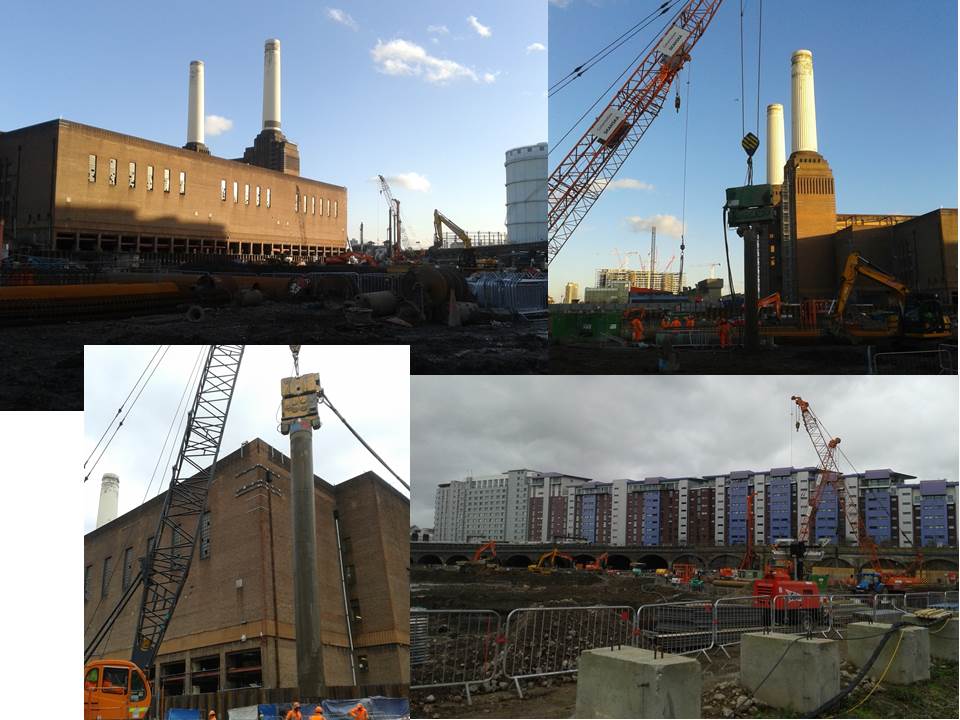
There are 3 main sub-contractors working on site: Appleton doing the sheet piling, Skansa Cementation doing the piling and O’Keefe seem to be doing everything else including excavations and drainage. It is quite an unusual set up as there is another company Elliot Thomas who run the site allocation as it is such a large development and Mace are already working on Phase 2 which is the redevelopment of the power station itself. We also have London Underground conducting borehole testing for the new station that will be built in the later phases. As the lead contractors Carillion seem to be more of the project managers of the site at the moment.
So far it looks like I am going to take on the role of one of the Section Engineers and I get to look after Utilities going out/into the site (aka OIC power and shitters!). We are looking to pipe jack a 375mm dia foul water pipe under Battersea Park Road into Thames Water’s existing sewer (and I need to get it adopted-glad I listened in the drainage lecture!). I also need to get our high voltage cable hooked up to the mains by the 1st April otherwise we have to pay for the generators for longer.
So far they have had big issues with the weather on site as it is turning into a nice muddy puddle-including the piling mats. They have had issues with the 6F2 material they have been using and the fines have been becoming a muddy slurry rather than a solid platform. There is potentially some scope for a TMR along those lines. I also attended a 4C’s meeting (something about Collaboration, Co-operation and some other C’s no-one seems to remember) which is basically a daily O Gp between the main contractor’s Foremen and Carillion. I could not believe the amount of whinging they made about not having a smoking shelter down in the main working area and then the logistics and temporary works design (TWD) that went behind putting one up! They even need to get a TWD to put up a barrier! It is really Health and Safety to the max and I now really respect the fact that we can trust our soldiers not to throw themselves off the top of the excavation they have just dug. I think they need a Sgt Major on site just to do the H+S patrol!
Anyway that is enough for my week 1 excitement I will attempt to put a few photos up and I will continue to chat up the guy from Mace to get a tour of the power station and trip up the chimney!
Where did my blog go?
Well I have just wasted about an hour and a half writing my first blog all for it to disappear into the ether despite saving the draft! So if anyone knows where it has gone please tell me where to find it! It isn’t saved in my blogs and I can’t find it in the HTS part-it seemed to disappear when I previewed it.
Anyway here is the truncated version:
I am working on this part of the project which is HUGE!! http://www.costar.co.uk/en/assets/news/2012/December/Battersea-first-phase-powers-up/
It is basically Ex COFFERDAM building 8-18 floors with a cofferdam right next door to the power station and the railway lines running into Victoria. It looks like I will be OIC HV cables and the foul water main (yeah sewers!). I did write a whole page about who was doing what and how surprised I am about the amount of hoops that need to be jumped through to get stuff done but that has disappeared! So I will keep this short and hopefully find my old post or learn how to use this stupid site before next week!
Roles and Responsibility?
Below are a few observations of my time in the design office so far, a continued criticism from the Orator is that there’s not enough reflection in my work so I’m trying to plug that gap slightly, this started off slightly more formal then it ended up however with a little pruning it will end up in AER 5. The final point is an observation on where geotechnics fit in to the grand picture, mainly at the bottom (pun intended). Sorry no pictures today, my desk is mainly looking dull.
I have been designated a Graduate Geotechnical Engineer, the positions more senior to me are:
Design Engineer – a number of years design experience, 3 in section.
Senior Engineer – A chartered engineer or geologist with commensurate experience, 2 in section.
Principal Engineer – An experienced Senior Engineer coordinating larger projects incorporating a number of junior engineers. 2 in section.
Associate, Project Director, Technical Director – Individuals with significant experience and typically dealing with checking, budgeting and oversight rather than design.
My presence at Ramboll is for a very specific purpose, to learn the more technical aspects of the civil engineering profession. My willingness to assume responsibility and ability to organise have been proven elsewhere in my career; by contrast for a junior engineer searching for competencies outside of their immediate day job opportunities would be very limited. Comparing this environment to that of a site based graduate working for a contractor the points I would note are:
- Responsibility. Both roles lack responsibility however the day to day tasks of a contractor are mundane and frequently just involve box ticking type inspections, there is very little thought beyond the consideration of safety infractions of particular operations. A contractor learns more through conversation with and observation of their line managers, from my time with Osborne there was not much of a mentoring type relationship. A designer by contrast is responsible for their design and must recognise the limits of their own competence, a designer learns by doing whilst mentored by a more senior engineer.
- Understanding of CDM. CDM is a fundamental aspect of construction in the UK, it shapes every stage of design and delivery. Much of the work seems to be completed early in a design, certainly from my experience as a contractor CDM was something that was done to you and to hear it’s title in conversation was a rarity. A contractor does get to understand buildability fairly quickly a benefit of being exposed to tradesmen from an early career stage. If you accept that much of CDM is completed in the early stages then it must be the designer that is doing it. This means a relatively junior engineer who has probably not been exposed to site work and is basing their work on university designs where things are wished in place. I would pride myself on being able to think through a problem and how it fits together in time and space and have found myself picking up aspects of design too late. An example has been designing the retained height of a wall to finished road level forgetting that a road needs to be dug out before it can be constructed therefore increasing the retained height of the wall in the temporary condition. How are junior designers expected to pick things like this up? The lesson I learn is that even though CDM felt like it was all complete by the time it hit site the truth is: Buildability needs looking at long before the on site operation begins. Unfortunately the reality is this is next to impossible due to time constraints on site.
- Application of knowledge. On site application of knowledge is rare and extends more to techniques rather than principles, the techniques are normally learnt from a more experienced manager or perhaps even a tradesman on site. The graduate contractor is quite possibly surrounded by managers of various backgrounds and depending on the company is probably in the minority as a civil engineering graduate. As a result they see many of their colleagues and line managers avoiding true engineering. It is quite natural for a graduate contractor to become relatively blind to technical issues or even shy away from them altogether. I certainly felt a couple of times like I had a bit too much of the classroom about me however soon realised this was wrong as others were blindly skipping along telling people to put their glasses on whilst ignoring bigger issues. Possibly this is natural due to the delineation of design responsibility and risk, why try and solve someone else’s problem? Actually it’s not a in contracting company’s interest to get involved as is muddies the waters when it comes to claim time.
- Management of people. A design engineer gets no exposure to managing people, reading the ‘Successful Chartered Professional Reviews’ book combined with the ICE DOs management and coordination is a key attribute of a Chartered Engineer. Whilst I acknowledge that the reviewers are asking the question ‘would this person make the right decisions if they were placed in the appropriate appointment?’ rather than ‘has this person made the decisions expected of a CEng?’ it must be hard for a designer to demonstrate that the answer to the former question is yes. This lack of management could possibly extend for the first 10 – 20 years of their career depending on how quickly they rise however ultimately some of these people must eventually become team directors and perhaps even board members. Times on site as residential engineers or secondments to contracting companies can close some of the gaps but possibly not fully. This is perhaps where matrix structures fall down and a more project based organisation has the potential to develop better future managers and leaders as there would be a greater exposure to project managers (who should be good people managers) doing their jobs. The opposite is of course true for a contractor, they are exposed to a huge variety of people from an early stage. Early on at the lower end of the spectrum they have to manage, cajole, bribe and blackmail them into doing what is required on site. As they become more senior they then have to ‘manage’ their own line managers by managing expectations and diplomatically telling them that some ideas are stupid.
-
Uniqueness of geotechnics. I am coming to the conclusion that Geotechnics isn’t where the cool kids hang out. We all know that work in the ground carries a huge amount of risk and that geotechnical engineers are often the key to reducing that risk to acceptable levels. However the geotechnical section always seems subordinate to everyone, for example the Associate in my section regularly seems to be picked on by an Associate from highways; the Senior engineer who is borderline special gets picked on by his equal from Building Structures. I don’t quite get it, I know our part of whatever is built is buried or hidden away and our work effectively becomes the enabling work but it’s always pretty important, and always on the critical path, it’s like we’re the RLC of the design world. For example highways need a large number of gantries designed for roads, the loads never changed, the kit that gets hung on them rarely changes the only different bit is the ground underneath and yet we are definitely working to them rather than the other way around.
 Holdfast Training Services Trial Blog