Old Bridges, New Bridges, Socks
Since last blog, things have not progressed massively with the work I am doing. I have completed the culvert sizing a preliminary draft reports for the 9 small bridges in South WA, and BG&E have just be given the contract to assess 14 more. It is not difficult work, just time consuming. BG&E are happy to take it currently as there is little on the plate for the waterways department and it keeps a regular client happy.
I have recently picked up a feasibility study on a Bridge up North in a town call Three Springs. It is a simple 2 span flat slab structure over a seasonal drainage channel that has been assessed by Main Roads WA (MRWA) as reaching its capacity. The reason for this is a recent revision of the standard vehicle loads. From the previous T44 classic truck load, it is now a fictional vehicle based on a 3 trailer road train with an additional UDL along its length. This puts the bridge in the critical basket.

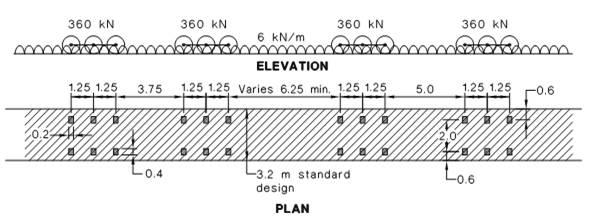
The plan is to check the capacity of the existing bridge then apply several methods to ascertain the effect, and price all against the cost of replacement. The bridge has been assessed as having a strength of 30m/mm2, and the steel a strength of 247N/mm2. Half the battle is working with awkward numbers from converting to metric after calculation in imperial units in 1960. I am using a grillage analysis programme called ACES with though better than QSE is still pretty cumbersome and crashes frequently.
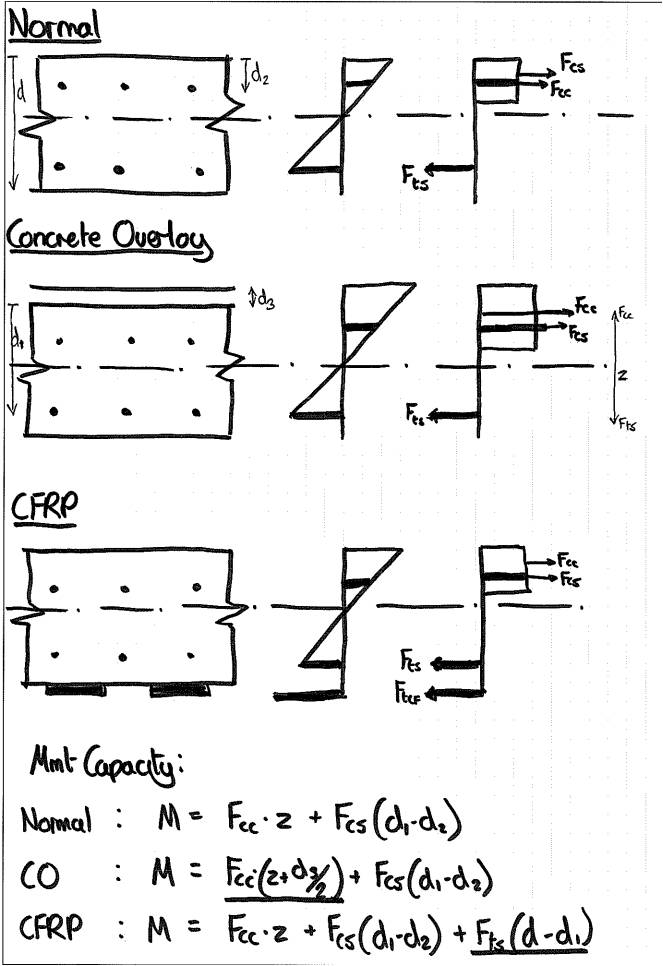
The methods will be: (1) A concrete overlay slab. (2) Carbon Fibre Reinforce Polymer (CFRP) strips on the soffit/surface.
The overlay slab works by increasing the depth of the section thereby increasing the amount and quality of concrete in compression at the outer fibres. This concrete overlay is keyed into the existing slab by steel -reinforcing bars glued in with epoxy resin and bent at 90degrees to the vertical to allow for shear and stop the slab slipping off. This method works fine in practice if the issue is one of sagging capacity. An additional depth of unreinforced concrete above a large hogging moment will have little effect.
The Sika Carbodur CFRP strips are simply epoxied to the underside of the slab at regular spacings and work as an increased tensile member at the extreme fibre of the section. A quick couple of calculations this morning tells me that the moment capacity of the section can be increased by 30kNm by use of 4 strips per m. This method has the reverse issue of the concrete overlay as it does nothing for a hogging moment unless strips can be applied on the top. In this case it would be much easier. Helpfully Sika provide a downloadable design package to assist.
Cost calculations (uber rough at this stage, and including for labour) tell me that the concrete overlay option will be almost 75% cheaper than the CFRP strips. But this detail will be refined when I can establish exact lengths of the CFRP as they will not be required to run the whole length of the bridge and can be curtailed to suit the induced moments.
See attached sketch for a rough idea of what is going on, but my initial thoughts are that a combination of the 2 would be most appropriate as the hogging moments appear large and a relatively small increase in section depth will give an increased factor of safety for sagging.
In other news, the CEO of the Shire of Murchison is back from holiday, and sent me an email to say she has a lot of money to spend on a bridge. Not too sure how commercially savvy she is as she informed me that she has not read my proposal yet and the BG&E fee has not been agreed. That said, I think the pricing is fair and hope that we will be given the contract next week. To the best of my knowledge there are no other tenders and they need the bridge fast so it bodes well. If won, I will take the reins of the project, hopefully getting some decent PM and contractual experience, with the intent to complete design before I leave.
I walking about the office in socks an Ozzie thing or is this common practice in the UK too?
Off to Bali tonight for the weekend, but not taking my board. I don’t want to do a Corby on the way back!
 Holdfast Training Services Trial Blog
Three thoughts,
Concrete overlays do add significantly to the fixed actions.
Even light anti-crack fabric (mesh)in an overlay has benefit when it comes to resisting hogging.
Has anyone tested/cored the concrete to find out what stength it is giving now – it will have been designed on 28 day strength but will now be stronger. It will also probably have been provided with a QA margin etc so you might find you have a much stronger bridge than anyone suspects. A contractor wouldn’t thank you for showing this but consultants can still invoice if no physical works take place!
Intersting
Couple of thoughts
1 If you can improve the sag resistance but not the hog….can the bridge ‘work’ as simply supported….forget how it was ‘designed’
2 Seen steel plates bonded to underside of decks for this purpose
3 Heard of tendons being used…a sort of pres-stressing
Richard,
The bridge has been inspected by Main roads own engineers and assessed as understrength for requirement. Considering it was constructed in 1960 and the mass of the avearge mine vehicle in this region is vastly larger than what was the norm back then I am inclined to agree with them. That said I take on board the 28day strength and QA points and will look into whether it should be persued. One of my main concerns is the central pier that at only 200mm wide with ony one line of vertical 12mm reinforcement, it may not have the capacity both in vertical and lateral load.
I can see that even putting a modest overlay on top with a light reinforcement (assuming adequate bond length and cover), but how is bursting minimised if it is only a thin topping layer?
John,
1. I am not too sure what you mean. Are you saying that by increasing the sag resistance it can reduce the requirement to increase hog resistance? I would guess that theoretically increasing the sagging resistance of the whole structure it could work independent of the central pier (if it was removed), but the current reinforcement in the structure is not set up to make this easy as it was designed for the central hogging moment.
2. Likewise, the highway bridge just outside the office has them. It strikes me as quite a neat retro-fix to increase the lifespan of the structure for a few more years.
3. Are you talking about drilling tendons?