Far too many documents
The last week or so has mainly been filled with finishing the Driven Piling Procedure for submission and buying thermocouples, data loggers and some formwork for large concrete test cubes. I’ve also had the joy of starting the Concrete Process Procedure and concurrently starting to write the Activity Method Statement (AMS) for the piling.
You may think that the piling procedure and method statement would be the same document, sadly they are not. The first one is submitted to the client for approval as it contains the “How we will do it” for a number of the piling activities that need to be approved in advance. For example the piling procedure (that I would think of as a method statement) must be submitted for approval a minimum of 21 days prior to starting piling. The second document is internal to John Holland and mainly covers the risk involved in the task, broken down into three areas: Quality, Safety and Environment. Its safe to say that I have been hassling the piling sub-contractor a lot for his intended methods and then changing them based on my vast knowledge gained from many years in the piling industry….or not. As it happens I had to alter his process to fit in the pile testing procedures, and there is likely to be a fair bit of waiting on site for the first hold point to be released (CAPWAP analysis needs to be completed before we can continue piling and the client needs to sign off on it).
I’ve also finished the projected program of works for bridge 1 for the next 3 weeks in detail, with the next step being planning out for the next 3 months. I’ve got one wee graduate engineer working for me and should have another 2 starting around mid March. I guess that’s D.O. C3 sorted. I think I’ll need them by then as the date for the first pile in the ground is fast approaching, and then the first concrete pour (pile cap on pier 3) is only a week after that.
I also had the (dis)pleasure of becoming more involved with the contracts side of things. My main focus is the JHG contract with the piling subcontractor (Caporn Piling), but I’ve also looked into the highly interesting tome that is the main contract with the Client (Qld Main Roads and Bridges). I can now see the advantages of the NEC 3 contract with its relatively limited use of “legal speak”. The contract is build only, with payment by instalments. Each month we submit the work lots that have been completed along with supporting evidence, and the client pays that amount. When tendering for the main contract it was a pretty quick process, there was no to and fro in making changes to this clause or that, it’s a simple take it as the government body sets it or don’t bother bidding. (I think JHG did submit a list of changes to Main Roads, but were told it’s a flat out no) I see the thinking behind levelling the playing field and avoiding any possible claims from losing bids (thinking back to Virgin Trains losing the west coast mainline contract and their subsequent legal challenge). In addition all bids had to submit conforming designs as per the tender documents, alternatives could only be submitted along with a conforming design. Any bids that submitted an alternative design only were dropped and did not proceed any further in the tender process.
From the clients point of view this is very good, all the roads and bridges in Queensland will be built to the same spec, reducing complexity and future maintenance costs. The downside for JHG as the main contractor is it is very difficult to find areas to make savings (and so increase the profit). To say the budget is tight would be an understatement (“tighter than a ducks arse” springs to mind). There is more to say on the supplementary specs and annexures, but I’ll save that for AER1.
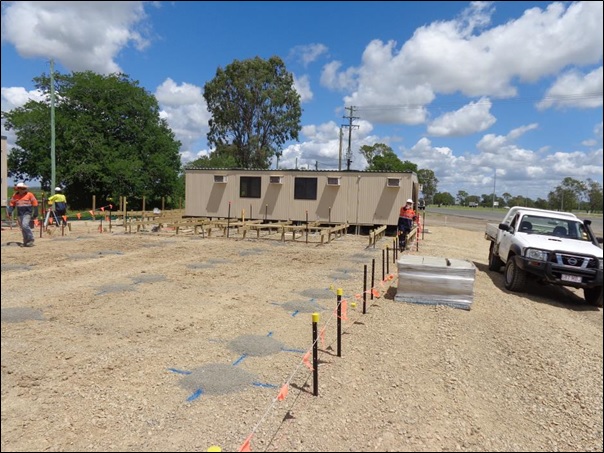
Oh, and the site office is finally going in so I should have somewhere to hide from the sun when I arrive next week.
In other news I went to Australia Zoo, so here is a photo I took of a tiger yawning.

 Holdfast Training Services Trial Blog
Can you not also see a downside for the client in that they have set out what they want with no flexibility i.e. any bright ideas which might have allowed both client and contractor to benefit from quality engineering in a pain/gain share is lost?
A mega blog indeed
On the contractual arrangment
Even in the days before ‘value engineering’ was a phrase…in public authorities it was usual to demand that a tender return was compliant BUT ,as long as there was a compliant return, a variation would be entertained….to possibly gain from contractor expertise….and so we rapidly get to …and sit up and pay attention McGuirk, at the back… the Latham Report which was titled ‘Constructing the Team’
To get best value for the customer ( in this case the public purse) we need to act as a team. There are varioius ways
1) One of the reasons why so many publically funded schemes are on NEC 3 C forms is that it implies client/contractor gain gain sharing against a target sum…..
So in this case the piling sub contractor might identify that the piles do not have to be quite so long and the gain would be shared..the company wouldn’t have to do the upper amount of work buit ( crudely) would be paid for something between what they did do and the upper value
2) (and more anachronostic) the client might identify high risk elements of the job ( piling and lots of it …costly and on the ciritical path…loooks risky to me) and might ask a number of companies (pre-qualified in some way) to undertake a tender for the purpose of being nominated) The expertise is culled and a Prime Cost sum goes into the main tender.
THat’s al for now!
Its funny that you mention the sharing of knowledge, as the project manager is very forward leaning on engaging with the designer (AECOM) and the clients Rep (for Main Roads Qld). Today was a key meeting to discuss the piling procedure I put together, and thankfully they accepted it with only 2 very superficial changes (change “accepted depth” to “the depth”). They also agreed to our change to the sequence of driving test piles and the location within the pier. They seems to take on board the piling contractors suggestion about a longer prebore on the piles too – potentially safer and faster, while also reducing the impact on traffic management on the highway. The designers did have concerns about the prebore holes collapsing (in the soft to firm layers of clay) but this should be ok provided the holes are not predrilled too far in advance (I’m thinking of the definition of undrained shear strength here and hoping I have it right….). It wont be possible to do this in every case, but even if we manage it on a few piers it will make a big difference (over 1000 piles…)I think this is a pretty good example of a win win situation. We get the piles in slightly faster, and the client reduces the disruption on his highway. My only concern is getting someone else (on the designers team) to do some proper calcs for the piles standing up in a 9m prebore.