Archive
My tunnel is too tight….
One thing that has struck me since joining CrossRail is that the opportunities for innuendo bingo are legion. I will not recount the most memerable examples here, but I encourage you through the medium of my blog to play along at home.
So after almost two weeks held in reserve, up in the main office at Hanover Square, I was unleashed on an unsuspecting site at Tottenham Court Road. Now I would like to think that coach put me in due to my obvious concrete competancy, but I fear it was much to do with a calender clash that distracted almost everyone else on the team. Turns out Friday, was the annual Concrete Society Dinner…a social event only just overshadowed by the Oscars this weekend….
The running tunnels, cross passages and concourses have all received their initial and primary sprayed concrete layers. Initial lining is utilised to protect and prime the excavated surface and is sprayed to thickness of approx 75mm. The primary layer contains steel fibre reinforcement and provides the main structural integrity of the tunnel, and runs to a thickness of 450mm. Following that, the surface requires regulation and preparation in order to cover rogure steel fibres that are likely to damage the subsequent waterproofing layer. This is acheived by spraying a finer aggregate layer. Or so we thought…..
I stepped in to take over the workss which had been programmed and planned…allegedly. Predictably I arrived at site to find that nobody down there had been briefed and the concrete hadnt been ordered! Difficult to spray concrete, I find, without, er, concrete…
After many an hour listening to a load of Irishmen shouting at each other we finally began to spray. The Potenza spray machine…essentially a large hose mounted on a pickup truck, which allows regulation of flow rate. This brings about a quality management point. The nozzlemen…Spr Bloggs as we would know him…want to spray at the max rate of 20-22m3/hr. He gets a bonus per advance/chainage completed in his shift. Understandable. However, this flow rate increases the chances of rebound. Exactly as it sounds, the concrete does not adhere readily to the substrate causing dimished strength.
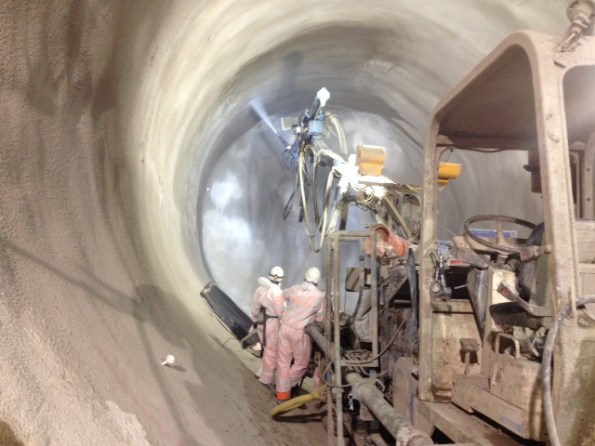
This brings about a quality management point. The nozzlemen…Spr Bloggs as we would know him…want to spray at the max rate of 20-22m3/hr. He gets a bonus per advance/chainage completed in his shift. Understandable. However, this flow rate increases the chances of rebound. Exactly as it sounds, the concrete does not adhere readily to the substrate causing dimished strength. Test panels that are sprayed, then cut into beams, highlight band layers which reduce the flexural strength by creating failure plains
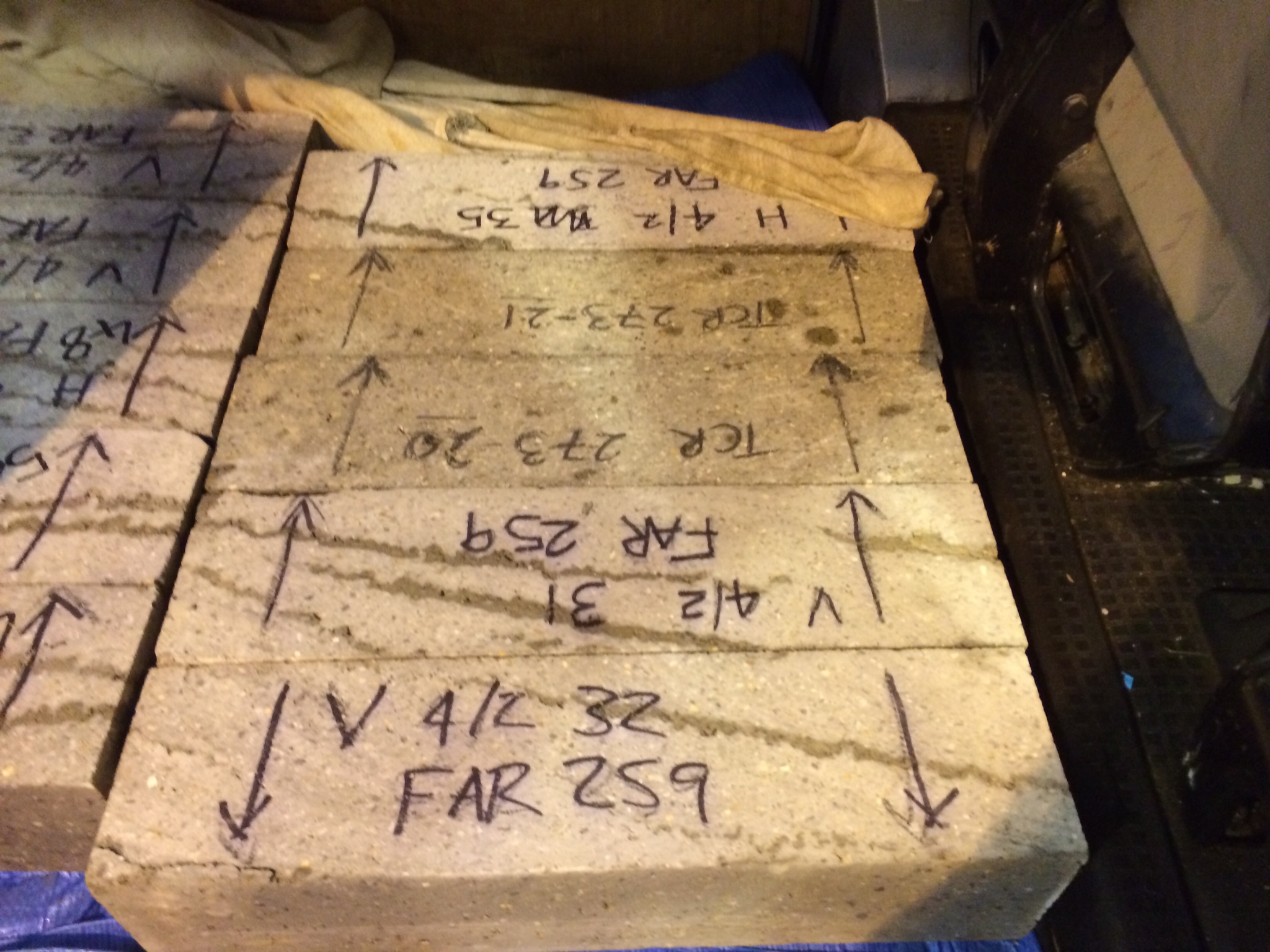
Note: TCR=Tottenham Court Road, no band layers. Far = Farringdon, band layers. Inconsistent quality assurance across sites is future blog fodder…look forward to that!
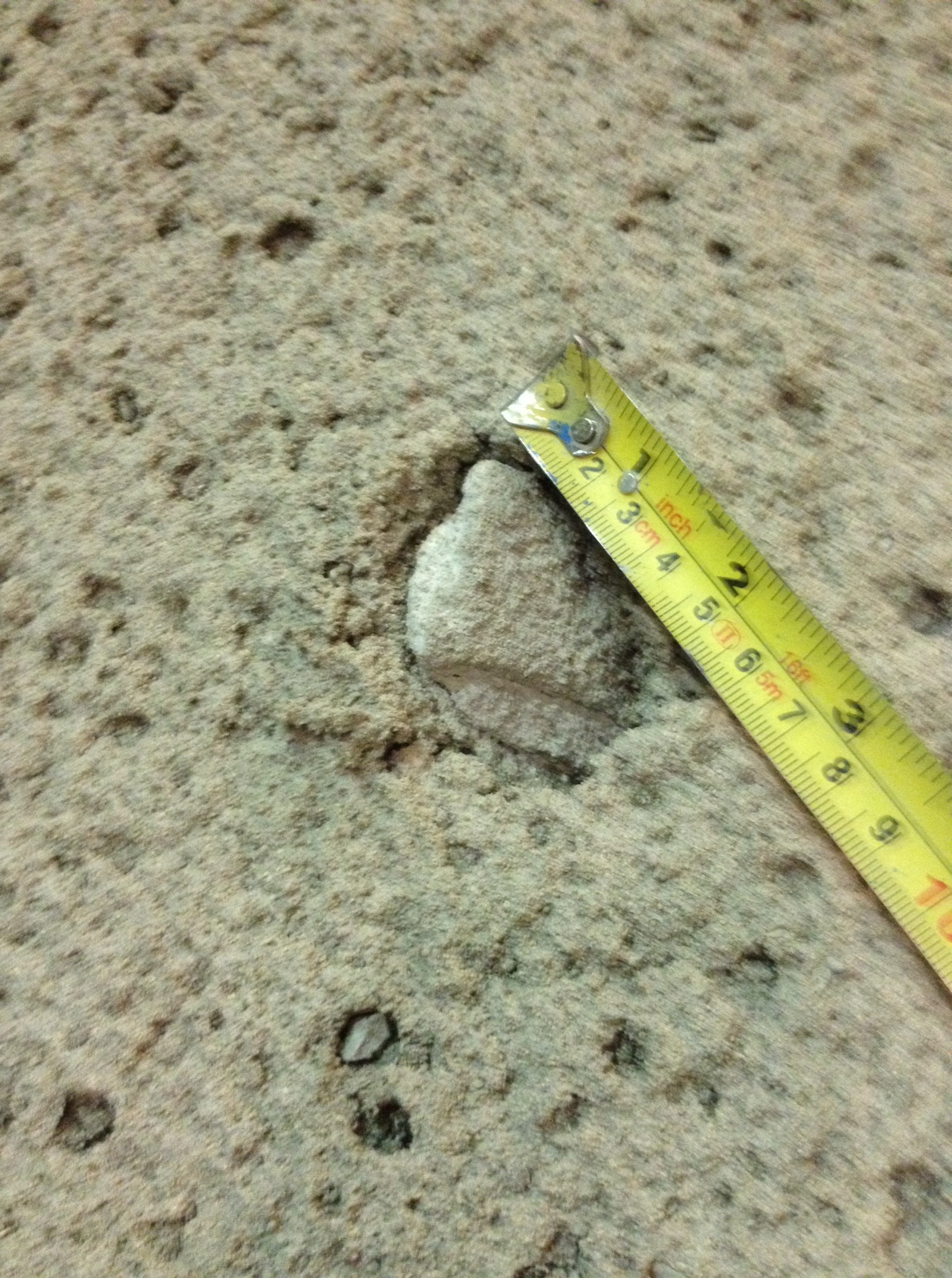
On completion of the regulating layer spraying, I returned to inspect. It was immediately clear that things hadnt gone well. The surface was particularly poor, and contained craters caused by large aggregate. The reg layer is supposed to be a finer aggregate so it was immediately clear that there was an issue with the batch

After some digging, a number of issues came to light surrounding the concrete contractor, Hanson.
1. The core contractual terms dictate that when concrete is ordered from site, it must be batched within 50mins and sent immediately to site, where the lorry is tracked. However, this does not apply to concrete used for trial which is outwith of the core contract meaning the contractor can effectively send it when he’s ready. Over six hours later in this case. When our first batch arrived at site, it was flow tested and failed arguably due to too long in the wagon.
2. Quality control. It seems that the batches were contaminated at the plant with a larger aggregate, whihc presently is unexplained. From our perspective this is frustrating. The mistake has managed to creep past the initial batcher, aswell as our liason guy at the plant (whose job is precisilt designed to prevent this!). Additionally, when it was receipted on site and tested (temp and flow) it was again not picked up.
As a lessons learnt, we will now have an SCL rep on the surface to oversee receipt of the batch. When a sample is taken, it will be poured into a bucket through a sieve as an additional check to confirm aggregate size.
Next up are the trials of the waterproofing layer, which is entirely my baby. I wrote and admin instruction and distributed it yesterday with a number of taskers. Its raised a number of eyebrows, as it doesnt seem to be the done thing to communicate with each other around here. Granted, due to my poor understanding of the hierarchy, I did effectively task CrossRails Chief of Staff! How to win friends etc….
 Holdfast Training Services Trial Blog