USACE – a cultural experience
 So what exactly is the United States Army Corps of Engineers (USACE) – it wasn’t what I thought….
So here’s how things work out here: the following USACE ‘customers’ will submit their engineering demands to the US Congress:
- Any US military installations around the world.
- States that need hydrological works on any of its waterways (these are classified as civil works and include everything from dredging to dam building).
- Federal emergency response services (flood/fire/tornado etc)
Congress will then approve a project, set the budget and hand it over to the USACE in that area to run. The laydown of the USACE can be seen below; my AO falls into the Harrisburg office of Pennsylvania. Escalating upwards on the CoC – 1UP: Baltimore District office (situ in downtown Baltimore), 2UP: North Atlantic Division (situ in New York); 3UP: USACE HQ (Washington DC).
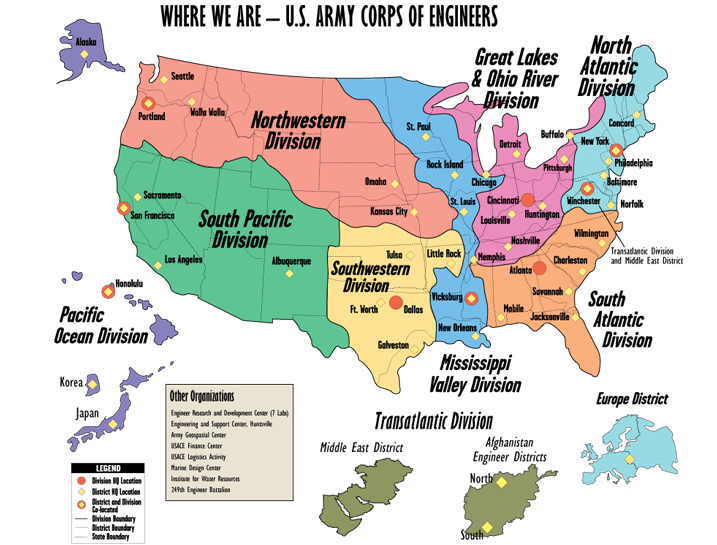 The majority of USACE construction projects compose of one of the following: (a) ‘Bid, Design, Bid, Build’ type contract i.e. the design process is put out to tender, then the construction is put out to tender, or (b) the design is done in-house by resident USACE architects and engineers (using BIM!!) who then put it out to tender for construction. The USACE do not actually conduct any of the construction – they are the eyes and ears of Congress to ensure that US taxpayers’ money is being spent correctly and that the government construction guidelines and H&S standards are being abided by (which are far more stringent than those outside the gov system).
So why on earth, I ask, would a contractor bid for a government contract when the administrative burden is so high, H&S is so strict, the gov can terminate a contract at a moments notice and you have the USACE keeping you in check at every turn??? Well, simply because payment for work is done by a payment schedule, and once work is approved by the USACE inspector the contractor will have their money in their account from the government within 14 days. If they were outside of government works, payment can apparently take months. Pockets therefore stay flush!
In order that such high standards are delivered, a large amount of SMEs are needed. The Baltimore office alone occupies an entire unmarked 10-storey office block in the central CBD. It is full of everything from archaeologists, GIS wizzes, environmental specialists, tornado trackers, emergency control rooms to lawyers….with only 3 uniformed servicemen (the Comd, Dep Comd…and the Brit!).
On a different note; food is the most talked about subject in the office (a close second to engineering). Recipes are swapped between cubicles (‘cubies’), men vie for bragging rights on their wive’s pancakes, ladies bring in herb-rubs every morning to ‘sniff’ and ‘swap’….I look forward to the upcoming lunch social where a 6 foot (yes – 6 foot) meatball sub will be brought in by an Italian bakery down the road to feed about 20 of us!!! I promise to send you a photo Pete.
Also, the fact that I wear uniform into work brings an interesting dimension to ‘commuting’. Railway ticket conductors stop their work , shake my hand and thank me for my ‘service’, beggars holler the same from across the street, mothers would thank me in shops, old men at petrol stations etc etc…humbling! Even the lady in Subway gives me a free cookie…I’m going have to watch my waistline!
ps The chance of me taking in any photos at this point is nigh on nil unless I clear it through Obama personally – but I’ll try a bit of artistic license to keep in engaging!
 Holdfast Training Services Trial Blog
Welcome into the fold Howard; hope the house hunting goes well.
Just remember they don’t quite get squaddie humour. So, if there are any unoccupied ‘cubies’ around, please remember to pay your respects to the previous (and possibly deceased) incumbant before nicking their coffee “‘cos they don’t need it anymore” (as a certain Capt Fry did).