Opps it don’t fit!
This week I have been treated to a short city break to Birmingham to attend the in house 3 day Lain O’Rourke surveying course. The course was an excellent opportunity to brush up on surveying knowledge and proved to be more challenging then I first thought and it has helped to cement in my mind that surveying needs to be taught over a greater period then is afforded to Margret and her team in the PET course programme. Whilst much of the theory is understood by many on the course the practical application and use of a total station is a little less well understood. I would even go as far to say non existent as I struggled to find the big red on button on the latest version of the Leica total stations we were using. Having found the on button and now successfully navigated myself around the menu system I feel a little more confident in the use of a total station but a skill I fear will easily be lost if not put to use fairly quickly.
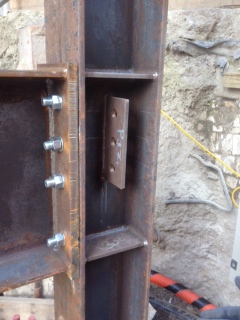
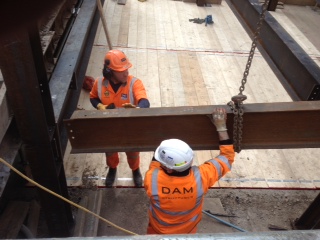
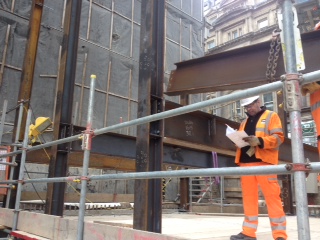
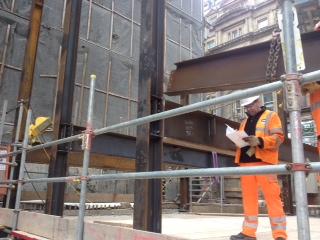
On returning to Liverpool street on Thursday I was faced with an issue of buildabiltiy. A steel structure designed to be robust and provide protection to personnel operating within its perimeter from incensed plant operators swing excavator buckets about was in fact so robust it couldn’t be built……..WTF. It had only taken 3 months to complete the designs and have it specially fabricated by a steel structures specialist and now we were going to be defeated by our own designs.
The issue was that were two I beams connected one end plate to another’s flange the designer had incorporated two web stiffeners top and bottom. This then prevented the perpendicular I beam from being lowered into position by the web stiffener. A morning of discussions ensued during which it was discussed about removing the top stiffener and replacing it, or completely removing it. Given that the purpose of the web stiffener in is to stiffen the web against buckling due to the compression of the flange and that in this case both web stiffeners would be required. The real issue was that the detailed calcs that supported the design were less detailed than one of my design exercise calcs and no one could seem to agree on the loading that the structure would have to resist, both permanent, imposed and accidental. Prophesising over all likely laods was brought to an abrupt halt as I gazed out of the window to watch the sub contractor bending one of the columns over to allow the beam to fit. Given that time was/is against us the requirement of the web stiffener suddenly became less of an issue and we turned our attention to managing the problem, and if I remember my lecture with the great orator this could have been avoided had we managed the engineering at the start. Your thoughts please.
 Holdfast Training Services Trial Blog
Nice blog…the connection onto the flange of the column is clearly a moment connection and the stiffners in the column flange are to prevent web buckle ( as you observe). The upper stiffener could only be working like this if there were a load reversal. The designer might claim that the top ‘stiffner’ was then holding then tension field – pah!
Other things that make me think that the design of this connection is pants is the relative size of the end plate and column flange – – generally there is no point making one thicker than the other. If the web plates welded in the the column webs were offset you can normally lift the beam in angled in plan and swing it to the web plates, one either side.
Surveying is due to be removed from the PET course because it forms no part of the Job Spec of a PQE career (newly qualified to CO Wks Group). Perhaps something to re-visit??
How far did you get with the prophesising of probable load cases and fag packet check on this? I suspect it was a wet asfternoon design task for a hard pressed structural Eng who went into P for plenty mode with little time or fee to be wasted on ‘trivial detail’. What do you think?