Radon and Snow???
My primary project is the construction of a Headquarters Building for the US Defence Logistics Agency – a $81 million project that should be complete Oct 15. Artistic overview below:

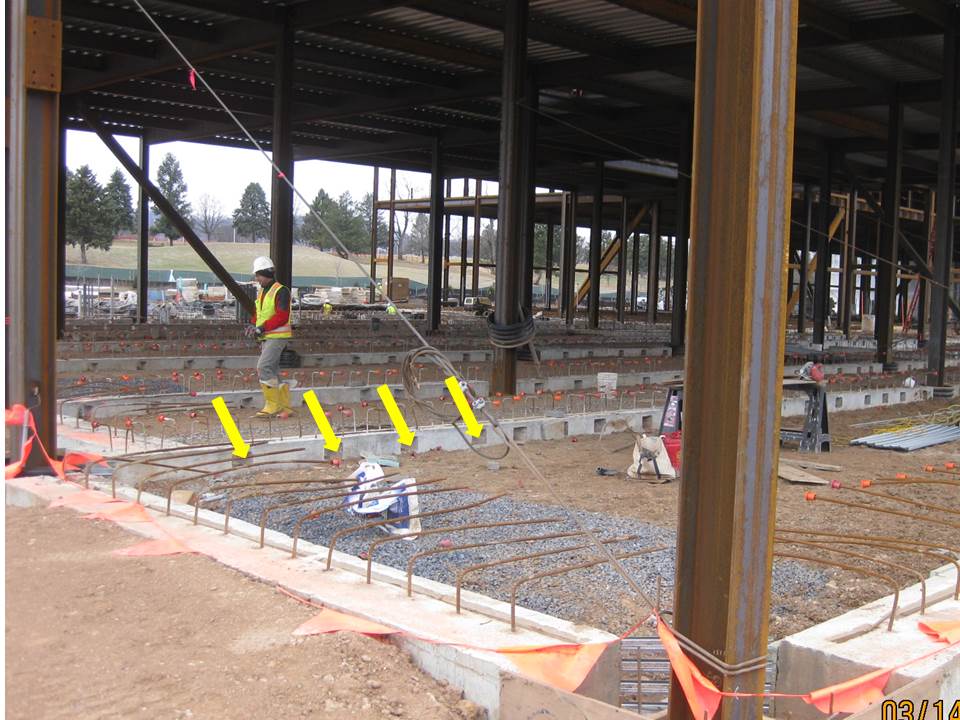
An interesting point to blog-share….Radon…??? I was curious as to what the holes indicated by the yellow arrows were? Well, they are to allow for the spread and extraction of radon across the area beneath the concrete floors. Radon is a natural occurring gas that is radioactive and causes the highest number of lung cancer cases in the USA amongst non-smokers. Little did I know, but the Pennsylvania area (Appalachians) has the one of the highest concentrations of radon in the USA. You will note an aggregate bed – this is approx. 0.2m thick upon which the non-structural concrete floor is laid; the compacted aggregate provides a bed upon which to lay the concrete floor but also a permeable band for the radon to move through.
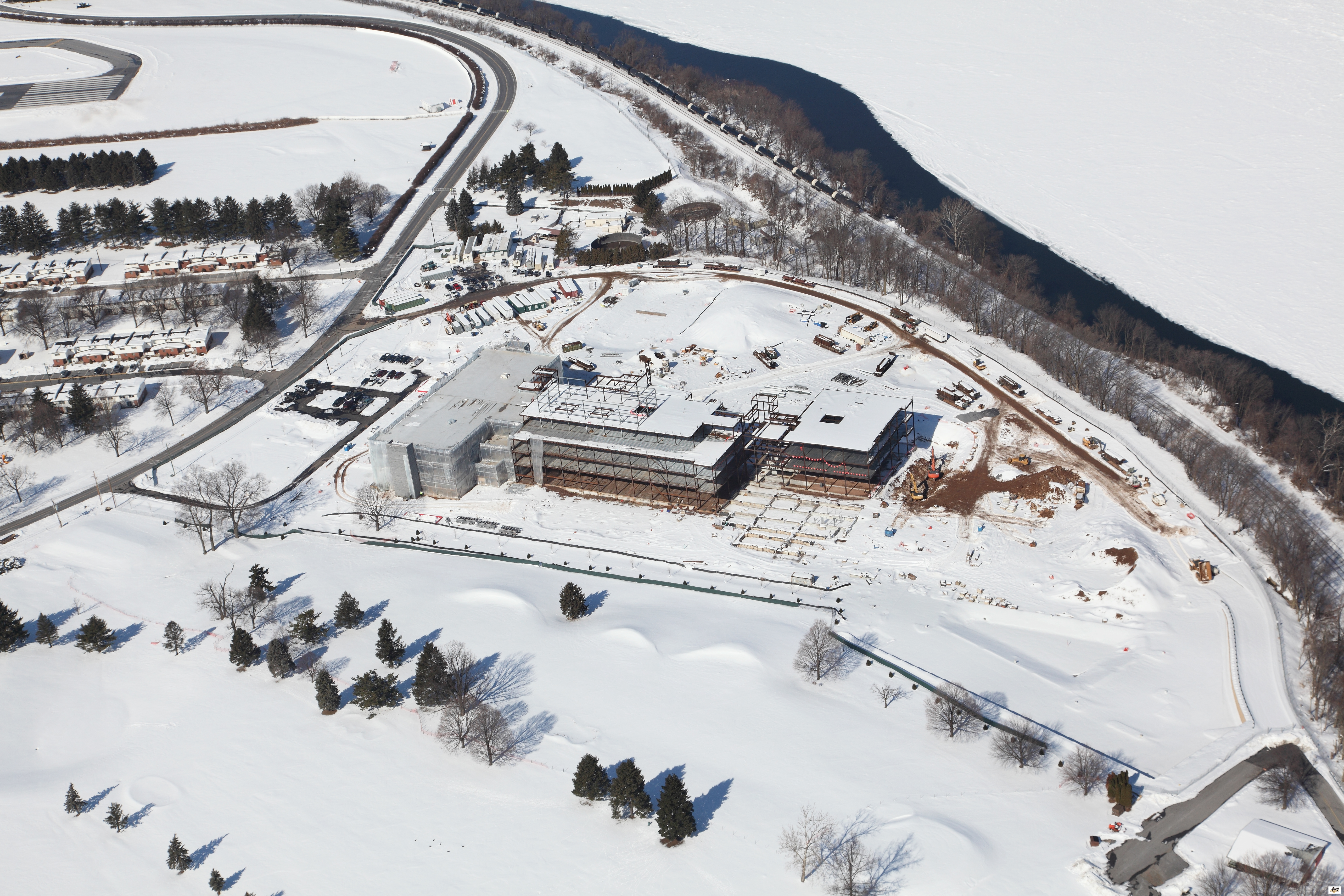
Weather has been a major issue with progress – one has to approach a problem differently in these climates. Despite local advice, the contractors cracked on with completing all the steel for the entire building – made sense from their point of view as its easy to continue one thing whilst you’re on a roll and all equip is on site. The problem now is that none of the concrete can be laid, particularly inside the building as it is too cold. To expand on this: there has only been 5 days since the end of November where temps have been above 5 deg C…the min temp needed to apparently maintain satisfactory curing. Our advice was to put up steel in one segment of the building; clad in the precast concrete walls in order to allow them to have an enclosed space to heat easily, where stairwells and flooring could then be poured. Instead contractors are making the best of a bad situation and installing M&E in as much of the building as possible. The photo below shows the site last month….it looks exactly the same this afternoon as another bout passes through!
 Holdfast Training Services Trial Blog
Really nice to hear form you Howard – nice picture – I’ll snaffle that. I you are describing a radon sump…I’ve always associated natural radon with granite and I know there are high concentrations in the West Country here for that reason…but I looked at the UK Public Helth site and it is clear that the existence goes beyond granite outcrops.
The other CPR type thing is that most designers would play steel against concrete: steel has a longer lead in time and faster erection; concrete has a short lead in time and is slower…..UNLESS…the temperatures are so extreme it doesn’t matter how low the lead in time if you can’t execute.
Thanks John. For your interest, it’s majority limestone beneath the site – in places it is nigh on surface level. This has proved interesting in other areas which I will touch on at another time, notably with piling and hitting large cavernous voids!
However this area is classed as at/near the ”Reading Prong” (see westernmost pink patch in attachment below) – reknown as having high uranium concentrations; the Prong is made up of different gneiss’s! So it’s general viewed that radon is caught up in pretty much of the soil in the area, hence the construction techniques seen and variations of this applied to al new builds.
Installed a gas blanked in the Bristol area beneath a timber framed motel once. Ended up running right accross the parking area as well to ensure things vented outward rather than collection from the capark and venting inwards! We had curious pipes rising up in the flower beds along the street frontage (but not too close to the boudary…). You’re right about the concrete curing issues of course – it’s not that the concrete won’t generate enough internal heat to cure but that the differential between the centre and the surface will lead to some fantstic thermally induced stressess Tent or enclosd spaces as per your proposals are the obvious example; stops the worry about what sort of wind chill is being allowed for and helps keep the surface warm. Do your contractors have a plan for when they’ve run out of incidentals to get on with and need thermal insulation? Have they any concept of lead in times, decision points and matices? HOw is the contract set for weather delays, who owns any float and how do you claim or disallow?
There are weather days built into the contract for each month; for example Jan has 14 days (!) delay built in. It is a rather over-simplified contract: there is only one mile stone – completion date, and float is owned by the contractor. The contractor can massage his work programme as he sees fit; if he doesn’t meet the end-date then he will pay liq damages to USACE of c.$10,000/week. Work is paid for at the end of each month according to works-complete; that said, we can hold back 10% for poor performance – the decider being the PE. If the contractor runs out of works to do, which is pretty unlikely with the built in delay and the amount of M&E, then they will need to apply to us for an extension. So, in extremis, if they do run out of works and need an extension, will they be penalised for not heeding our advise?…unlikely, as the general principles of working are rather gentlemen-like, our advice was exactly that – ‘advice’. Snow has gone, replaced by rain, but steel now continues to go up as the final foundations of the main building are in place.
Hi Howard
I have not been on the blog for a while. If you have some spare time I would love a selection of steel joint photos for the next course.
You also need to be sure that they do not put up too much steel that they cannot access the ares that need concrete!
All the best.
Neil