The Rise (and Fall) of the Machines
My main focus over the last two weeks has been the planning and execution of the trials of the water proof membrane layer of the Sprayed Concrete Lining tunnels. Following the application of the initial layer of spray concrete (min 75mm), which stabilises and regulates the substrate, the primary layer (between 250mm and 350mm) , which is comprised of the same concrete mix, with steel fibre reinforcement to provide the main structural element of the tunnel the waterproof membrane is applied. This will subsequently be ‘sandwiched’ by secondary layer and finally a surface layer which I will not discuss here. See drawings Typical Lining and Thicknesses
The ‘Eye of Sauron’ is now on this section of the works, and I have lost count of the amount of times the client side have reminded me that we dont want to be standing on the platform in a few years time next to a bucket catching the drips from the lining. The chemical is polyurethane based, and is delivered as a white powder in 20kg bags. Designed to be used in hand or spray application, the powder is mixed with water and applied to the lining as a paste, which then cures to a material of the texture of a hard rubber. The lining is applied to a thickness of 4mm, which leaves a smooth and shiny finish.
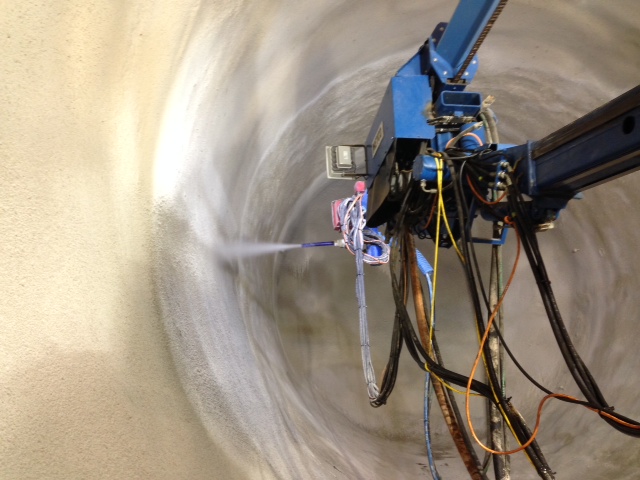
Logica spraying MasterSeal (Top)
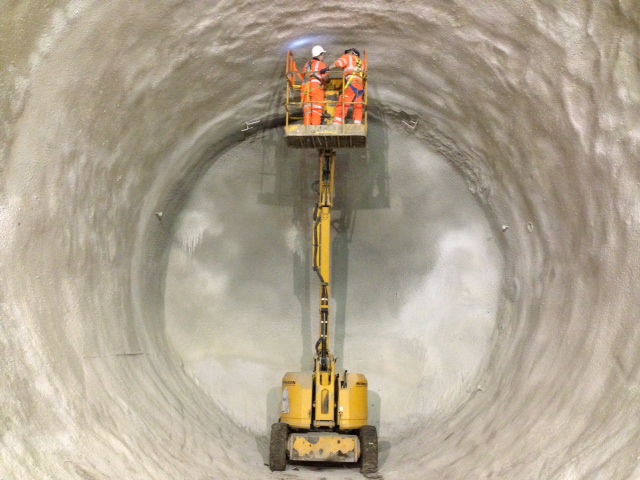
Inspection of MasterSeal layer for compliance, alongside MottMac Designers (bottom)
Concurrently, a spray application machine known as the Logica has been procured from BASF, one of the suppliers of waterproof membrane. This machine not only doubles the rate of production, but minimises wastage by its ability to automatically spray to a pre programmed profile. The trial of this machiine was observed by a number of nozzlemen who obviously felt consigned to the stoneage! However, the procurement of material and machine have thrown up a number of interesting contractual notes.
ISSUES
1. Logica.
A flat bed lorry carrying a hose arragement designed to attach to a spray concrete delivery system, applying upto 20m3/hr of concrete to the walls. Much the same as a system that already exists on site, uniquely it is has an on board automated survey system allowing it to scan a the profile of the tunnel, then apply material to a consistent thickness. Manufactured by MeyCo in Switzerland there are only 5 operational units in the world. BASF purchased one, and are seeking to procure a second. (This is important later.)
The BFK JV deemed it appropriate to rent this machine to apply the waterproof membrane across all SCL sites. A smart move given that 373tonnes are required, not including tolerances or wastage. BASF now lease the vehicleto us at a flat rate of £12500/month. The delivery to site and subsequent testing and approval then became my issue.
For someone who has now embraced Whole Fleet Management, and a few headaches aside, been impressed, I was astionished at how little we got for our money. The vehicle turned up at site having been ‘refurbished’ Despite having been given a thorough wash and wax, it immediately became clear that this had not happened , as I quickly found myself replacing water pipes and watching the replacement of a hydraulic ram on the boom. Clearly the machine had not been run up at all before delivery.
Secondly, and mainly due to the unique nature of the machine the corporate knowledge for operation is almost nil, even with BASF. It is all contained witin the head of an Austrian fellow called Kristian, who lives, conveniently, in the Faroe Islands! He nursed the machine back to life over the course of a day and night and we were back in business and now the best of friends (although I strongly suspect he may be an android!)
So….the program for waterproofing and secondary lining is now solely reliant on 1 machine, and 1 man. More to follow
2. MasterSeal.
The BASF branded waterproof membrane product. By far the most expensive element of the tunnel lining, and the the 373 tonnes will cost us just shy of £1.3million. Not only that, it is manufactured in the States and comes with a 6 week lead time. Additionally it will arrive in 20ft shipping containers, and since space on site is at a premium it certainly wont be stored here. But surely, considering the size of this order, all this will have been thought about? See below…
WHAT HAVE I DONE?
Considering the issues surrounding the vehicle, I sought out the contract to establish a what we could expect from BASF. There wasn’t one. The best I came up with was a Plant Hire Order detailing the quote and generic T&Cs. A bit more investigation found the initial invoice with an attached, generic contract from BASF which amongst other things told us that it was our perks to repair and maintain this machine AT OUR COST!
Given the lack of knowledge I organised the nozzlemen and fitters (M&E) to udergo familiarisation training at the beginning of each shift to try to mitigate the reliance on one Faroe Islander. Having directed this on the Friday, I expected 3 of the 4 shifts to have been trained by the Monday morning. Most were pulled away elsewhere !!!
Neatly slipped into the T&Cs was a clause that dictated the Logica was only to be used with BASF products…ie MasterSeal. This clearly makes it difficult to conduct a fair and objective commercial assessment of suppliers as it seems the horse has already bolted.
So based on this newly found knowledge, and a serious indicator in the fact that BASF are the only supplier seemingly in the race, I began to look into how the order was progressing. Again, there wasn’t one.
Next, I collated all the site programs, and established that the Fisher Street site intend to begin spraying waterproof membrane on 3 Jun 14, meaning that with the lead time for deliver plus a weeks contingency, the last safe moment to order this stuff is 14 Apr 14…11 days from now.
Thus, and in a mild panic by this stage, I returned to the commercial team to discuss lead times on the procurement process on an order so large. I was told and average of 2-3 months. Red Card moment.
REFLECTIONS
It seems that a limited Commercial Assessment was done in July of last year which compared 4 suppliers. BASF were preferred almost immediately despite being 2nd most expensive, as they could provide a better level of technical support, with the added sweetner of the Logica. However, since that point, nobody has been repsonsible for this section of work. This speaks to wider issueS at BFK which is thematic across the project.
Communication. Despite everybody being cognascent of the importance of this section of works, a robust plan has not been considered, resourced and properly tasked. This lack of proper tasking is exacerbated by the retincence of people to take responsibility for execution. Below senior management there is very little accountability. In this example, the commercial team have done a bit, and the construction team have done a bit and the whole process has been bounced around before being completely dropped. There is now NCO equivalent who seeks an intent, follows an endorsed scheme of manouevre, and is accountable for achieving an endstate.
So after a series of polite prompts, I presented all this to my line manager and said, we need to get this order completed, supported by a robust contractual agreement which details ongoing maintenance and technical support, and includes a training program for the guys, and guaranteed delivery times and storage for the product…and we need it yesterday. I was told ‘Ok…we best do that then…’
 Holdfast Training Services Trial Blog
Thanks Ryan,
Looks like you just talked yourself into a job – all the reponsibility, no pay and recognition. Sensible bit of APM methodology and good record keeping required and, as friend keeps telling me, make sure you have as many people with you in the canoe padling as you can get ‘cos otherwise they’ll be on the bank throwing stones.
The horse has not bolted on the BASF supply of material becasue your plant hire leaves you with the repair and maintenance liability anyway. If you choose to use a different product the worst that can happen is machine failure which you have to put right. A sensible supply agreement would build risk transfer for operational issues caused by the product to the product supplier i.e. you’d fix the machine and then pass the costs on to them. all of which means you can shop around for lowest cost or best value as you see fit (mind the gap…). You might also look at the contingency of procuring your own machine if you’re hire costs and liabilities are so big but I suspect that this is a too late option and you’re stuck with quickest options winning out over cost and quality.
Looking at the lining thickness tolerances drawing it is interesting to note that all construction tolerance risks lie with the contractor which is as might be expected although I am unclear as to what the designer expects the additional note to mean that the contractor does by way of monitoring the excavation.
Hi Richard
Sorry for the delay…just catching up on these.
By way of update, I’ve just raised a materials requisition order to the value of £1.2million. (slightly sweating coldly, but there is a terrifying reticence to grip this, when it seems the writing is on the wall for the programme!)
I managed to find a ‘commercial comparision’ dated Jul 13 for 4 suppliers with attached invoices, and itemisations. I intend to blog the detail later today as an interesting commercial nugget for CPR for the wider group to bank. In essence, armed with this, I’ve written an instruction to the commercial team to include clauses for the following:
1. Full technical support
2. Standardised training package with accreditation delivered to operatives
3. Ongoing supervision and assistance with quality testing.
In conjuction, I’ve asked for an analysis from the site as to the currnet competancy of the poperatives so we can better understand where the risk lies. I’m hoping that someone will check though this, and add to it before it all gets signed off!
The procurement issue is a sticky one. The machine is unique (6 in existence) and in very high demand. BASF shrewdly purchased theirs, and were only able to get and ‘in’ because they used to own MeyCo. Procurement of a second Logica is ongoing without success over a 9month period.
Reference the lining thicknesses tolerance, the contract is particularly onerous in this regard. Say again your final point? Not clear on what you mean about the additional note?
Thanks for your feedback. Which supplier are you going with or is that up to commercial? The tail end comment is trivial with respect to the bulk and was.. The drawing notes say: 5. Site investigation carried out in the area suggests that “faulted ground” might be encountered west of chainage 3880. During excavation the contractor shall monitor the excavation to be able to determine whether “faulted ground” is encountered.
My question is how does the designer expect this monitoring to be done? Visual inspection of arising’s to try to guess if they originated from ‘faulted ground’ – what would you see that is different? A general description to the excavator operators to suggest they should slow down and lose bonus if they think the ground is getting too easy? What action does the designer expect? Stop and await an independent verification? At whose cost? In what timeframe? His note doesn’t say in the event of…then… So it’s a pretty meaningless note and a great debate awaiting the lawyers for a feeding frenzy in the event of any incident.
All I was trying to point out is that it’s too easy to make bland statements that can cause no end of problems later. This is either a risk that needs to be mitigated properly or it is not. This note clouds rather than clarifies.
Well done. I look forwards to the next installment.
Grappling with this:
Firstly – it is worth distinguishing between wet and dry processes- I would guess this is dry – that is the moisture is added to the mix and the nozzle. The w.c. ratio equivalent is much lower
Secondly why go for this expensive kit?
The two BIG issues in shotcretelinings are control of applied thickness and quality of finsished material
So this kit is attacking risk 1 ( the pre- and post application geomtries are known to 4mm – and I presume that the saving on the £3.5k per T specialist lining material is secondary- although if controlled to 4mm it is a potential saving of £350/m – I wonder what the rebound rate is ( in my calc below I use 50% – or about £0.9k/m)
The other main risk in the main lining is the quality of the material which you can test on the test panels and at points using a penetrometer – so you have an interesting project looking for some other remote NDT method of assessing this across the lining
Of the waterproof membrane – from the section I take it that this is about 15-20mm thick at a W/C ratio of 0.4 and allowing for about 50% rebound loss in firing I make your 373T worth about 200 lin m of 12m dia lining – about right?
Hi John
In answer to you first…you are right. The preocess is dry. The material – MasterSeal- is poured from 20kg bags as a white powder into the bin attached to the machine. It is then gravity fed and mixed with water at the nozzle, prior to being sprayed under pressure onto the wall.
To your second….the primary reasoning behind the hire of the Logica is relataed not unsurprisingly to cost and time. Firstly the machine sprays to whatever thickness you input. This means that you save significant amounts of the expensive MasterSeal lost during overspray or uneven spraying requiring infil., when compared to a nozzlemen. Interestingly, whilst great for MasterSeal, when it comes to spraying thhe follow on regulating layer designed to even out the surface to profile which is the proposition, it causes a headache. Clearly the machine will simply imitate the contours of the layer below.
Time is the second big bonus. Anecdotally, the Logica will spray 6 x 4m long bays, 2 x coats per shift. You can expect a nozzleman to achieve 50% this rate. This experience is based purely on its previous most recent use on the Hindhead Towers
Rebound is not considered an issue with this material so is not factored in the calculations. That said, having seen the trials, whilst there was no large material rebound, the tunnel became very very dusty very quickly. The trials weren’t large enough to accuratley estimate wastage, but I wouldnt be surprised if it wasnt substantially more than we have estimated when it is rolled out on site.
The profile is assumed to be 4mm throughout according to manufacturers recommendations.
Richard
Point taken. I dont know the answer, but I am pushing to move to site immediately after Easter so should be in a better postion to find out. Fo interest the supplier is BASF. I’m not sure that ‘decision’ was really the right word with this. It seems to have evolved from a field of 4 to the point where onlu one supplier has trialled. Under instruction from the commercial team ahead of the materials requisition being raised, I had to try to justify a single source derogation, as CrossRail (the client) are extremely hot on due diligence in order to get best value!
Ryan
An excellent blog – not like being in the thick of things. – excellent CPR stuff.
Kind Regards
Neil