Holes and rattlesnakes!
There has been little tangible movement on the flood repair since my last blog other than to’ing and fro’ing of submittals from the contractor for his dewatering plan (or lack of), erosion and sedimentation plan and random others such as concrete and pozzolan specs. It has taking even longer when the chain comprises of the subcontractor, contractor, USACE area office, USACE design office and then additional third parties – state Dept of Transport or State enviro guys – I sit in the middle getting annoyed and cross-eyed. Even with my immature engr eyes I have picked up errors in submittals as simple as not supplying the right concrete ‘psi’ despite it being clearly stated in the specs. Despite the paper-pushing, the clock has started for the contractor; I can only persuade and remind them of the repercussions of late completion but this is preaching to the converted somewhat so the ball is really in their court.
I have continued with the QA on the HQ site. Today was my first soiree into the E&M world…..DALT testing! A quick google search as to what exactly that meant – Duct Air Leakage Testing. Thinking I’d be out of my depth, I was pleased to see that in the initial briefing and explanation for 12 of the witnesses (incl me) that it was quickly apparent that only about 2 of them knew what exactly was going to happen having been baffled by a handout of 20 pages of which 2 pages were only relevant, while the rest all kept quiet trying to look both interested and knowledgeable – the veneer crumbled rapidly when the uniformed guy in the corner with a funny accent started asking questions!!
Adjacent to the office is another USACE project I have been keeping my eye on – a large warehouse that has just started foundation work. The ground is a mix of silt, sand and clay and general debris (having had an entire ground penetrating radar scan) with a high water table of approx 0.5m. The line of attack therefore is to build geo-piers (otherwise known as rammed aggregate piers). The technique is exceptionally simple – a 12-15ft shaft is formed by the ‘rammer’, it is then withdrawn and layer upon layer of aggregate is poured and rammed/compacted into the hole – see below.

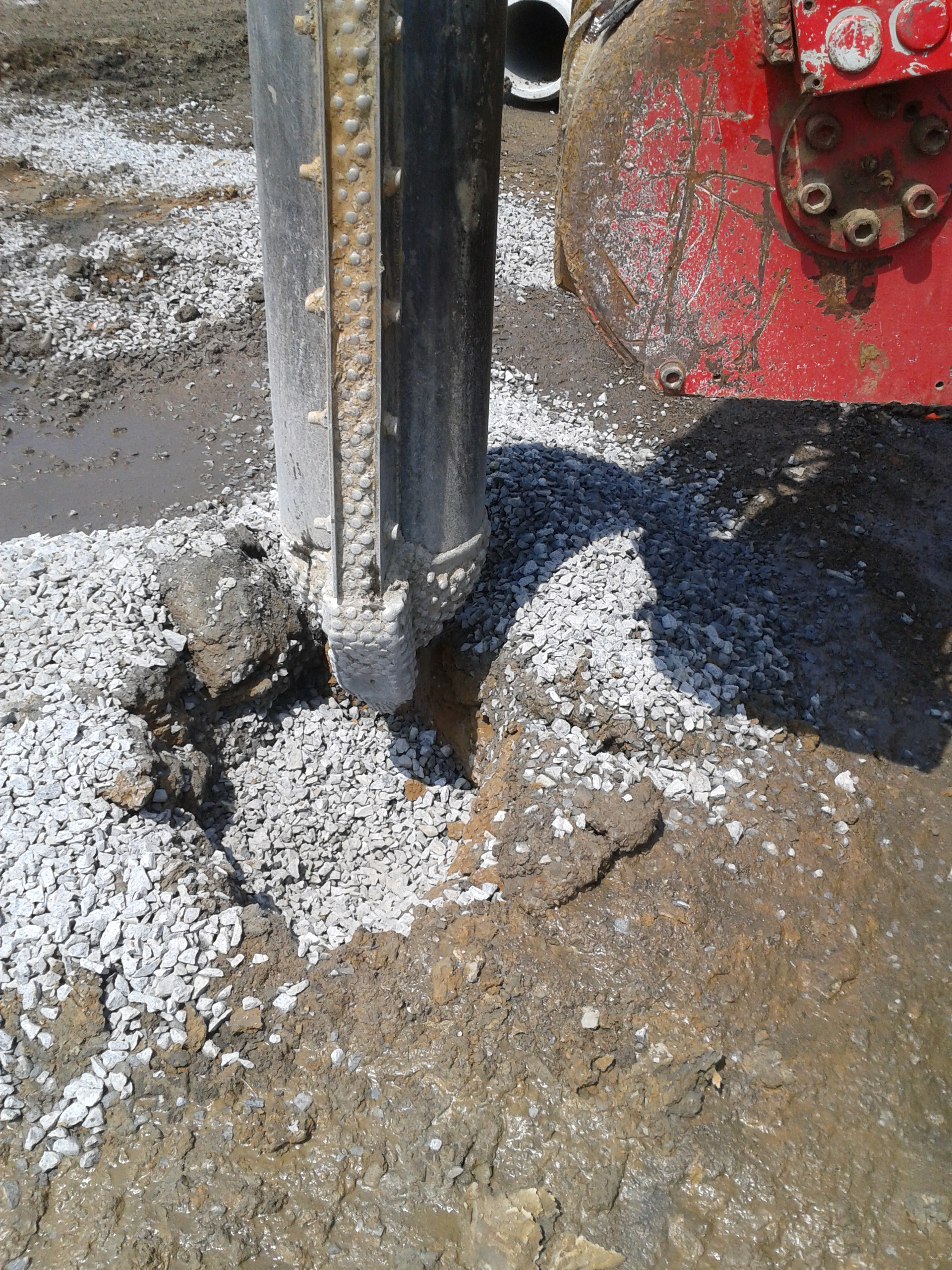
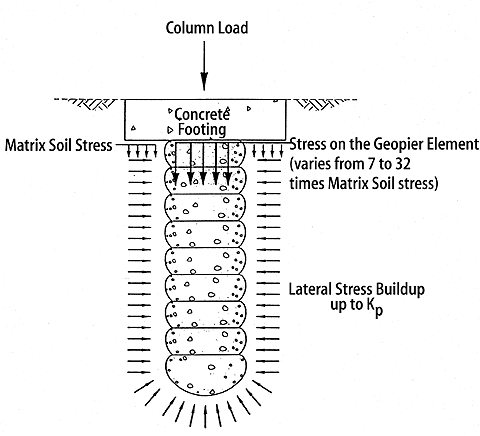
I sense John putting on his reading glasses now….rather than our typically taught shallow or deep foundations, these are known as ‘intermediate’. The rammer tool has 45deg edges to press the rock laterally – this ‘preconsolidation’ technique pre-strains and pre-stresses the soil below the drilled bottom, creating a bulbous base of aggregate upon which succesive layers are piled and compacted (each layer no more than 0.3m). The ramming therefore creates a very stiff dense rock pier (”load goes to stiffness”) but also improves the strength and stiffness of the soil surrounding the pier, through compaction >> increased lateral stress >>increased effective stress >> increased shear strength (Mohr’s circle) . It does however involve a huge amount of piers, 3600 for that matter under a warehouse approx 200m x 100m, but each rig can complete approx 50 piers per day; one more is inbound (with a top hopper). In this case no steel is being used, but it can be incorporated to prevent uplift.
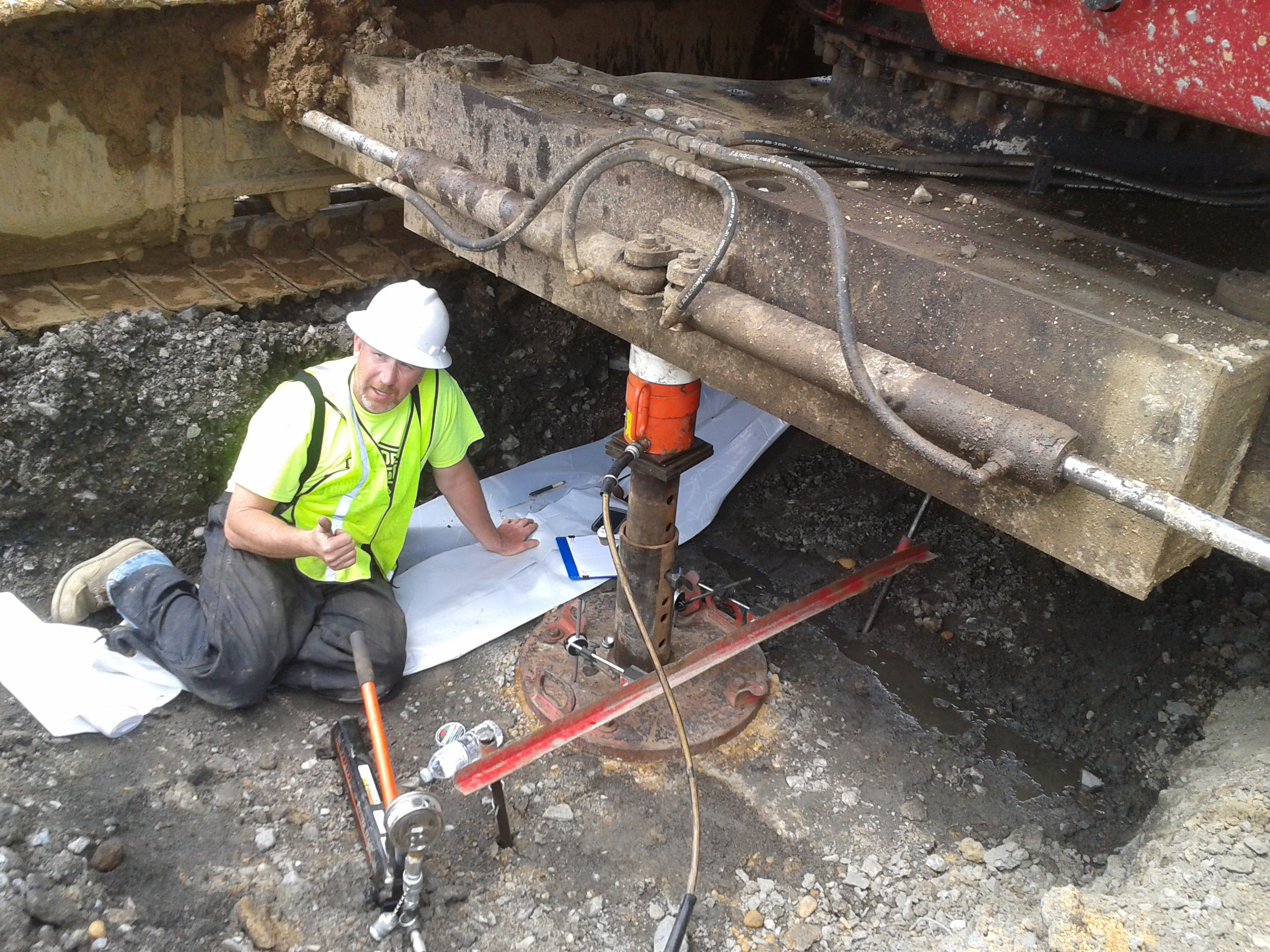
One day in we conducted the modulus test on one pier – the top foot (sacrificial) of pier was hoed back, while a pressure of double the design load was placed upon it (550kN/m2). Settlement was then recorded as pressure was increased, as was the rebound when pressure was released. We await exact figures and analysis but down and dirty figures were a total settlement of approx 8mm, with a rebound of 7mm – recall the consolidation curves.
In other news, we just enjoyed a long wkend (memorial day yesterday) full of BBQs with friends and family. Smoked, slow cooked, pulled pork is the food of choice for BBQs out here having eaten it 3 days in a row – certainly not complaining!! The SI joined us for a few days last week – no doubt he is telling tales of our 10ft rattlesnake fight on the Appalachian trail…I certainly am! Weather has now hit the 30deg C so the outdoor pool at work got a visit today at lunch – tough life!
 Holdfast Training Services Trial Blog
Hi Howard,
Hope the questions re DALT paved the way for learniing by all! There was a journal piece on R4 this morning re the best understanding and solutionising techniques requiring an ability to admit lack of knowledge in order to tackle it. I’m intrigued by the mix of silt sand and caly; are we talking made ground? I’ll let John discuss vibro stone columns with you (check http://keller-uk.com/solution/vibro-stone-columns). What benefits or disadvantages/risks do you percieve?
Hi Richard – definite advantages over regular concrete piers/piles is a substantial cost saving, and ease of emplacement and simplicity of logistics (aggregate vs concrete mix or cast). I am struggling to see any disadvantages at the moment; risks (notably settlement) are mitigated at the forefront through modulus testing – with double the design load and such a small settlement, confidence is high. That said, the design was for 12-15ft columns and most have refused at 7-8ft due to the vast amount of ‘junk’ under the surface, so the actual length is nigh on half that designed- initial alarm bells…but the modulus testing was conducted on said 7ft pier with success…we await technical analysis results.