Mr Cropper is too blunt
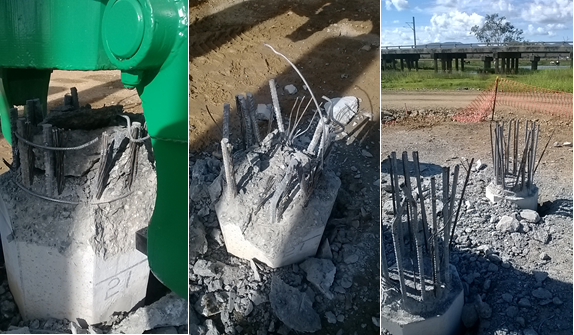
Things are picking up on site. The excavation has now been completed on the first to piers and the piles are being broken down. The hydraulic cropper arrived on site (after much delay it ended up being shipped in from the UK), and it has promptly fell on its arse. It works fine, too good really as it is mangling the reinforcement and strand within the piles that need to be tied into the pilecap reinforcement. There just seems to be too much congestion in the pile for it to work as intended. The helical cage combined with the strand and the normal 24mm bars seems too much for it. The photos below show what the pile cropper in action and what its first and fourth attempts produced. There was an improvement in the technique, but it was still causing too much damage from a QA point of view.
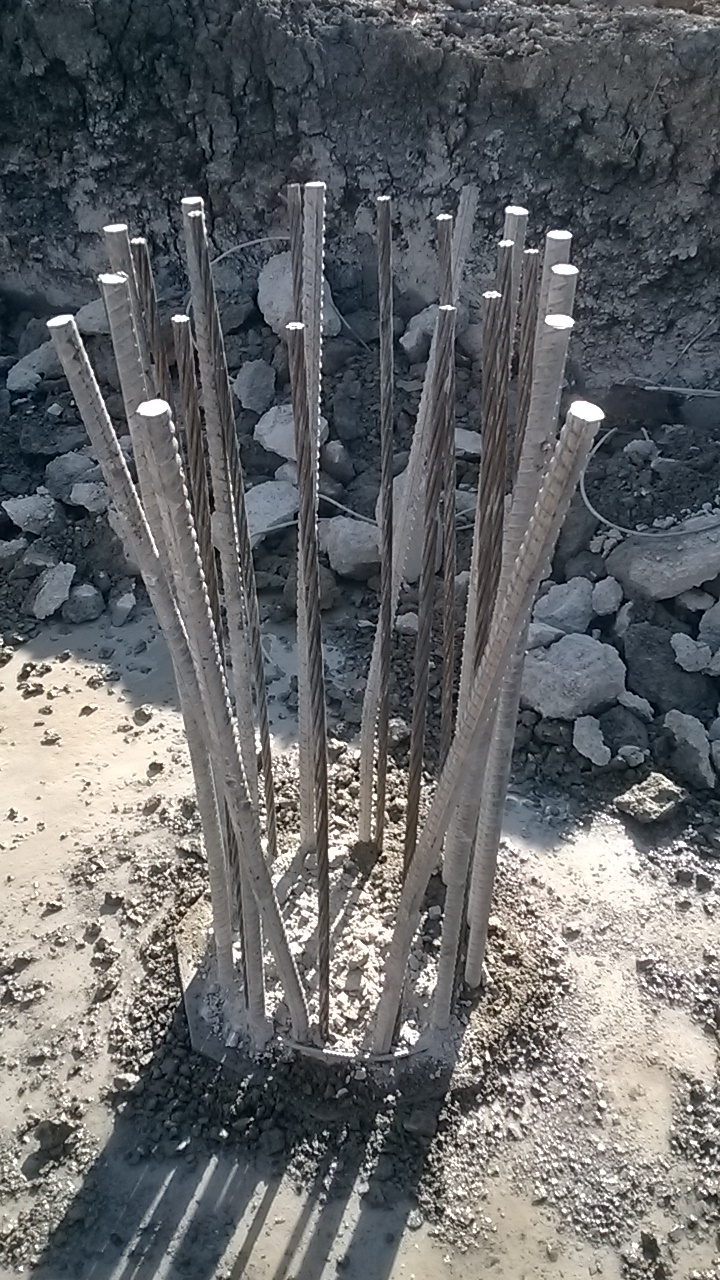
Below is the pile that was broken out through a combination of a rock breaker on the backactor of a LWT and men with jackhammers. I know Joe had great success with the cropper but it seems that the combination of high grade concrete (should be 50MPa but in 28 day crush tests its reaching over 70MPa) with lots of reinforcement is too much for it.
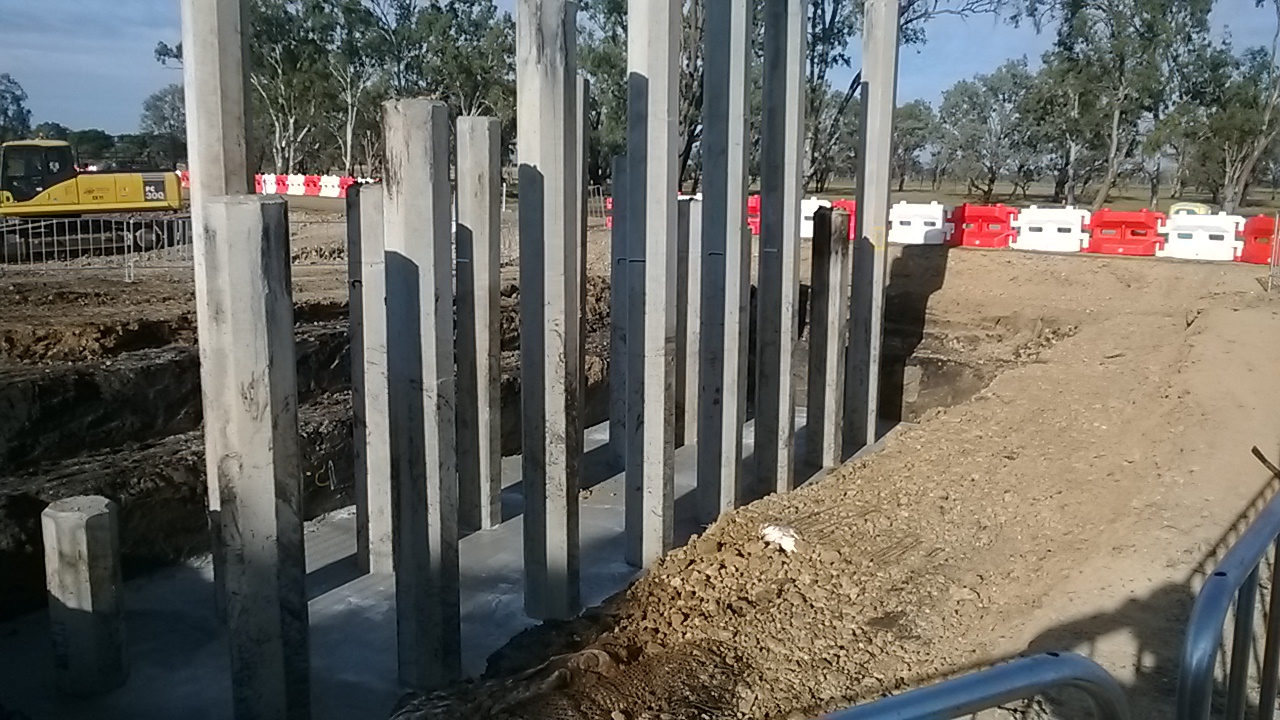
The excavation has been stepped back at a 1:1 bench with a further stand off equal to the depth of the excavation (to make a 1:2 slope). The same geotechnical consultant that is certifying our crane and piling pads has looked at this and he seems more than happy with this for normal traffic. We’ve looked a lot more closely at the loading for the 80T rough terrain cranes that will be lifting the forms into position. Things still seem good when considering the bearing pressures. The biggest problem seems to be passage of information to the guys doing the work on the ground. When barricading was put in to maintain this stand off all was good. I then found out it was moved to get an EWP in closer to the edge for access to something. It seems the workers thought the barricade was to prevent falls into the excavation, and the supervisor hadn’t passed on it was for standoff. Its now been covered in the daily prestart and I’ve spoken with the crew on the ground too. I’ve spoken with the geotechnical consultant about the benching and how long it will be safe for, I’m anticipating a few questions from John on this….
In other news there are still dramas over steel reinforcement in the headstocks. The cages for the columns have started to get tied by the steelfixers. The formwork for the headstocks still requires modifications and I’ve been in touch with the designers Bonacci about modifying their drawings. One of the big questions is how to remove the support frame around the column once the headstock has been poured. This might have to be another blog on its own.
I’m now going to elaborate on what happened on Tims site for the civils that maybe don’t read the E&M blogs. All this information is from either Tim or the John Holland internal safety alert system (JHET). Its been raised on my site and across John Holland as a whole, its of particular relevance as I have temporary excavations currently in place and the upcoming formwork installation too. It seems to be a good way of passing the information and making sure that the group as a whole learns from mistakes – I’m not sure what the others in Oz think about this? Is there an equivalent system on Crossrail?
Description of incident:
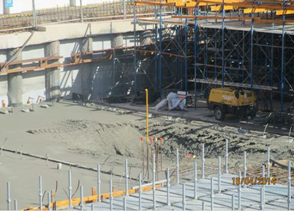
A Subcontractor concrete work crew were pouring concrete in Zone 2, Basement 2, Pour 1. During this work, the Bondeck and supporting formwork/falsework, partially collapsed resulting in approximately 8 m3 of concrete in a 40m2 area to fall through deck to lower level. The concrete work crew identified the failing deck and evacuated the area prior to collapse. No personnel were below the deck at the time and there were no injuries as a result of the incident. The site was immediately evacuated.
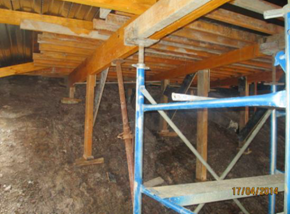
Contributing Factors
• 32mm of rain overnight prior to the incident affected the stability / integrity of the base plates and tombs on the batter between B2 and B3.
• The Formwork Engineer issued Formwork certificate 5 days prior to the pour, providing opportunity for external factors to change or affect the integrity of the formwork structure.
• Temporary works procedure not implemented adequately
Lessons learned
• Where formwork is supported on two types of ground bearing (e.g. natural earth batter and slab on ground), specific design documentation, inspection regimes and certification processes need to be implemented.
• When Engineer certification is provided for temporary works well in advance of activity and bearing on non-unified material, due to unforeseen delays with potential for alteration, modification or damage to the temporary works, a re-inspection / certification process needs to be implemented
 Holdfast Training Services Trial Blog
Peter,
The decent cropper (the one your trying to use) was not the one we actually used in the end as it was prioritised elsewhere. We used a smaller version, attached to arm of an excavator that only crushed the concrete and did not cut the rebar. The link below shows you the one we were using.
http://www.astrasiteservices.co.uk/hire-division/square-pile-cropper-70/
My piles were significantly smaller 0.27m2 C35/45 with 4 x 14mm rebars and hence we could use this particular type of crusher. Once the pile had been cut to the correct height (by hand) the crusher exposed the steel in 3-4 drops of the crusher and the top surface of the pile was then finished and cleaned up by hand. This was done by cutting a criss-cross pattern into the top surface using a stihl saw and then breaking out the cubes on concrete with an electric chisel. Once the lads got the hang of it they were cracking through the piles quite quickly. Sounds to me that this is almost the exact same process you are undertaking.
The next link shows you effectively the same piece of equipment but for hexagonal piles and if you can procure/hire one, may speed things up for you.
http://www.directindustry.com/prod/mantovanibenne/hydraulic-pile-crushers-56765-967431.html
Peter,
This is my second attempt at writing a reply, as I didn’t realise that this website interprets the ‘post comment’ button below as ‘delete message’.
Anyway…In the end we did not use the pile crusher you have shown in the pictures for the majority of the piles in my section, as it was prioritised elsewhere. In the end I used a smaller version that simply crushed the concrete and not the rebar, shown in the link below:
http://www.astrasiteservices.co.uk/hire-division/square-pile-cropper-70/
The piles were cut to the correct height by hand, using a stihl saw, then the crusher would be lowered onto the remaining exposed pile section and the concrete crushed. This action would have to be repeated a couple of times to clear all of the concrete but it left the rebar exposed and undamaged. The pile would then be finished by hand. The top exposed surface would have a ‘criss-cross’ pattern cut into it, using the stihl saw, and then the ‘cubes’ of concrete would be cut away with an electric chisel. This would produce a good clean finish and could be accurately left at 75mm above the blinding, the depth of the foundation bottom cover. Once the lads got the hang of it they could get them done quite quickly. This seems to be a very similar process to the one that you now appear to be conducting.
I have found a similar piece of equipment for hexagonal piles that you could procure/hire that may speed things up for you? I suspect the amount of rebar in your piles may still make it difficult but if doing everything by hand is taking too long, it may help?
http://www.directindustry.com/prod/mantovanibenne/hydraulic-pile-crushers-56765-967431.html
This looks very similar to a probelm Nik West had on his site.
He reported a false work failure and on quizzinf identified that the baseplates of the props were
a) on a slope
b) that there had been a water leakage close by
…since the baseplate is a foundation…the rest writes itself
Joe, you’ve pretty much described our initial methodology. This has now gone out the window due to the damage to the reinforcement. At present we’re using a breaker on the back arm of an excavator to smash the concrete out after the initial tops are cut off with a stihl saw. The chaps then get in with hand breakers and tidy up. Out of curiosity how were you removing the excess pile that was cut off? We’ve had some pretty big sections (over 7m) and current method is to hook it up to a crane with a choked chain while the notch is cut 90% of the way round. The final bar is always the one on the side with the choke. After being cut the crane slews slightly, just enough to snap the centre core of concrete and lifts the top away. Does this sound similar to what you did?
I’ve seen the multi ram crushers, but discounted them. They mainly seem to be used for CFA piles, and I don’t think they’ll have the grunt or reach in the ram to crack the concrete core inside the pile reinforcement.
We had some fairly large top sections to be removed, similar to yours 7m+, and we used a very similar but slightly rougher method to remove them. The guys used the stihl and cut into the 4 corners to just cut the rebar – ie cut until the sparks just stop – and due to the central core of concrete being strong enough the pile would still stand vertically, no problem. Although the rebar was cut the top sections were supported by 93% of the concrete as only 7% was cut away to cut the steel. As the majority of my piles were vertical (I promise) there was no tension in the pile only dead load in compression so the removal of all of the steel did not worry me. We then got an excavator in, moved everyone out of the way and simply pushed it over with the bucket. I would say that the majority of the top sections left were 2-3m and space was not an issue so for most of the time this method was fine. For the really large ones the lads used the excavator avec chains in a similar method to your crane but again space was not an issue on this site.
Chatting to the guys in this office and showing them your pile photos they seem to think that the ram crusher would probably do the job. Yes it will leave a cone of concrete in the middle but as you crush from the top down in small increments it should break up the majority of the concrete sufficiently. I suppose if a hydraulic breaker is doing the job then its an additional cost saved in hiring equipment but it may need to be weighed against the cost in additional time if the hydraulic breaker is slower??
I’ve now finished that section and they’ve moved me onto a retaining wall. Away goes chapter 12…hello chapter 8!!!!