Archive
Red Card Moments – Part 2
Following the PFA ambush of last week, BFK have found themselves backpedalling to find a solution. A contract wide issue that is still being discussed by senior management up in the ‘Deathstar’; however, down at Fisher St, we critically need a self compacting mix trialled and approved before the middle of next month, should the PFA risk manifest itself. So with an empty chair where the materials manager used to sit, and our Materials Tech jumping ship, we were down to a cast of one….
Requirements
The client’s materials and workmanship specification for cast in situ dictates mix design and trial requirements as follows:
Temperature: 2 key points:
- At the time of deposition of the concrete, shall be in the range 5 degrees and 30 degrees. (A planning figure for expected heat gain is approx 10 degrees per 100kg of cement per m^3. Our mix contains 270kg per m^3, and therefore a 27degree heat gain on a 30 degree ambient temp would remain in spec because….
- The upper temperature limit of the placed concrete should not exceed 60 degrees C. Designed to minimise the risk of thermal cracking.
Testing. During trial mixtures need to demostrate results for:
- Compressive Strength
- Consistence
- OvenDry density
- Fresh Density
- Bleed
- Segregation
Testing is conducted on at least three specimens from at least three batches, andis in accordance with Annex A of BS EN 206-1:2000 and is a thrilling good read!
Temperature Testing
In order to demostrate the temperature gain and the max temp value, a 1m^3 sample is poured into a ‘coffin’. This coffin is installed with thermocouples which will measure the core temp, surface temp and the ambient temp during curing. This setup is shown below.

1m^3 of self compacting mix. Note green thermocouple wiring
Temperatures will be recorded by the data logger at a rate of every 30mins for two weeks.

Ruggedised data logger will record data over a two week period
Concrete Strength
Requirement:
In Situ Concrete strength requirements, C8/10(12hrs), C32/40(28 days)
Test cubes will be crushed at the following frequency, in accordance with the specification. 1 x 12hr, 1 x 24 hr, 3 x 7 day, 3 x 28 day, 3 x 56 day. This frequency will give indicative early age strength gain for reassurance, followed by the criteria test at 28days. This allows concurrent activity…I have written the Materials Compliance report for approval by the client on the basis of the early age stregth gain;it has been approved, on the caveat that it does gain the 28day strength. If this criteria is not met at 28days, the 56 day cubes will be crushed, and the results will be demostrated to the client for approval.
Consistence
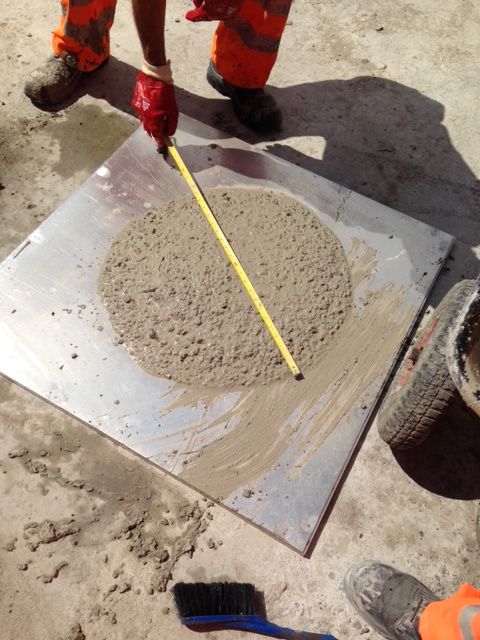
A slump/flow test is conducted in accordance with BS EN 12350-2. A critical feature of the self compacting mix in this instance is the workability. The location in the works dictates that the concrete pour would be difficult/unsafe to effectively vibrate into position, and thus a flow to allow movement into these areas is an imperative.
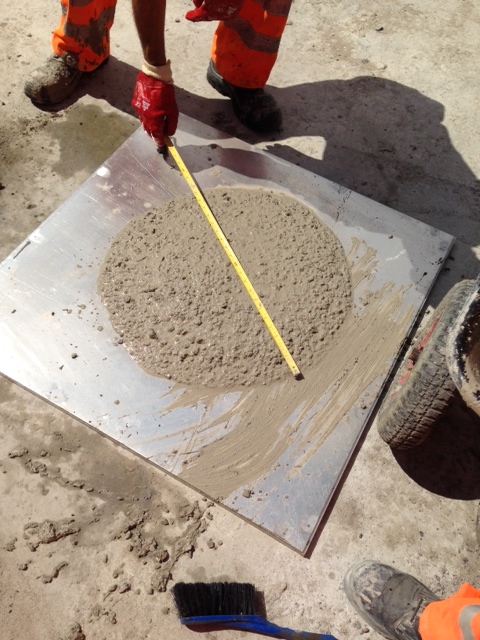
Note sample has been allowed to reach its full diameter at measurement.
The specification requires samples to acheive a flow result of 490mm – 650mm. This sample achieve and average measurement of 550mm. Additonally, bleed was visually inspected on this sample and considered to be the within limits
Segregation
Three cylinders of 150mm diameter and 300mm height were cast for the batch. The cylinders are then sliced into 6 sections of equal thickness. The mass of each slice is then measured and the density calculated to determine density variation throughout top to bottom of the sample. The average variation from the top to bottom of the cylinder shall not be greater than 10% of the mean density of the concrete
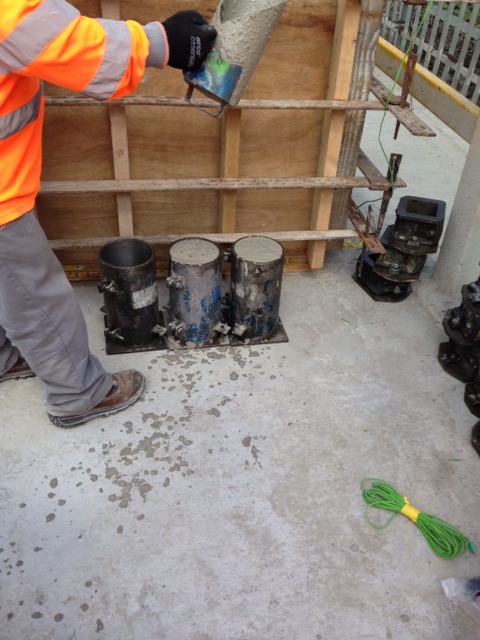
Segregation in the sample will be demostrated by aggregate gradually moving to the bottom of the cylinder, thus increasing the average density to the bottom.
So with help from the concrete supplier, we’ve designed and tested a self compacting concrete mix, that thus far is performing as required by the specification. If it continues this way, my mix design may well be used throughout cast secondary lining throughout the western tunnels. Terrifying….
BUT…before there is a mass protest/retirement at PEW!
Just as I was about to publish this, I’ve just received a slightly panicked email. Due to concrete suppliers switching to GGBS after the PFA shortage, and a problem with the discharging of ships at the Port of Entry at Tilbury, UK GGBS stocks are currently at 30%! Brilliant…
 Holdfast Training Services Trial Blog