How long is too long?
This relates to an issue from last month that has now been resolved, but I thought it interesting enough to share and see if anyone would approach the problem differently.
The problem
At the start of the project the length of pile that was needing to be cut off was manageable at around the 4m mark. However as progress moved to the middle of the bridge the ground improved and we struggled to reach the underdrive allowance in some piers. This was leaving up to 8m of pile needing to be cut, before breaking down the final metre of pile where the reinforcement is exposed (and then tied into the pilecap).
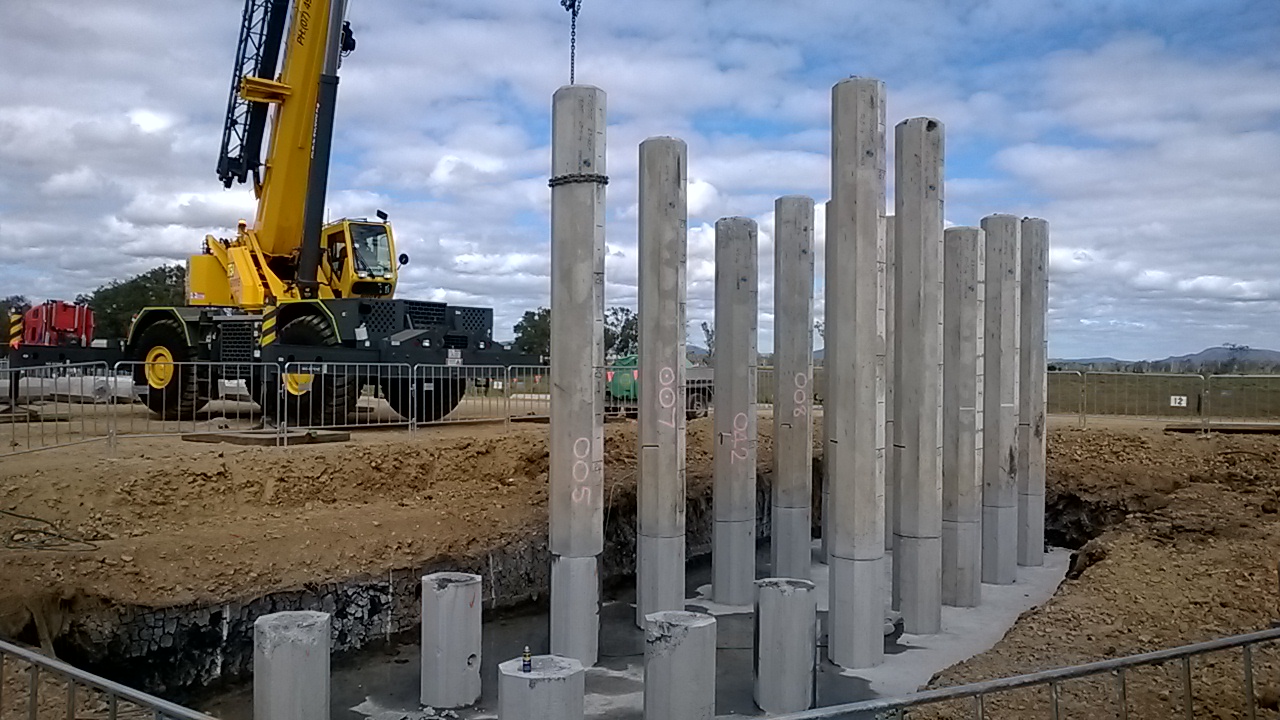
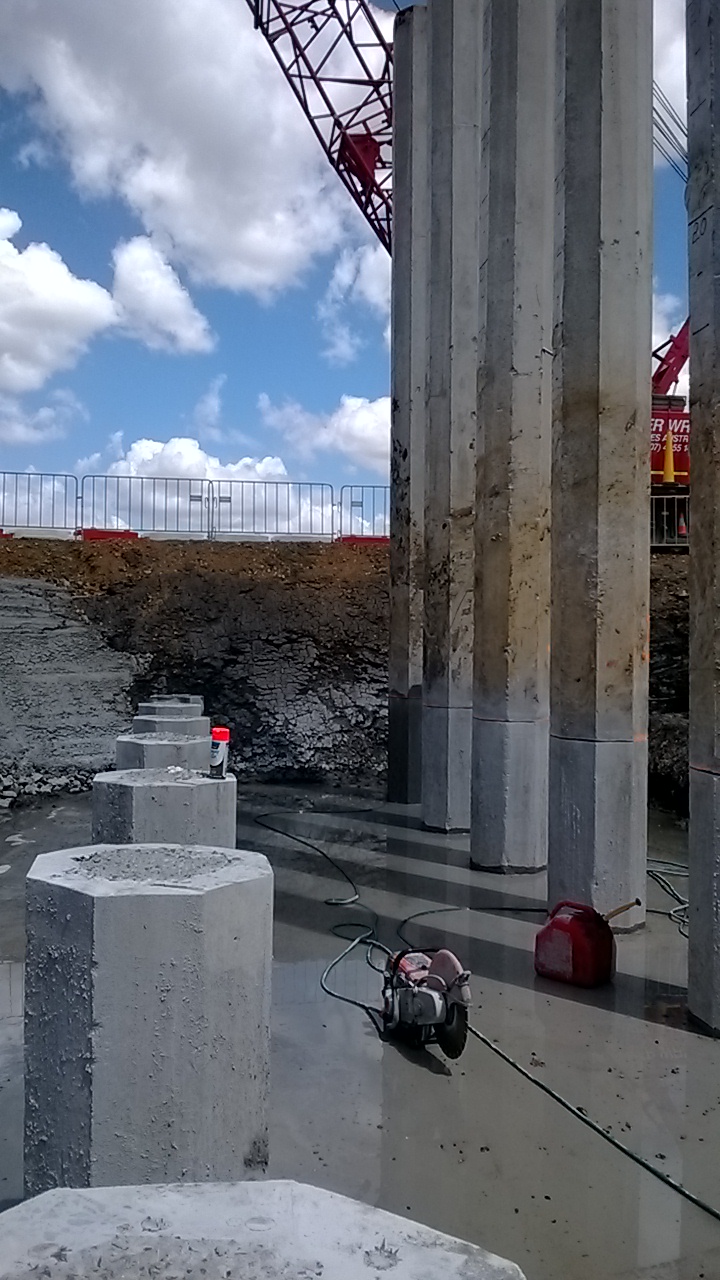
The process for the shorter lengths had been to cut 7 of the 8 sides with a circular saw to a depth of approx. 100mm. This ensured that the strand and reinforcement was cut. A crane would then hook up to the pile and (for some) snap the pile off. For most piles this would not be enough, and the final side would then be cut, or a breaker on a backhoe would tap the pile and it would swing off. With the increase in length the crew cutting the piles became increasingly worried about the stability of the piles prior to the crane hooking onto them. As the pile breakdown was not on the critical path, it happened whenever the crane was not on more critical tasks. – meaning the piles could be cut and sit for a day or two before being snapped off.
The question then came, has anyone checked whether this method is safe? No, the original supervisor was doing what he’d done on other jobs back in the day. He had then handed over to another supervisor and then the length to cut off increased.
The analysis
Safety and the powers would not accept anything that was not signed off by an REPQ (the equivalent of CEng in Queensland). However I still did my own rough check with a free body diagram of the issue to see if I thought it was safe. I took the worst case possible rake on the pile (but still within tolerance – 20mm in 1m) and I assumed a wind loading of 10% of the self weight of the pile. I decided to include the resistance of the reinforcement, even though it was in compression (mainly due to it being confined by the concrete to stop it buckling. Then I negated the concrete in tension and only counted the concrete in compression. Based on my rough calcs I was happy with the situation. The only thing I didn’t consider was accidental loading (in the form of an EWP striking the piles). The piles are made with 50MPa concrete and have 12 x 24mm dia headbars. I did not include the prestressing strand. The diagram below shows my starting point.
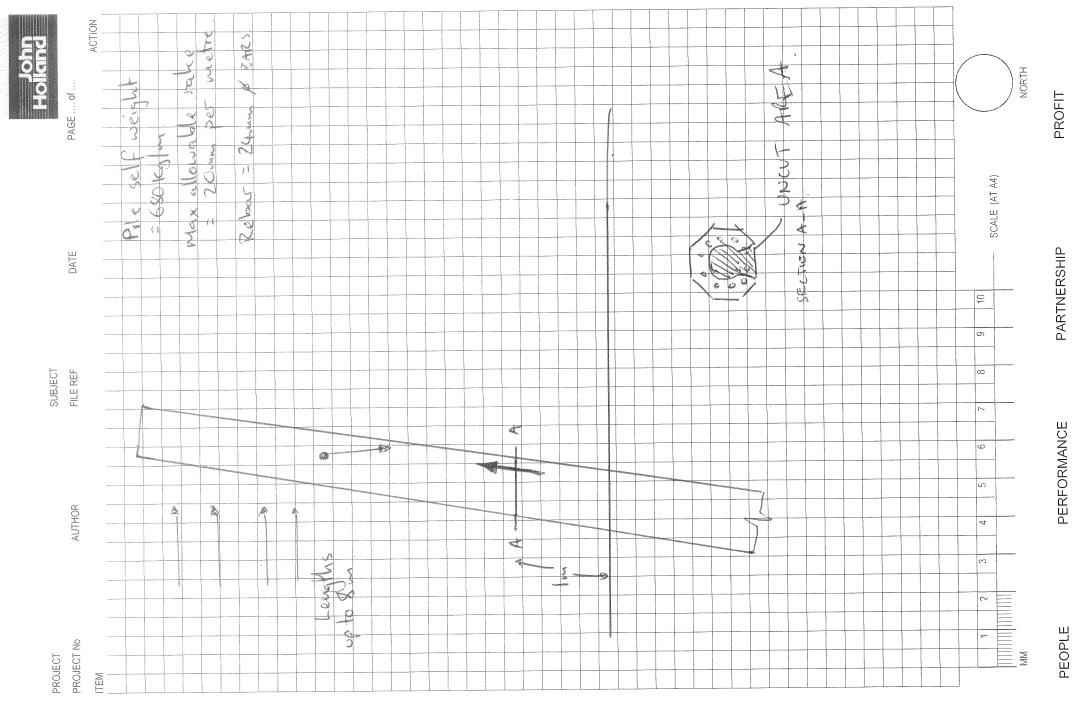
I wanted to see if anyone would approach this a different way to me. I will put my process up after this in a subsequent post (as I don’t want to influence the ideas of others). To give a brief hint there were 2 limits set, one at 4m and the other at 8m with different controls at those points. How would everyone else approach this?
In other news we’ve also started to have a bunch of snakes appearing on site. There were 4 red bellied black snakes on Friday that the catchers had to relocate. Apparently they’re the third deadliest in Australia, might need to put that in my AMS…
 Holdfast Training Services Trial Blog
Nice problem- the worst O/T moment is the wind and the se;lf weight acting together; There are 12 basrs and 7 cuts – we have to assume that ( at worst) we are left with 1 24mm dia bar – with ( approx 100mm form edge to bar centre)
Now if the bar acts in tensionopposite the toe around which the overturning moment acts – we are probably OK BUT this assumes;
a) the uncut face is always the face opposite the tilt (see below)
b) The wind only acts in one direction
We therefore (b) have to discount this and look at the worst case
a) the steel can only provide compression ( and he shear necessary to equilibrate the horizontal wind load)
b) that the overturning toe edge is on a cut face
With the 10% wind allocation the resultant in the freebobdy diagram always falls outside the base and implies that the uncut concrete must develop tension………..weeeerrrrrrr’alll doooooomed …dooooooooooooooooomed!
The 10% allowance for wind seems fairly sensible BUT, form the weight given I calculated a pile daimeter’ of about 650mm A tropic wind might be giving 5kPa and you’get maybe 5 times the horizontal load implied by 10% of the weight….dooooomed I say …doooomed!
Pete-we have been using a pile muncher on an excavator to break them down in small pieces. I am guessing yours are too long or the concrete is too strong in this case? Or are they just being lazy and wanted to cut it all off in one chunk? My colleague Eddie has been working on piles and has had all sorts of tolerance problems. Around 40% of the 1000 piles surveyed so far have had a Non-Conformance Report written about them (either cage too high/low/off-vertical, concrete cracked or rebar bent). Let me know if you want the info on the remediation or them as he has made a nice flow chart.