The Queen is not the best landlord
I’m working with a small firm of consulting structural and geotechnical engineers called Michael Barclay Partnership (MBP) Limited Liability Partnership (LLP). They employ roughly thirty engineers, ten CAD operators and some admin staff. We’re based on the Strand, just down from the Savoy Hotel and the building is owned by the Queens personal estate. Sounds great right? Well our office is on the top floor of the building and we’ve had no heating since Christmas!

The firm’s business model is to achieve a high turnover of work on small to medium sized projects in London and the South East of England. Their work is predominantly in domestic/residential structural design of new build (or redevelopment) projects, but they also have public, retail and commercial projects on their books.
The role I have taken up is as a Junior Structural Engineer. I’ve been given responsibility for the design of a residential development in Battersea, which I have been working on full time. The developers budget for the project is approximately £5m. The design fee will be no more than 1.5% of this. In addition to this design work, I have been on a number of site visits around London (or simply the Royal Borough of Kensington & Chelsea) to gain practical experience of basement construction, underpinning and significant structural alteration works.
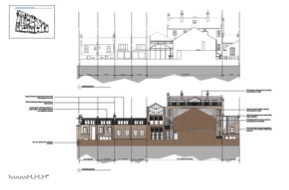
The project in Battersea I am responsible for is the redevelopment of a Baptist Congregational Hall built in 1895. The developer hopes to convert the Hall into thirteen flats. Adjacent to the Hall are five terraced properties. It is hoped to demolish four of these and replace each of them with new 2×2 bed houses (these are the four properties to the east on the below plan).
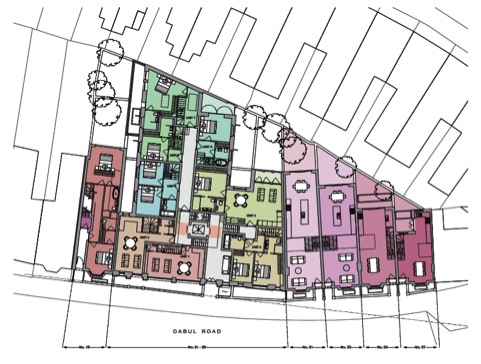
I completed a Desk Study and Construction Method Statement for the planning application, which was submitted just prior to Christmas. Since then I have worked on the Concept Design of the development. Once my line manager, one of the four principals of the LLP, approved this I moved onto the Developed Design. I am now in the throws of modelling the structure such that I can verify my concept design. After this I will finalise the Detailed/Technical Design.

The last five weeks of design office time have gone exceptionally quickly. I feel as though my learner plates are coming off at last. A little like Joe’s office, most people design using British Standards. I’ve opted for EuroCodes and this doesn’t seem to be a problem. The last week, or so, I’ve immersed myself in learning how to model structures using Robot, which is part of the AutoDesk family. Here his a screen grab from one of my models.
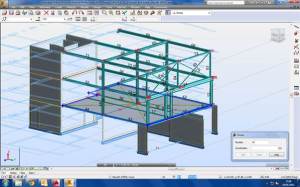
It is a pretty powerful tool and I’m now just about getting to grips with it. We also use Tedds which is great for very speedy verification of simple elements, and 2D analysis. Some of the structural challenges ahead of me include retaining the front and side facades of the Congregation Hall, underpinning the retained facades and party walls to dig the basement, erecting new roofs, designing a new core within the building and installing a new steel frame within.
Monitoring the planning application online for the Battersea development a lot of local residents have objected to the fact there is no off-street parking. The developer did commission a parking study but this was done on a Wednesday afternoon in mid December and showed there were plenty of free parking places! The residents are up in arms with this since it is not representative of their parking ‘crisis’. Therefore I won’t hold my breath that planning with get the green light immediately.
All in all it should be a good five months ahead. There is plenty of interesting work coming into the office which I will no doubt be involved with.
 Holdfast Training Services Trial Blog
Hi Rich,
Nice size of office and scale of project to work on – should give you everything you need for DO’s and be pretty satisfying. Watch out for robustness on the structural front – we don’t do it very deeply here but it is very important! Stability throughout the lifecycle, particularly in construction, is one I’m sure you are all over given your site experiences. From my side of things I have always found drainage plans both layout of down pipes (they have a habit of suddenly being introduced late on and then requiring pipe runs through the footings at inconvenient locations)and the planned foul drops and chamber locations. pipes through footings is a messy business espescially if you are tight to the street and have limited falls to meet. Structural engieers often forget to look at the services aspects until it is a pain late in the game!
I rate CRP’s website above that of MBP. Comapre with Thomasons which is a slightly larger LLP. All very good places to be exposed to consultancy and very different to that which Steve will see at Arup.
Hi Rich,
You make some good points. Services is already at the top of my RFI list since the architects have placed toilets, kitchens and bathrooms all over the place! The new basement will also be lower than the existing services in the street most likely so that will need a plan.
I’ve already come up against the robustness issue. You’re also right that it is not really covered on Phase 1. i.e. What is a tie and where is it needed?
A four storey block of flats is Class 2B. However because one of the storeys is a basement then the structure can be split 2A above ground and 2B below. This means we don’t have to provide a new frame within the existing structure, just provide ties. We do have to make sure the basement is Class 2B though. This could be a challenge since some of it is only at partial basement level!
Hi Richard
An excellent job that has the whole range of tasks. It is good to see that you have gone for the Eurocodes – you will have to be careful otherwise you will end up giving CPD for the other junior engineers. As Richard said excellent DO stuff. Stabilising the facade will be fun.
All the very best
Neil