Life on the Western Front
I’ve now been on the Peters Village project with BamNuttall for a couple of weeks and am slowly working out what is going on…we’re building a bridge!
The Peters Village project is a new community consisting of 1000 houses, schools, shops and so on. It is expected that in time it will grow to 5000 houses and as a result the local area infrastructure requires a large uplift. BamNuttall are responsible for the local area infrastructure but not the housing development.
The project office sits on the East side of the river, however the bridge section of the project is run from the West. Currently the site resembles a complex obstacle plan and is covered in a foot of mud making it look more like the Somme than a building site.
Project Overview
The project can be neatly split into a series of sections each with a dedicated team:
On Site Roads – These will feed the new built community and incorporate some ground preparation for the village.
Off Site Roads – 3km of road network to link the village to the surrounding area.
Medway Valley Crossing MVC – 150m pre-stressed, post-tensioned, cast in place river bridge
– 30m pre-stressed, pre-tensioned bridge over a live rail line
– 500m road and deep drainage linking the two
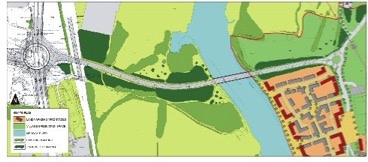
Kent council scheme proposal
Thankfully I am in the team responsible for the MVC, which will expose me to a much broader range of tasks and engineering issues. The river bridge sits on the critical path for the MVC section of work and that is the main focus of attention at this stage. The Rail Bridge has, and continues to, slip further behind regarding the start date, however, it has so much float in the schedule that there is no immediate concern.
Currently there are two key areas where efforts are being focussed, these are:
- The False Work Jetty
There is a requirement to maintain a 20m navigable channel open at all times. In order to achieve this a jetty will span out of each bank parallel to the main bridge; these will support the cranes required for construction. Directly below the main bridge a second jetty will be constructed to support the bridge false work. At present we have the west side crane jetty complete and are halfway through piling the west side false work jetty. Finally, two cofferdams will be constructed (the first started today) in order to provide access to construct the main bridge piers. Below are a couple of images that will hopefully add clarity to my poor explanation.
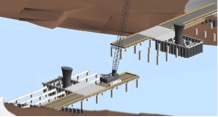
Crane jetty’s, false work Jetty’s, cofferdams and bridge piers
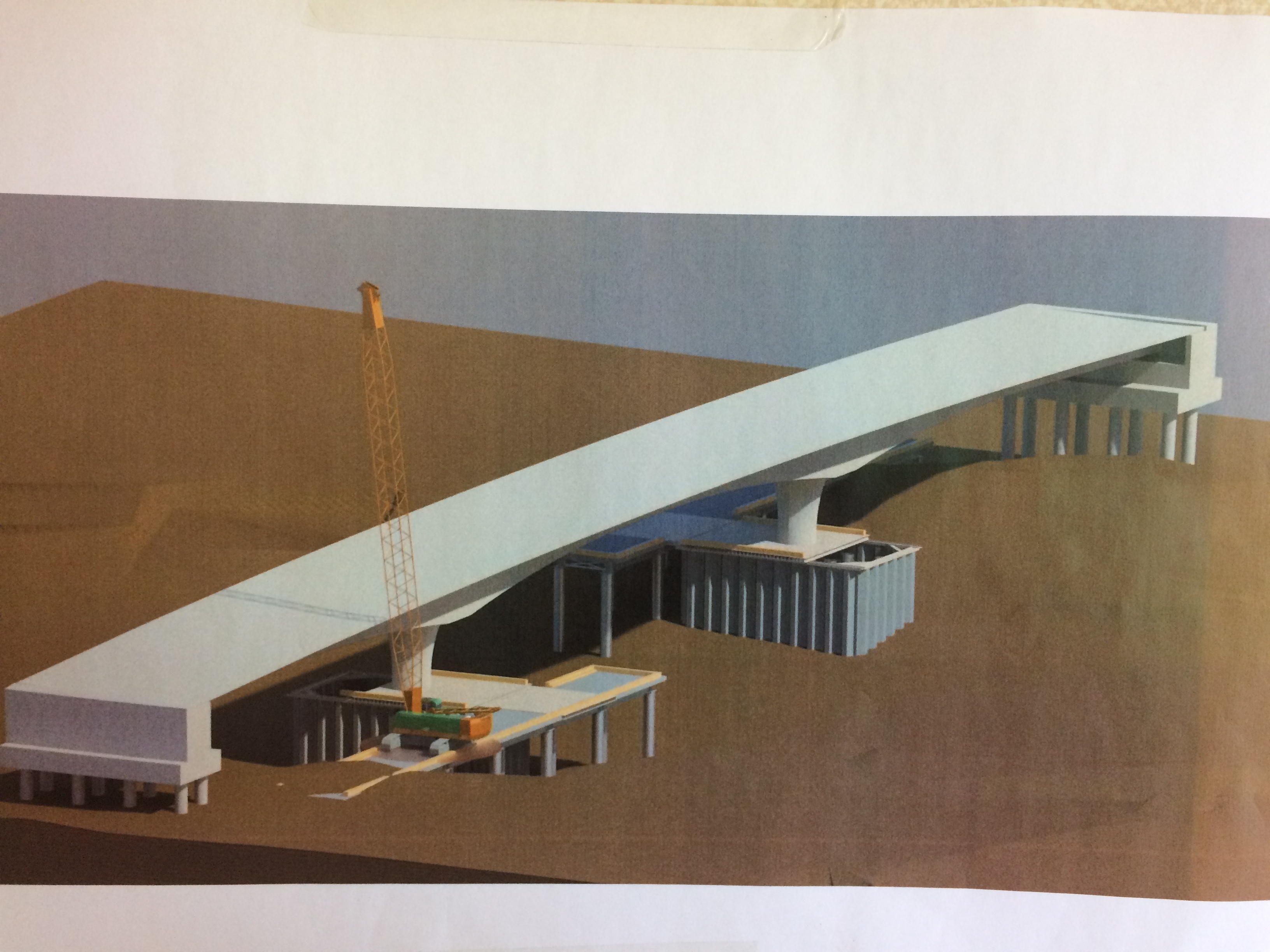
Late stages of construction, false work removed
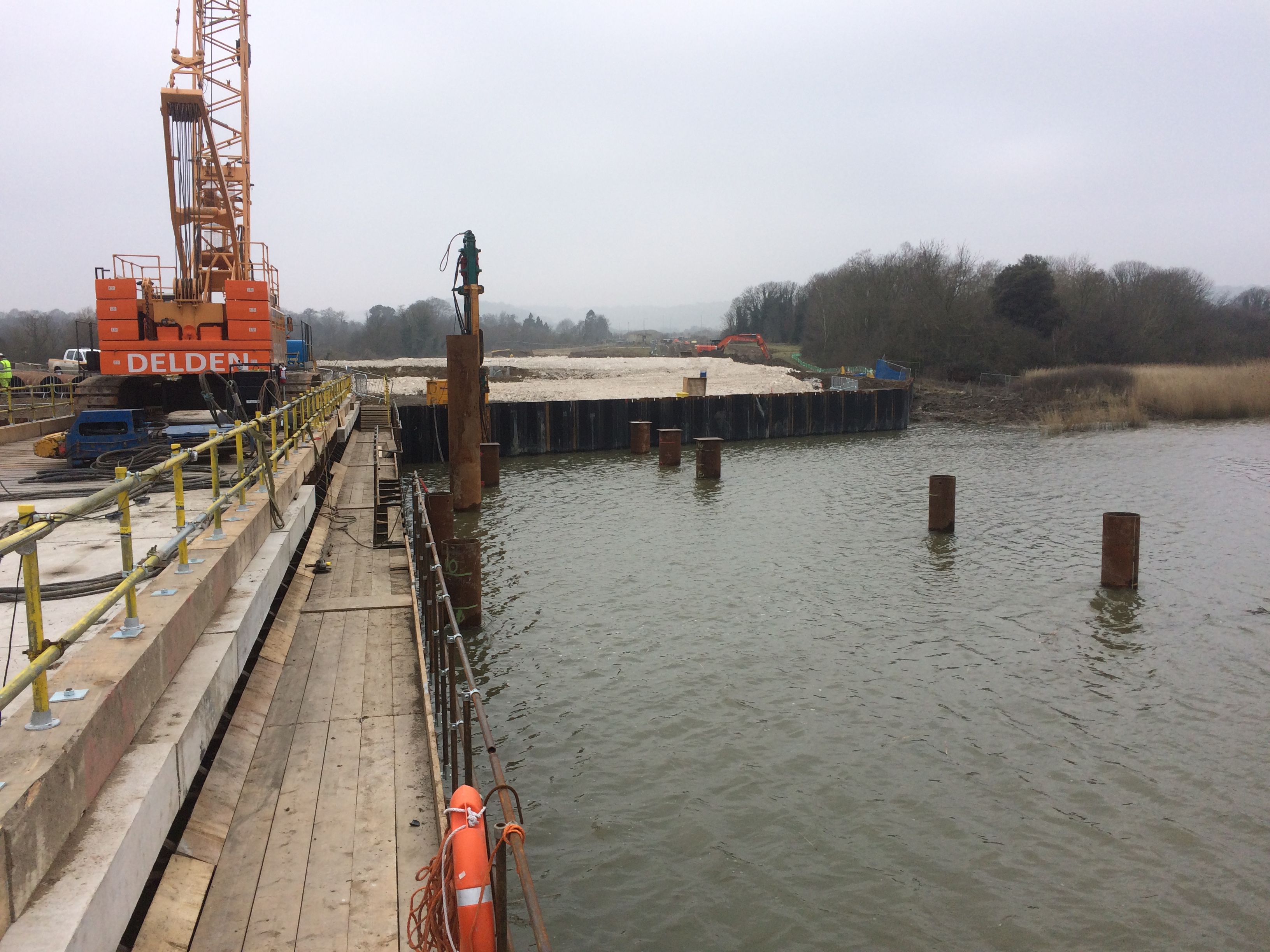
View from the end of the west crane jetty. The closest four piles
Mark the corners of the cofferdam. Taken at high tide.
- Consolidation of Existing Ground
The ground profile across the site is clay over laying chalk with a thickening alluvial layer as you near the river. Currently the site slopes towards the river and is anywhere from 4-8m below the required formation level. Chalk is currently being imported from the cross rail tunnels to build up the level of the site and also to surcharge the clay and consolidate it. In order to increase the speed of consolidation band drains have been used. It is predicted that it will take at least six months to reach the required level of consolidation and a number of techniques are being used to monitor it. I will expand on this in detail in future blogs.
In Other News
Remember that moment on Ex Cofferdam when you messed up your calcs at 0200hrs on Wednesday morning and you can’t understand why no pump in existence is capable of emptying your hole…no…maybe that was just me, but fear not because we have a little blue pump on site that could not only deal with Ex Cofferdam but is actually callable of pumping out a rising tide on the Medway!!!!!!!!!
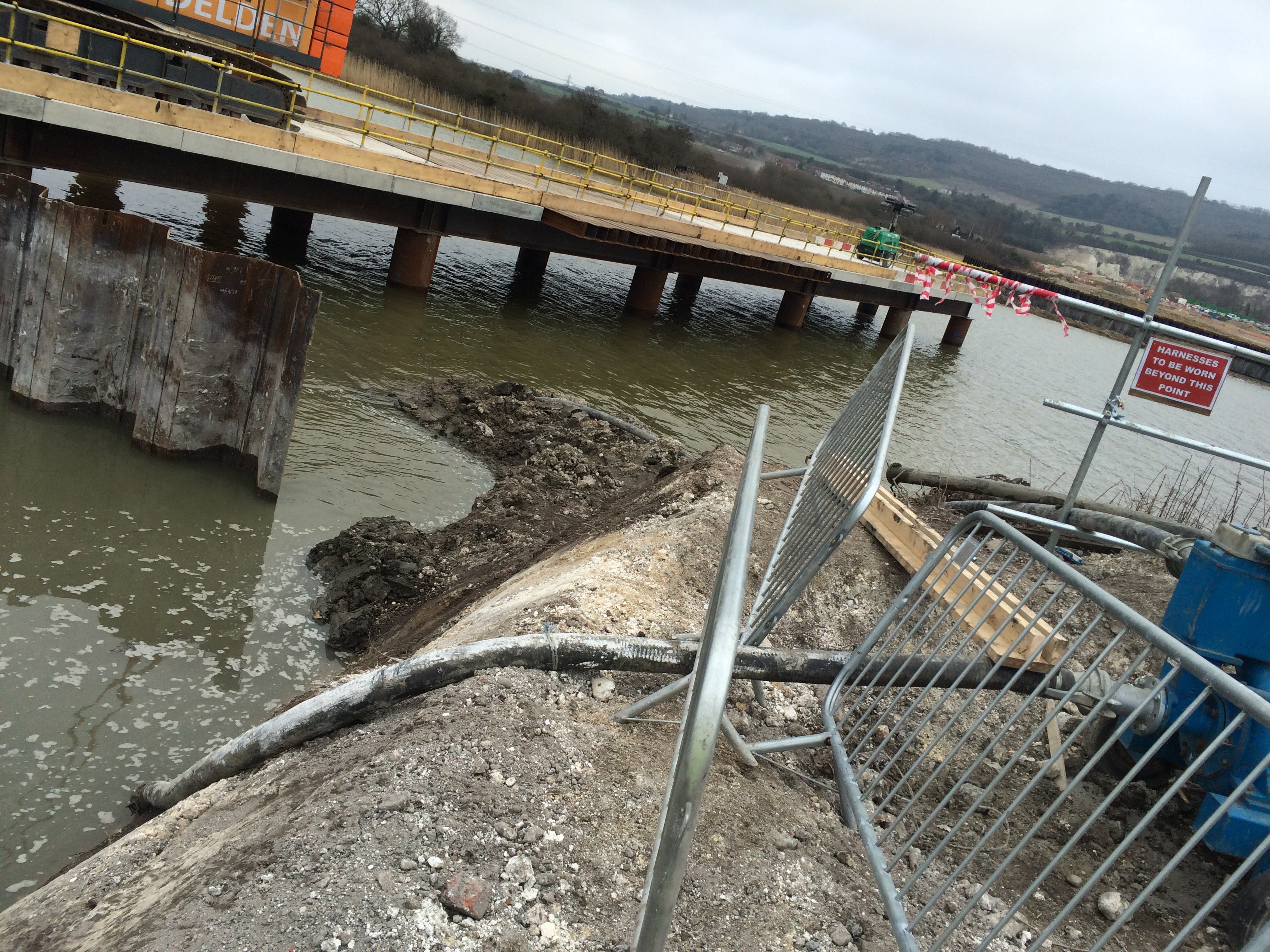
Thankfully a concrete plug now seals the end of the sheet pile wall and we’re not wasting diesel trying to fight nature any longer! I’m not sure if the poor lad monitoring the pump had been told to do it as a wind-up or not but as it was my third day on site I just smiled!
And Finally…
In case you were wondering, yes it is possible to eat an entire Soreen loaf, Mars Bar and drink close to a litre of Coke in the time it takes to drive an 18m pile into the ground. Should anyone wish to marvel at the evolutionary wonder that is our 110T crane driver please feel free to get in touch to arrange a private viewing.
 Holdfast Training Services Trial Blog
How long does it take to drive a 18m pile? From the amount consumed I’m guessing about 4 minutes? Or is that just how fast I inhale Soreen?!
Were your piles in the water driven from a barge? What’s the tolerance on them like?
Good to see you on the blog.
The closest 4 piles marking the cofferdam or the cofferdam location to be? If it marks the cofferdam how much was it over-topped?
Regards
Guz – All of the piles that you can see poking out of the water were pitched and located (stood up in the right place) at low tide with the use of the 110T crane. The water level is a little over 5m lower at that time. All of these piles have been free driven which means no piling gate has been used. This technique carries a significantly greater risk as ultimately it means someone being at the base of a 4.5 tonne pile whist it hangs off the vibrating jaws man handling it in to place! This has become a contentious issue, but has however been accepted and has allowed the rate of piling to increase by approx 100%…cue TMR 1 theme!
The False work jetty will support a modular false work system that is to be designed, constructed and maintained by RMD, a false work specialist. I say ‘to be designed’ because we still don’t know what system they will use. The RMD system will sit on 900x900mm plates welded to the top of the piles; you may be able to see a couple on the furthest piles. The position tolerance is 75mm and verticality is 1:75.
Now for the important stuff…out of the 18m pile pitched around 2m generally gets cut off as we reach refusal before the required depth. Six metres is exposed above the alluvial layer, it sinks 2m under it’s own weight and vibrates around 5m so we only end up hammering 3m. It is in this last section that I witnessed the UK’s version of man vs food. I would say it’s a little over 6mins.
Neil – The cofferdam walling will be installed over the next few days and the sheet piles will hopefully start going in by the end of the week. The cofferdam walls will sit around 300mm higher than the 4 piles currently poking out on that photo at high tide. The medway can get a bit choppy and when complete there is a slight chance that some water may over-top at high tide but this will be managed by limiting work and pumping out. The height of the coffer wall is limited by access requirements for the CFA piling rig that will sit on the crane jetty.
Olly, looking at where the 110T crane is positioned and considering the reach it requires to installs the piles furthest away, are the temporary piles designed for a greater set of actions than the permanent ones? Is your Temporary Works Coordinator a Chartered Engineer? Have you got divers positioning/checking where these piles go in/end up? I see you are doing CFA piling – hopefully the logistics of this method have been well planned!
Damo – the furthest piles are within a meter of the cranes limit for the pile weight, however, the crane jetty has been designed for a 140T crawler. The construction method for the main bridge has changed as a result of a value engineering exercise last year (more at a later date) and as a result the max size of lifts has been reduced. In order to ensure the loads from the crane are transmitted axially down the crane jetty piles, wooden track guides have been used on the main deck.
The CFA permanent piles that sit below the pile caps at the base of the two piers will be 40m. Along with the two abutments they will carry all of the loads that the bridge is subjected to. The temp pile below the falsework jetty cover all but 20m of the span and consist of 2 rows approx 9m apart. So in short the permanent piles will carry greater loads in all directions and combinations.
All of the piles that we have free driven up to now have been positioned by a man in a cherry picker pushing and shoving them around. At low tide we can see the base so we are checking the location with a total station. When we get out further and can’t see the base we will use the exposed 7m of pile (at low tide) to survey the position and angle to work out the precise river bed location.
CFA’s will be bored from a rig on a temp platform bridged between the crane jetty and the falsework jetty. The material that comes out will be removed by a mini excavator and then hauled by the crane. Concrete will then be pumped directly from the bank. I’m assuming these are the logistics you’re talking about?
Nice Blog Olly, with the piling what are the plans for establishing if they have achieved the required capacity? Are you going to use O-cells? Do you know how many piles will be tested? Were there any test piles completed prior to work starting on site?
Pete – The piling sub-contractor, P J Edwards was formally appointed a couple of weeks ago and is now working on its detailed design and methodology hence everything I say now being subject to change. I can only assume (always a great start) that the 40m CFA depth was conceived back in 2007 in the initial design and has not been challenged since.
Currently plans show 12 piles under each abutment and 24 under each river pier pile cap. The current plan is to test one pile under each abutment at the start under working loads with O-cells. The ground profile changes mid river obviously in height AOD but also in layer thickness and lay down. I asked last week if we were testing the river pier piles and was told not. This seemed a little risky to me however it is in line with the execution code and I have spoken to John in the meantime who has agreed that their proposal sounds fine. He has raised some questions regarding the QA for the piles.
I will offer detail in due course as to what design is proposed and how it actually pans out on site as we are due to start boring in four weeks.
Damo – was my response inline with your point about CFA piling logistics?