Still not talking…
My site will have one gigantic basement raft slab that covers the entire site. There is a podium slab 6 metres higher then the buildings above that.

The basement raft slab is built in sections of varying depths. There’s an 800mm deep section of C40/50 with 75mm cover. There’s a 500mm thick section of C50/60 with 40mm cover (shown by shaded area below). There’s bit with steel orthogonal to the western line of sheet piles, and there’s bits with steel orthogonal to the eastern line of piles. There’s areas with steel at 150mm centres, there’s areas with steel at 75mm centres. There’s steel ranging from 32mm diameter bars down to 20mm diameter.
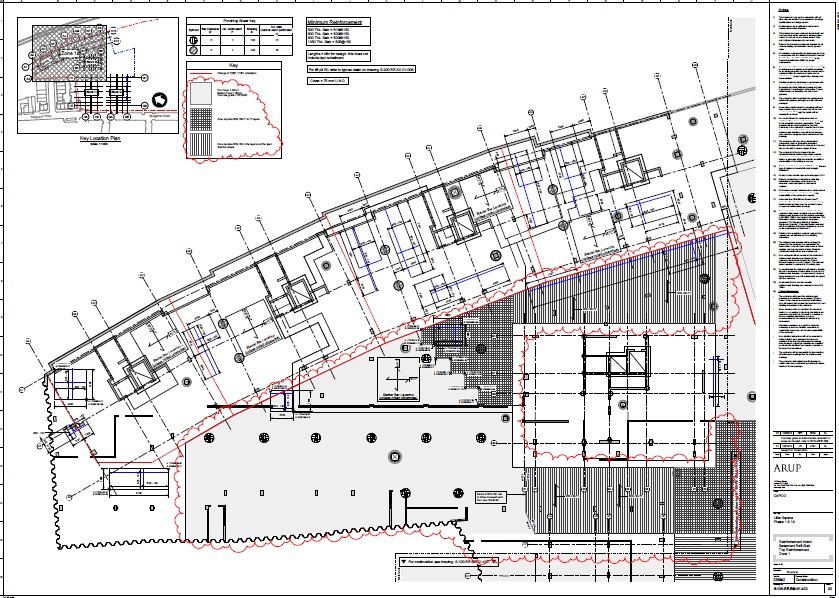
The drainage is no better. We’ve had a nightmare with clashes between the bottom steel and the drainage runs. There are also areas where the drainage runs for several metres into a manhole, only to turn around and run back the other way (shown by the brown arrows). Why doesn’t it run along the black arrow?

Believe it or not, our project was subject to a significant value engineering study where some of these issues were designed out, only to be put back in again due to continually changing client requirements.
The Arup design is a “reinforcement intent”. The detailed design is done by the sub-contractor. The detailed design showed the reinforcement around an ACO drain like this:
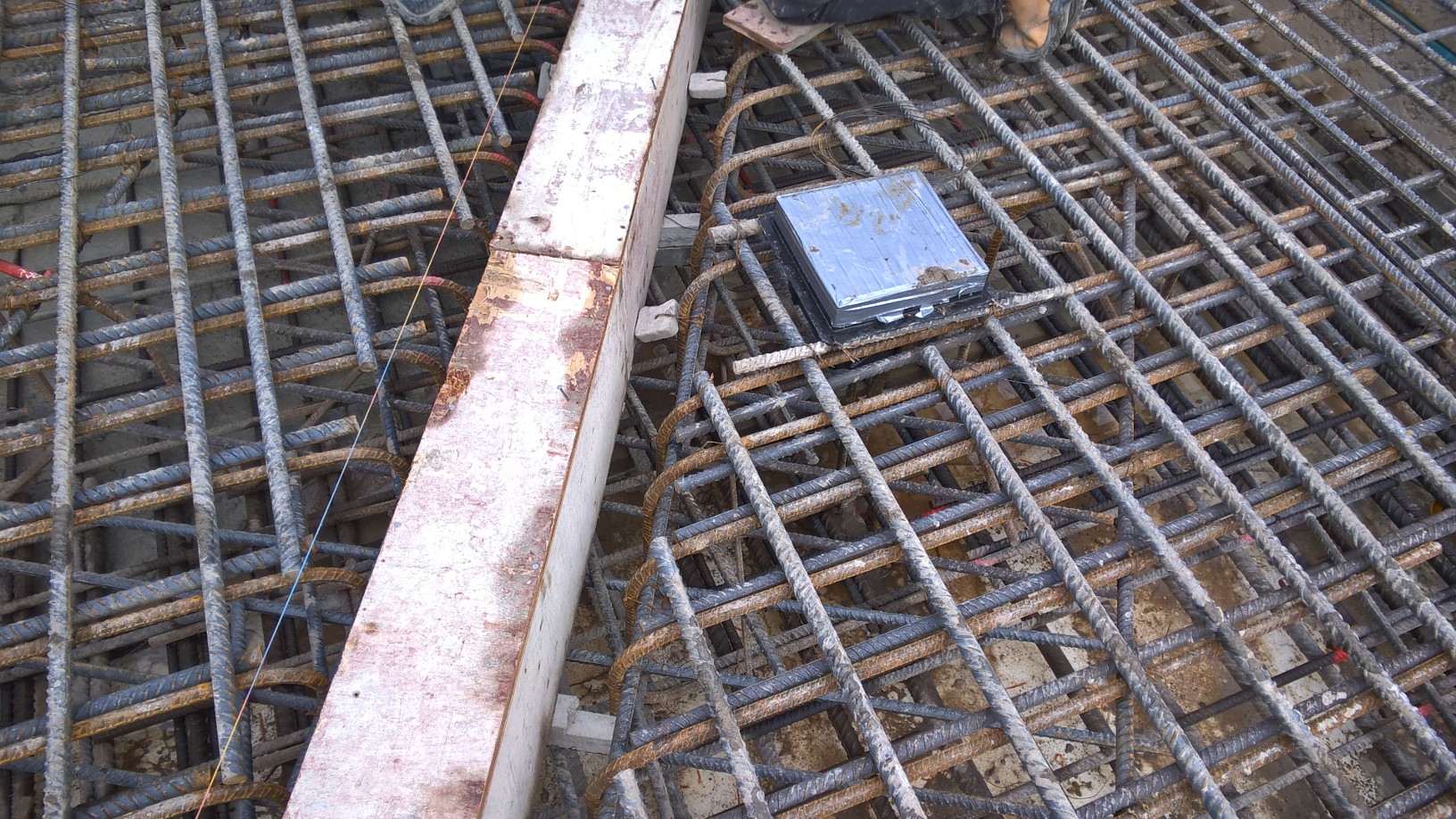
Arup OK’d it, but on seeing it built decided it wasn’t ok and made them add in additional bars. Which they had to do around the rapidly approaching concrete. Timely!
The drainage designer is a bloke with a beard at Arup. The structural designer is a bloke with a beard at Arup. The reinforcement detailer is a bloke without a beard who doesn’t work at Arup (you can’t have everything). And they haven’t spoken to each other, thus the clashes. We’re on a design and build JCT contract. So all the structural designers and architects were novated to us when the contract was signed. Therefore all of these things are our problem to solve.
We have a design manager on site. In fact we have three. But ultimately the drainage in the responsibility of the drainage package manager, the steel that of the structural package manager and so on. And they haven’t spoken to each other.
To link back to a previous blog… Communication is key is this situation. And we’re lacking it.
So what are we going to do about it? Well this is where I’m not too sure. McAlpine SOPs seem to be to let them fail and say “I told you so” later. Not sure why. I’m sure I’ll work it out in time.
 Holdfast Training Services Trial Blog
Guz, as with many things on our attachments I have a similar contractural arrangement. At the pre-contract stage (letter of intent, sort of) the client has the risk on the design. On novation to the contractor, the risk shifts to the contractor with the design and build contract. In theory the design should be at RIBA stage 4 (developed design complete, contractor to do detailed design). An interesting balance of risks. On the one hand the designer is getting the entire building to Stage 4 and the contractor is worrying about rebar schedules to meet permanent and temporary parts of the build. Few people are focused on the details of rebar and drainage deconfliction. Even if they were to have been, the design intention has been given and I doubt they (Arup) would have spent significant resources resolving what is a stage 5 onwards issue. At least that is the impression I get on my site.
The one recourse I could see for you is if Arup approved a reinforcement design and then required it to be amended, suggesting they got in wrong in the first place. Either way, if novation had already happened, it’s the contractor’s responsibility.
I wonder whether BIM might be a club in the golf back to help with some of this, although costly at the outset, certainly we are hoping the longer-term benefits are realised…, although at the moment getting rc schedules from 3D models is not proving so simple.
Regarding the McAlpine, let it go wrong and deal with it after attitude, this might become an issue as the point about being responsible for the detailed design sits with them because of the d&b contract and because of the Stage at which novation occurred.
Very interested to know how these issues are resolved (other than by forcing people to talk, redoing work and having deconfliction/planning sessions) because I can see myself being in the midst of them in about 3-months time (my basement slab)…
Guz,
OK I’ve laughed at the lunacy of the failure to co-ordinated raft thickness, grade and reinforcement and then glanced at the drainage extract – arghh!! Drainage never runs into and out of a chamber at less than a right angle. Why backdrop ~600mm? the components and finishing on that costs more than the additional dig to run in at a gradient, particularly if it is eased down (rules apply). The linear drainage channel had better not be ina location that is ‘working’ because the channel won’t carry the compression implied by the steel beneath it. This has all the hallmarks of a young graduate cutting their teeth on drainage design and needs a sharp rocket to consultancy.
The question regarding which coinsultant is interesting because it would be the detailers if the design intent had been shown to be workable albeit not fully detailed i.e. developed/initial design one step on from concept. But it does look as if the concept has not been taken to a workable initial design and so might not have been fit for passing over to detailed designers. The reasons for this are simple: In consultancy the contract is often awarded on a lowest fixed price basis that usually means the consultant has allowed for an amount of work at each stage. They then try to keep as much in the bag to use later on when the client stops changing their mind every five minutes to try to deliver without having to raise claims (doing so take time aneffort, is not interesting engineering and leads to price increases in the clients eyes i.e. no project come in on buydget…) Ultimately the next trick is, having crashed oout a reasonable concept/developed design hope that it gets detailed design and build buyy others and only wade back in if there is an RFI that threatens to hit your PI insurance if it goes wrong otherwise leave all alone as SEP (somebody elses problem). If you’re paying them then the consultants are all yours to manage but the let it go wrong and then deal with it approach is not uncommon. Usual reasons are 1) If you put time into trying to resolve it it costs you time and money and you end up attracting risk for no reward. 2) The QS will have costed the works based on the concept provided the MC is intersted in delivering this design not developing it and delivering it. All questions cause delay and unltimately cost money somewhere along the line! 3) If it doesn’t go wrong then that’s jolly nice, and if it does then the costs of finding out why and sorting it are part of arbitration and court costs not the main contract and the people who look bad are the designers not the MC who deliverd the design on time and to budget.
One interesting aspect ot look at is the commitment novated consultants have wrt the personnel committed to the job and their ability to change names and faces at will (false beards?).
Thoughts?
Hi Richard,
I will wade in because this is all very relevant to me (sorry to hijack your post Guz!).
I will pick up your pints on 3 reasons for allowing things to go wrong. If the contract is a novated Design and Build one with the same consultants that did the design then anything pre-novation, to amended by the consultant, is at nil cost to the Main Contractor (other than a bit of time sending in RFIs or other questions). As soon as the contract is novated, the costs sit with the MC, therefore do nothing = costs money and no reward, do something = costs money and problem solved. Your point 2, QS price on concept not detail – fine, I suspect often the case at early tender stage, but in reality for un-detailed items the risk allowance is much greater based on the uncertainty of the design. The point that it ultimately costs something is true, but who pays is more important: pre-novation = client, post = MC. Therefore the do nothing method is likely to cost the MC more, assuming post rectification costs more than pre-spotted amendments. Thirdly – arbitration I suspect would be tricky if the concept designs have been adopted by the MC. Now being novated, unless the original design was proved faulty, the risk sits with the MC and therefore the cost too.
In my view, the approach is either spot mistakes pre-novation (clearly too late here) or hope that resolving issues costs less than what was budgeted – again too late here, so McAlpine will have to stump up/resolve/seek money back elsewhere. However, in a broad sense, the design and build methodology places the risk onto the MC and therefore costs the client more. I.e. things of this nature (clashes, unbuildable designs, etc) are at the expense of the MC, but hopefully covered within the tender price because the risk pot used for these uncertainties in concept, not final designs.
In my case, we are pre-novation, so clearly we are very keen to get design issues resolved now. Having said that the project’s staff power is so small it is hard enough to get current things sorted, let alone look 6-months to 3 years out to resolve potential issues. The intent is there (weekly technical meetings to discuss designs and how things are built), and because at this stage we are still in an enabling contract phase, the final price to do the remainder of the works is able to be modified until the client agrees to proceed (or not) with Laing O’Rourke. This therefore allows the price to change to cover weakly planned concept design issues or more usefully, costs that had not been identified previously. This does not do Laing O’Rourke any favours to help win the main contract, but it will be a much more realistic figure for the client and probably avoid excessive future disputes/variations (I hope!).
Those are my thoughts anyway!
Damian,
I hear your concern that the MC should strive to get it right and agree that not doing so will not be at the clients cost. The fly in the pintment is, in my opinion, introduced where concept bumps up against reality and that is the point at whichthe novated consultant is percieved as being part of the D&B contract. The consultant is independent of the MC and, although both would publicly profess to being a tight nit delivery team, in private there is no real movement of funds to cover being jolly good chaps and getting it sorted out/covering each others backs so costs don’t actually sit with the MC but usually lie where they fall. This is why the MC wants to get on and build. Claims by a client after practical completion for poor workmanship will indeed cost them (the MC) but if it is a design flaw then it passes staight through to9 the consultants on the back to back contract and the MC doesn’t lose any time or money. There is also a very grey legal fog around novation and responsibility/risk transfer. The acceptance or otherwise of concept is almost immaterial because novation in theroy transfers the consultants with their design and therfore all risks along with it and the consultants will be unable to shed risk upwards to the MC so the MC will simply insist that they develop thier design and make it cheaper and easier to build. If it then is shown not to work it is the consultants that are at the wrong end of the pointy stick not the MC so again, the MC option is often to just get on and build it and deal with claims as and when they arise after the event. All in all it’s one for a TMR/beer in a pub I think.
Glad my post has spurred such conversation.
On a slightly more practical front: the detailed design by the sub-contractor was checked by the designer who said it was fine. But as the drain crossed the rebar at an angle, and the detail only showed one angle (T1, B1), it was missed that the other angle (T2, B2) did not contain the same detail.
The order was given to fit more rebar, so they did.
When they fitted the first bars under the drain (T1) they were 2 metres long and crossed perpendicular to the drain. This gave them a 800mm anchor each side. When T2 was added it was done so in line with the existing T2 steel. It therefore crossed the drain at a much more acute angle. But the same length bar was used meaning the anchorage length was just 400mm each side. Arup were not happy. Additionally the vertical sections were missing (no Z or U bars available on site) so the anchorage length required (through some very complicated EC2 related maths) worked out to be 1520mm! (I’ll post the design drawing in a future post).
Thus the steel fixers adding additional bars in the face on ensuing concrete.
Who’s fault is this:
a) The sub-contractor for not detailing properly?
b) The designer for not checking the detail?
c) The sub-contractor for adding too short a bar?
d) Mine – coz it’s me.
There are other options too, but actually its all irrelevant. The subcontractor will find it very difficult to claim for it as they started the pour before they’d got a signature from us to say that we were happy with the pour. Therefore they’ve just had to accept the additional work and materials and get on with it.
The very complicated contractual relationships have been trumped by the paperwork.
Now if you could just put your comments into JSP 101 I can copy and paste it into a TMR…?
Guz, one for later (possibly a TMR, maybe just a discussion with Angela) is to compare the approach here of building a flat slab across the whole site, verses the appraoch on Angela’s site of contouring (stepping) the basement slab to minimise excavation.
I really do not know what you are complaining about!!!!
Kind Regards