At least they got the specification of the biscuits sorted…
As promised last week, this blog will aim to outline what my role will entail, detail the main challenges associated with the project and highlight some issues that I’ve already come across.
Job role
I’ve been given the job title of Building Services Manager and as I mentioned last week I am being given responsibility for the services in the basement; although it looks like I’m going to be shadowing the principal building services manager whilst I earn my spurs. The M&E services within phase 1 are being delivered by one main sub-contractor, Skanska. My role will involve setting benchmarks for different areas / services within the basement and ensuring these are complied with, reviewing & approving risk assessments and method statement (RAMS) and conducting Inspection and Testing Plans (ITPs). There will also be an element of facilitating Skanska’s work within the basement and coordinating with Carillion’s project manager for the basement. Any feedback from the PEW staff or cse 55 on whether this seems like a sensible role for working towards passing professional review would be greatly appreciated.
Project Challenges
The most significant challenges on the project appear to be logistics, the programme and design.
The logistics issues with the site are caused by the lack of available space on site for storage, the size of the build and limited hook time (despite there being 10 tower cranes on site) available. The service risers, corridor modules (horizontal pipework distribution), bathrooms, apartment utility cupboards (consumer unit, DHW and MVHR) and plant rooms are being pre-fabricated and brought onto site as modules for final connection. Byrne brothers, the concrete contractor, have priority on hook time, so Skanska are having to move their stores onto the appropriate floor between 1730 and 2200. The demand on lift is also stopping waste material leaving the site promptly and is having an impact on housekeeping. The logistic issues look like they will be a challenge throughout the construction phase although I am looking at options to alleviate this in the basement by getting round the reliance on the tower crane.
The programme has had to change for various reasons and is becoming more aggressive as acceleration is used to try and claw back the 22 weeks of delay. Work is regularly being carried out until 2200 during the week and the site is open on Saturdays. Hopefully a final version of the programme will shortly be agreed when the client and Carillion come to a consensus on how the existing delay and future variation that I previously mentioned will be dealt with.
The final challenge is the design, which is still evolving as the client varies his requirement. Again it is hoped that this should be finalised shortly. There does appear to be some method in the client’s madness to changing their mind constantly; there is a general push to complete the entire redevelopment as quickly as possible to capitalise on London’s high property prices. Therefore phase 1 construction was started before the remaining phases were designed and this is causing issues and additional costs where there is inter-dependency. At least it looks like there is no inter-dependency or requirement for change when it comes to biscuits. Whilst wadding through reams of project documentation I came across the following clause in the employer’s requirements:
The Contractor is to ensure that…a selection of biscuits is to be provided at all times which should include but not be limited to chocolate digestives, chocolate bourbons and ginger biscuits. Cadbury’s chocolate selection and pink wafer biscuits or similar is to be provided for Principal and Project meetings.
The story so far.
To date I’ve generally been shadowing people around site and reading into the project documentation. A recent walk-around produced an interesting turn up for the books. Skanska had been craning some of the pre-fabricated service risers into position. Due to their allocated hook time this was occurring late into the evening. During a walk around on Friday morning the following was found:

Service riser with non-RAMS compliant edge protection.
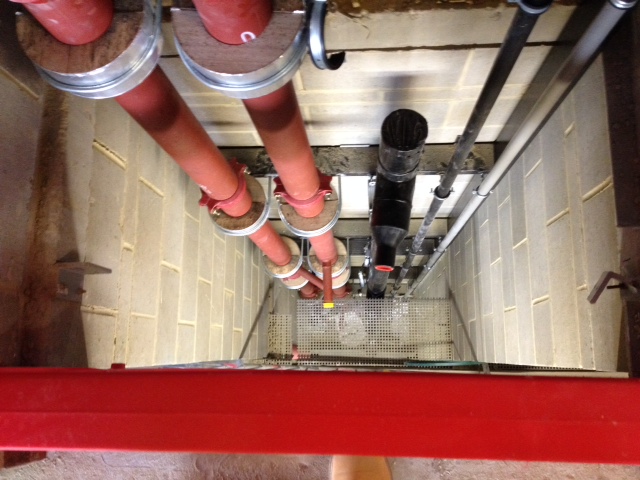
3m fall behind flimsy plastic barrier
Essentially the service risers had been left without Dura grid in at each floor, the protection in front of the riser was not as per the RAMS and was deemed to be unsafe. The immediate solution was that works were stopped until Skanska had rectified the issue, which was achieved within a couple of hours. This final solution was the installation of anchor bolts on each side of the riser to which ply board was bolted and the appropriate warning signs attached. What I found particularly interesting was that initial discussions were that a near miss should be created for the issue, despite the fact that nothing had fallen down the riser and nobody had come close to falling down the riser. However, as soon as the Integrate Systems Management (ISM) manager highlighted that a near miss would need putting on AIRline and impact on Carillion’s Key Performance Indicators the situation was de-escalated. A decision was instead made to produce an internal report rather than a near miss. My conclusion is that safety is taken seriously but so is performance and reputation. It also ties in with what Guz mentioned with regards to the five times the tipper truck on his site could have rolled but wasn’t recorded. The real cause of the problem is undoubtedly the time the work was carried out. Skanska’s hook time is in the evening, but their operatives work throughout the day as well. It is more than likely that it is guys from the day shift who are working overtime in the evening and an attitude of let’s just get the job done and get home is what led to it not being finished off properly. The programme does not allow for evening works to be cancelled and so it looks like the solution will be to employ additional supervisors specifically for the evening to ensure RAMS are being adhered to.
 Holdfast Training Services Trial Blog
I would have thought that there are direct linkages between saftey, performance and reputation? I would also suggest that if there were no fixings in place for duragrid or any other platform structure and the openning was only closed off by the plastic barrier that hole and the potential fall have been there since the structure went up and are not the result of overnight working – this has been a risk that has just been walked by on a daily basis until it suited somebody to raise it…
Richard,
I agree, but it seems that given nobody was hurt, nearly hurt and that the issue does not appear on the schedule of reportable dangerous occurences:
http://www.legislation.gov.uk/uksi/2013/1471/schedule/2/made
that repuation & performance trump going above and beyond what is required by the HSE. For clarification Duragrid was in place prior to the service risers going in. It was removed in order to allow the risers to be lowered into position and not put back in properly.
Regards,
Rich
Rich,
I am not arguing that it should be reported or recorded as a near miss, although more on that in a moment. I was suggesting that the issue had existed for a considrable period of time but your confirmaion that duragrid (whatever that actually is) was in place before works and not put back knock that on the head. I misinterpreted the need to fit anchopr bolts and fix ply as meaning that the equipment solution had not previously been in place and was therfore not readily available. Does beg the question why not just re-install modified Duregrid.
On the “What is a near miss?” question, which might make a half decent TMR at some point for someone, it is relatively clear that it is not dangerous ocurrances that are in question (your link) but any situation that might lead to non-fatal or fatal injuries. These are covered in other schedules but, necessarily, the situations that might lead to them are myriad. Would it be fair to say that the existence of all of the ingredients for an injury, which is then averted through positive action, would constitute a near miss? If so, this then begs the question how many components of an incident need to be present/absent for it to be a near miss? Just how close to being a hit does it need to be before it counts? I’d suggest that near miss is a qualitative, concept and perhaps not very helpful in performance grading or contractual matters.
Richard,
The duragrid (plastic grid) could and should have been have been re-instated fairly easily as it is replaceable floor. However one of the issues was that the block work that went into the riser had been laid in such a manner that the duragrid was no longer replaceable and had to be cut out to allow the risers to craned into position.
Near misses are definitely subjective, Carillion have recorded this incident as unsafe practice which they see as being a level below a near miss.