Archive
You’ll Get What You Pay For
Contract Stuff
Last week I intimated that there was a potential issue pushing a new contract through the procurement process in time before the base contract to which it would be attached expires. At the start of the week we got confirmation that the course of action we pursued was OK with the KOR and I received verification that I could have the funds fairly quickly, which was good. My week then spiralled down into deep, dark, depressing realms of frustration, repeated work and government bureaucracy.
To relate everything I have been required to do will induce eye-stabbing levels of boredom in the reader, and no doubt some level of confusion. I will therefore ‘paraphrase’ and highlight key points.
One of the many hoops I have to jump through along the procurement process is an Independent Government Estimate (IGE) which is essentially a method of making sure that the contractor isn’t ripping us off. This is a fairly important part of being responsible for spending tax dollars on behalf of the taxpayer. Using the Scope of Work I produced I was able to attribute a level of staffing that would be required to fulfill the requirements of the scope and, using pre-negotiated rates from the base contract, attach a cost. In parallel to this I sent a Request for Proposal (RFP) to the Contractor who did the same.
When I received the proposal back from the Contractor I had to wait before I could open it because I still had to get sign off on the IGE; to open the proposal prior to this would be illegal. Office policy dictates that if my IGE and the Contractor Proposal are within 10% of each other I can combine the next stages of the acquisition process into one. Fortunately, when I was able to open the proposal, the bottom lines read within 6% of each other. This meant that I could accept the proposal, no questions asked – as long as I could justify and explain the minor discrepancies in a document called the POM/PNM (this document goes against every JSP101 principle and is judged by weight, not content). On the face of it I could quite easily justify the discrepancies, however when I dug into the weeds I found that the pricing strategies used by myself and the Contractor were wildly different. The overall level of effort was essentially the same, except it was allocated to different task lines. This was a bad thing as it meant that the acquisition would have to go through a negotiation stage, which we don’t have time for. Fortunately, one of the experienced contract officers here recommended that I simply conduct a “scope clarification conference” with the contractor*.
At this juncture it is important to note that negotiating with the contractor without first sending a copy of the Pre-negotiated Objective Memorandum (POM) through the District office is against official policy, however if you call and clarify the scope with him and he sends you an entirely new proposal. Well, that’s fine. Happily the scope was a lot clearer to the Contractor after we had negotiated had our scope clarification conference and I received a second proposal, for a similar amount but broken down in a similar way to the IGE.
Now, the other aspect of this is deciding what pot to pay for the services from. In order to put the scope together I had canvassed opinion around the stakeholders in the various offices as to what level of effort they would require for the period of performance so that I could write a suitable SOW to meet their requirements. However when I called a Purchase Request and Commitment (PR&C) meeting to discuss the issue of paying there was a huge reluctance to stump up the cash! Issues varied from just not having budgeted for what was requested (then I’ll adjust the SOW and you’ll lose your scheduler) to suddenly realising the costs involved are too high to justify. Fortunately for me there was an adult in the room who was able to bat away some of the niff naff poor drills excuses and so the meeting was actually really useful, and there was resolution on who was paying for what…as long as I adjusted the SOW, IGE and POM/PNM…
Lessons –
- The importance of an absolutely watertight scope from the outset, written in consultation with the key stakeholders.
- The importance of lining your funding sources up. Always figure out who is going to pay and then hold them accountable.
- The importance of not leaving anything contractual to the last minute, and then trying to rush task orders through to buy more time to deal with them.
- The sheer amount of interpretation that goes on with regards to rules and policy. This is where the area managers earn their crust and put their head on the block.
Health and Safety Stuff
I echo Henrys sentiments with regards to Health and Safety. I have been on site twice now (not bad in 2 months) and have been assigned some more site based responsibilities. I will retain responsibility for the contract I am setting up, including running it once it’s/ if it gets through, but I am also shortly to be a Project Engineer on 2 projects.
In outline I am working on a site that is home to (currently) three large scale construction projects; all part of the same programme in all but funding; at various stages of construction (from 0 – 30% project completion; 0 – 90% structural completion). I will be working on one that is around 7% complete (out of the ground and having cast in place concrete pours on level 2 presently) and one multi level parking structure that was awarded to the principle contractor around 2 weeks ago. This is due to break ground in c. July.
On my walk around I noticed that the method of access to the second floor slab of one structure was by a wooden ladder, no handrails, which seems to have been erected by a class 2 chippy. There was no method of holding on, other than to hold the rungs, and no tie down at the top or bottom! Good. The edge protection, whilst similar in height to UK spec was also knocked up by the same chippy. There has been a recent revision by the Department of Labor (sic) and Occupational Safety & Health Administration (OSHA) which has placed more stringent measures to site working practices. This might well be a blog in itself.
Chartered Engineer – Professional Engineer Stuff
I have been chatting to the US engineers out here to get a flavour of their ‘route to chartership.’ I won’t go into details for fear of this tome getting even more tomier, but the interesting comparison to draw between the US and UK is that US Professional Engineers (PEs) are pretty much ten a penny out here, compared to the UK, where I gather a Chartered Engineer is rather a rare beast?
And also,
Myself, Danielle, Henry and Jo enjoyed Intercourse immensely. I would highly recommend it to anybody who visits.

Pun intended.

- The sports model.

Health and What?
Over the last week my main achievement has been getting into the USACE computer system and completing my extensive mandatory online training. As Howard and Brad will attest to, this is a significant achievement and through efficiencies the system has managed to ‘trim’ a week from Howard’s time.
In the mean time I have managed a bit of time on site and a few meetings, which have brought home to me the differences in the Health and Safety (H&S) cultures between our Nations. In the UK I would put myself firmly in the category of thinking we have maybe gone a little too far, however out here I am beginning to feel like a H&S fundamentalist. As yet I haven’t reconciled the reasoning, as it is in stark contrast to the incredibly litigious culture out here and so that may have to be a future blog. For now I will give a few examples:
Firstly I was just shocked by this entirely logical solution to working at height: stilts! They appear to be incredibly useful for fitting ceiling grid and both plastering and painting the tops of walls. They give the users freedom and flexibility to work and apparently are quite easy to get the hang of.
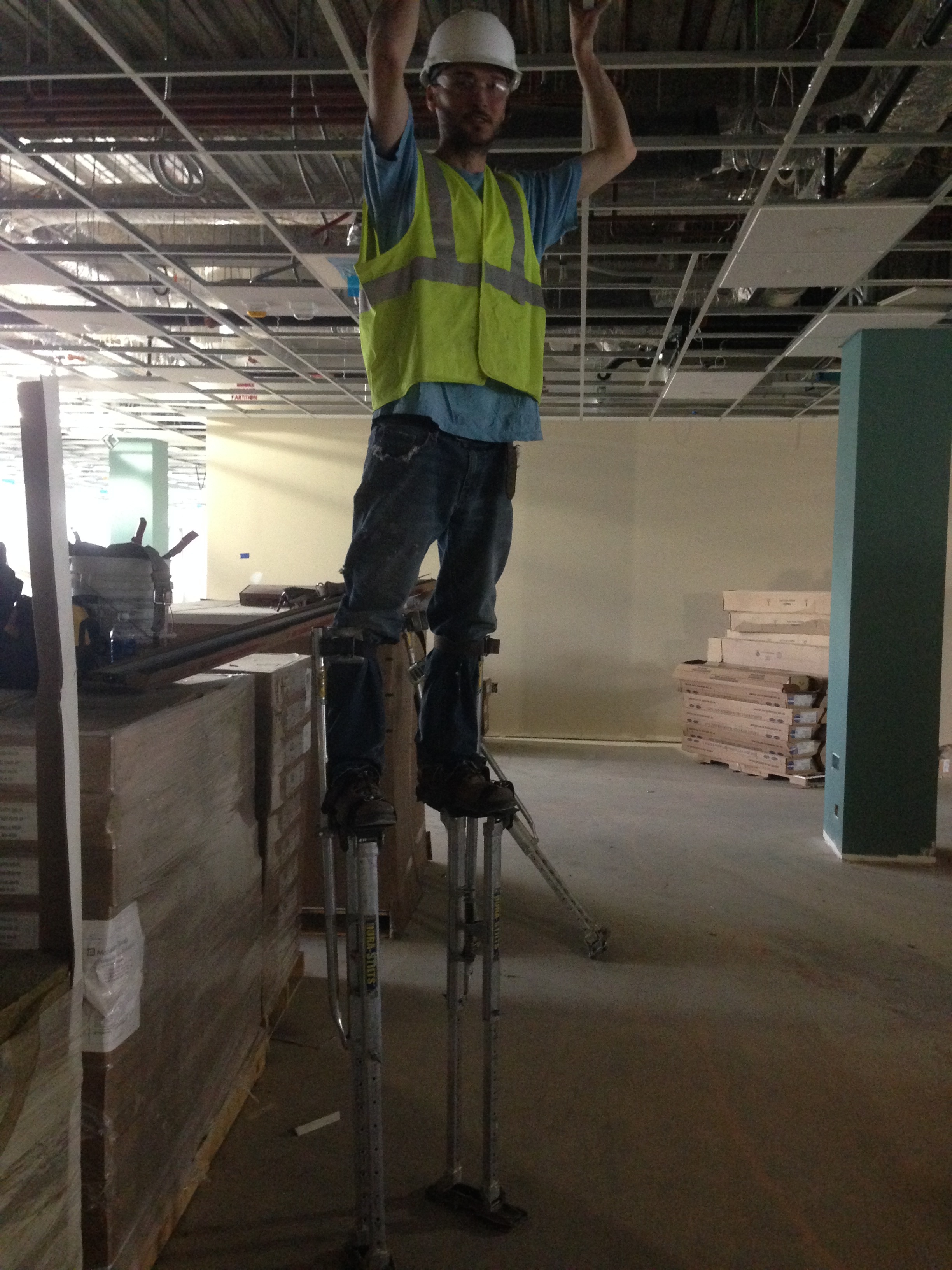
Entirely logical
On the safety front, 6ft is considered working at height and my friend here is about 4ft up. That said there isn’t a specified limit on stilt height in the USACE Health and Safety Manual, just a requirement to protect falls from them of more than 6ft with a guardrail at least 42 inches above stilt height. Therefore the limitation is based on realistic feasibility rather than rules. The USACE H&S Manual stipulates that people must be trained and competent as well as floors being clear of detritus so to me, properly implemented seems an entirely sensible idea.
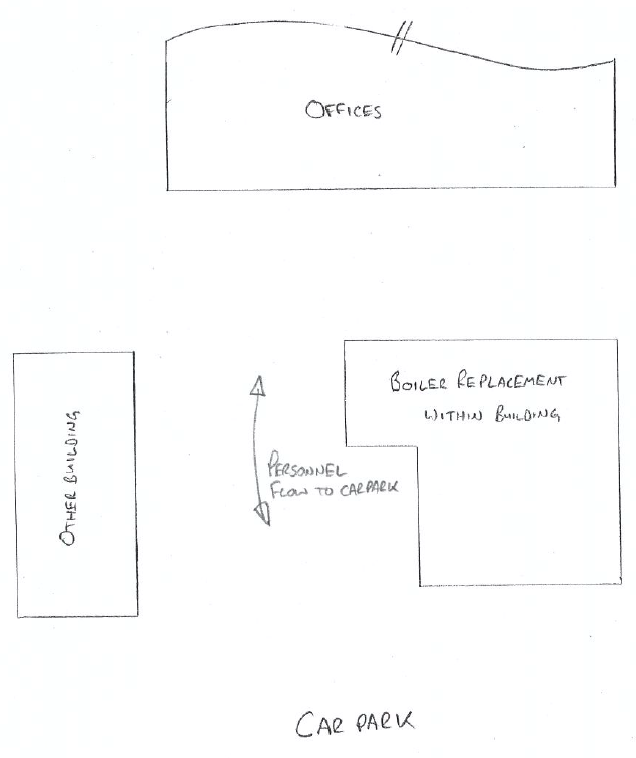
As the FIG site currently stands
Secondly, it is commonly known that people are simultaneously stupid, curious and lazy. Therefore it makes sense to fence construction sites to shepherd people into areas of safety and away from all the things that mean we require training, site briefings and PPE when we enter a site. Below are 4 very crude layout sketches of the Fort Indiantown Gap (FIG) boiler replacement site showing: the current site, the contractor’s ‘plan’, my plan and the compromised solution.
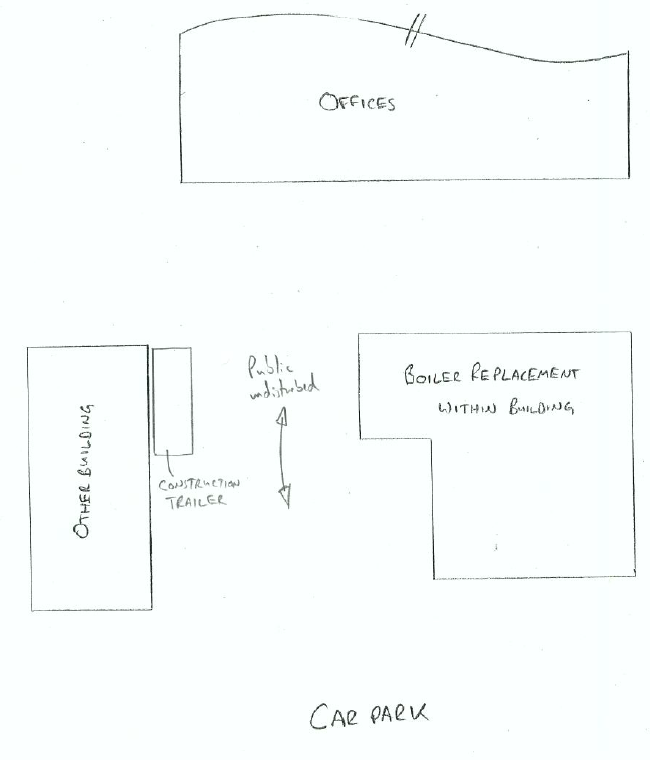
Their plan
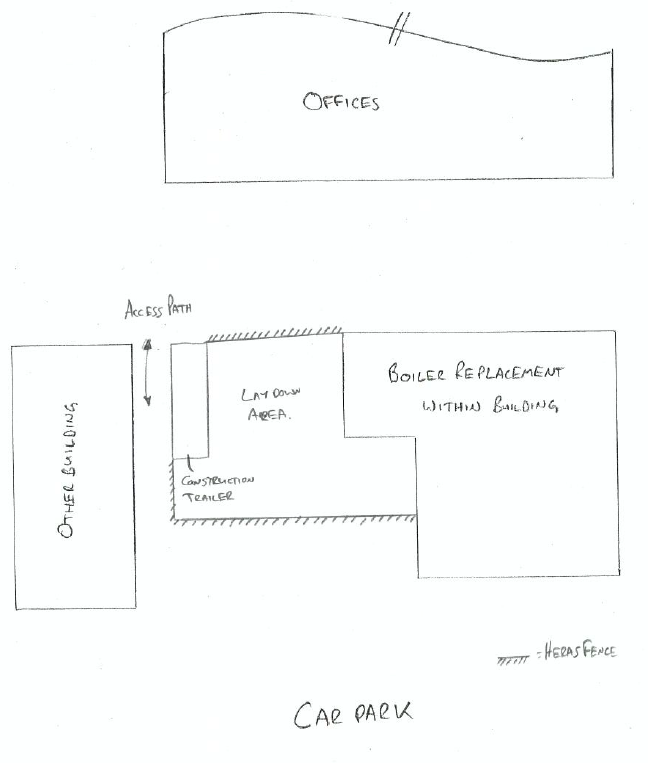
My Plan
The project is quite small and all of the actual engineering will take place inside the building, which is a plant room, so in terms of danger to the public it is not immense. However there will be deliveries, a lay down area and probably some work such as metal cutting done outside of the tight confines of the plant room. As people will, twice a day, walk to and from their cars through the site it seemed sensible to enclose the whole site with a fence to protect people from these dangers and themselves.
On a second level, we appeared to have different ideas of what a fence actually is. My idea of a fence is 8ft high Heras fencing, theirs a 42” high orange barrier fence which is analogous to mine tape at 42”. Whilst I admit it will stop most Americans, including the contractor’s quality manager, to me it still leaves the thought of shortcutting through site open for some people. On a small project like this overheads are clearly tight and there is an obvious cost differential I can understand the reasoning; however the cost of a single litigation event will not only dwarf that but the entire $500,000 contract value. A compromise was achieved and all of my visits will now involve a visual inspection of the fence.
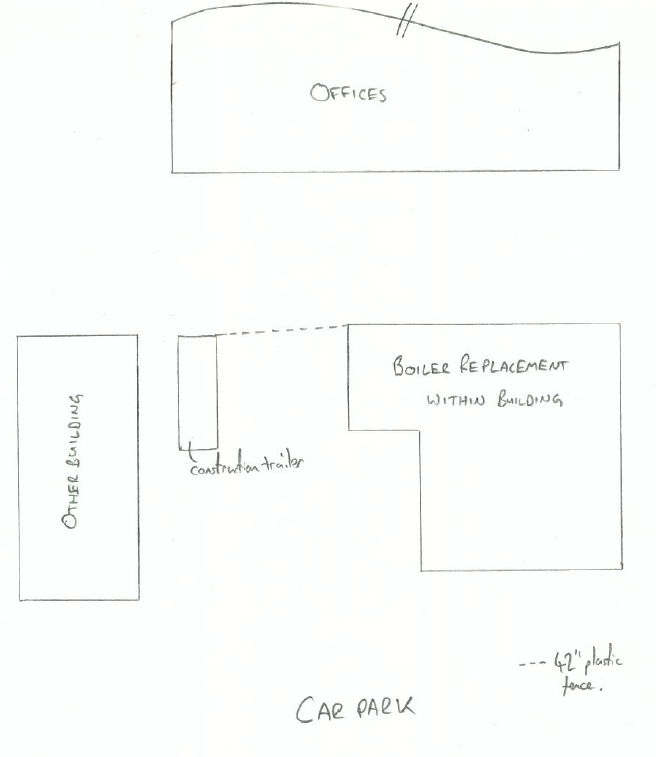
The ‘solution’
Finally, Brad, Danielle, Jo and I took the obligatory visit to Intercourse, primarily to be able to check in on Facebook and with the secondary aim of seeing some Amish people.
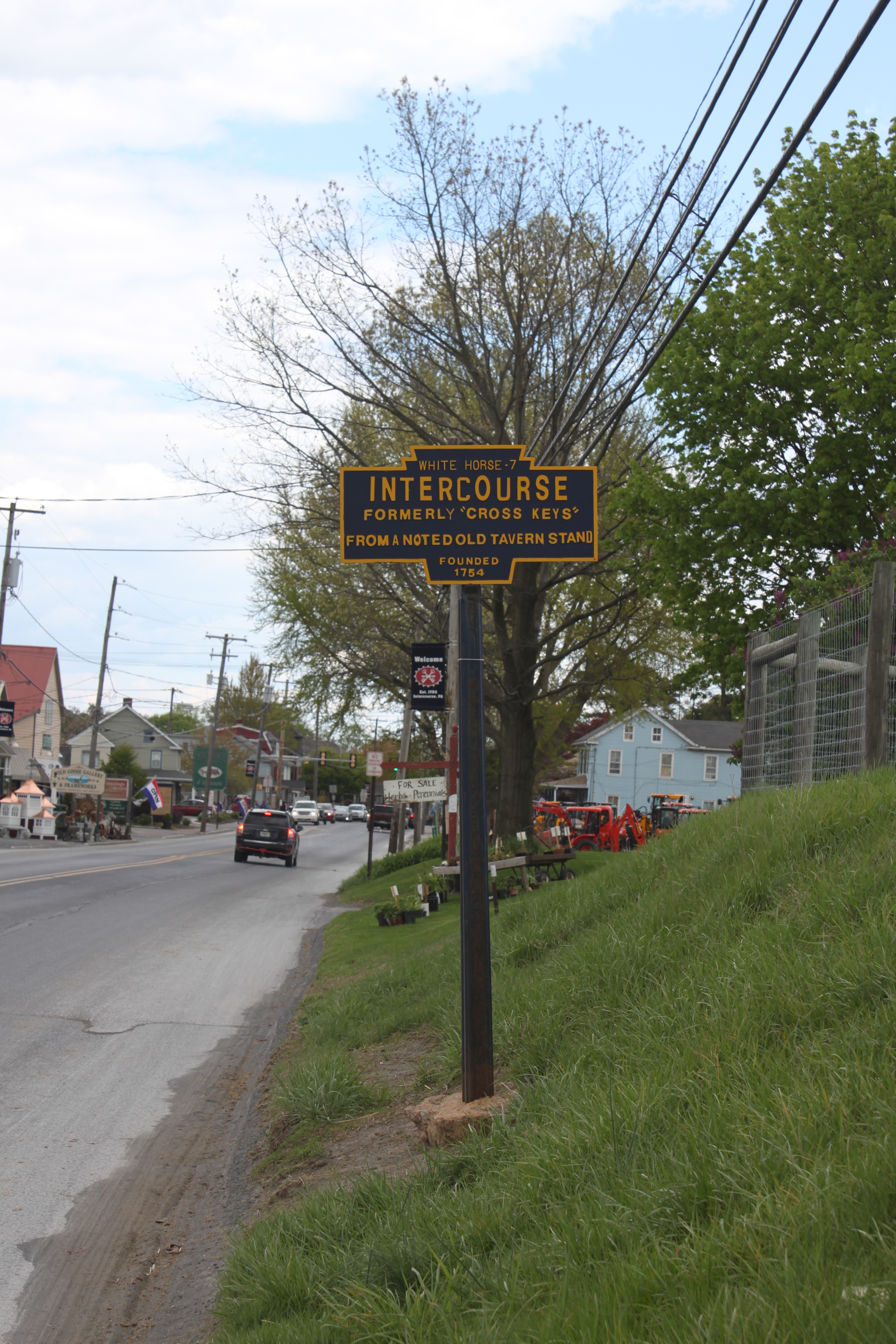
Cue childish sniggering
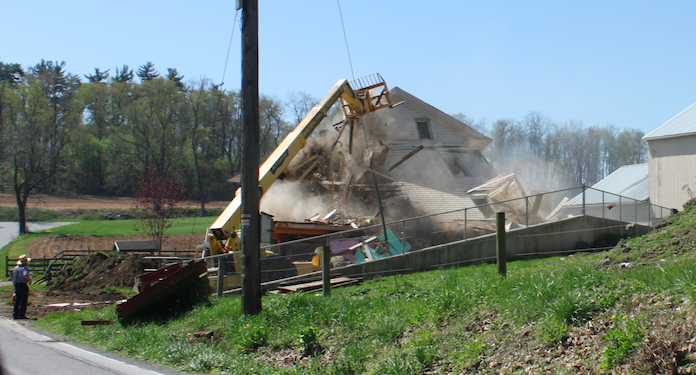
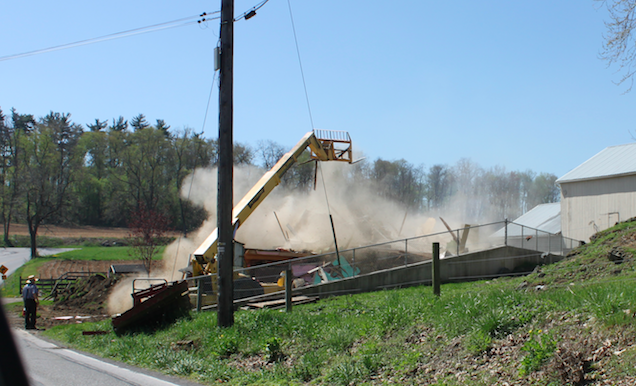
But, the learning never stops so behold our amazement at house demolition Amish style! It was clearly a big deal as there was quite a crowd, although I was quite disappointed by the looseness of their morals to be using a telehandler that clearly has electrical components, although barely. Apparently it is okay if it is ‘for business’.
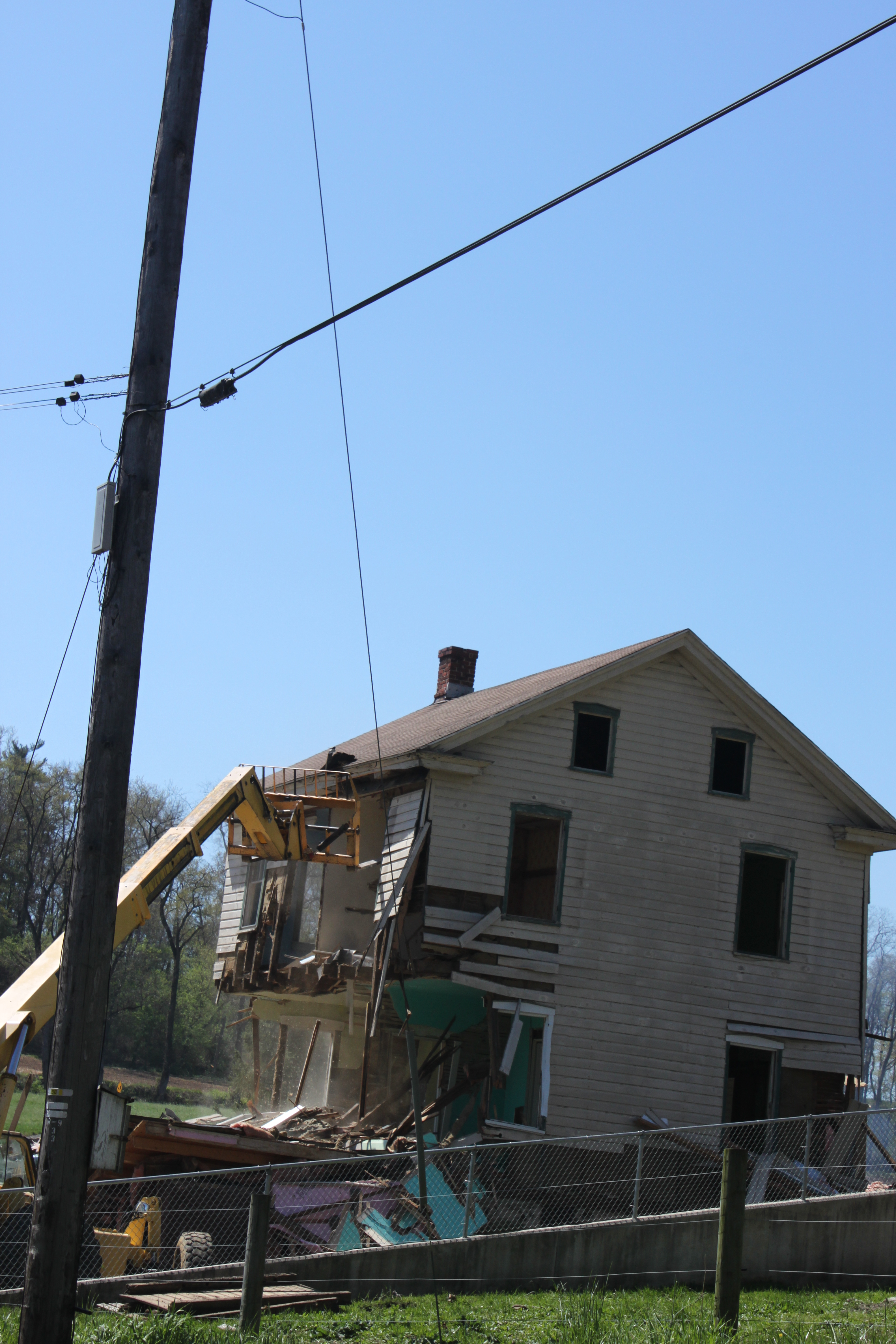
If only I could safely yet quickly take down this house
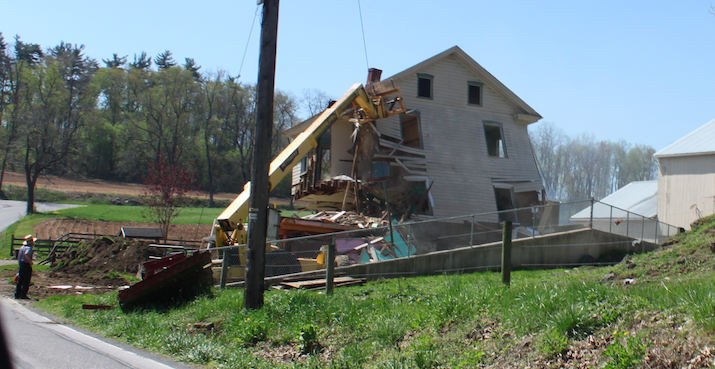
How about?
Looking good
All in a day’s work!
 Holdfast Training Services Trial Blog