Health and What?
Over the last week my main achievement has been getting into the USACE computer system and completing my extensive mandatory online training. As Howard and Brad will attest to, this is a significant achievement and through efficiencies the system has managed to ‘trim’ a week from Howard’s time.
In the mean time I have managed a bit of time on site and a few meetings, which have brought home to me the differences in the Health and Safety (H&S) cultures between our Nations. In the UK I would put myself firmly in the category of thinking we have maybe gone a little too far, however out here I am beginning to feel like a H&S fundamentalist. As yet I haven’t reconciled the reasoning, as it is in stark contrast to the incredibly litigious culture out here and so that may have to be a future blog. For now I will give a few examples:
Firstly I was just shocked by this entirely logical solution to working at height: stilts! They appear to be incredibly useful for fitting ceiling grid and both plastering and painting the tops of walls. They give the users freedom and flexibility to work and apparently are quite easy to get the hang of.
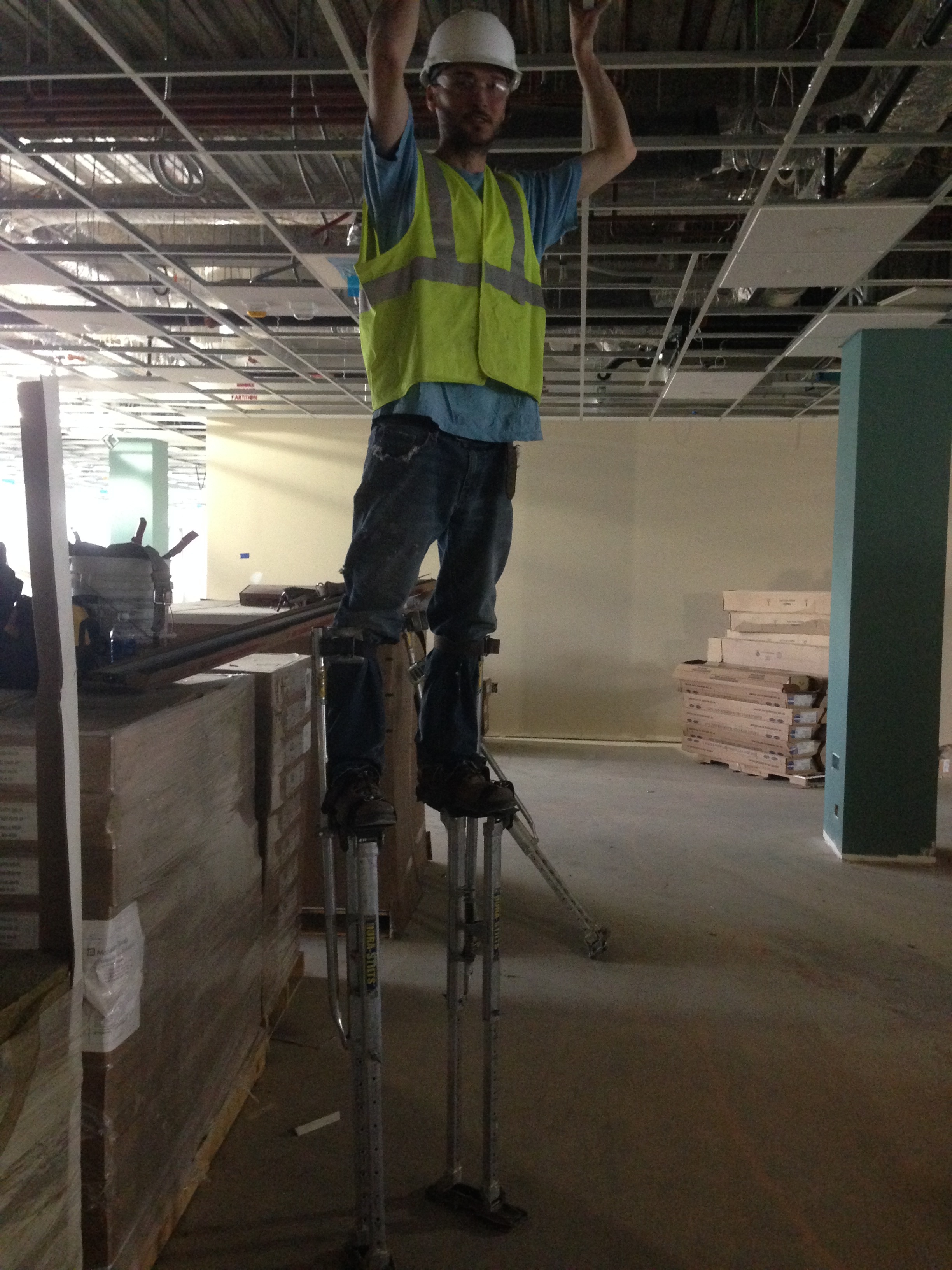
Entirely logical
On the safety front, 6ft is considered working at height and my friend here is about 4ft up. That said there isn’t a specified limit on stilt height in the USACE Health and Safety Manual, just a requirement to protect falls from them of more than 6ft with a guardrail at least 42 inches above stilt height. Therefore the limitation is based on realistic feasibility rather than rules. The USACE H&S Manual stipulates that people must be trained and competent as well as floors being clear of detritus so to me, properly implemented seems an entirely sensible idea.
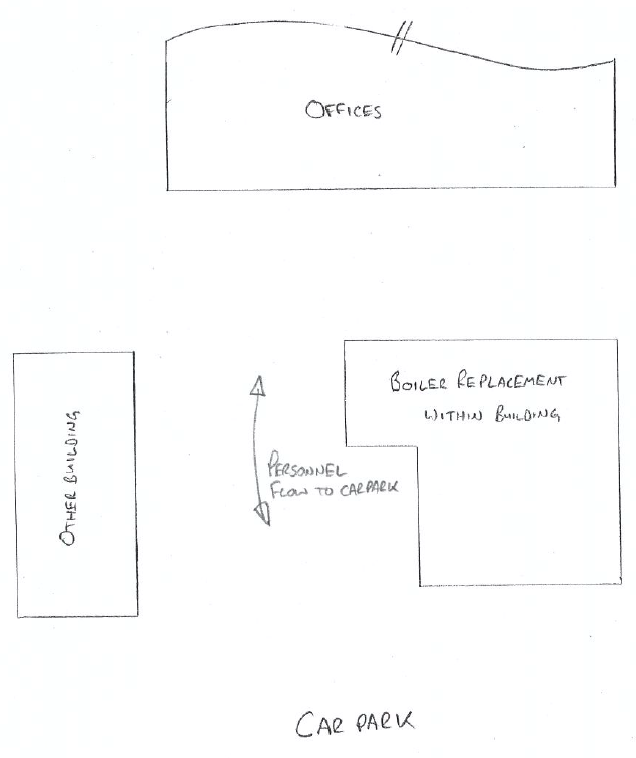
As the FIG site currently stands
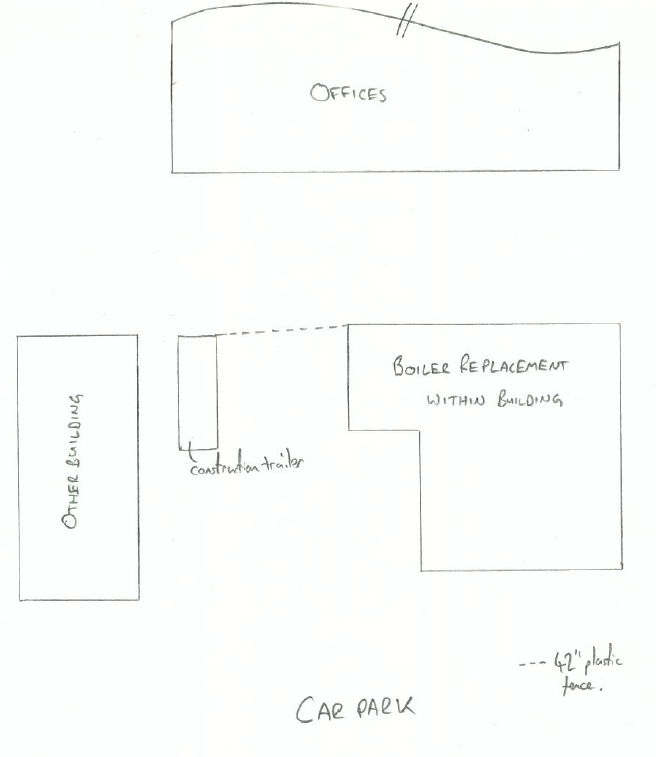
Secondly, it is commonly known that people are simultaneously stupid, curious and lazy. Therefore it makes sense to fence construction sites to shepherd people into areas of safety and away from all the things that mean we require training, site briefings and PPE when we enter a site. Below are 4 very crude layout sketches of the Fort Indiantown Gap (FIG) boiler replacement site showing: the current site, the contractor’s ‘plan’, my plan and the compromised solution.
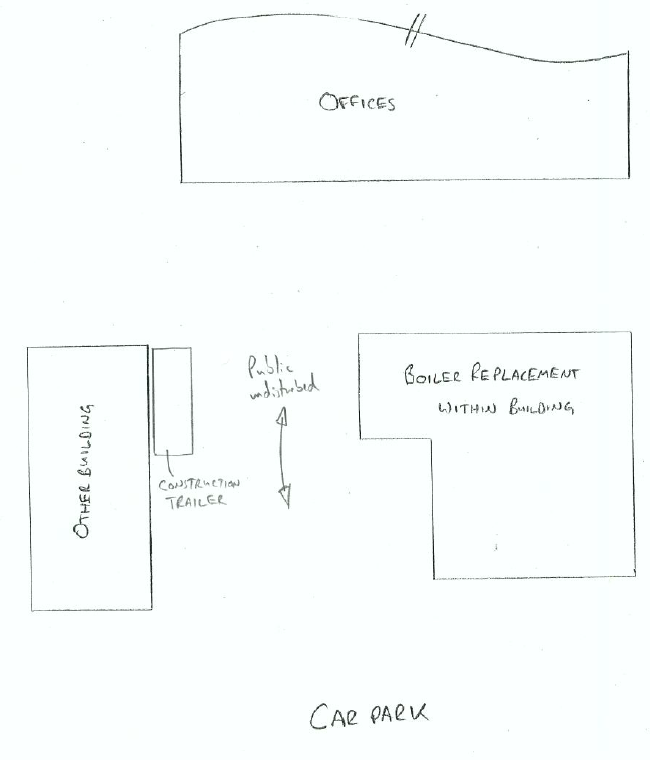
Their plan
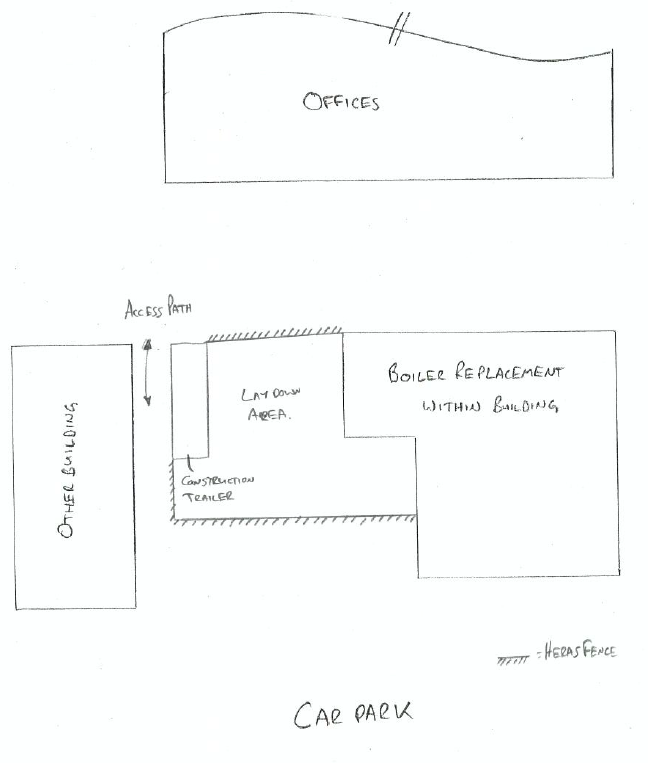
My Plan
The project is quite small and all of the actual engineering will take place inside the building, which is a plant room, so in terms of danger to the public it is not immense. However there will be deliveries, a lay down area and probably some work such as metal cutting done outside of the tight confines of the plant room. As people will, twice a day, walk to and from their cars through the site it seemed sensible to enclose the whole site with a fence to protect people from these dangers and themselves.
On a second level, we appeared to have different ideas of what a fence actually is. My idea of a fence is 8ft high Heras fencing, theirs a 42” high orange barrier fence which is analogous to mine tape at 42”. Whilst I admit it will stop most Americans, including the contractor’s quality manager, to me it still leaves the thought of shortcutting through site open for some people. On a small project like this overheads are clearly tight and there is an obvious cost differential I can understand the reasoning; however the cost of a single litigation event will not only dwarf that but the entire $500,000 contract value. A compromise was achieved and all of my visits will now involve a visual inspection of the fence.
The ‘solution’
Finally, Brad, Danielle, Jo and I took the obligatory visit to Intercourse, primarily to be able to check in on Facebook and with the secondary aim of seeing some Amish people.
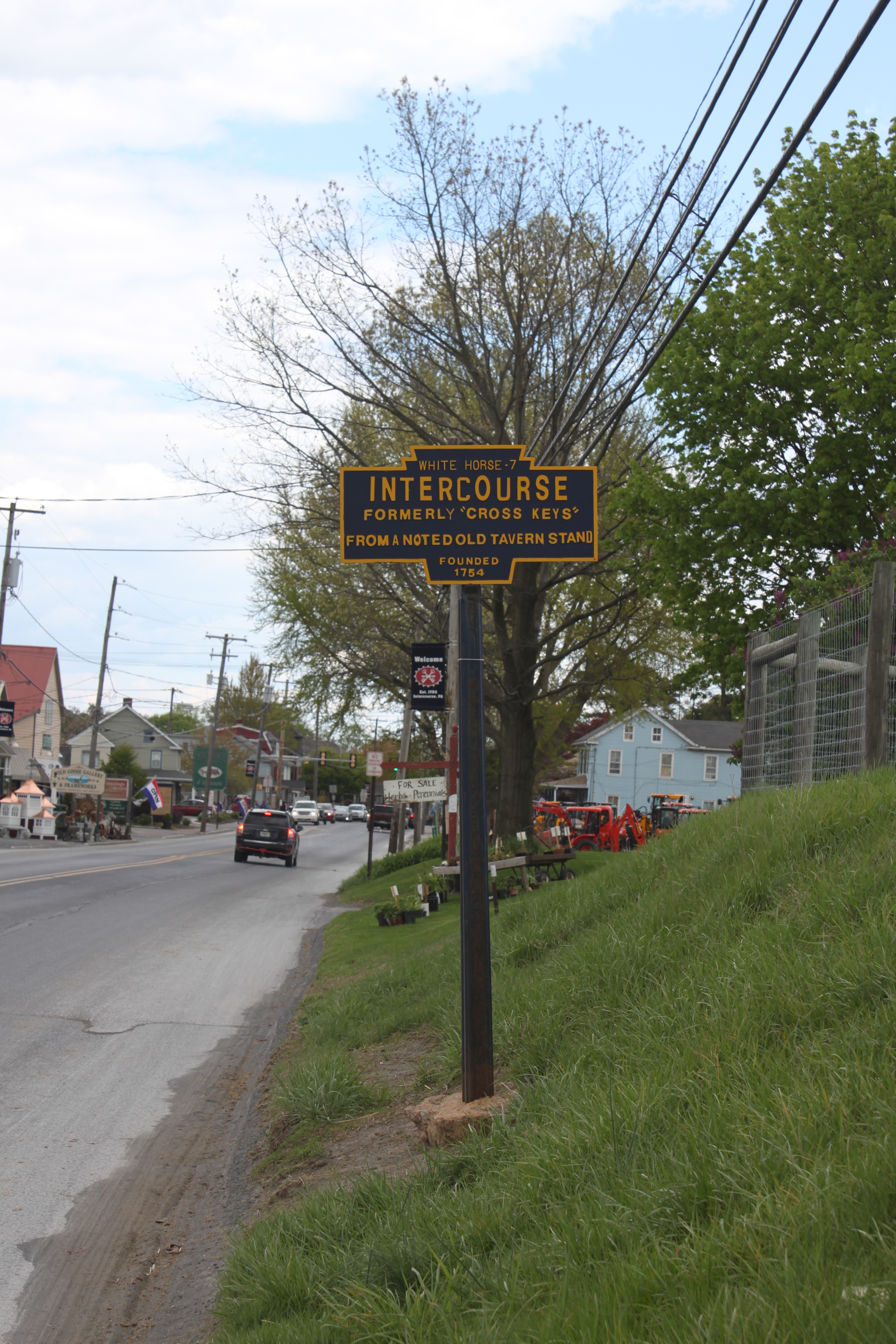
Cue childish sniggering
But, the learning never stops so behold our amazement at house demolition Amish style! It was clearly a big deal as there was quite a crowd, although I was quite disappointed by the looseness of their morals to be using a telehandler that clearly has electrical components, although barely. Apparently it is okay if it is ‘for business’.
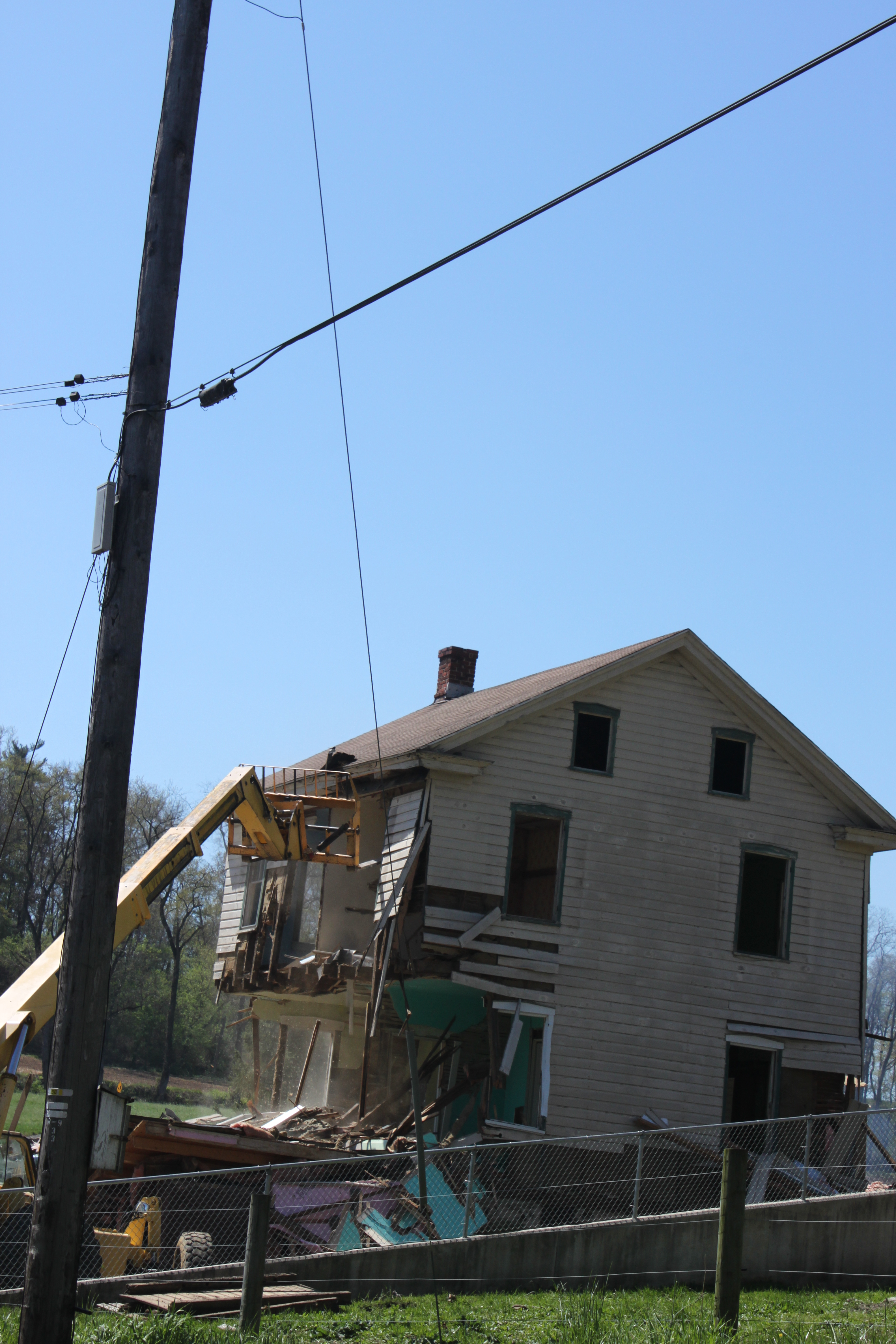
If only I could safely yet quickly take down this house
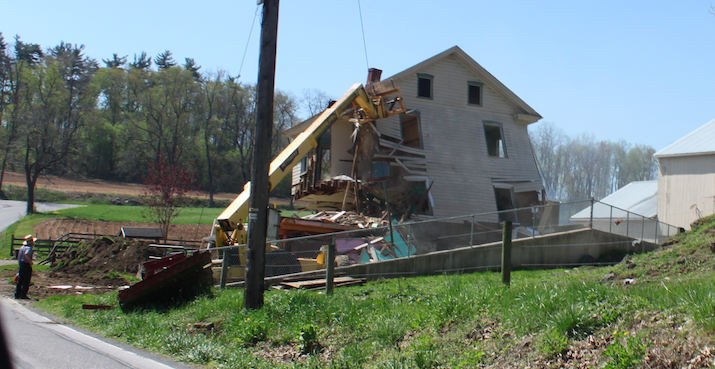
How about?
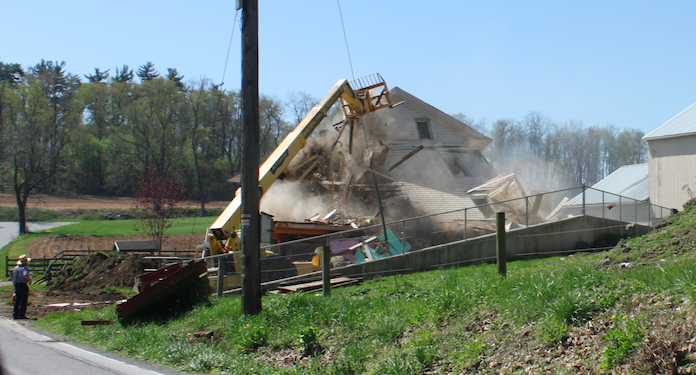
Looking good
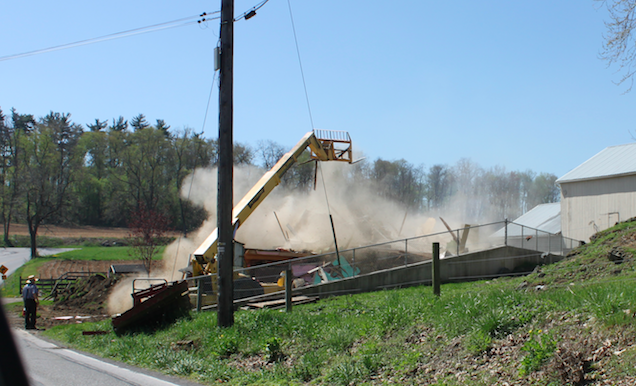
All in a day’s work!
 Holdfast Training Services Trial Blog
Henry,
Has anyone thought about additional safety actions like spray painting semi-permanent lines on the ground to act as walkways? Although not a physical barrier but we all know we’re creatures of habit and love a bid of order in our lives. It’s cheap, can be easily and quickly upgraded if required and more importantly shows intent to keep people safe. Clearly it depends on how much traffic transits the site; human or otherwise.
Fran,
Sorry I didn’t indicate but the traffic is all pedestrian. Whereas I agree traffic would adhere to lines on the ground I very much doubt pedestrians would. I think you would also be turning the tarmac into art attack to get your point across with little pedestrian silhouettes in order to get people to understand whereas a fence is a more obvious statement of intent. Spray paint signage might help as a supplement though and I’ll certainly think about it when we get underway.
Hi Brad,
I am currently working on a design for Montserrat in the Caribbean, and although this is a UK Overseas Territory, it works in Feet and Inches. The issue is that my draftie can’t seem to find the Feet & Inches button for dimensions (Just Feet OR Inches). What do they do out West?
Many thanks
Nik
Or Henry…..
Nik,
Having investigated this I am afraid the answer isn’t too encouraging. Essentially they mix up feet and inches just as we would in the UK when talking about dimensions in casual conversation. For things like pipework inches rule but if you are coming to the scale of something such as a door frame then a mixture is used. When going smaller than an inch fractions tend to be the way forward. There are standards somewhere (ASME I believe) but IT issues are preventing me opening them.
If the problem is CAD software the only suggestions I could offer would be: if you put in FEET mode does the remainder not come out as inches? or is there a U.S. mode somewhere deeper in the settings.
As I’m sure you’re aware, the issue with just sacking it off and going metric is going to be in the specifying and supply of material as local materials will be in imperial.
Henry
PS. My office number is +1 717 770 7312
Thanks pal. I’ll have a chat with the CAD-Monkey’s.
Nik, a late pick up on this one. The USACE design office actually has two seperate CAD programmes – for CAD Civil-3D that is. One being ‘Civil 3D imperial’ and the other ‘Civil 3D Metric’. Which might explain your problems if you have the metric version!?