Archive
More Bent Stuff
This weeks thrilling instalment follows on (inadvertently) the theme set by Guz and Olly. Apparently.
I have just completed my transition week, which now sees me as a Project Engineer out of an Area Office (a more familiar construct for those who have been / are in the US) working on two projects and also minor obligation back to the PM and PrM Office running the contract I have set up. As will be usual for most I had to undergo a site safety induction, ran by the principle contractor of the site on which I will be spending most time. With reference to mine and Henry’s last comments; the brief was actually fairly impressive and many of the standards that are in place are similar to those I experienced in the UK, with a few exceptions (so far – The rickety ladder of doom, no requirement for banksmen for reversing vehicles, gloves optional unless doing specific tasks)
Site itself is fairly dynamic and its not unusual for it to be almost unrecognisable from one visit to the next, particularly with concrete pours; movement of fill material from one area to the next to facilitate access; creation of new haul roads etc. This will only become more disorienting with the award of, now, two new jobs on what is already a complicated and congested site. An area that I am tracking is the interface between two projects, one of which is responsible for the placement of services and utilities in an area which falls within the new project’s Limit of Disturbance (LOD – AKA a boundary). This is an interesting issue because there was a change order submitted to accelerate the placement of the utilities months ago, however this was cancelled when the schedule for the new work was reviewed and it was seen that no work was going to take place until after the utilities were originally scheduled to be placed anyway. So, a requirement was included in the contract for the two Principle Contractors to de-conflict activities where there were pinch points in LODs. There are now mutterings however that the principle contractor on the new job (who is apparently very savvy when it comes to working with the government) is expected to submit claims to the government due to a change in site conditions, which precludes him from going into an area that he doesn’t intend to go into anyway. Good!
On a more real time issue, myself and another Project Engineer inspected a deficiency yesterday on a basement structural RC beam. It is still propped and not fully load bearing yet however there is a large crack running pretty much the length of the beam (c.3.5m) which varies from around 300mm wide in places to c. 50mm and is deep enough to expose the reinforcement. (For Damo’s amusement I have attached a Sketch)
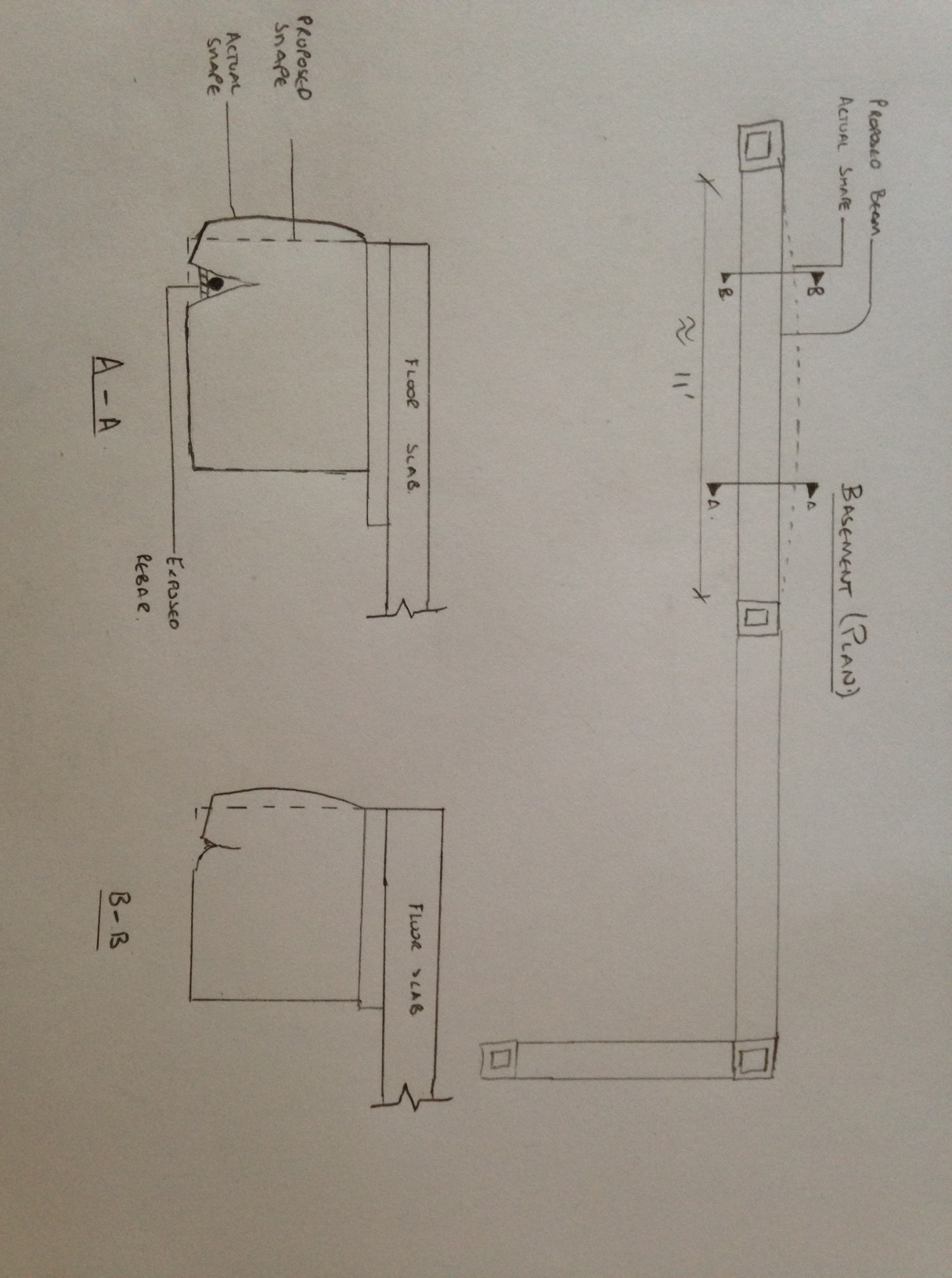
There is significant bowing to one side of the beam which seems to indicate that the formwork has failed which has allowed concrete to pour onto the floor below and caused the deformation of the beam. The deficiency has been highlighted to the designer for inspection and comment. I expect that there will be a requirement to chip away the majority of the side of the beam where the deficiency is and either replace the concrete around the existing pour as is, or epoxy some steel dowels (form savers or similar) and replace the concrete. There may be some practicality issues with this solution as the beam is obviously supposed to be flush with the floor slab.
Other ‘interesting things’ I have seen:
- Mixing of red dye into concrete surrounding some electrical utilities so that any future workers will be able to identify what they are potentially about to dig through. I thought this was ingenious – is it common practice: have I just completely shown myself up?!
- The way that schedule changes affect the engineering of a job. The basement slab has not yet been poured due to weather delays and a desire to get out of the ground. Therefore the basement walls (essentially now cantilevered) have been extended in order to resist the moment imposed due to the active lateral earth pressure
- The utility of a road traffic sign (presumed stolen) as part of some pretty sketchy looking formwork. It was only a pour below knee level or so, and was not structural.
- An excavator, almost excavating under itself as it sat atop some fill material, which was clearly exhibiting signs of face slippage. I highlighted this to the Engineer I was with (Geotechnical background) but he didn’t seem bothered. Apparently if the Operator were to ‘feel it going’ he would simply put his bucket down to the ground. ‘They’re pretty quick off the mark with those buckets.’ Good to know.
- Slump testing concrete at point of arrival and point of placement. There was a bit of pushback when this was spotted in the specification from the designer, however they would not budge. Personally I can see the utility for pumped pours where some slump is gained after pumping. For one, any sub-standard batches are caught before the pumping begins, for two, any batches that are close to the limit (4”-8” in this case) at delivery can be verified at placement and the requirement to return a batch ‘just to be on the safe side’ is mitigated. This is important where timing is critical, especially on larger pours, when the formation of cold joints in the slab is a potential issue. (seen before on the site)
- Construction sequence affecting design – whereby holes have been left in the first floor slab to allow for stores to be lowered into the basement at a later date when the basement slab is eventually poured. This has meant additional reinforcement requirements at the corners and the placement of form savers to allow rebar to be placed across the void at a later date (screwed in) to allow continuity. Also – similar gap exists adjacent where the tower crane currently sits.
I also attended a webinar event ran by the NCE titled ‘Building the Age of Resilience.’ It pretty much took the form of plugging the following product (which I have never heard of) : www.globalcalculator.org
From what I can gather this tool enables the user to postulate future global scenarios of energy requirements, industrial output, global consumption of meat, fuels and goods etc and simulate the effects on global temperature. This video https://www.youtube.com/watch?v=2_6flonHN0o is a brief tutorial on how to use the tool but it’s fairly self-explanatory. From what I can gather unless you are the CEO of a company trying to assess some strategic direction, or the Prime Minister then it’s really just an interest thing, but it is actually, sadly, quite interesting! I guess if you are trying to assess the future impact of a single project you could potentially (at the concept stage) adjust a single ‘lever’ and see if the economic impact to the project is worth the engineering effort? Perhaps.
Pile Collapse
The west abutment piles (8No, 900mm dia, 40m deep) are now complete and passed the working load test with ease. We are now in the process of blinding the area to create a working platform prior to integrity testing the piles tomorrow.
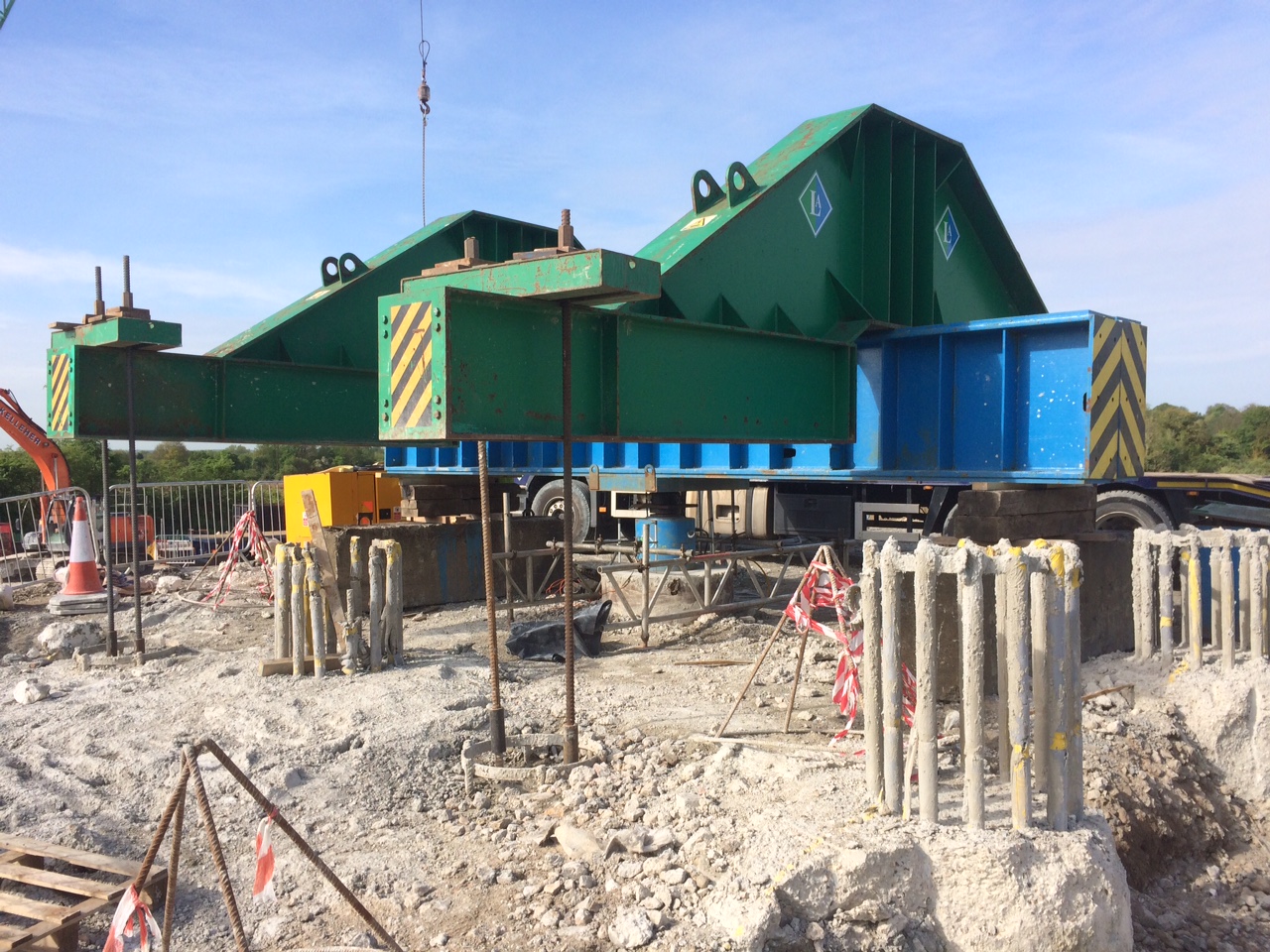
West Abutment Pile Test
The west cofferdam is complete. The excavation turned out to be more complex than we anticipated and caused numerous problems. Eventually we managed to dig to depth and blind without having to fit the intended lower waling. The top of the sheet pile walls have been capped and a UB panel roof has been fitted. The 80tn piling rig now sits on top of this and bores through the open cofferdam and into the ground below. A piling case gate has been fabricated to stabilise the case above ground level and help locate it whilst being lowered.
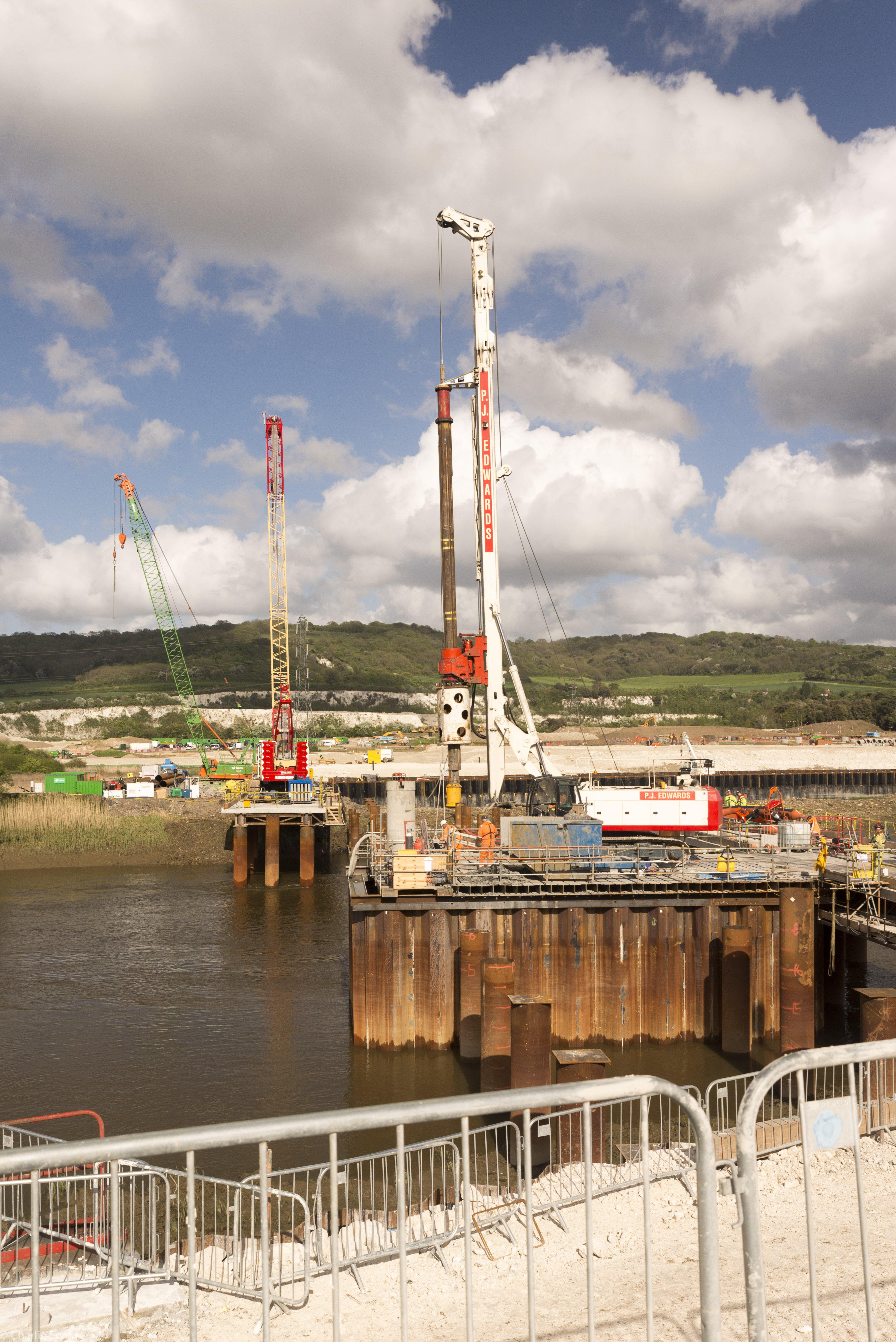
80tn Rig on Cofferdam. This is the most unusual place the Piling Foreman has piled in 30 years
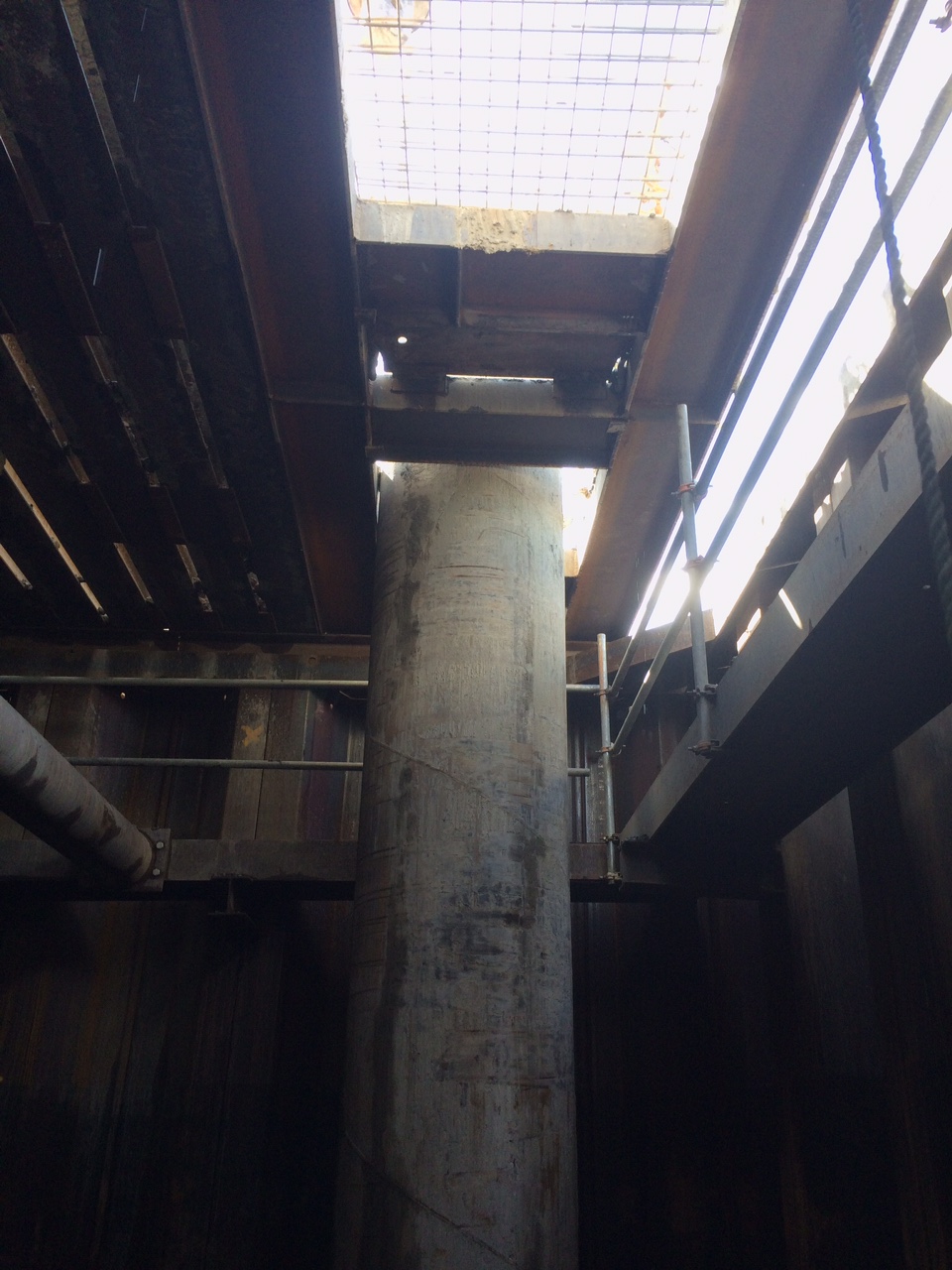
Piling gate and pile casing.
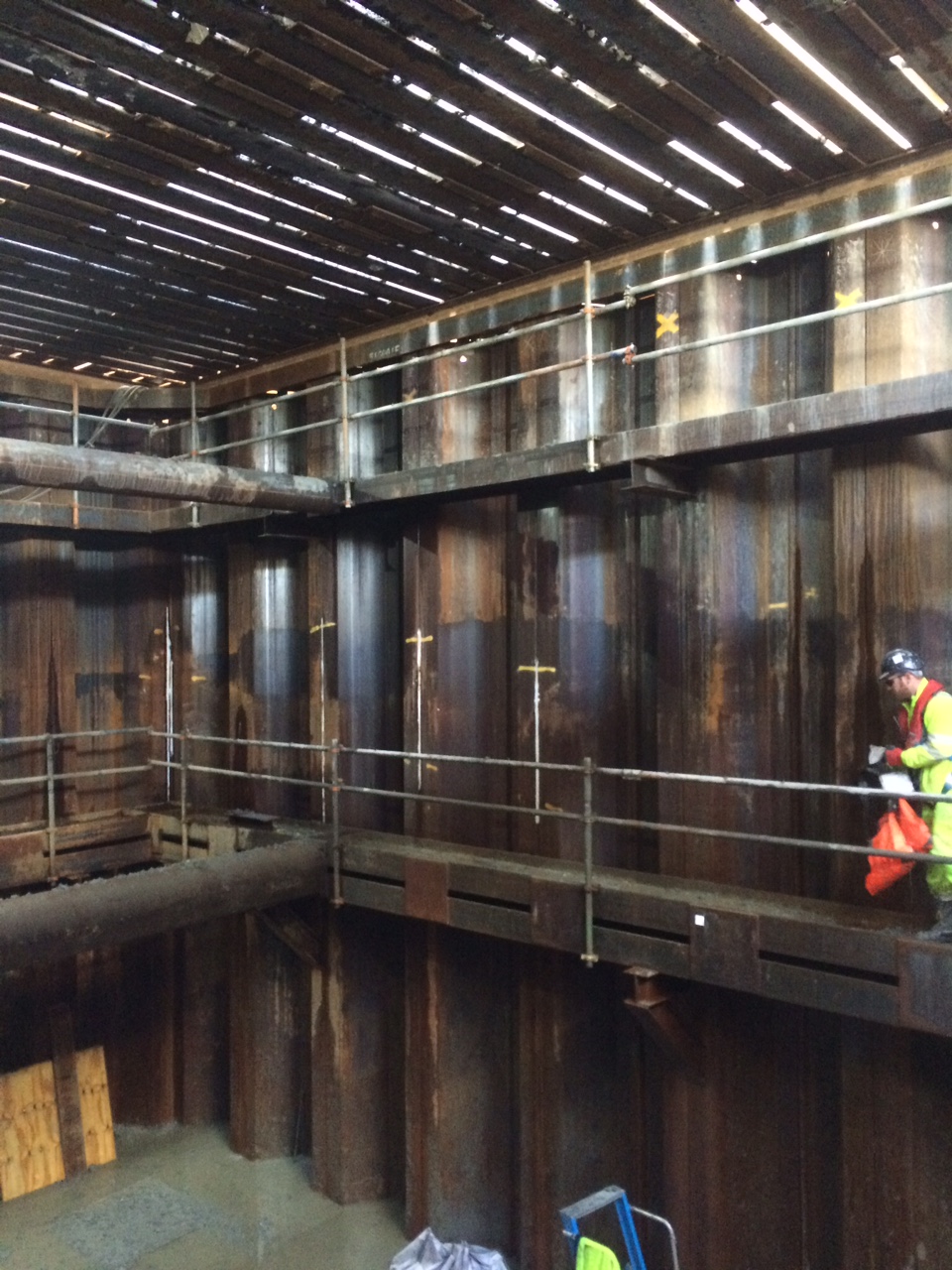
Inside the west dam with the rig above.
The casing starts 1m above the deck and drops 8m through open space and a further 5m into the ground of which 3m is toed into dense clay. The first problem this throws up is that the pilers can’t see the ground level down the shaft, to resolve this issue they have cut a window in the casing above ground level that they can look through from the base of the cofferdam. This window also acts as a water escape when the concrete is being poured allowing us to capture the spill in the dam. It also allows us to monitor the concrete to ensure we are not over filling and creating a large mess (7m3) when the case is pulled.
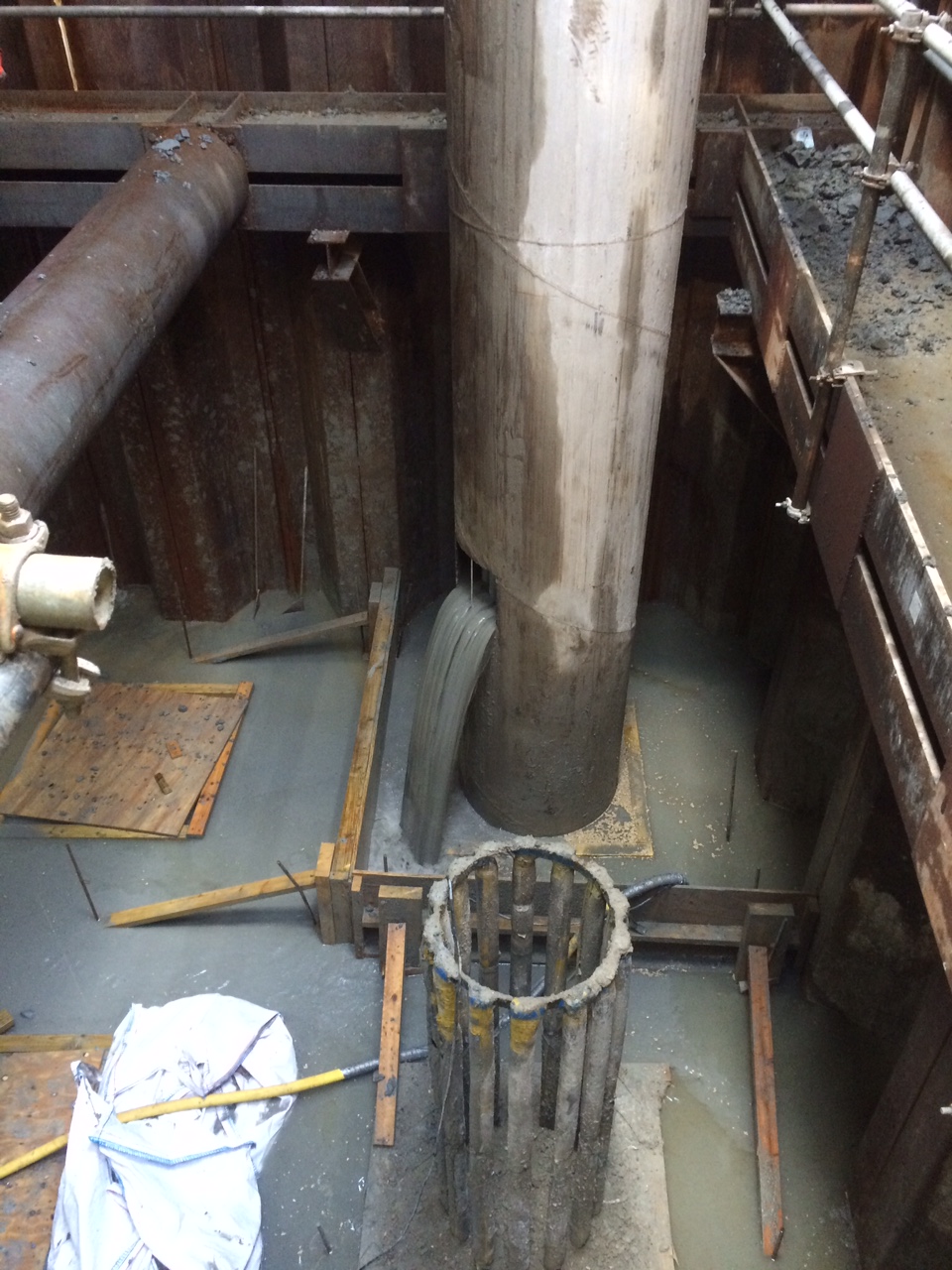
Pile casing with window during a pour. Excess concrete is kept within the simple shutter and cleared up by hand 12 hours after a pour.
Working on top of the cofferdam has caused a few logistical problems, there is no space to store any equipment and the spoil has to be spun off in to a skip and then craned on to the land which slows the whole operation.
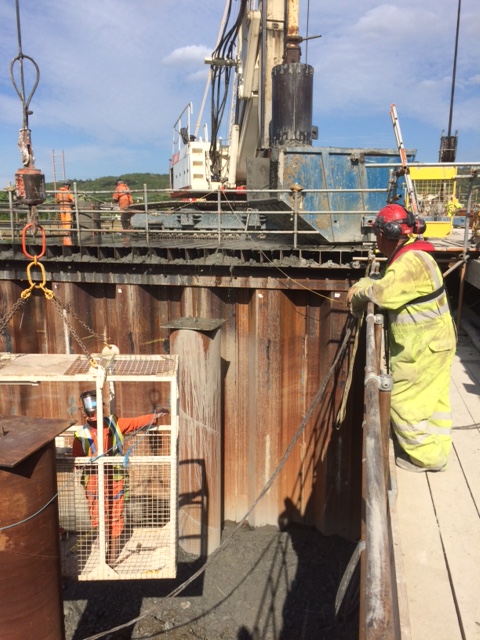
Bore spoil is spun in to a tipper skip. Note this is not an accurate process and we lose some over the edge which has to be recovered.
All has been going well and we are completing them at a rate of one a day, until…TODAY!
The piling gang are on a fixed price contract and are clearly keen to get the job done and move on. They asked last week whether they could auger out at the end of a day and then concrete the following morning. This is outside of the 12 hours that is permitted to leave a bore open. On Tuesday approval was granted that this could be done under strict rules:
- 12-24 hrs open – increase the depth and cage length 1m
- 24-36 hrs open – increase the depth and cage length 2m
- 36-48 hrs open – increase the depth and cage length 6m
These rules were issued by the piling designer and based on 10% reduction in shaft resistance per 12 hours. When question on the 10% reduction they simply responded with ‘it’s over designed to negate any risk’. This makes perfect sense, as any decision to leave a bore open would be with the piling contractor and as such any increased cost in materials, time and risk would all sit with him, not us or the designer.
That same day (Tuesday) the rig broke down just after they have reached full depth. By the time the rig was fixed (Wednesday) and it had got back on task, cleaned out the shaft and augured out the extra 1m (rule 1) they had missed the concrete window and had to leave the shaft open again overnight.
When they came in this morning (Thursday) they found that the 43m shaft was now only c.20m. Due to the casing they are unable to see what has collapsed. We are currently pumping 10kN concrete in to a hole with no real idea where it is going or how much of it we will need to cap it off.
So what…
We must now treat that area as unstable and move the piling operation to the other side of the cofferdam and work back towards it. The pile designer has been briefed and will now carry out a redesign of the failed pile. We expect them to either design a number of smaller piles to be placed around the failed one or to insist we re-auger in the same location though the low strength concrete. We are unsure how wide the collapse area is and whether it has affected the existing piles or fresh ground that we are due to pile through in the coming days. Either way the replacement pile/piles will require full casing to depth which will increase the duration of the job.
In other news…
we bent a waling!!!
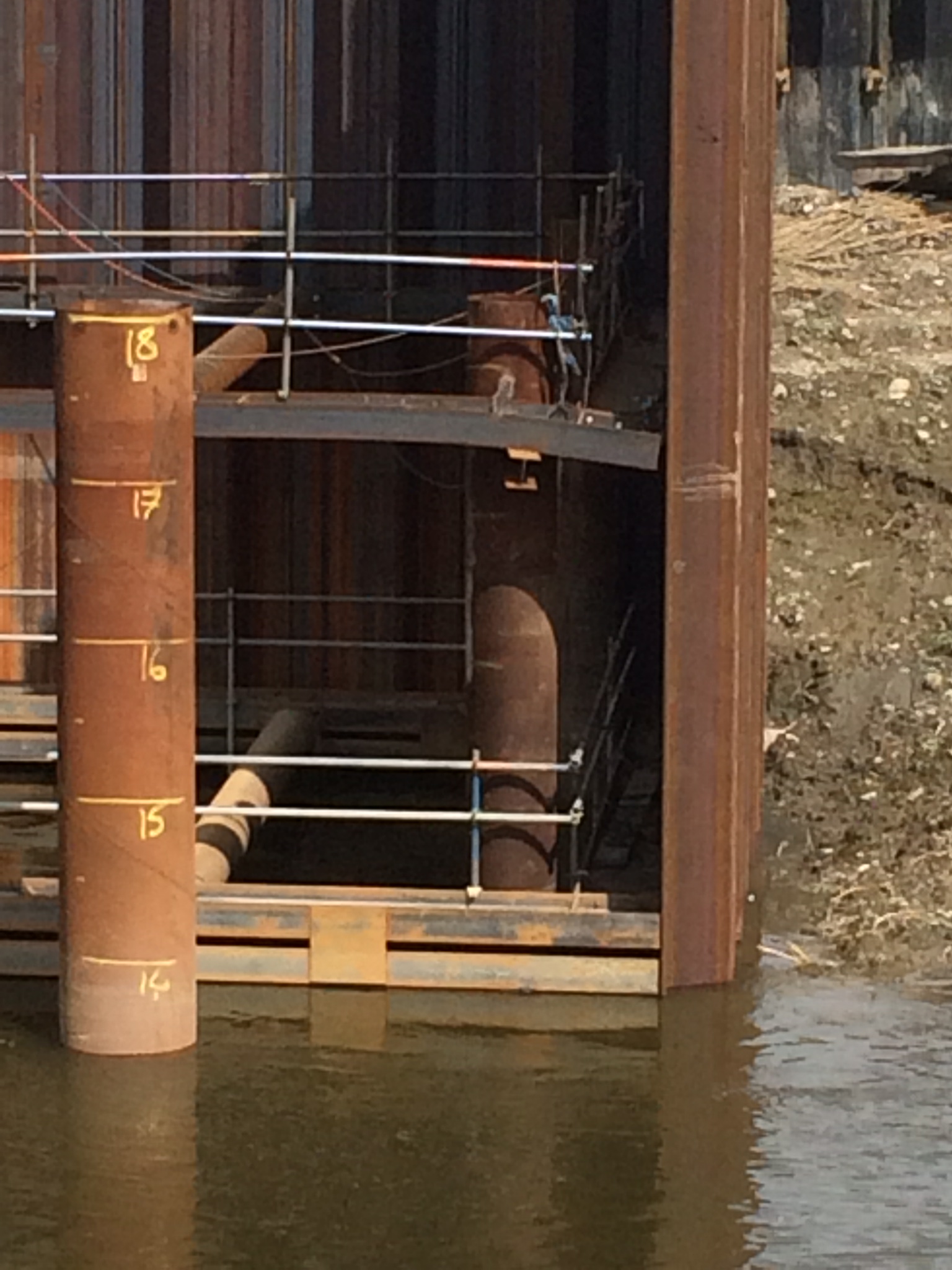
Sheet pile was stood unslung in 3m of alluvium which has a Cu of about -15!!! When the vibro was lowered on it pushed the pile which sank immediately and dragged the waling with it!
Bent stuff
It’s been a couple of weeks since my last blog thanks to TMR 1 consuming my time and then I was away for a week.
Life on site has been interesting…
Yesterday a man got 5 minutes into the induction before asking for written, signed confirmation that if PC Harrington go under (which they have), Sir Robert McAlpine will pay him. We couldn’t offer that, so he left.
On a slightly more technical note I have spent most of today trying to work out if the sheer pile wall will fall down if I take a corner prop out. The prop is really bent. It was hit by an excavator during the dig. It’s meant to be straight and connected to the capping beam each side by a plate and some fairly serious bolts. Since the beam is as bent as it is, I think that it’s load bearing capacity will have been severely reduced. Which temporary works are designed to withstand impacts, this was a big one. Look at the deflection! Additionally it would appear to have lifted away from the capping beam at each end, so isn’t in proper contact anyway. Also the inclinometers, prisms and google maps so no movement on the sheet pile walls. So I think it isn’t really carrying any load. However I can’t prove it. And without an ability to prove it, no one will take the risk on taking it out.
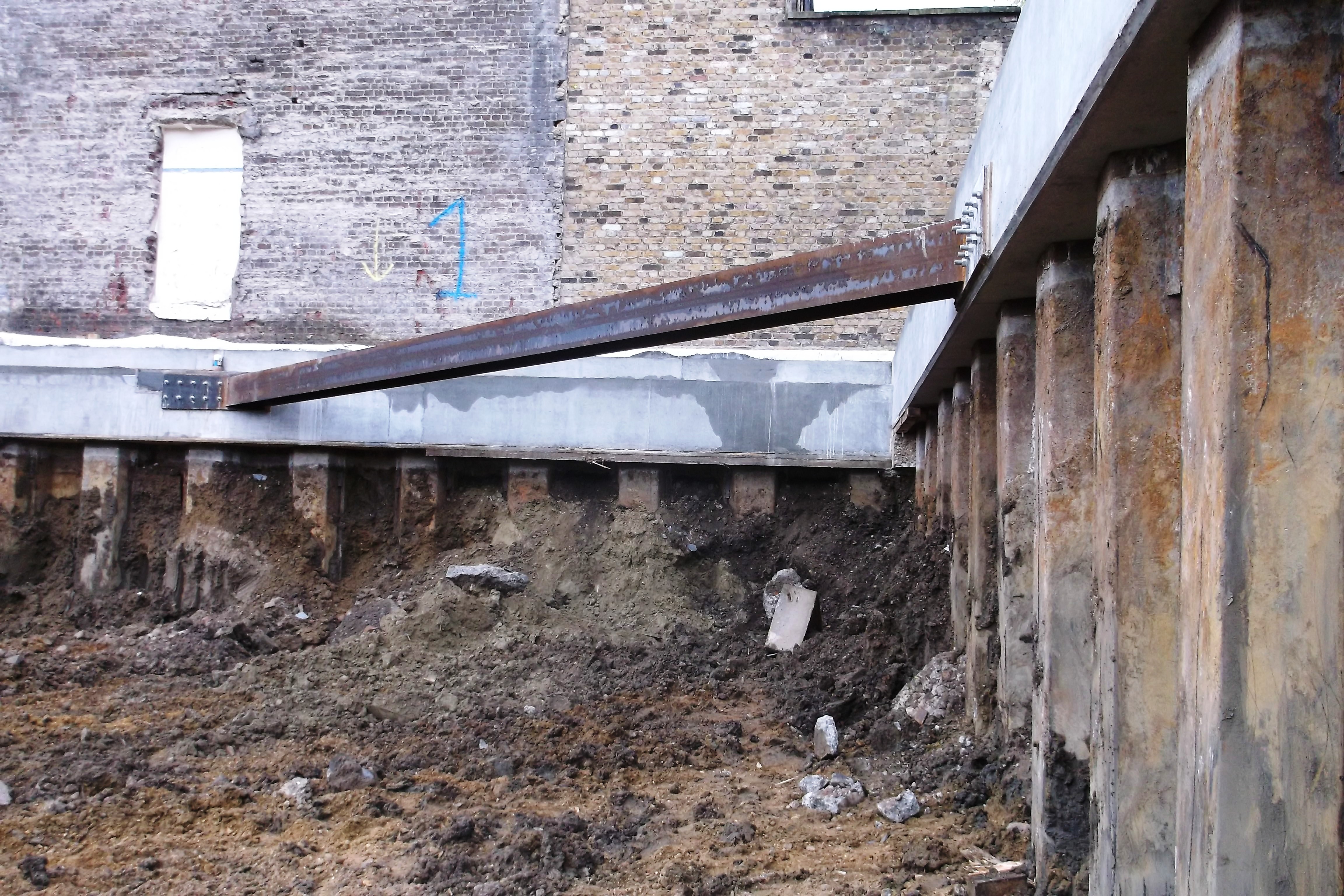
Beam as installed
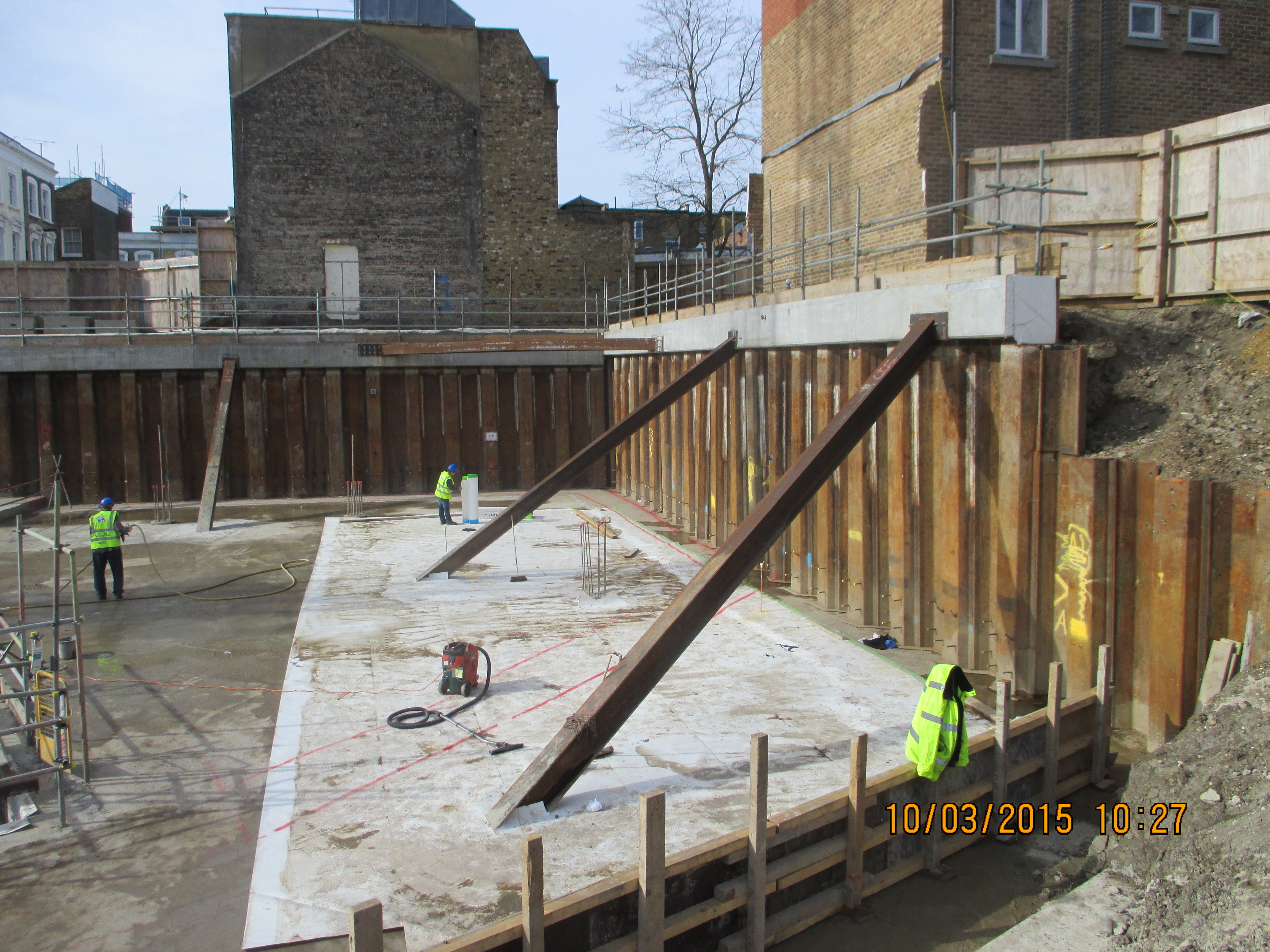
Beam post strike
So instead the subcontractor will be required I box around the beam. Wait for the concrete to cure enough and then allow the slab to take the strain before the beam can be removed.
In other news we’ve just changed caterers in the canteen and the lunch menu has significantly improved!

 Holdfast Training Services Trial Blog