More Bent Stuff
This weeks thrilling instalment follows on (inadvertently) the theme set by Guz and Olly. Apparently.
I have just completed my transition week, which now sees me as a Project Engineer out of an Area Office (a more familiar construct for those who have been / are in the US) working on two projects and also minor obligation back to the PM and PrM Office running the contract I have set up. As will be usual for most I had to undergo a site safety induction, ran by the principle contractor of the site on which I will be spending most time. With reference to mine and Henry’s last comments; the brief was actually fairly impressive and many of the standards that are in place are similar to those I experienced in the UK, with a few exceptions (so far – The rickety ladder of doom, no requirement for banksmen for reversing vehicles, gloves optional unless doing specific tasks)
Site itself is fairly dynamic and its not unusual for it to be almost unrecognisable from one visit to the next, particularly with concrete pours; movement of fill material from one area to the next to facilitate access; creation of new haul roads etc. This will only become more disorienting with the award of, now, two new jobs on what is already a complicated and congested site. An area that I am tracking is the interface between two projects, one of which is responsible for the placement of services and utilities in an area which falls within the new project’s Limit of Disturbance (LOD – AKA a boundary). This is an interesting issue because there was a change order submitted to accelerate the placement of the utilities months ago, however this was cancelled when the schedule for the new work was reviewed and it was seen that no work was going to take place until after the utilities were originally scheduled to be placed anyway. So, a requirement was included in the contract for the two Principle Contractors to de-conflict activities where there were pinch points in LODs. There are now mutterings however that the principle contractor on the new job (who is apparently very savvy when it comes to working with the government) is expected to submit claims to the government due to a change in site conditions, which precludes him from going into an area that he doesn’t intend to go into anyway. Good!
On a more real time issue, myself and another Project Engineer inspected a deficiency yesterday on a basement structural RC beam. It is still propped and not fully load bearing yet however there is a large crack running pretty much the length of the beam (c.3.5m) which varies from around 300mm wide in places to c. 50mm and is deep enough to expose the reinforcement. (For Damo’s amusement I have attached a Sketch)
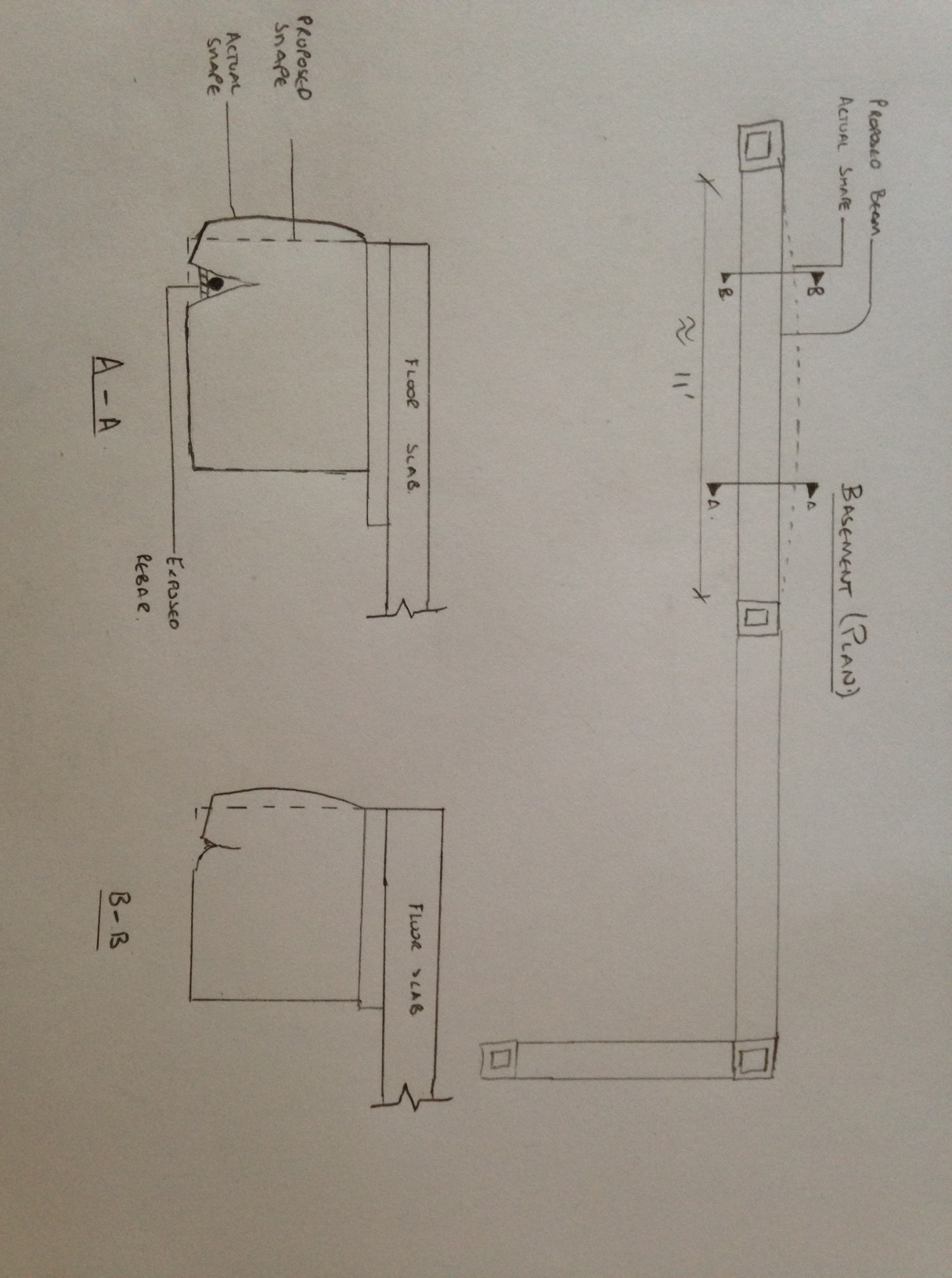
There is significant bowing to one side of the beam which seems to indicate that the formwork has failed which has allowed concrete to pour onto the floor below and caused the deformation of the beam. The deficiency has been highlighted to the designer for inspection and comment. I expect that there will be a requirement to chip away the majority of the side of the beam where the deficiency is and either replace the concrete around the existing pour as is, or epoxy some steel dowels (form savers or similar) and replace the concrete. There may be some practicality issues with this solution as the beam is obviously supposed to be flush with the floor slab.
Other ‘interesting things’ I have seen:
- Mixing of red dye into concrete surrounding some electrical utilities so that any future workers will be able to identify what they are potentially about to dig through. I thought this was ingenious – is it common practice: have I just completely shown myself up?!
- The way that schedule changes affect the engineering of a job. The basement slab has not yet been poured due to weather delays and a desire to get out of the ground. Therefore the basement walls (essentially now cantilevered) have been extended in order to resist the moment imposed due to the active lateral earth pressure
- The utility of a road traffic sign (presumed stolen) as part of some pretty sketchy looking formwork. It was only a pour below knee level or so, and was not structural.
- An excavator, almost excavating under itself as it sat atop some fill material, which was clearly exhibiting signs of face slippage. I highlighted this to the Engineer I was with (Geotechnical background) but he didn’t seem bothered. Apparently if the Operator were to ‘feel it going’ he would simply put his bucket down to the ground. ‘They’re pretty quick off the mark with those buckets.’ Good to know.
- Slump testing concrete at point of arrival and point of placement. There was a bit of pushback when this was spotted in the specification from the designer, however they would not budge. Personally I can see the utility for pumped pours where some slump is gained after pumping. For one, any sub-standard batches are caught before the pumping begins, for two, any batches that are close to the limit (4”-8” in this case) at delivery can be verified at placement and the requirement to return a batch ‘just to be on the safe side’ is mitigated. This is important where timing is critical, especially on larger pours, when the formation of cold joints in the slab is a potential issue. (seen before on the site)
- Construction sequence affecting design – whereby holes have been left in the first floor slab to allow for stores to be lowered into the basement at a later date when the basement slab is eventually poured. This has meant additional reinforcement requirements at the corners and the placement of form savers to allow rebar to be placed across the void at a later date (screwed in) to allow continuity. Also – similar gap exists adjacent where the tower crane currently sits.
I also attended a webinar event ran by the NCE titled ‘Building the Age of Resilience.’ It pretty much took the form of plugging the following product (which I have never heard of) : www.globalcalculator.org
From what I can gather this tool enables the user to postulate future global scenarios of energy requirements, industrial output, global consumption of meat, fuels and goods etc and simulate the effects on global temperature. This video https://www.youtube.com/watch?v=2_6flonHN0o is a brief tutorial on how to use the tool but it’s fairly self-explanatory. From what I can gather unless you are the CEO of a company trying to assess some strategic direction, or the Prime Minister then it’s really just an interest thing, but it is actually, sadly, quite interesting! I guess if you are trying to assess the future impact of a single project you could potentially (at the concept stage) adjust a single ‘lever’ and see if the economic impact to the project is worth the engineering effort? Perhaps.
 Holdfast Training Services Trial Blog
That red dye thing is brilliant, and I’ve certainly never heard of it. What do they use to dye it?
Phew! Was standing by for a tirade of “thicko” comments! I’m not sure what the dye is, I will do some asking and get back to you.
I’m guessing your red concrete was being used to fill a service trench. UK would still require warning tapes above – once it’s covered in mud you won’t see the colour of it – ask Joe Wood! Similar trick is however used on bridge decks where a red ‘sand’ blanket is laid on the deck below the asphalt so that planing off for refurbishment doesn’t get too enthusiastic.
Hey buddy, The red dye that they use at the batching plant is a chalk like powder. The results are pretty good, I saw some today that was placed a while ago and there is no way you could mistake what it was if you saw it. The batching plants apparently don’t like to do it because its a nightmare to clean the mixers after, especially if the next order is requesting a white concrete for whatever reason! Typically they will reserve one of the mixers at the batching plant for this sort of thing and keep the others as sterile as possible.
Hi Brad,
Like the sketch, shame you used a ruler though! Not sure about the formwork failure causing concrete to come away from the steel. If the formwork failed, why would the concrete above not have just filled the void around teh rebar? I can see the bulge being as a result of the formwork failing, but is that different to the exposed rebar? Then again I may be confused despite the drawing! Can you tell if the steel was corroded – it looks to be more like spalling with the rebar expansion causing the concrete to break away. Is it/could it be a damp environment? Could you see any other hairline cracks with could lead to moisture ingress?
If you are pumping the concrete I assume the mix is very fluid like. Therefore have you found very high slump values? We are doing flow tests, because of the mix being of such high consistence it just runs everywhere.
Thanks – I actually used the side of a hayfever tablet blister packet, as you know I don’t own a ruler!
Its a bit of a conundrum, especially since the concrete at the apparent site of the formwork failure (I’m still going with that option) fell on to the floor below. If you saw the amount of rebar that has gone into these beams however, you might be less surprised that there is not more evidence of a ‘backfilling’ effect. The rebar doesn’t look corroded nor do I expect it has expanded due to oxidation (its in the basement and is Class 0; dry in service, and has been dried in) and the mix design has GGBS in it (reduced permeability is a by product, although this is not the reason it was added). There’s also no staining to the surrounding concrete.
Where we are pumping the slump values are fairly high (around 7″) but certainly nothing requiring flow testing! Incidentally the guys doing the testing usually tell me the slump to within 1/2″ as they are scooping it in!
The sketch is indeed truely horrific and one we should consider remedial training to address. I’m a little confused about the actual demensions of these cracks at 11 feet long and 1 ft wide (300mm) – really?? I guess it is 30-50mm wide at the widest point tapering? Are you saying there is a high steel density in thiese beams? Have you had concrete bridgeing as well as a formwork fail (which you clearly have sufferred)? Has the form been driven into, pushe off and lifted up and away whilst the concrete is still plastic (corner is drawn as lifted)? Do give us some actual background to the whole thing – a decent set of sketches showing design and as built (if you can’t include photographs), sequence of events, engineering description of the intended structure steel quantity and lyout, concrete specification… and useful description of what you can see. Whilst this is presently mildly amusing and a conversation piece it is of no real value and I’m of the view John’s Granny might have done better thus far!
30 – 50 is more like it. There is a very high steel density in the beams yes. The formwork sat at (I am estimating) 15 feet off the current ground level; it has not been driven into. The beam forms a part of the 2 way spanning slab above, which will be the first floor. I haven’t had a close up view of the deficiency but will try to get up with the inspection crew. At present I assume that the formwork has split at its joint, however I am confused slightly by the apparent hardening prior to this, indicated by the intact nature of the bottom LHS of the beam. If anything unusual – or of value comes as a result I will update.
Thanks Brad, that’s more like it, Look forward to the update.