Archive
Oz PCH – Smokey and the Bandit
This week, amongst other tasks, I have started on one of my main project responsibilities; that of managing the Cause & Effect (C&E) Matrix. The C&E Matrix details all the outcomes required of certain building services systems in the event of a fire, like; smoke management; lift function and door access control. The fires suppression and alarm systems being managed separately. The obvious priority in a fire situation is preservation of life but in a hospital you can’t start wheeling hundreds of beds down corridors in order to save little johnnies’ life and there will be a number of patients in various states of critical conditions where they are hooked up to all manner of support systems, so staged zonal evacuation is required and extinguishing the fire becomes a very close second priority. However, the biggest killer in a fire situation is smoke inhalation.
Cause & Effect Smoke Management
Who’s who?
Advanced Solutions (AS) – Smoke Management Services.
Schneider – Technology Interface.
NDY – Design Consultancy Sub-contracted to JHG.
The System
I attended my first C&E mtg, this one regarding just the smoke management in a fire situation and to be honest I didn’t really fully understanding the systems in place and found a lot of the detail going straight over my head. However, post mtg and with a little explanation from my LM it started to become clear.
In the event of a fire the smoke created as a result provides the easiest means of detection, especially when you consider a fire could break-out in any room throughout the vast number found in a hospital and potentially in a non-occupied one with no-one present to see the flames and hit the alarm. Smoke, being a by-product of the fire is hotter than the surrounding air and so rises thus making it easier to detect from high level (usually ceiling) mounted detectors. I’m not going to discuss the methods used for confirming the fire, extinguishing it and the alarm systems here so will leave that for subsequent blogs. What I am going to cover is how the smoke management system was designed to work and its operation.
The building is provided with a zone smoke control system throughout. The zone smoke control system utilises the return air system of the air-conditioning as smoke spill (detection). In support of the building’s zonal smoke control strategy, all of the significant AHUs within the building will be used to control and limit smoke migration. When smoke is detected in a fire-affected zone it uses an extraction system to remove it from that zone and simultaneously shuts down the air supply (via the AHUs) to create negative (-ve) pressure imbalance in that zone. Supplementary to this, air supply fans in adjacent zones ramp up and the extraction fans close thus creating positive (+ve) pressurisation in order to ensure inward migration of clean, smoke-free air into the fire-affected zone which assists in keeping the egress paths relatively clear of smoke.
All fire management systems should be powered from the Essential Supply (ES) because the ES is backed-up by the stand-by generators (UPS) so in a fire situation the ES is more likely to remain functional over the Non-Essential Supply (Non-ES) which isn’t backed-up. The two systems then operate; the extraction sys by controlling fans to extract smoke out of the building; and the pressurisation sys by controlling the Air Handling Units (AHUs) and various dampers/fans. The fire zones generally coincide with the AHU zones and it is these that determine the various AHU behaviours in the event of a fire, although some adjacent zones may not contribute towards zone pressurisation e.g. adjacent zones crossing the atrium from East to West Towers – see below examples of AHU zonal layout of the ground level and level 2.
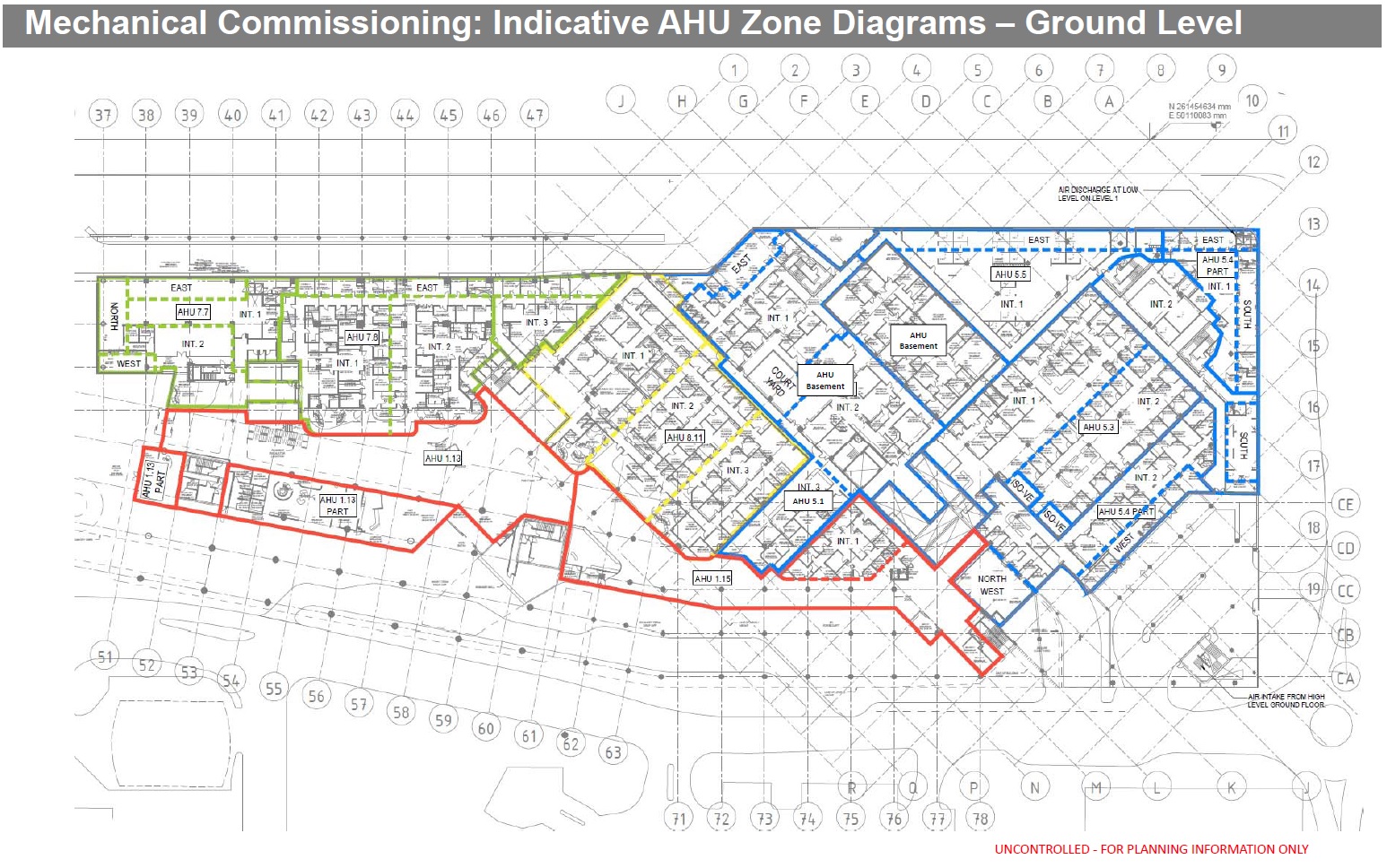
Ground Level AHU layout by zones.
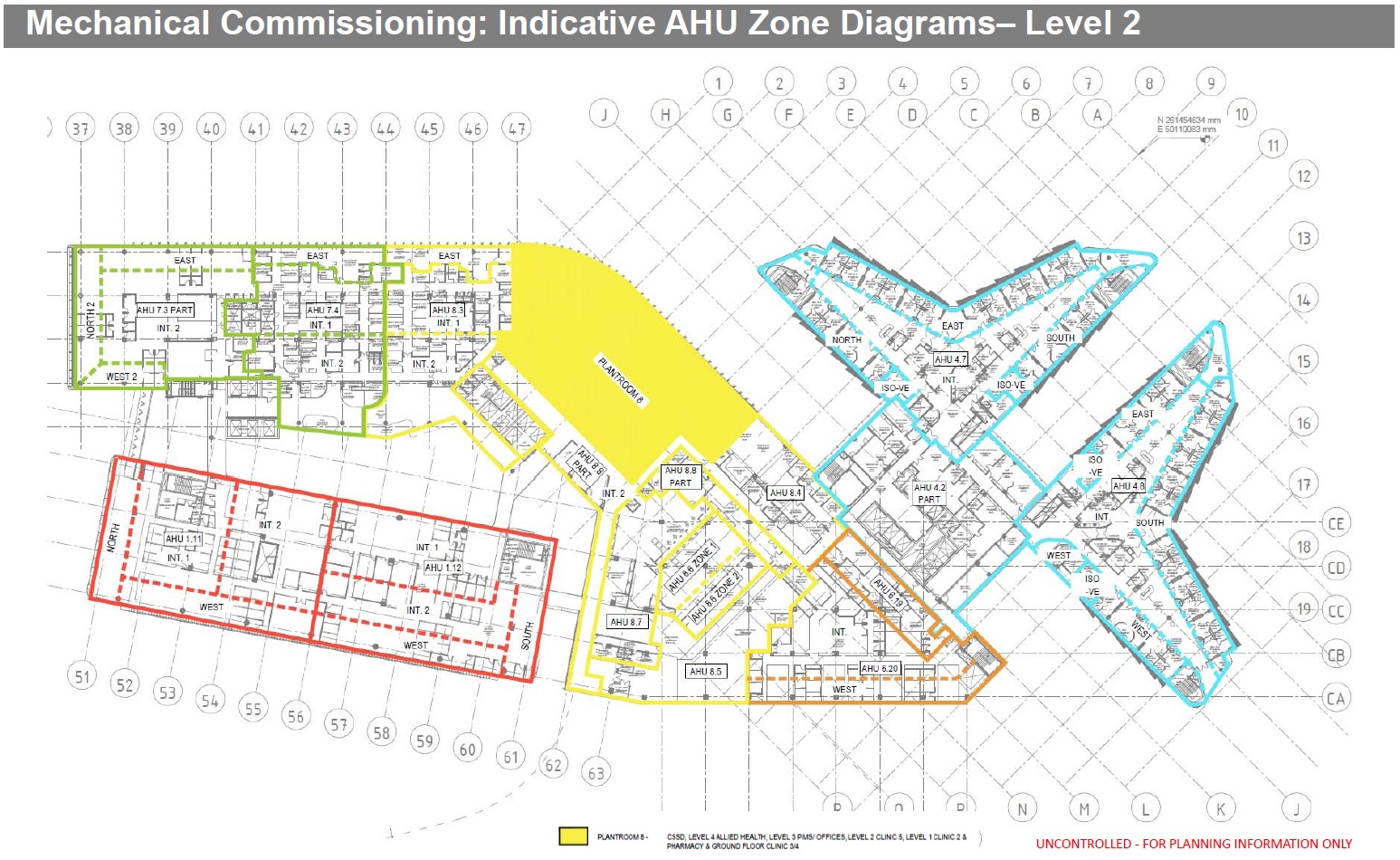
Level 2 AHU Zones – You can see pressurising West Block zone (red) will not positively affect the East Block zone (green) as the atrium in the middle will prohibit effectiveness.
The Issue
In order to control the zones both extraction and positive pressurization are used to create a pressure differential of not less than 20Pa (20N/m2) but not more than 100Pa (100N/ m2) between any single fire-affected zone and its adjacent non-fire-affected zones in accordance with the requirements of AS/NZS1668.1:1998 (Australia and New Zealand’s Standard for the use of ventilation and air-conditioning in buildings – Fire and smoke control in multi-compartment buildings). 20Pa is actually quite a lot of differential across a doorway and would require quite a high air flow rate to achieve this. The maximum being 100Pa is due to the required force to open a door is not permitted to exceed 110N. It is generally accepted that for most applications a positive pressure of around 20Pa in non-fire-affected compartments with respect to the fire-affected compartment will minimize the spread of smoke. A higher pressure should be designed for where ceiling heights exceed 3m; 40Pa is suggested for 6m high ceilings. Using both systems allow the greatest amount of flexibility when concerning complex zonal layouts where certain rooms (dependant on their designed use) are a higher priority than others to remain smoke free (see rough sketch below). However, it is possible to create the required pressure differential from extraction alone but it offers less flexibility and may even be impossible in certain scenarios (see basic differences between systems in the second pic below).
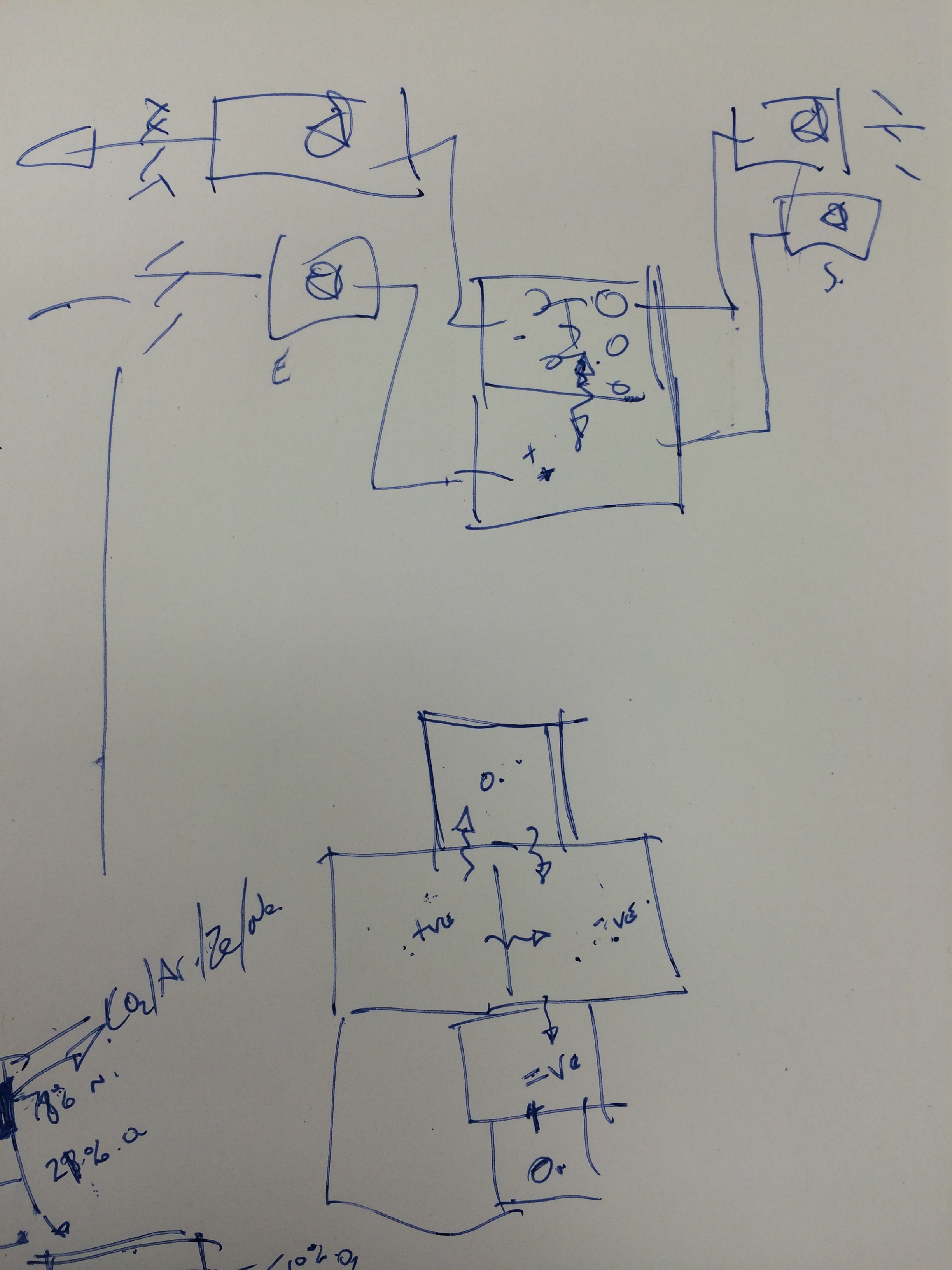
I know this sketch is very ‘Jonny age 5’ but in drawing it, it aided understanding in the potential complexities of adjacent rooms requiring different pressurisation.
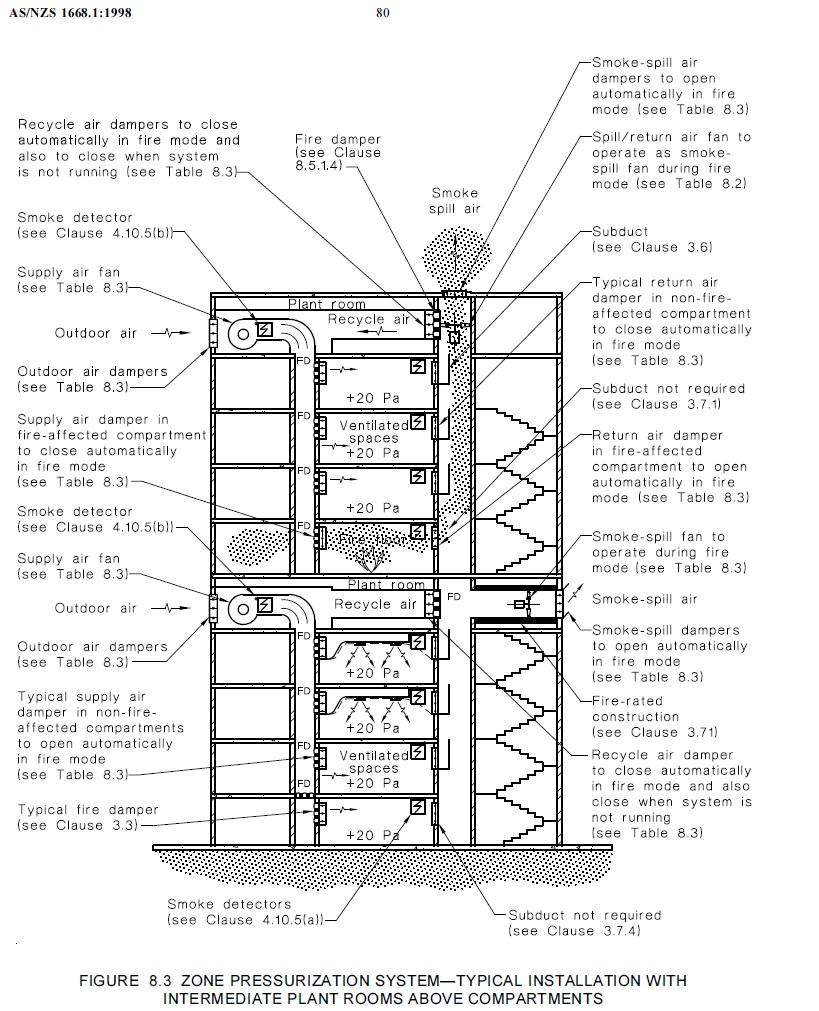
However this diagram (from the AS/NZS1668.1:1998) does explain pictorially how the two systems work together including what each type of damper should do in the event of a fire dependant on if the damper is in the fire-affected zone or not – this is indicative of building layout in the PCH project having plantrooms between levels.
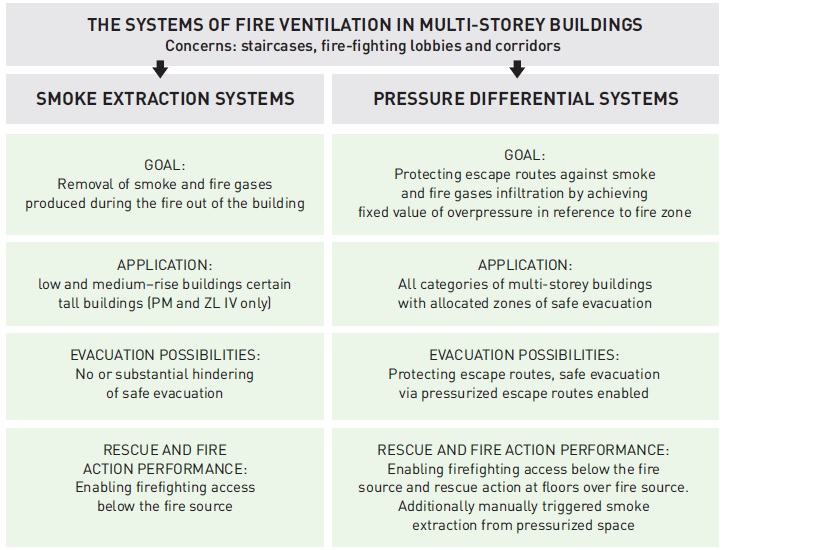
This is an extract from iSAFTEY WAY – Pressure Differential Systems in High-Rise Buildings describing the basic features of smoke extraction and pressure differential systems.
Therefore the design from NDY was to use both extract and positive pressurisation…and here’s comes the but…but approx. 40% (36) of the 91 x AHUs (see pic below) are on the Non-ES which could cause major problems because, as mentioned above, the Non-ES is not backed-up and thus if the fire damages the Non-ES, power to AHUs will be lost and thus not operate as intended.

AHU Layout across all levels and Blocks. Each box (less those that say Commissioning Plant Room) represents one or in some cases more AHUs.
The Solution
Our view is that all AHUs should be on the ES but NDY say they can achieve the required zonal pressurisation from extraction alone so we have asked the question for them to confirm that’s the case. If so then everything should be ok but if not then it’s a gargantuan problem and will cost hundreds of thousands to rectify in changing the power supply to approx. 60 x AHUs; which would consist of changing connection to different MSSBs, cabling etc, etc.
Once the above issue is sorted and the system can theoretically pressurise zonally either by only extract or a combination of the two systems then Advanced Solutions (AS) will ensure their control management is in place for all AHU dampers/fans to operate dependant on the requirement for a particular room/zone and thus manage the smoke.
The Hard Part
The hard part is in the testing of ALL AHUs and dampers/fans reacting as intended along with the other more onerous task of physically checking the other C&E systems work as intended, for example; ensuring that every door within or on the boundary of a fire compartment automatically disengages from its magnetic hold open device to close thus preventing the spread of smoke and fire and that non-fire rated motorised doors or smoke doors located on escape routes are to continue to operate as required until power failure at which point they are sprung loaded and will fail safe to the open position. Also allowing any secured access doors (via swipe card) to release on general fire alarm activation to ensure free egress. Additionally there are protocols for all other systems including; fire shutters and roller shutter doors; lifts; pneumatic tube system (carrying predominantly blood samples); gas supply; Automatic Guided Vehicles (AGVs); and miscellaneous systems, such as medical gas supply. The execution will be very time consuming and imperative that we get the recording of results right as the C&E Matrix forms part of the handover documentation for the Client and indeed the building users.
In Other News
I was shown this in the office and found it quite funny so thought I’d share it with you.
 Holdfast Training Services Trial Blog