Site Two Fifty One – Environmental Awareness
As site Two Fifty One continues to get established part of the works have included moving the hoarding outwards. This gives more space inside and sets the correct position for the entrance gates. However, outside of the original hoarding line were 6 mature trees (trunk greater than 100mm/greater than 10 years old). They now sit within the site.
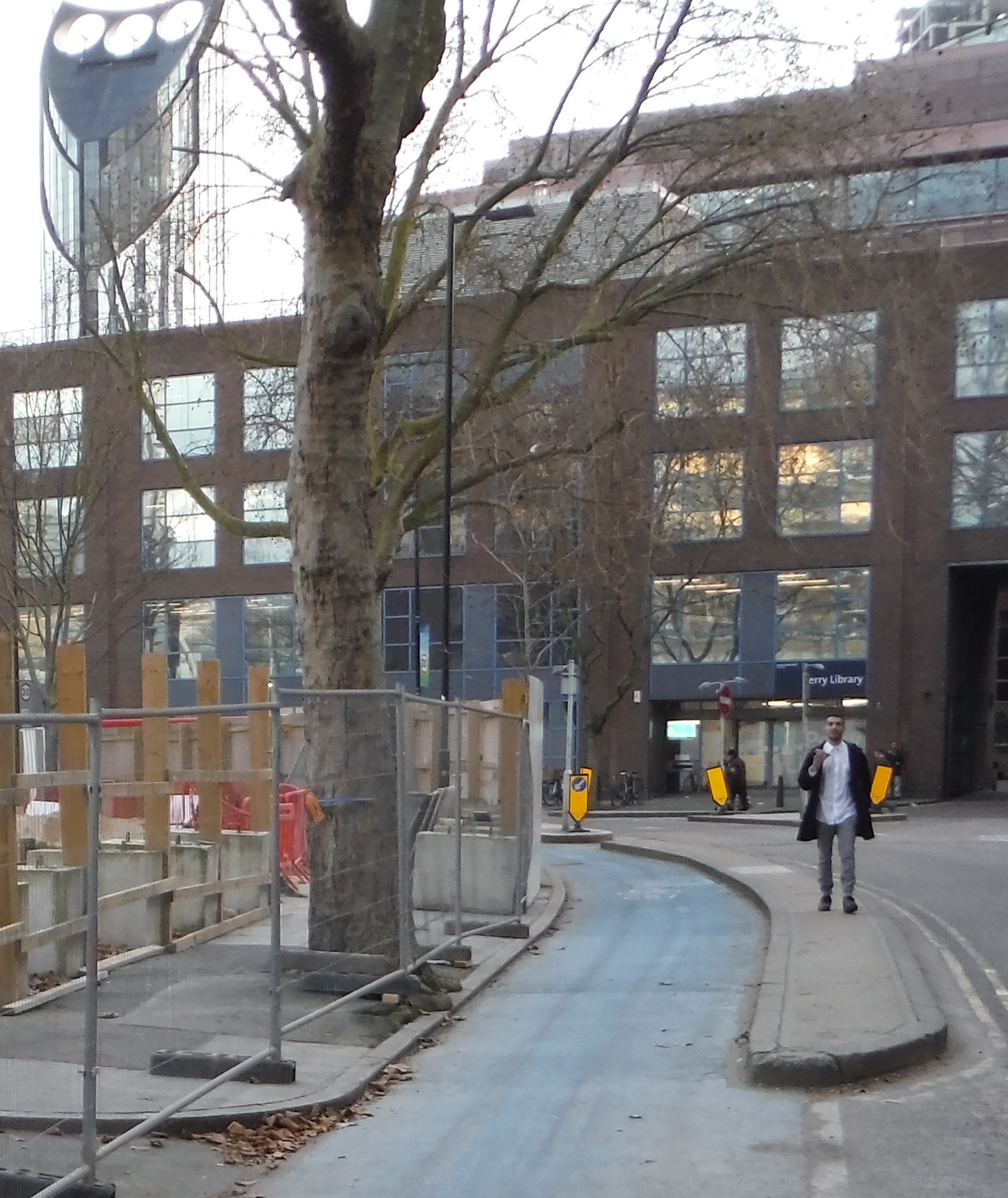
Left – See concrete blocks with posts on – this is the original hoarding line. Right of tree – see blocks moved to edge of pavement, tree will now sit “inside” the site.

Tree within hoarding creates ecological value, therefore making it harder to gain credits for improving the site’s ecological value in the future.
So What?
The original site survey in 2007 determined that no trees sat within the site, therefore it was classed as having a ‘low ecological value’. This presents two advantages: 1. No effort required in protecting trees or other species and 2. Using the Building Research Establishment Environmental Assessment Method (BREEAM – See areas below) and Code for Sustainable Homes it is easy to gain credits by planting trees in the future to turn the site into a development with ecological value.
- LE 02 – Ecological value of site and protection of ecological features – Two Fifty One is starting at a low baseline (i.e. no trees within the site).
- LE 04 – Enhancing Site Ecology (easier if LE 02 is met because low start point)
- LE 05 – Long Term impact upon Biodiversity (add more trees!)
This reminds me of John’s brief of Rich Phillips’ TMR discussing BREEAM based credits gained for little extra effort (points for being near a bus stop – quite likely in a high population urban development!). The aim is to avoid the loss of credits, which in all tally to give a ‘very good’ rating, would mean the project would slip down a notch and therefore not comply with planning consent. Seeing as the client is still to approve Laing O’Rourke’s tender for the superstructure, now failing to meet the planning requirements would be pretty embarrassing.
So how is this problem going to be resolved. Along one side of site it is simple; sections of hoarding will be moved to inside of the 5 trees. Unfortunately, one tree in a different part of site cannot be easily excluded from the site. BS 5837:2012 (Trees in relation to design, demolition and construction – Recommendations) states: “It might be feasible on some sites to use temporary site office buildings as components of the tree protection barriers, provided these can be installed and removed without damaging the retained trees or their rooting environment”. This is particularly handy because the site store is going to be positioned next to this tree and will actually act as a useful barrier to prevent damage to the tree. This means the tree is protected
Is it right that credits are given for a tree to be outside or inside a hoarding line? The advantage is, if it is outside, the trunk will not be knocked and bashed by construction traffic or have materials stacked against it. It also means that the development is likely to have a focus on green areas and planting vegetation – which is a good thing.
So in all, is BREEAM and the Code for Sustainable Homes actually going to help the ecology of the local area? Somewhat. By signing up to the “Very Good” BREEAM rating the project is accountable for carrying out its actions as it said it would to the local council. Therefore simply removing trees cannot happen and even small things like protecting trees will be taken seriously.
 Holdfast Training Services Trial Blog
Interesting to see the difference that a few metres can make with regards to hoarding and the knock on impacts, particularly in your case where the overall credit has been part of the planning consent of the project. Are there financial penalties or similar if the rating drops below that agreed for consent? I am getting involved with the Leadership in Energy & Environmental Design (LEED) stuff for my project/s (similar to BREAM). How is the BREAM system run? Here the LEED count tallys up through the design life of the project up to handover to the user. This means that points are gained for design and construction. I was wondering, do you get ‘audited’ on your environmental practices? Here the Principle Contractor (PC) is required to keep 100% records of such things as where materials come from; type of paints and adhesives used in the construction (which involves identifying whether something is a shellac or acrylic etc from a list of around 50 and ensuring the Volatile Organic Compound (VOC) content is below certain limits!) Do you have to do similar? This is important to note because if something which doesn’t comply is utilised in the structure there has to be compensations elsewhere (ie using a super expensive, super low VOC materials elsewhere to offset). This means someone from the PC has to classify whats going into the building and check on the Material Safety Data Sheet (MSDS) for the VOC content. It seems like a niff naff job on the outset, but when the implications are considered it all becomes rather important. Is your project signed off for a certain level but pushing for higher do you know (happening here). Do you have certain levels of achievement to hit for material procurement? (ie points for local procurement?) what is the radius if so? Its 500 miles here, as the crow flies so all the material requisition sheets come with a little map! Do you get any points for material storage and construction practices?
My site doesn’t have such implications as yours, but the drive is still pretty hard. I think so as to allow some top level bragging rights with key stake-holders, which is important to gather future funding for further projects.
Brad to answer some of your other questions about procurement and use of low VOC level materials – Laing O’Rourke has a pretty robust procurement policy and all products are sustainably sourced. To the extent that we pay more to get steel from Europe, rather than purchasing from China (not sure where Laing O’Rourke projects in Hong Kong get their steel from…). Waste disposal is a big thing and when recently the HSE made a fuss about incorrectly filled out waste transfer notes – due to a Standard Industry Code not being used, there was a rapid regain across all sites. So the corporate machine that is Laing O’Rourke is able to make quick blanket changes across all projects quickly. My cynical view is that the purpose is not for the good and benefit of future generations, but for company image and worldly standing, but maybe that is also achieving the former!
An interesting discussion on a former-left-field topic that illustrates how far environmental issues have moved in recent years. Anyone from Oz want/able to compare and contrast attitudes down-under (for a truely global persective)?
When JHG commenced the PCH project the receiving environment, in particular the ecology was deemed of limited value, the site having previously been a car park. The nearest area of a much higher value is in the nearby King’s Park and Swan River but these are separated from the site by a dual carriageway. So I can’t really add anything by way of a comparison suffice to say that the equivalent standard here in Oz is called Green Star – although some projects do use LEED as well.
I seem to recall Steve Dollimore explaining the concept of the mamlian bridges that were originally intended to cross the dual carriageway at various levels/directions to allow ikle furry wurries to move from the kings Park onto the green spaces of the hospital and back. All an early casualty to cost and reality. It is striking that the site does have a very strong green agenda that has been gradually erroded to the point that, even though engaged on the site, you are unaware of it locally. Might be worth some reviewing, almost a TMR… errosion of …
When it comes to CPR is it useful to remember that ‘sustainability ‘ incorportates issues social , economic and environmental.
The various mesurement methods usually have the three elements.
RIch Phillips submitted a TMR , and in a not atypical manner, re-analysed the BRRAM ones for his site into: point thorugh initial designed ; points available by doing sod-all; point availble by making slight course alteration when on site.
In his analysis he found little evidence of the first- but in CPR you’d have to tug the forelock in the direction of the importance of designing for sustainability…Anyway here is a list of the BREEAM metrics. You can (sort of) guess the detail that might lie beneath each:
• Management, which deals with sustainable procurement, responsible construction practices,
construction site impacts, stakeholder participation (including consultation with relevant parties, accessible design, building user information and post-occupancy evaluation),life-cycle costing and service-life planning
• Health and Wellbeing, which deals with those aspects of a design that impact on the health or wellbeing of building occupants, including visual and thermal comfort, indoor air and water quality, acoustic performance, and providing low-risk, safe and secure access to and use of buildings
• Energy, which deals with the reduction of carbon emissions, including the use of energy efficient building services, plant and equipment, low- or zero-carbon energy-generating technologies, and the ability to monitor energy use by sub-metering
• Transport, which deals with access to adjacent public transport networks and local amenities, along with the provision of information on travel options to building occupants, the provision of cyclist facilities and the limitation of car parking
• Water, which deals with opportunities for reducing water consumption through the use of efficient sanitary ware, the reuse and recycling of water, the provision of leak detection and prevention of leaks, monitoring controls and the provision of water-efficient equipment
• Materials, which considers the embodied life-cycle environmental impacts of materials ,the use of responsibly sourced materials and the robustness of the building fabric
• Waste, which deals with reducing construction waste, the possible use of recycled aggregates, the provision of space to encourage operational recycling and encouraging the specification of finishes by the building’s occupants
• Land Use and Ecology, which considers the environmental impact of site selection including its ecological value and the protection of existing ecological features, mitigating the impact on and enhancing the ecological value of a site and limiting any long-term impacts on a site’s biodiversity
• Pollution, which deals with the impacts of refrigerants and nitrous oxide emissions, the impacts of surface water run-off from a site and the impact of light and noise pollution on neighbours
• Innovation – the BREEAM 2008 Scheme introduced additional credits that could be awarded in recognition of achieving either exemplary levels of performance (above best practice performance currently recognised by BREEAM) in certain Issues or for incorporating innovative sustainability solutions within a building’s design. This can help to boost a building’s BREEAM performance
Hi Brad – thanks for the comments, interesting to hear the similarity to what you are doing in the US to what I am doing in London. The Building Research Establishment Environmental Assessment Method (BREEAM) is supposed to be word wide, but it seems it has failed to influence the US where Leadership in Energy and Environmental Design (LEED) is the frontrunner, likewise Green Star in Australia. A quick Google reveals each method uses a set of metrics to assess developments on (BREEAM using the 9+ John described). One comparison of the 3 assessment methods indicated Green Star was a little more simplified and so changing a few aspects of a project would have a considerable change on rating. BREEAM tends to sit in the middle and LEED appears to be more onerous.
We get audited monthly on my site’s construction environmental practices but I think that during a project life cycle the following observations are typical:
Design/Pre-construction (planning) – Lots of descriptive effort in proving conformity to environmental ratings (BREEAM or otherwise). This is to gain consent for a project and once approved…
Construction – Loss of focus in what was said regarding conforming to environmental standards – pressure is more focussed on “Price”, a bit on “People” and less on “Planet” using Richard’s 3Ps to replace John’s sustainability 3 pillars of: economy, social and environmental.
Use – Environmental considerations revert back to what was designed – normally pretty good if design was found to be cost efficient (or cheap) to build. However, if the green ideas were expensive, I suspect they would be the first to be “value engineered” out by a client! – agreeing with Richard’s comments on erosion.
John – I understand Rich Phillips’ point of view, however my take is I am sure the whole situation would be worse without some sort of framework to work against. There will always be a number of ‘freebee’ credits for coincidental environmental achievements, but there will be advancements in some projects that do achieve more and perhaps achieve more because there is a framework to prove one’s self against.
Damian, to add more to Brad’s experience with the US, the Dept of Defence has mandated that all federal projects are to attain a minimum of LEED Silver accreditation. It is obvious that many contractors working for the government find this burdensome as outside of the federal system they address it merely as they see fit (as you suggest, company image etc). An observation thus far is that sustainability is far higher on the US agenda than H&S in terms of being outwards looking for both improvement and global matching. Conversely, your blogs suggest the opposite in the UK. My take – the UK is light years ahead of the US in H&S but lags in certain areas of sustainability policy and legislation such as SuDS – e.g. in the US, SuDS are militarily enforced so much so that sites are often better off than prior to construction for runoff control and treatment.
SuDS (which started out as SUDS) has been very much on the UK agenda and was probably first formalised into policy through PPG 25 in 2001. The national catchment and basin mangement schemes, local plans and network of EA officers would strongly disagree with your assertion that UK is not serious about SuDS! I would also suggest that any UK housbuilder would be delighted to see a lighter touch that the oft draconian greenfield equivalence. The UK is host to at least one EU demonstrator project See: http://www.susdrain.org/case-studies/case_studies/lamb_drove_residential_suds_scheme_cambourne.html which although championend by Royal Haskoning (clients engineers and EU contact) was actually designed by the developers engineers under D&B contract which included all negotiation and modelling. The Engnieers were Thomasons and I lead the team (of two!).
Richard, you should enjoy getting to grips with my thesis on this very topic. Just to be clear, I was making the comparison with the US; I am certainly not saying they are not serious – as my thesis will demo. I agree thorough policy is in place, but legislation is still to be formalised by government. The US has policy and legislation at almost every level: borough, city, state, nation, defence just on the very topic of SuDS. Somewhat different to their rudimentary H&S policies.