Making it up
This week’s blog is about stuff that doesn’t fit…
We’ve got a channel for an ACO drain in the steel, and a pipe for the ACO drain, but the two don’t line up. I checked the setting out for the pipe, it was in the correct location according to the setting out information from Arup. I then checked the channel in the steel. It too was in the correct location according to the setting out information from Arup. It turns out that if you overlay the structural drawing and the drainage drawing they don’t line up:
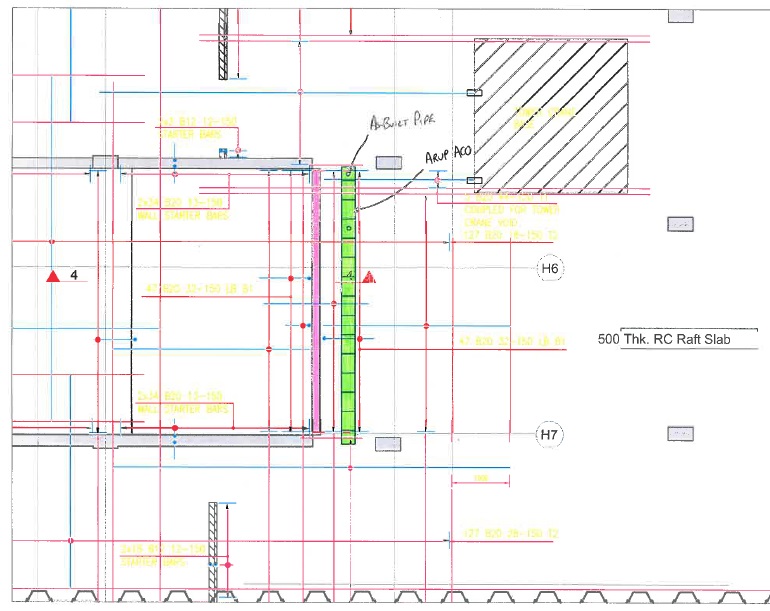
Pink shows structural design location for ACO drain, Green shows the drainage design location
We’ve solved the problem with the imaginative use of a 90 degree bend (which are actually 87.5 degrees, but that’s another story) and a T junction.

I would dearly love this to be the only such balls up, but it’s not. We had a drainage run that should be a straight pipe with a y to a second drain. It couldn’t go there as it would clash with the discharge pipe for another sump. So we tried it the other way round and that clashed with a pile head. So we’ve had to bend it round the pile in order to get it in.
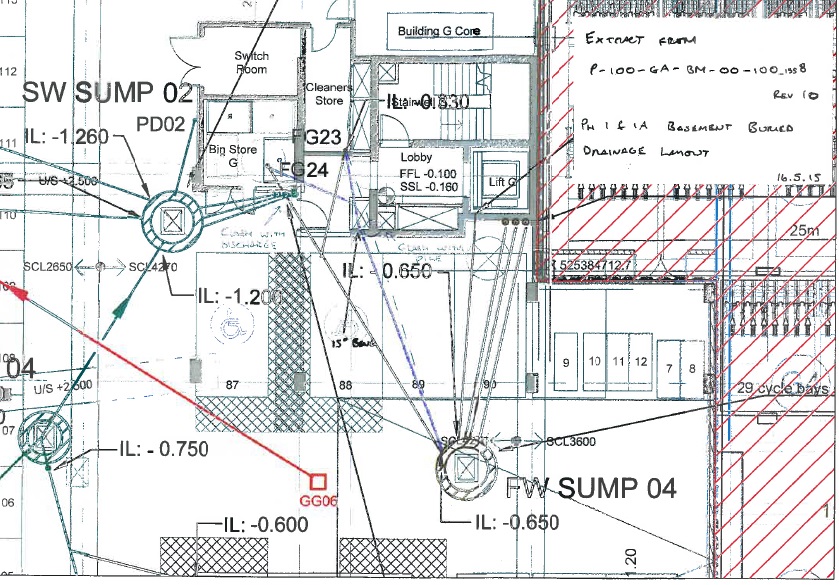

Both the drainage design and the structural design are both done by Arup, so yet more examples of an organisation sending out contradictory information.
But unlike previous examples where it was because people in open plan offices sit next to each other and yet still prefer to send emails rather than have any form of human contact, this would appear to be mostly due to one man thinking his area of responsibility is more important than anyone else’s and assumed that everyone would make their designs fit his. The structural engineers assumed they were the most important and so didn’t bother to check.
We’ve solved all of these problems but it does begin to raise concerns about the competency of the people who design these things. Neil often asks about how on earth they designed something as complicated as the Shard. I fear the answer may be: “They just made it up!”
It’s not all bad news though. Our 5th tower crane is up and the site is really moving now. PCH are here only in name but the blokes are very much here in person so we’re progressing nicely!

 Holdfast Training Services Trial Blog
Well it happens. I’ve a job on at the moment and I’ve lost count of how many times the drainage runs have been run to the front and then alternatively to the back and then pumped back up to the front; then the architect want some to the back and some to the front,; then ‘can you remind me whay we have to pump it up from the back and not send it thorugh a ( solid steel) piled wallto the rear?’! ; now I thnk he wants it part to the front and part to the back (to the pumping station) becuse ‘ we need to have some gravity drained only’. The problem now is the contractor has finished wall the new rc foundations to the front and there are no service ducts to run anything thorugh……just about everyone is and the contractor moves on apace……I wonder whether your twists and turns are rod-able?
There are a couple of bends that definitely aren’t, but I was told I wasn’t allowed to put a rodding eye in as the architect thought they were ugly!
Hopefully you have found building regulations Part H. All common drains must have access for clearance of blockages… It’s architect versus secretary of state…
I can’t tell you how true your comment is about design offices and designers sitting in cells worried about their own little world of drainage or foundations etc. I seem to be looked on as a bit of keen-o when issues arise and I walk the floor chatting to structures then elec etc to ensure my storm drainage changes will work. Rather than the traditional method of designing, and making the assumption that everyone else is less busy than you and have the time every day to filter through the 100’s of CAD drawings to make sure nothing has affected their own little empire. The problem arises when others make changes and then don’t tell me. I must have redesigned my project’s Storm Drainage 15 times as a result!
I expected as much. Do they all have beards too? They do in my imagination!
🙂 This was my world until 2007. I implemented a system of call in referencing to the civils drawings so I could see what the structural engieers ahd changed everytime we openned up one of ours. IT didn’t stop the arrogance but did mean we could ask some very shar questions as soon as they drove piles through our drains. This is, of course, an impossibility now we have BIM…
So presumably these work on the basis of whatever gets installed first is the most important because those constructing it will want to avoid rework and will fit the next system around it accordingly.
Guz, out here you’re a minority if you don’t have a beard!