Archive
Oz PCH – Bad Press.
The following link is a report from the Australian Financial Review News Paper regarding JHG’s treatment of sub-contractors.
In summary, a sub-contractor (Yuanda) has issued a claim demanding payment of AUD$8.6 million as part of a progress payment with two other subbies following suit.
The payment is being withheld due to defective/damaged work and the report says that Yuanda’s claim states that JHG is not entitled to offset payment for defects under their subcontract.
Below is an extract from my AER 1 regarding payments:
…In terms of the sub-contracts JHG will, subject to any rights to set-off, pay the subcontractor through either Percentage Progress (% against pricing schedule) or Quantities (re-measurable basis) payment methods. Once a payment claim is made by the subcontractor JHG have to produce a payment schedule and, by the scheduled timeframe, make payment on account until approved security of the amount has been acquired and the final payment can be made. JHG can deduct from payment monies otherwise due to the subcontractor under the rights of set-off (JHG (B) 2014).
The right of set-off from the standard subcontract itself states:
12.18 Right of Set-Off
John Holland may deduct from moneys otherwise due to the Subcontractor under or associated with the Subcontract:
(a) any debt or other moneys due from the Subcontractor to John Holland; or
(b) any claim to money which John Holland may have against the Subcontractor whether for damages (including liquidated damages) or otherwise.
Technically Yuanda are right. The off-set explained above at (b) is JHG’s right to off-set payment in the case if JHG get hit with liquidated damages from the Client for late delivery caused by defective/damaged works by the sub-contractor.
JHG automatically hold a percentage back, usually 5% for a one year Defects Liability Period (DLP) but this project has a two year DLP so it may be slightly higher. Either way it is this sum that JHG are contractually obliged to withhold payment on should the work be defective and not the reported progress payment.
I haven’t actually seen the specific Yuanda sub-contract so there may have been another clause put in but either way it’s not good press.
So what?
This kind of bad press could cause many things to happen, the most significant of which would be that JHG lose potential tenders. Additionally, for tenders that JHG have won, when it comes to tendering for sub-contractors these sub-contractors may either look elsewhere or see an opportunity and to protect themselves from potentially getting shafted, factor in a higher contingency risk fee. This results in JHG either being left with a substandard sub-contractor as a result of not assigning a ‘preferred sub-contractor’, which they may have spent time and money on sweetening-up from a previous project, or worse still getting the ‘preferred sub-contractor’ on-board but paying out more for the privilege.
The Good, the Bad and the bloke setting out
It seems to me that there are two types of engineer. I don’t refer to those people that sub-contractors refer to as engineers that just carry a total station around all day, they are not engineers. Instead I refer to good ones and bad ones. A good one looks at something, asks a million questions about it, wants to know all the details and then enters them into a spreadsheet. A bad one says “fuck it – that’ll do” and moves on to the next thing.
On my site we have this:
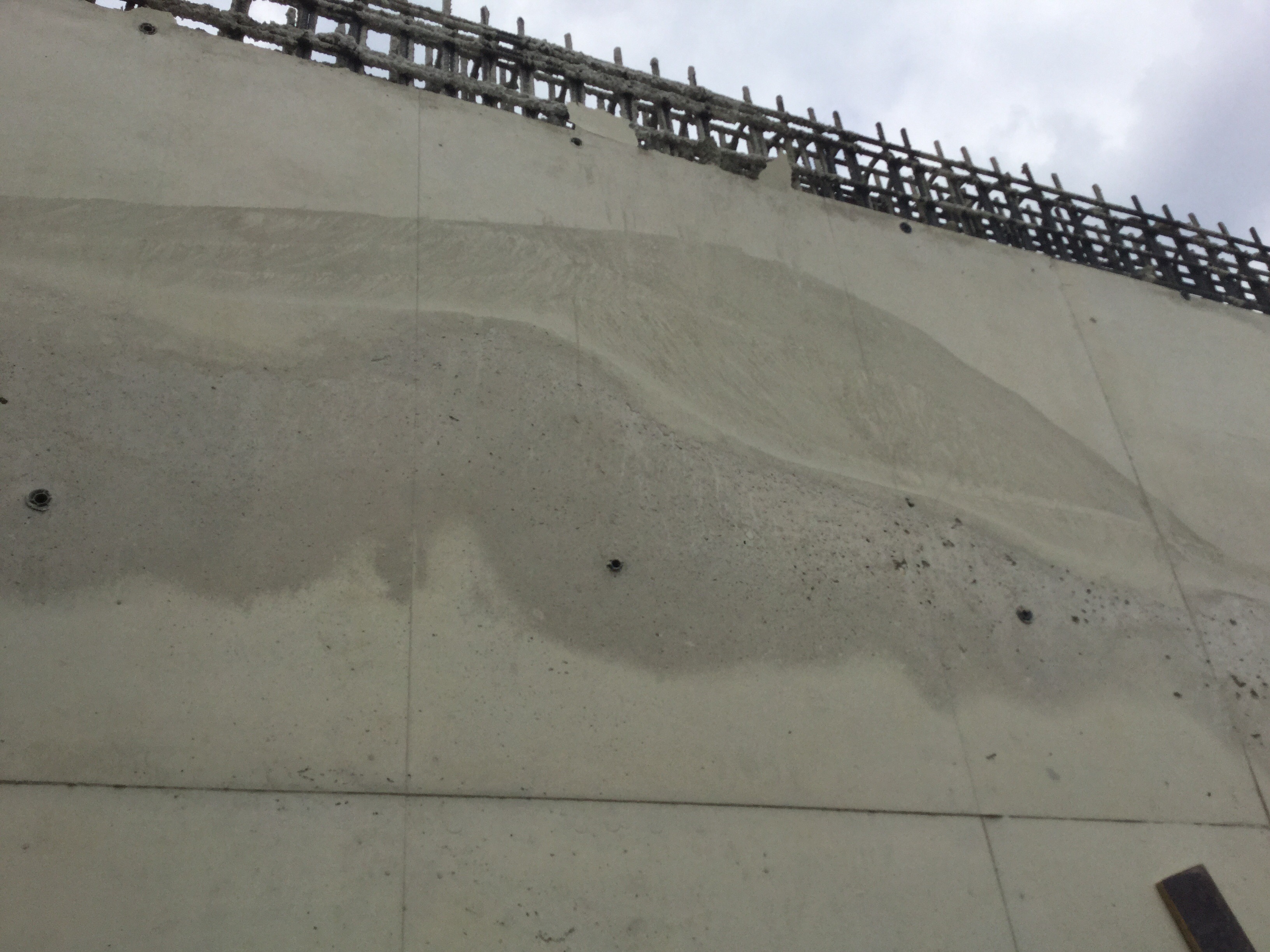
Discolouration in concrete retaining wall
I looked at it and went “oh look, funny colours”, then moved onto the next thing.
Luckily we have a resident engineer from Arup on site called Tom (who incidentally once held the world record for the tallest tower made of dominoes). He looked at it and asked “why has it done that?” And a good job he did too. It turns out the upper bit of darker concrete is simply a higher strength concrete that was put there by mistake, no dramas there then. The lower bit it turns out is where the cement and fines have migrated up within the concrete and the aggregate has settled out. While we can’t be sure why this has happened it is believed the concrete was at the sloppy end of the allowable slump test result and the man with the vibratory poker lift it in the concrete while he went for a fag.
This is a problem because if there is no cement or fines around the aggregate at the bottom it will not be bound together properly. If there is no aggregate in the top bit then it won’t be strong enough. So we’ve ordered some cores to be taken. If they pass we’re ok. If not the wall will have to come down.
I have learnt a lesson: Ask more questions! Ask why much more often. It might make all the difference!
Stay tuned for the results of the core tests and the DNA test to see if Tom is in fact related to Damo….

Tom and his dominoes
Commercial 101
Learned about the ‘start calc’. A walk through – talk through of a JHG system which identifies areas of risks and opportunities, and the monetary values attached to them. The estimating team feeds data from the project tender to us which is effectively the cost code budget. The forecast then informs the start card. Not used by all sectors within JHG, it is favoured by the operations manager (Dave) who the PM reports to. I liken him to John Moran – been around too long to entertain bullsh1t (pardon my Aussie).
The start card is a logical user friendly tool to turn qualitative opinions into quantitative estimates e.g. ‘we reckon we’re going to make a big margin’ as opposed to ‘how much’ do we reckon we will make? It takes the individual cost codes and churns out a plus or minus value from how we estimate we can do the ‘work’ for against what the estimators thought when we tendered for the project. It’s the profit ‘P’ of the triple bottom line.
In forecasting, I have produced product breakdown structures which have created work breakdown structures. From that I have built up cost breakdown structures (thank-you Steve Payne), and coughed up a dollar value for the ‘cost code’. If this is higher than the estimators envisioned, the code is in the red and vice versa equals in the black. Follow suit for all of the cost codes by the team members and we land up with a total bottom line red or black figure for the project. (It should be mentioned that my team does not use the APMP method and the feedback has been positive).
Too much in the black and JHG senior management will take money off our project to offset projects which are heading south. The trick seems to be to lie through your teeth with a smile on your face. Find places to ‘hide the fat’ e.g. $30k on ‘small tools’. The point being that if you show your cost breakdown to match (or darn near equal) the estimate from the tender estimate, the JHG powers that be will leave you alone. Dave wasn’t born yesterday and he knows the score, he just can’t prove anything – yet.
Another angle is that from a quantitative direct cost risk analysis process (as used on my project), both opportunities and risks are assigned monetary values. Take the value of the cost code and multiply it by the likelihood of an event occurring and voila – you have a red or black number (risk or opportunity). Any ‘fat’ i.e. black you accumulate is then used to offset the red figures from incompetent estimating or ‘Jonahs’. Essentially nothing more than a contingency fund. Like anything, too much of it (visible) is bad as the senior management will transfer it to another suffering project, not enough and the project is costing JHG money.
So this morning taught me to keep your friends close and your enemies closer. Hide the money up your sleeve. Also, bad news is best delivered early. Make your superiors aware of the curve early so that they can fleece other projects to help you, rather than waiting until the project is a hopeless flop and then begging for handouts.
In other news; supersize your kangaroo leather hat with a genuine kangaroo scrotum bottle opener for just $30 AUD extra.

Roo sack – gen.
A Novated Contract
My project was originally run to tender in 2007 but our bid fell short. When the economy did a summersault the project was shelved. In 2014 it was revived however our new bid was also declined and most of the tender work was thrown away. Within a matter of weeks BamNuttall were asked to resubmit it’s tender as T&Cs had not been agreed with the 2014 contract winner and the they had pulled out…cue alarm bells!
The revised 2014 quote was c.£400k lower than the initial 2014 quote. It was accepted pending two key conditions:
- A team would be mobilised with immediate effect and begin work (this took a week). This was necessary to comply with planning conditions outlined by the local authorities.
- The original designer who designed most (not the river bridge) of the 2007 scheme would be novated to us under a D&B contract but they would now become the sole designer for the whole scheme and adopt the original river bridge design from Halcrow.
Novated – I had to look it up but in effect it means that you take on the asset under the original T&Cs.
The Problems…
- The original river bridge was designed by Halcrow. The designs were handed to WSP but none of the supporting calcs, therefore WSP had to pretty much redesign the whole bridge prior to an external CAT3 check. This was not costed in the tender. It also lead to lengthy discussion as to whether WSP accepted the risk when agreeing to adopt the bridge design or whether they were explicit in outlining the cost associated with a redesign.
- TrentPort (Client) use JCT contract for all of their other project. This was already in place with WSP when our bid was finally accepted. We have entered into a D&B NEC3 contract with the client however; we have taken over the JCT contract with the designer. This means that when we all sit around the table we are not contractually talking the same language.
- Value Engineering benefits the designer. Within the NEC3 contact we have detailed that any value engineering change will benefit us 75% and the client 25%. If this is a method change then no VI is required however if a VI is required then the designer will be paid and the profit reduce prior to the split. However, because the designer is in a different contract he has tied our hands on numerous issues and we have been forced to pay hand over fist to move the most simply checks and tweaks through.
The Sticking Point…
The relationship with WSP is frosty to say the least. The designer working on our project is a nice guy who appear rather uncomfortable at meetings when he’s asked to comment or make quick amendment. He simply speaks on behalf of his master and repeats ‘please formally request the RFI or design change, we’ll quote you for the work and then you must instruct us to carry it out’. As you can imagine this is a long, slow and frustrating process which often takes weeks for tweaks!
The Solution…
We continue to press on often building at risk or making quick changes to the programme to re-order the construction sequence whilst we wait for answers.
A meeting has taken place between our commercial team, our design co-ord and WSP. Some form of payment (details are unknown) has been agreed in order to speed up VIs, RFIs, TQs. Over the last couple of weeks there has been a marked improvement however the it feels like a triangular mine field where no one is willing to step in to the middle but would rather tiptoe around the edge and waste time and money.
SWOT
Guz hit the nail on the head when he mentioned the use of a SWOT analysis or lack thereof. The speed that this project was established was rapid, I spoke to Steve Payne a couple of weeks ago and he was shocked at how quickly things had moved. It appear that the focus was very much on the ‘O’ with a little ‘S’ thrown in for good measure but I’m not sure a great deal of time and effort was invested in to the ‘W and T’.
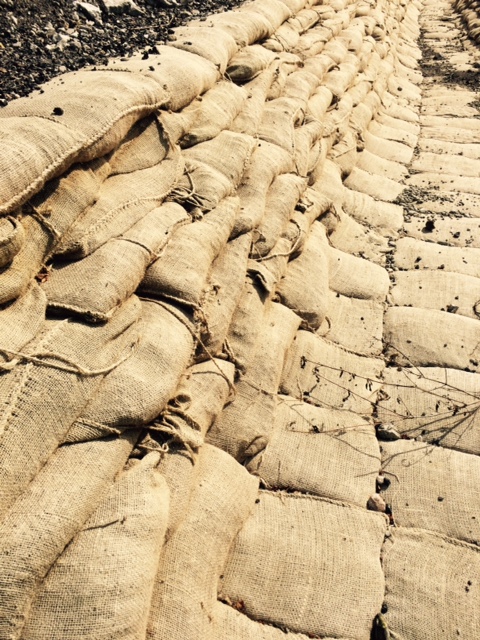
On a Lighter Note…Check out this sandbagging!
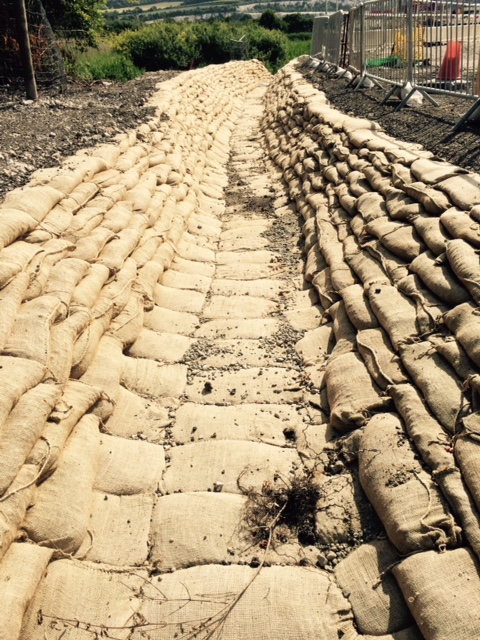
Silly Money
In the original contract BoQ we agreed to pay PCH nearly £1000 per tonne of reinforcement steel to procure and fix the steel. When PCH started having cash flow issues back in March, McAlpine started buying in the steel themselves and free issuing it to PCH. Since McAlpine were paying for the steel it was decided that they (and by that I mean me) should call it off too. An agreement was made with PCH that we would subtract how much we were paying for the steel from PCH’s BoQ rate and pay them the rest.
Then when PCH went into administration a couple of months ago we started paying the steel fixers directly too. So again, we deducted that amount from the BoQ rate and paid PCH the rest.
While initially that made sense: we couldn’t be sure we’d get the steel at the same rate as PCH so we minimised the risk by guaranteeing the combined rate for supply and installation. But now we’re in a position where we pay around £250 per tonne to buy the steel direct to the supplier. We then pay £500 per tonne direct to the sub-contractor to fix the steel. We then give the remaining £250 to PCH for what? Currently we’ve given PCH nearly £250 000 for doing nothing.
McAlpine chose to minimise their risk by ensuring they would never have to pay more than the original BoQ rate, but they missed an opportunity to pay less. It seems so obvious but a SWOT analysis of the situation probably would have identified the opportunity to make a saving, but no one did one. They simply identified a risk and dealt with that.
While I accept the risks are hugely important, I would suggest the SWO is important to and therefore before dealing with the risks we should first identify the other elements in order to make a fully informed decision.
The Coffee Cup
As the summer weather sets in construction of a new part of the campus begins and I have been given the responsibility of ‘Structural Lead’ for what will eventually be a Central Utilities Plant (CUP) building which will provide the cooling loads for the buildings on site. The structure itself is around 55m x 65m and is a steel braced frame construction sitting on a mixture of shallow concrete strip and pad foundations. The exterior will be clad with insulated metal panels, with one of the elevations detailed so that it can be disassembled at a later date and expanded, as and when the campus is expanded. This bit of the design echoes the nature of the entire project, which is expansion and longevity of the campus. The site is located on what will be called Coffee Road, and so some of the funnier members of the team have taken to calling it the Coffee Cup. All of the footings have been poured, with base plates set into them onto which the steel columns can be placed. Late last week I conducted a random check on some of the steel that has been delivered to site and cross referenced with the shop drawings whilst the contractor who is responsible for constructing the CUP structural steel surveyed the base plates to ensure that the concrete contractor had placed them in the correct location. All but one were approved on the as-builts and so work has just started erecting the steel, with an RFI submitted with regards to the erroneous plate. I had a slightly harder time however because for some reason the numbers on the steel work corresponds to the field set of drawings, which in turn do NOT correspond to the shop drawings. Quite why is a mystery however after much panicking I got to the bottom of the issue and the simple one man task became a difficult two man task with me cross referencing field drawings and shop drawings in order to ascertain which bit of steel we were looking at and whether or not it was correct.
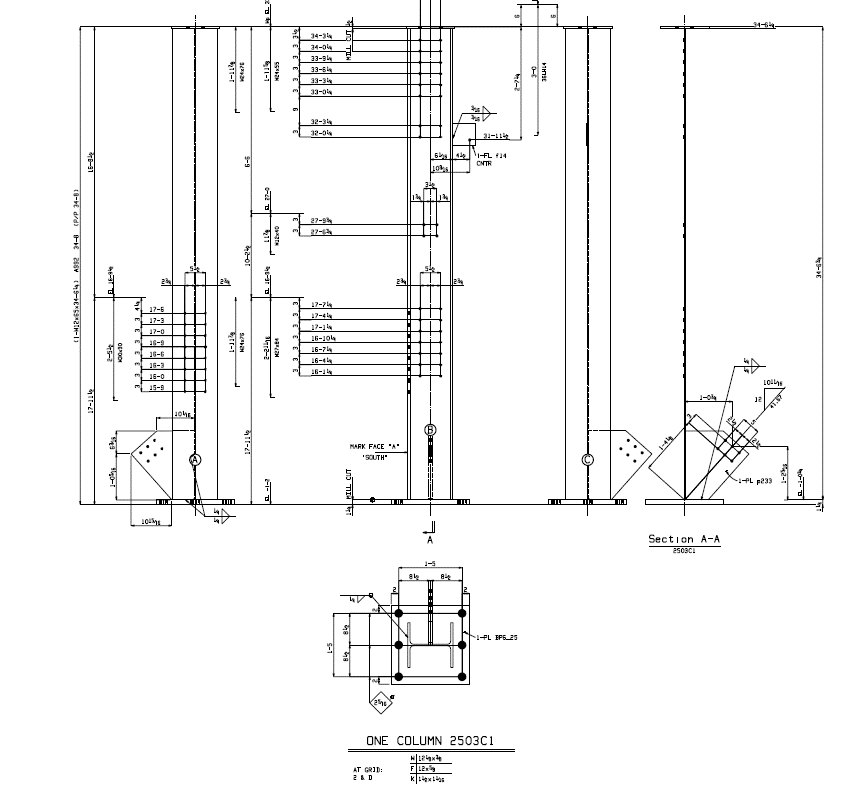
Example of Field Drawings for QA
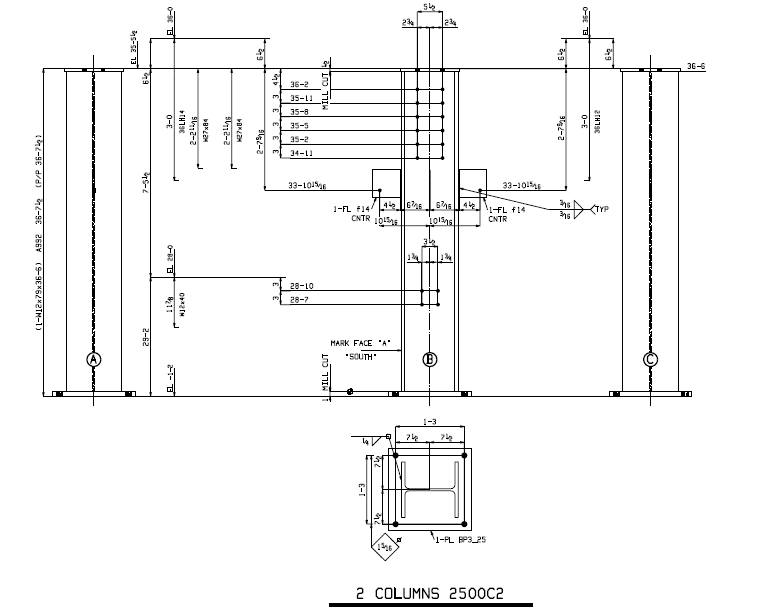
Example of Field Drawings for QA
Note also the lack of scale, which was initially confusing. The upper and lower holes are separated by c. 10”
Concurrently to this the concrete Slab on Grade (SOG) is being poured, with the second of four (2/4) pours complete already. The SOG is 6” thick with minimal bottom reinforcement and so the QA checks were fairly simple. An earlier RFI for the masonry walls location caught me out however as the approved reinforcement detail for the starter bars at these locations was drilled dowels, to be installed at a later stage, as opposed to what was shown on my field plans, which is the normal bent rebar protruding upwards.
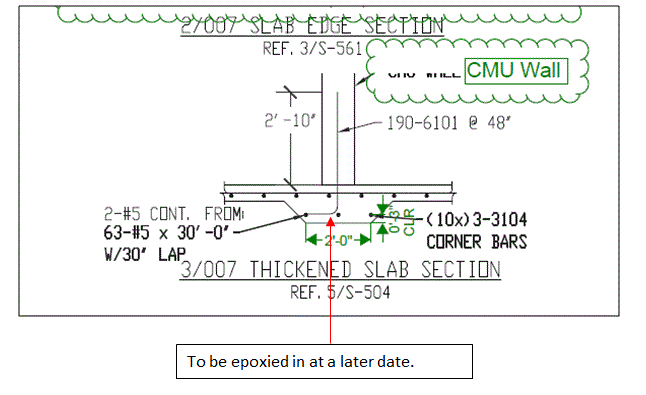
Lesson – keep abreast of the RFIs.
Mostly the pours went well but I saw an impact on the project which some of you may or may not have come across, but which is very difficult to mitigate.
About a quarter way into the 2/4 SOG pour at the point of the second slump test there was a recorded measurement of 11”. This is 2” out of tolerance and should have been caught as the first concrete came down the chute and into the pump. It is at this location where the first of arguably three slump tests is taken.
The worker here, who works for a third party QC contractor, is hugely experienced and can estimate to within a half inch what the slump of the concrete is. The reason I say that there are arguably three slump tests on the concrete is because as it comes down the chute he is supposed to estimate whether the concrete is compliant or not; if not the truck is immediately told to cease pouring so that only minimal deficient concrete enters the pump. This is done because the actual slump test cannot be conducted on the first 10% of concrete in accordance with ASTM C172 and ASTM C143. In short the issue is that the contractor at the chute should have identified the fact that the concrete was deficient. Instead he had given a positive reading to us that the slump was only 8”. Some might call this a lie.
As it turns out there is a bit of history with the worker in question who is, by all accounts, a disgruntled employee for reasons which I won’t go into here. Since it was too late to turn the truck away at this point and deficient concrete had already been placed it was noted exactly where the deficient concrete went in the slab (2 locations) and additional cylinders were ordered by the Principal Contractor. It is anticipated that these will close out the deficiency when tested as the slab is only rated at 4500psi (30N/mm2) and most of the tests come out higher than spec. but if not then core samples will be taken and the way forwards decided from there. Since the incident the worker in question is closely supervised. I’m not sure of the politics but to my mind he is tying up additional manpower and should probably be re-tasked.
Away from this I have had my first Health and Safety impact on site. The issue was to do with a slope stability problem next to one of the haul roads which runs adjacent to a sizeable chiller pipe chamber (essentially a big hole) As I was driving from the Coffee Cup back to the office I noticed that the batter angle on the slope was near vertical, and that there were track marks right on the edge of the road. I recognised the signs of a slope failure which I attributed to reduced shear strength of the soil (due to afternoon deluges we experience) and surcharge (of the tracked plant). My concern was that given the location of the tracks, which were right on the edge of the haul road, and the location of the haul road with respect to the gaping hole that a vehicle could easily cause further failure and would subsequently topple into said hole. I called the Principal Contractor who agreed to ‘have a look’ at the area. They obviously agreed with my assessment as the road was re-graded the next day and concrete barriers were placed along the edge of the road to prevent vehicles tracking too close to the edge again.
In other news
My car MPG is noticeably lower of late. As I’ve mentioned the weather is hotting up. The only reasonable explanation, from an E&M point of view, is that this has caused the many thirsty horses under my ‘hood’ to become thirstier. It did pass a rigorous 5 minute annual emissions test though. I’m not sure how, I can only assume that the test is to verify that it does have emissions.
I also recently participated in ‘Organization Day’ which marked the 240th birthday of the USACE, which is two days older than the Army apparently. It was a good day out with ‘soccer’ and volleyball tournaments. I was more use to the soccer team, with 2 goals helping ease the RSFO team to the trophy. Unfortunately I did little to halt the demise of the volleyball team, losing as we did 25-9. Good ‘cook out’ (BBQ) though.
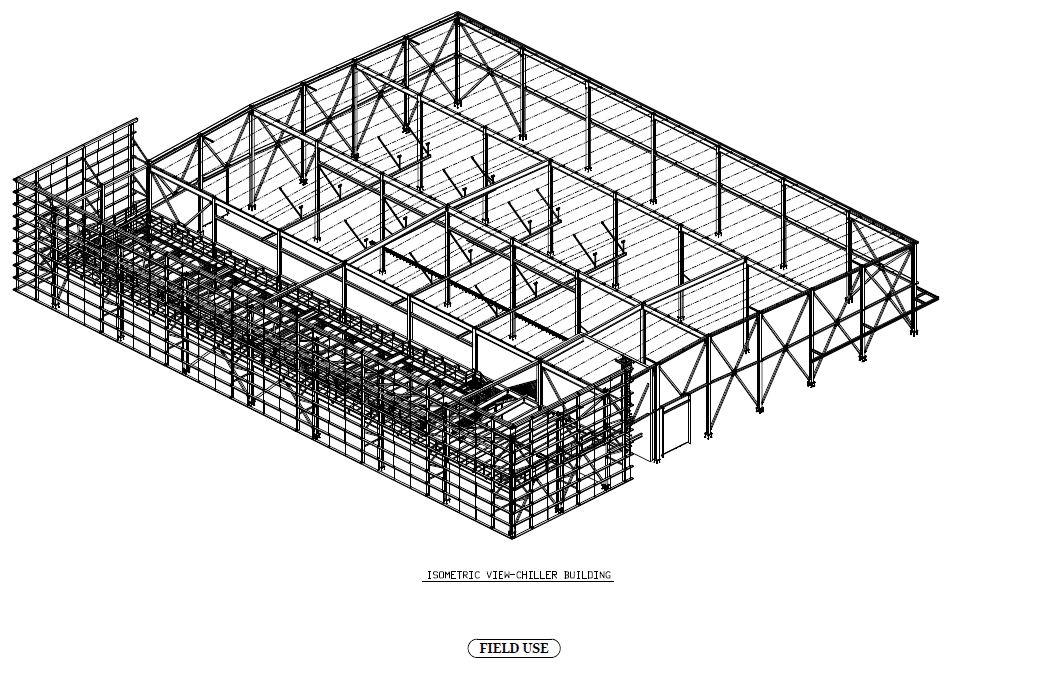
The Coffee Cup
Version what?
Our surveyor has started on the northern end of the alignment as it was the first land given to us by the client. He is marking out the construction boundary and the CL of the tunnel alignment. There are some discrepancies – the title lines do not lie exactly with the fence lines. So what? There is a fibre optic cable that runs the length of the fence which makes up the western construction boundary and runs parallel to the railway. Effectively, the construction boundary has been reduced by approximately 1.0m due to this fence. We are not considering removing the fence and placing a new one for the sake of this meter. So what are the risks? They are two-fold. Firstly, the risk of cutting something increases (slightly), but it is not a show stopper, the show will go on.
The second risk has more severe consequences. The works zone is in an area of significance to the Wurundjeri Tribe Land Compensation and Cultural Heritage Council (WTLCCHC) as it connects present day Aboriginal people with their ancestors who have lived in the region for thousands of years. As you may have read in my first blog, I attended a CHMP (Cultural Heritage Management Plan). This involved an Aboriginal ‘laying down the law’ with regards to excavating in our project corridor. Artefacts of cultural heritage were displayed which included glass ‘knives’ and stone ‘spear heads’ and ‘axe heads’. The Aboriginal Heritage Act 2006 makes it a legal requirement for contractors working in sensitive areas to produce a CHMP. It is a legally binding document which must be followed by everyone working on site.

Aboriginal artefacts.
Our corridor has up to 80 areas deemed to be of CH value. We are permitted to remove topsoil inside a 20m corridor centred directly above the sewer tunnel, and outside a 100m corridor of either of the 2 creeks (Merri and Malcolm) without the need to call an Aboriginal ‘advisor’ to monitor our works. However, should we uncover a broken grogg bottle or spear head, or human remains(!), works must halt and the advisor is to be called in. Reaction times can be anything up to 48 hours. Historical dealings include the advisor arriving on site, picking up the ‘valuable spearhead’, and throwing it in a bush. All this for a handsome $2500 per day (or 5 minutes), and we have 8 kilometres of this to look forward to.
So how is this related to the surveyor? We aren’t scraping for BREEAM points by including trees in our construction boundary, but we are going to lose Brownie points, time and money if our works mistakenly step outside our corridor. If everybody is singing off different song-sheets, we are exposing ourselves to future potential disputes, particularly with the cultural heritage side of life. It all seems to come back to communication and version control; two things I feel JHG could improve upon.
In other news, I am the proud owner of a genuine Kangaroo leather hat. Taking orders now for my return to the UK. $60AUD.
Guz in a dress?? for everything else there’s Mastercard. (Other payment methods are available)
Site Two Fifty One – Drainage and Confined spaces
Site Two Fifty One – Drainage and Confined spaces
Drainage
It was about time we had a drainage dilemma – my view is there will always be uncertainty when connecting to existing foul water sewers and unsurprisingly we have encountered a problem.
To put it mildly Manhole 02 has been a mess-up from the start. It is a new manhole with the purpose of connecting the site to an existing Thames Water pipe. Firstly the drainage drawing had it positioned in the wrong place. See the drainage drawing grid line B and structural drawing grid line B. Man Hole 02 is closer to grid line B in the drainage drawing than in the structural drawing.

Drainage Drawing showing location of new Manhole 02. Note proximity to grid line B.
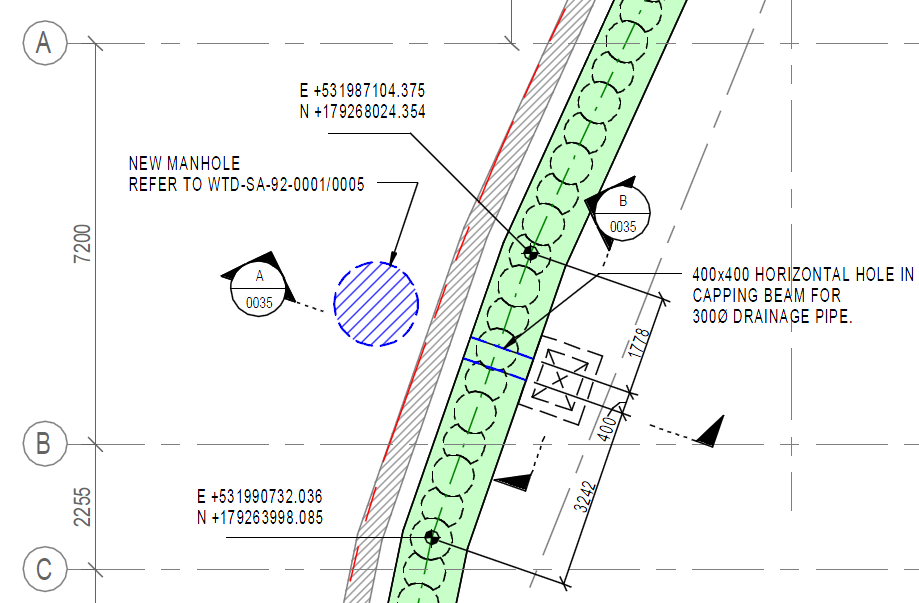
Structural Drawing showing location of Manhole 02 further away from grid line B.
So to fix the problem, as the issue was realised after constructing the manhole, a new header will be constructed – not hugely difficult, but it will cost someone something (more below).
Here is the real issue – Invert Levels.
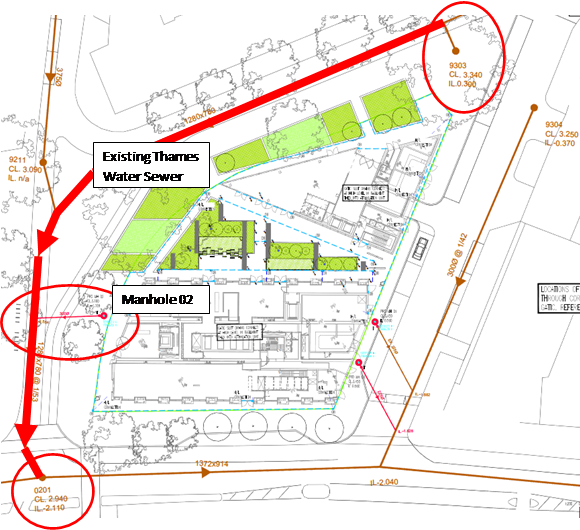
The drainage drawing of the existing Thames Water sewer invert levels looks to be correct. Invert levels taken at other existing manholes gives a pretty accurate picture. However when the heading from Manhole 02 was excavated towards the existing sewer no existing sewer was found. Mystery?
Earlier in the year a ground penetration radar survey had been done to identify existing services. At the time it showed that there were pipes under the ground so everyone was content. However, on further analysis of the study it appears the following was found:
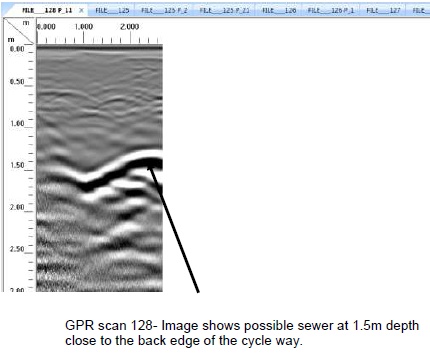
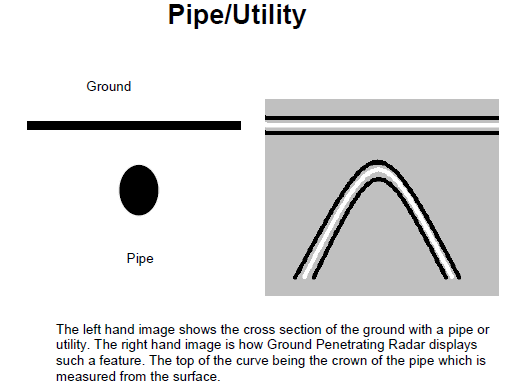
Print screens from the GPR report – pipe identified at 1.5m below ground level.
The GPR survey showed the following:
Ground level: 3.15m AOD
Pipe depth: 1.5m below ground level
Pipe diameter: 1.28m
Therefore invert level of the actual existing pipe: 0.37m AOD
The issue?
Going back to the drainage drawing the Invert Level of the Manhole 02 connection to the sewr is given as -1.109m AOD. Last time I checked water flowed downhill…
So why was the Invert Level designed at -1.109m AOD. Good old interpolation it seems. An upstream and downstream set of invert levels were used to interpolate between to give a connection invert level. Good idea, but as there is no pipe there it seems somewhere beyond the connection point the sewer drops down – i.e. runs at two gradients. (1 in 53 gradient now seems a bit steep).
So what?
For a start the issue is not resolved yet. There is little point burrowing around until we find the pipe. A drainage team are being employed to run a camera down the existing pipe to understand what it does. More onerous for the designers the difference in height of over 1m puts the inlet into the building higher within the basement level 1 floor – I am sure that can be overcome, but again someone will have to pay for that change. As we are still pre-contract, novation not yet occured, I suspect Laing O’Rourke will push the client to pay.
Health and Safety
This week we had a health and safety stand-down. This was not due to an incident on my site, but as a bit of a pre-emptive measure because there have been a number of reportable incidents on other Laing O’Rourke sites of late. We got the workforce look around their work areas and identify hazards and press home the importance of keeping walkways open and clear. A useful exercise, if nothing else to reinforce how important safety is on site and that starts with the basics of access.
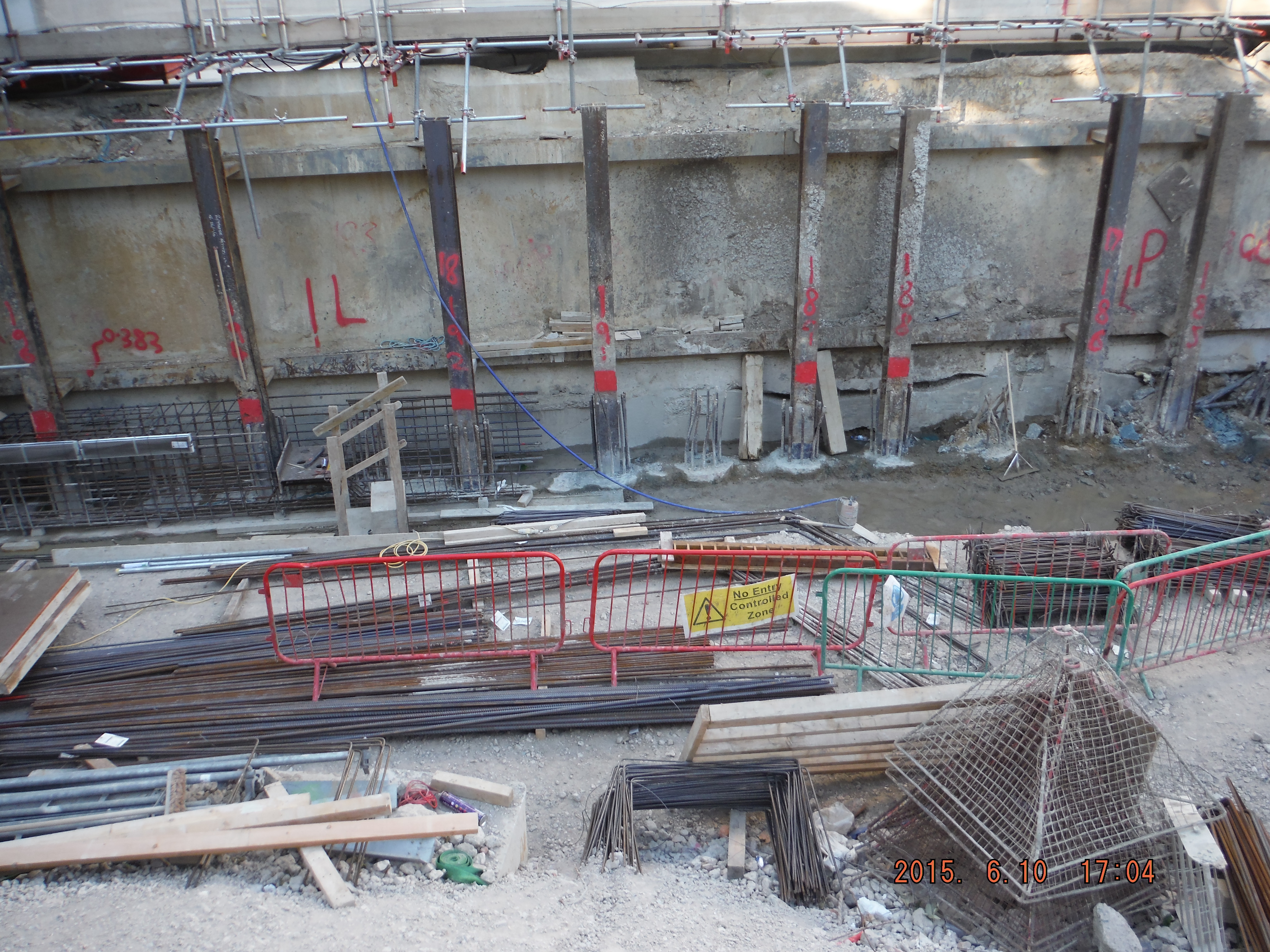
You would almost have to try and obstruct a walkway as much as this!
Later in the week we had a Laing O’Rourke Safety Leader visit. The site was looking far better than it has done – segregated work areas, banksmen, coordination, signage and it generally appeared tidy. However, we have a sub-contractor, Murphy, undertaking works to install further manholes (and to fix the debacle around Manhole 02 I have mentioned above).
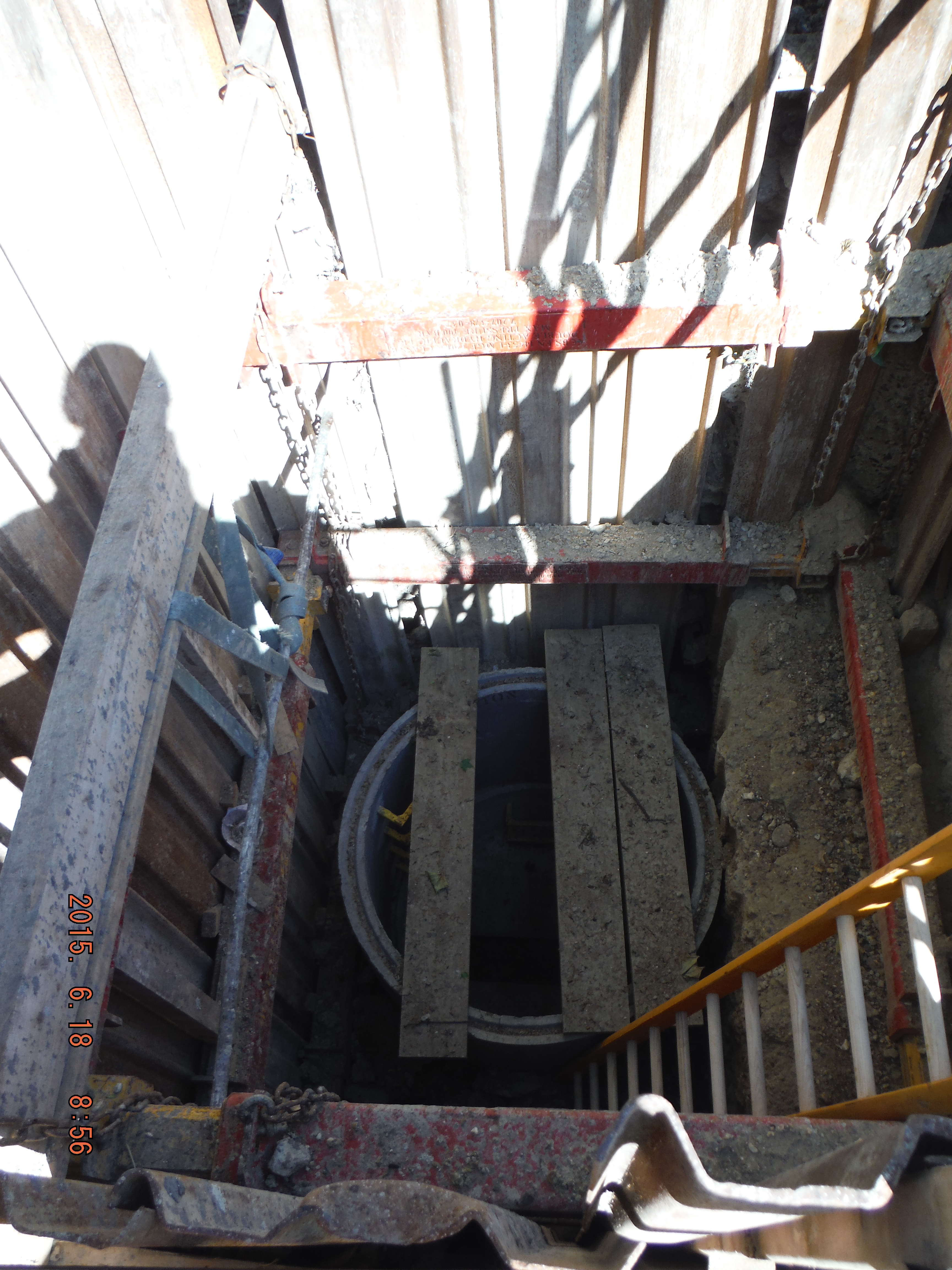
Manhole 02 temporarily paused while the connecting (existing) sewer is found.
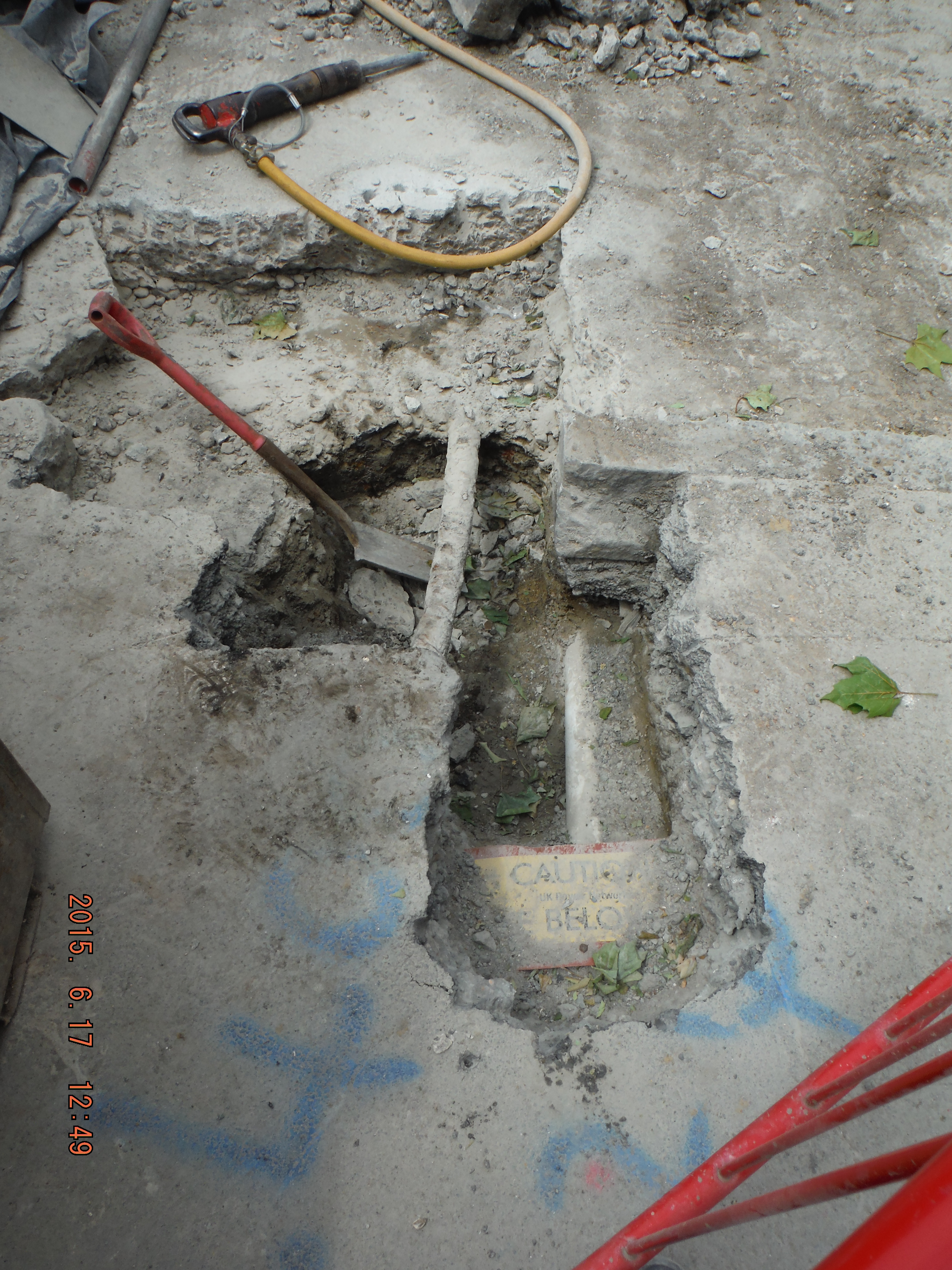
The start of Manhole 03 – plenty of existing services to deal with.
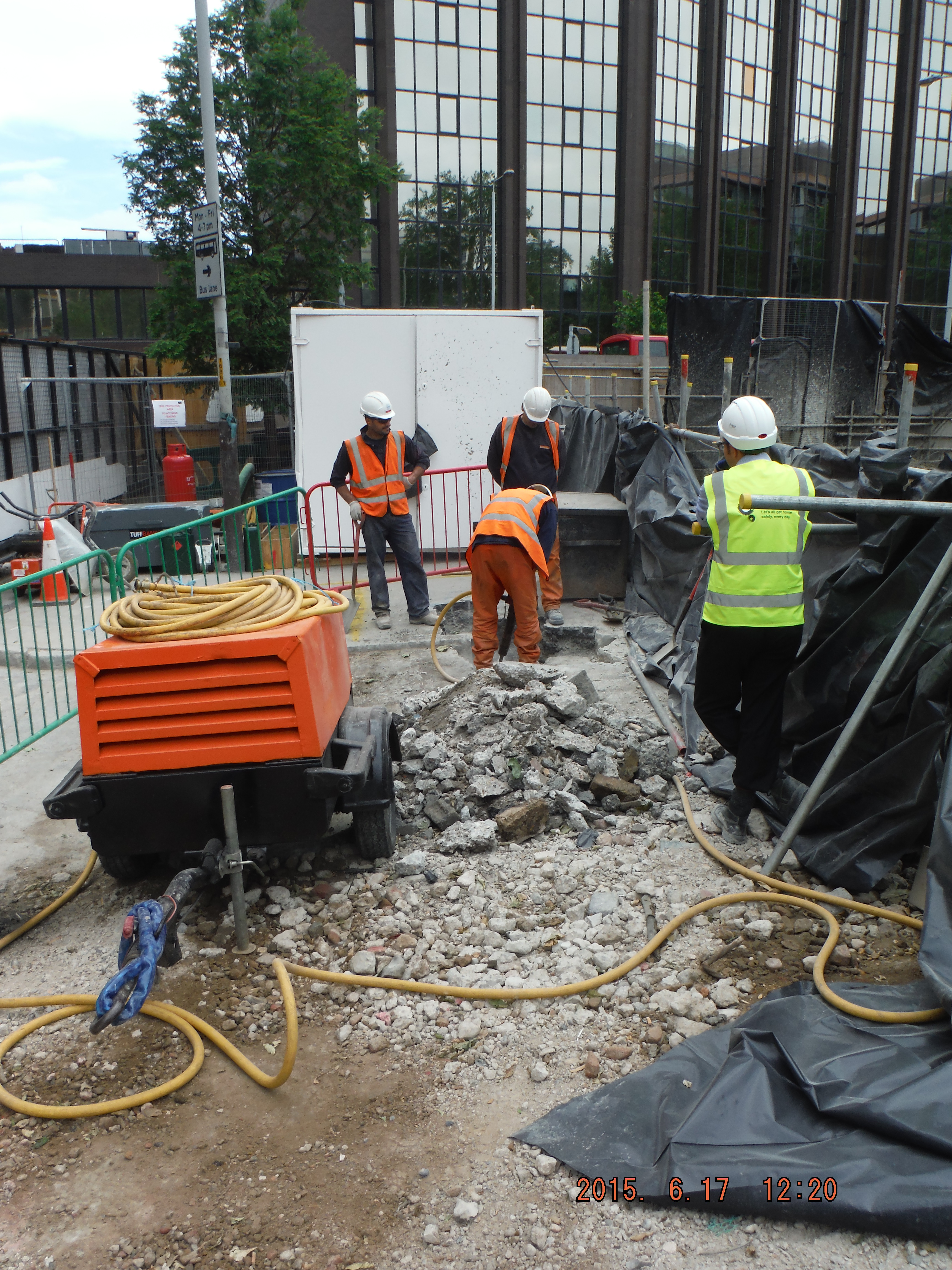
Manhole 03 – confined space approaching as the hole is deepened. Compressor fumes settling into the hole (confined space) present a significant hazard.
The question was asked, from the Main Contractor (Expanded Structures in this instance, filling the One Team role of working for Laing O’Rourke), who is confined spaces trained? The second question was, what is a key hazard of working in confined spaces? Not my answer, but one I might have given is: structural integrity of the hole being dug. No – fumes from both the compressor an excavator filling the hole so when the operative enters he gets into difficulty. Clearly the Murphy operatives need to be trained in confined spaces, but so does the main contractor.
So What?
“Under domestic law (the Health and Safety at Work etc Act 1974) employers are responsible for ensuring the safety of their employees and others. This responsibility is reinforced by regulations.”
The Confined Spaces Regulations 1997 contain the following key duties:
avoid entry to confined spaces, eg by doing the work from outside; (not possible)
if entry to a confined space is unavoidable, follow a safe system of work; (yes in place) and
put in place adequate emergency arrangements before the work starts. (yes in place)
Even though safe systems of work have been checked, because there is deemed to be a lack of competence (no training) of the main contractor to supervise the works, this must be rectified and an appropriately competent person will need to review the method statements and emergency procedures.
Reflecting on this – it now seems pretty obvious that to adequately approve a sub-contractor’s safe system of work, the main contractor must be trained (in this case in confined spaces). The question is what is competent. If it is where all practicable measures have been taken to reduce risks, then we fail – experience without training is perhaps another way of saying it worked last time so it’ll be alright this time – i.e. a dangerous place in be and we are not even in the hole yet!
Finally a couple of concrete finish photos: F5 (flow not slump), C40/50, Waterproof concrete…
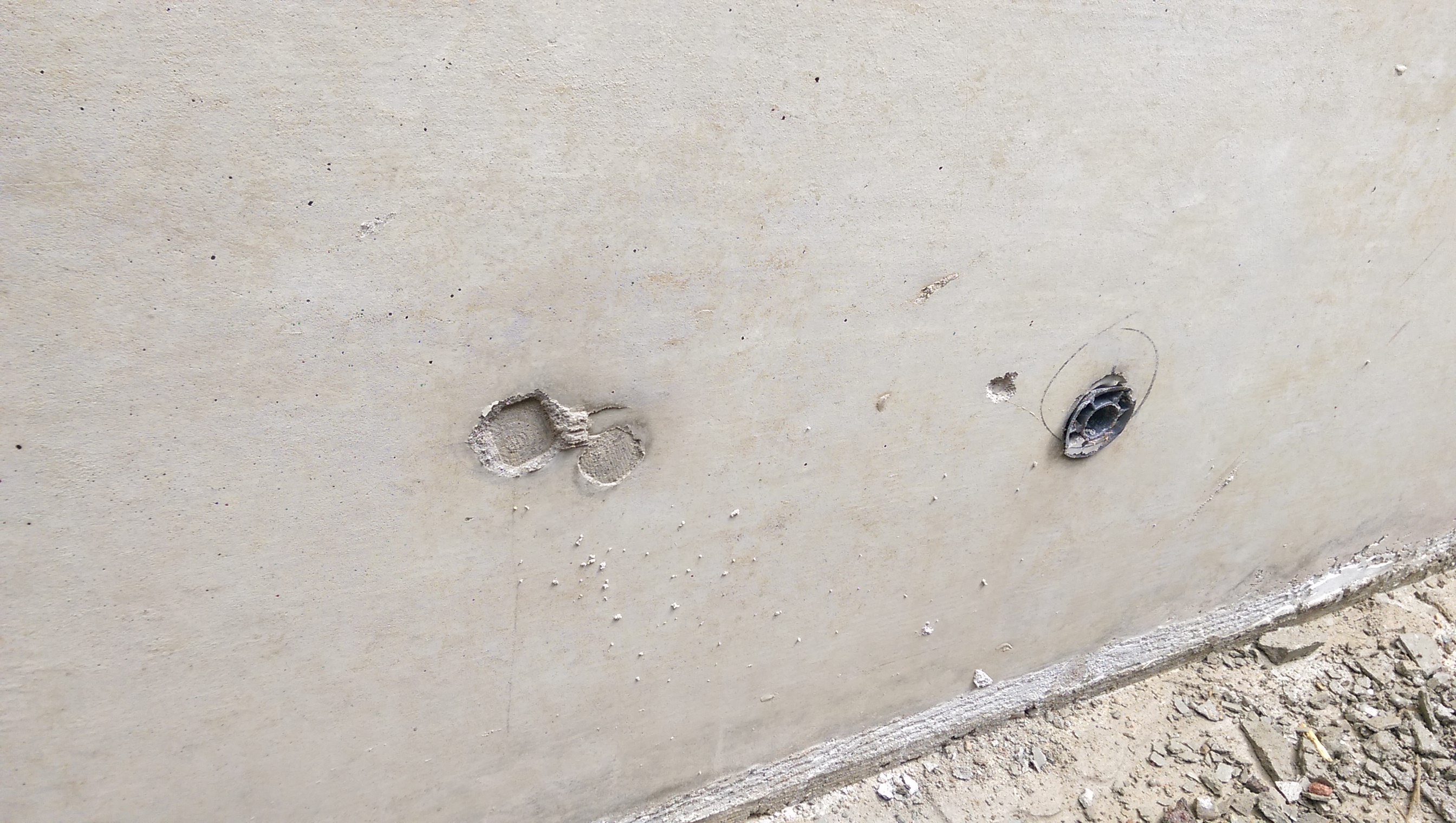
Decent finish, shame about tie bar holes.
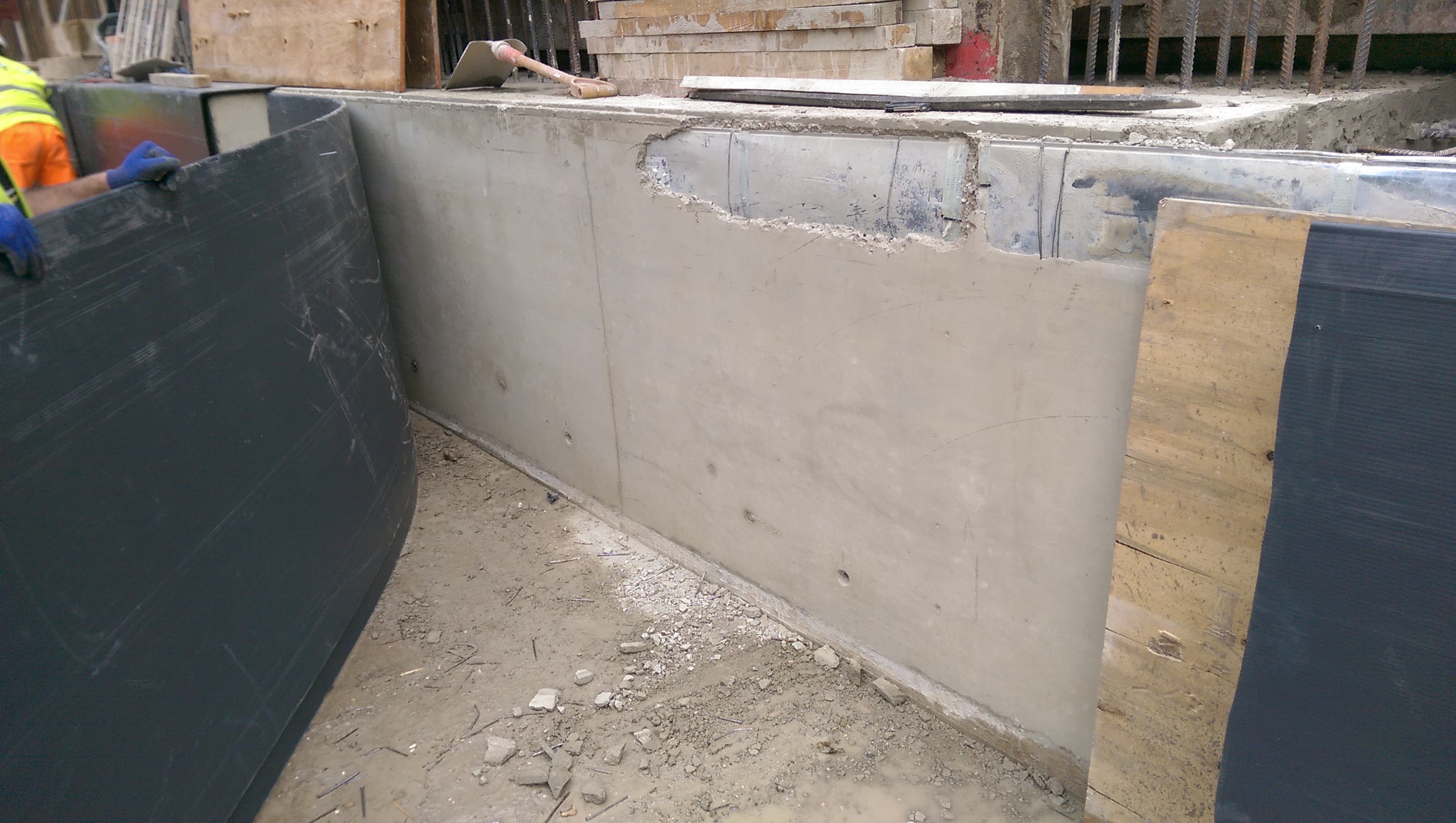
Cordek plastic sheet being used to protect the face of the capping beam. Kwika strip being revealed at the top of the beam.
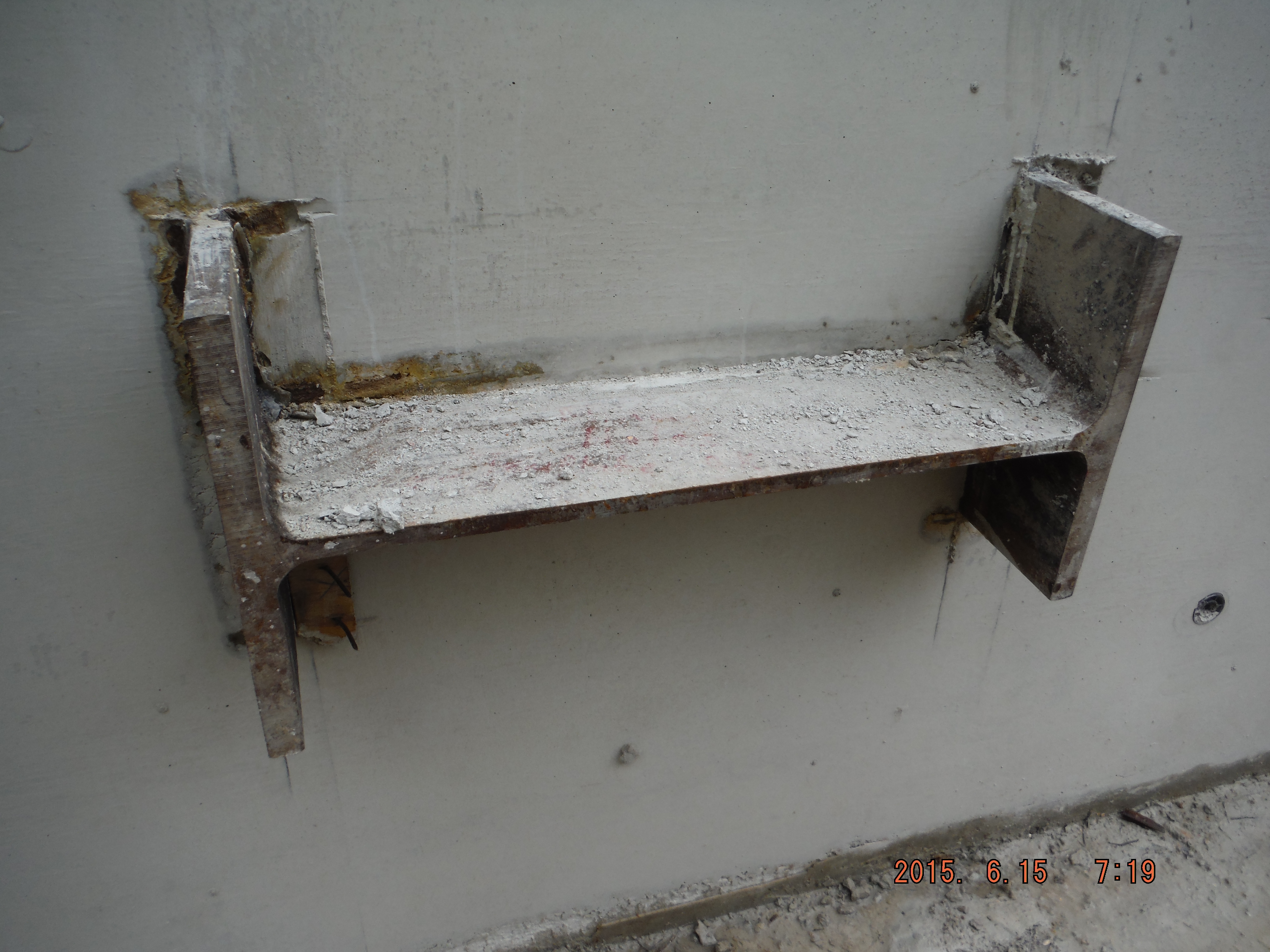
Shear stub for props – note fibre board used to create a recess around it to allow the stub to be burnt off and made good many months down the line.

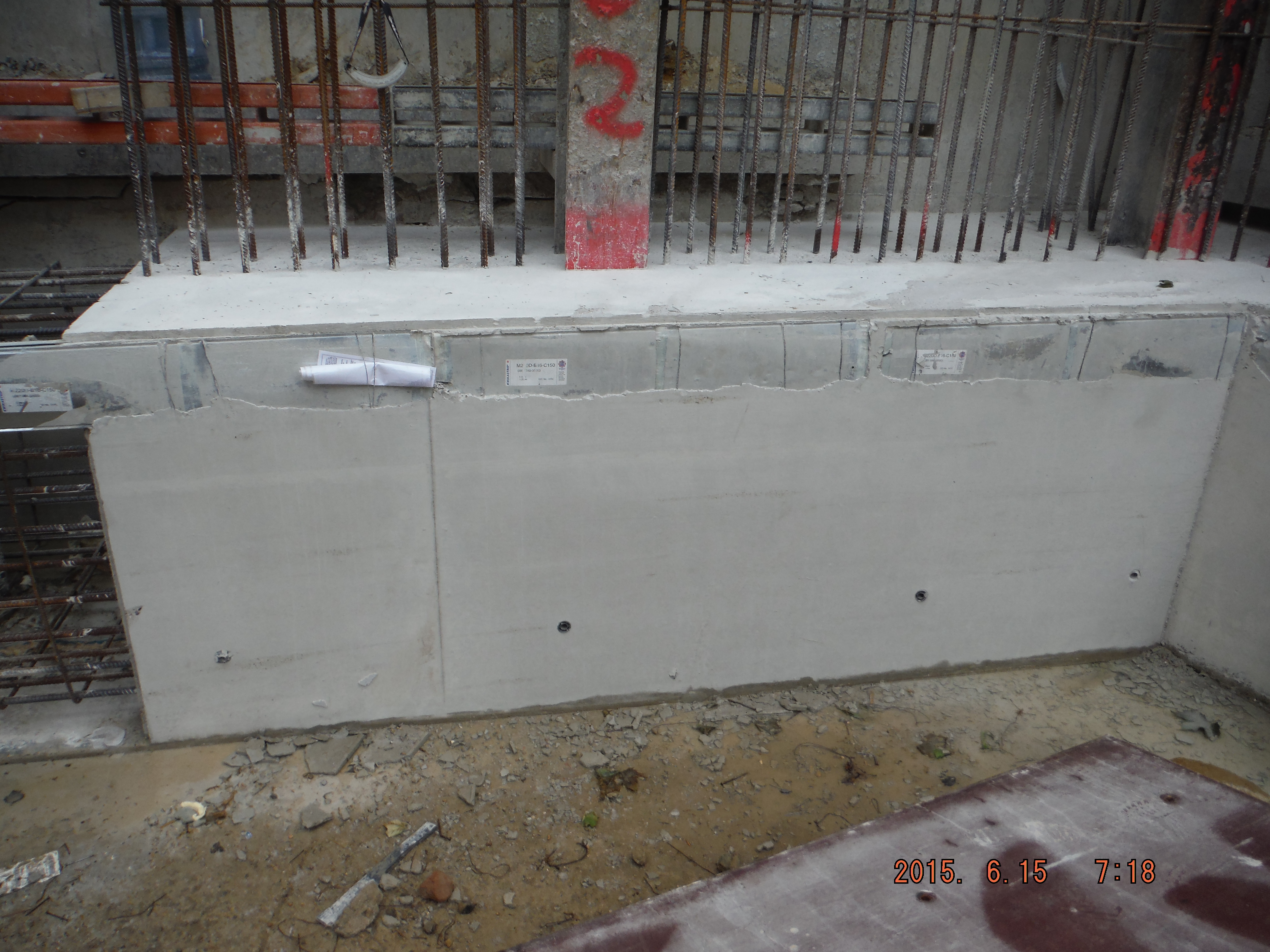
More of the same – note blinding layer at base of capping beam to be removed during excavation of ground.
 Holdfast Training Services Trial Blog