Archive
Mortar, PT and Mily Cyrus
Two points of interest this week.
Firstly the Mortar Silo. This is not where we store the mortar rounds on site. My site is in West London, not America and therefore we have no need for heavy armourments to protect against the gun toting British, gun toting police or indeed gun toting population.
It is in fact where we store the mortar for the Blockwork. A package I have been given to look after. “Sort out the silo” I was told. “Easy” I thought (once I’d googled what one was). Oh how wrong I was!
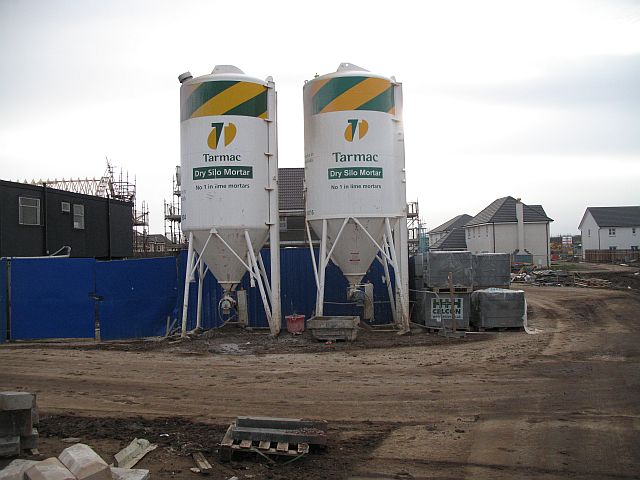
The first question I tried to answer was “where should it go?”. Our construction manager picked a spot, then went on holiday for a week. In his absence everyone else agreed that was a stupid place to put it. So another spot was picked with the assistance of the man from Tarmac who came to site on a recce. The silo requires water and power. The location chosen is against a fence along which the water ring main runs – so a tick there. It’s also next to a large steel portal frame building where prefabrication will occur. That building has lights and stuff so I thought the electrical bit would be fine. Wrong again. The building does have electickery but it’s not turned on. And won’t be until the road has been dug up (again). I’m hopeful it will be on in time but I’m not so sure.
Next it needs to sit on a concrete slab. This slab must be 400mm deep (to accommodate some holding down bolts) but cannot be higher than 100mm from ground level. So we need to dig a hole. In a car park. Made of concrete. Laid on top of cobbles. With train tracks in it. Oh dear.
Then there’s the bolts themselves. Tarmac sent me the spec for the bolts but couldn’t send me setting out details since the silos are apparently made by someone with the accuracy of the Royal Artillery and therefore no two are the same. The only way round it is to sit the silo on the slab. Drill through where the holes are and attach the bolts all while hoping it doesn’t fall on you. So we’re going to use our massive forklift to hold the Silo in place while we mess about with the feet.
So it looks like I’ve sorted it, or at least I would have if the Blockwork sub-contractor would tell me how many of the things he wants!
My other headache this week was the PT slab. The first one should have been poured on Wednesday, but the designer was working for PC Harrington, who didn’t pay them. So McAlpine paid them and they did the work. The pour was then rescheduled for today. It isn’t happening. It was discovered yesterday that Arup (the principle designer) had designed the building with a certain tolerance for differential settlement between the building core and the surrounding slab. This was published in their “movement and settlement report” which was issued to PC Harrington for onwards dissemination to the PT designer. It never got there. So the PT slab was designed with a different set of applied forces to that which Arup thought it should. Arup ran some numbers and told the PT designer that they’d have to do it again increasing shear by 12%, bending moment within the slab by 10% and (this is the biggy) punching shear by 38%! The PT designer is not happy. They think that they’ve done what they were asked since the Arup PT spec doesn’t mention the report and they were never given it anyway. They say the recalculations will take 3 days and cost “thousands”. After the calcs the additional steel will need to be ordered, delivered and installed. So we’re probably looking at a week delay and the associated penalties.
McAlpine blame PC Harrington for this (along with the current delay, the poor quality concrete finish, third world poverty and Mily Cyrus). PC Harrington think it’s Arup’s fault as their spec doesn’t specifically mention the requirement to design in accordance with that report. But it does say that all “relevant reports” should be considered. I would say that the bit of paper that quantified the differential settlement is fairly relevant.
Previously I spoke about how people within Arup weren’t talking to each other and therefore the drainage and the reinforcement steel clashed all over the place. That was clearly a communication problem. So is this. There have been numerous examples where a specification or a drawing says something that is ambiguous, as a result the product is not quite what the designer intended. Some of this is inevitable, it is the shortfall of language. But some of this is down to people using flashy words when they don’t need to. It not just a military problem. While I’ve not heard anyone ask for “greater granularity” on anything yet, I have heard loads of people attempt to describe something in words when they should just draw it, or use clever sounding words when they should just use plain English. This is particularly relevant when a lot of the people who do the lower level design work don’t speak English. Or at least not any better than I do.
So if part of the point of AMRs, TMRs, essays, etc is to ensure that PQE Officers can write in clear English – I say good. And for future courses maybe there should be more of them. Along with stretcher runs, drill and CBRN training obviously!
Finally a shimpf: a few weeks ago I posted a link to our justgiving page for sponsorship for an event. The support has been somewhat underwhelming. I know its not a military charity but I do think it’s a good cause. It all goes towards improving infrastructure in some of the worlds poorest places. Places most of us have seen and so probably understand how shit it would be to live there without clean water or electricity. Please help!
 Holdfast Training Services Trial Blog