Archive
Silly Money
In the original contract BoQ we agreed to pay PCH nearly £1000 per tonne of reinforcement steel to procure and fix the steel. When PCH started having cash flow issues back in March, McAlpine started buying in the steel themselves and free issuing it to PCH. Since McAlpine were paying for the steel it was decided that they (and by that I mean me) should call it off too. An agreement was made with PCH that we would subtract how much we were paying for the steel from PCH’s BoQ rate and pay them the rest.
Then when PCH went into administration a couple of months ago we started paying the steel fixers directly too. So again, we deducted that amount from the BoQ rate and paid PCH the rest.
While initially that made sense: we couldn’t be sure we’d get the steel at the same rate as PCH so we minimised the risk by guaranteeing the combined rate for supply and installation. But now we’re in a position where we pay around £250 per tonne to buy the steel direct to the supplier. We then pay £500 per tonne direct to the sub-contractor to fix the steel. We then give the remaining £250 to PCH for what? Currently we’ve given PCH nearly £250 000 for doing nothing.
McAlpine chose to minimise their risk by ensuring they would never have to pay more than the original BoQ rate, but they missed an opportunity to pay less. It seems so obvious but a SWOT analysis of the situation probably would have identified the opportunity to make a saving, but no one did one. They simply identified a risk and dealt with that.
While I accept the risks are hugely important, I would suggest the SWO is important to and therefore before dealing with the risks we should first identify the other elements in order to make a fully informed decision.
The Coffee Cup
As the summer weather sets in construction of a new part of the campus begins and I have been given the responsibility of ‘Structural Lead’ for what will eventually be a Central Utilities Plant (CUP) building which will provide the cooling loads for the buildings on site. The structure itself is around 55m x 65m and is a steel braced frame construction sitting on a mixture of shallow concrete strip and pad foundations. The exterior will be clad with insulated metal panels, with one of the elevations detailed so that it can be disassembled at a later date and expanded, as and when the campus is expanded. This bit of the design echoes the nature of the entire project, which is expansion and longevity of the campus. The site is located on what will be called Coffee Road, and so some of the funnier members of the team have taken to calling it the Coffee Cup. All of the footings have been poured, with base plates set into them onto which the steel columns can be placed. Late last week I conducted a random check on some of the steel that has been delivered to site and cross referenced with the shop drawings whilst the contractor who is responsible for constructing the CUP structural steel surveyed the base plates to ensure that the concrete contractor had placed them in the correct location. All but one were approved on the as-builts and so work has just started erecting the steel, with an RFI submitted with regards to the erroneous plate. I had a slightly harder time however because for some reason the numbers on the steel work corresponds to the field set of drawings, which in turn do NOT correspond to the shop drawings. Quite why is a mystery however after much panicking I got to the bottom of the issue and the simple one man task became a difficult two man task with me cross referencing field drawings and shop drawings in order to ascertain which bit of steel we were looking at and whether or not it was correct.
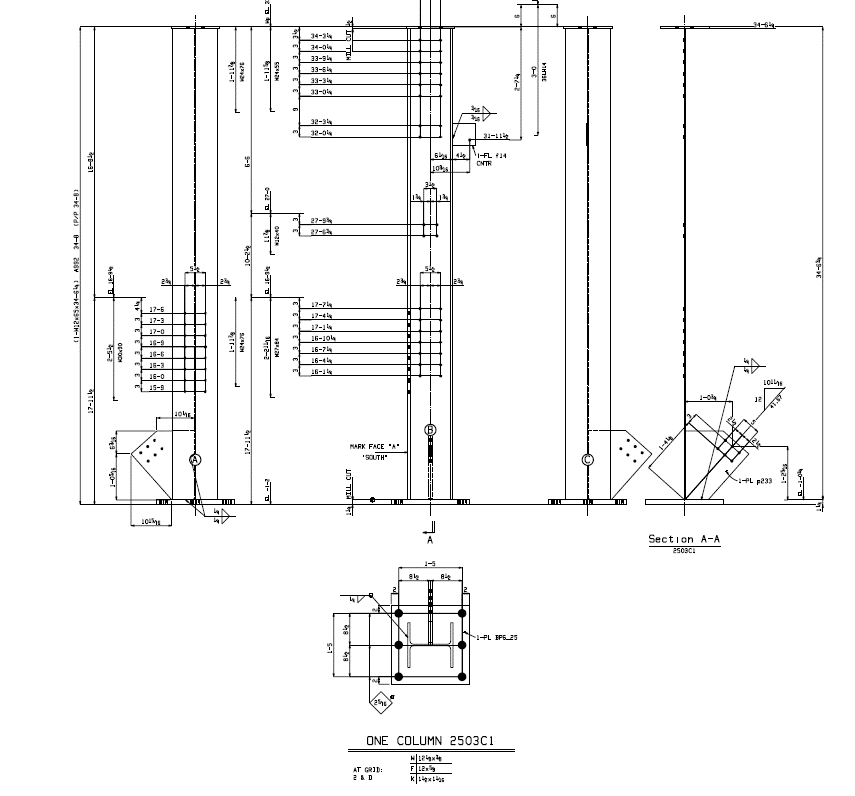
Example of Field Drawings for QA
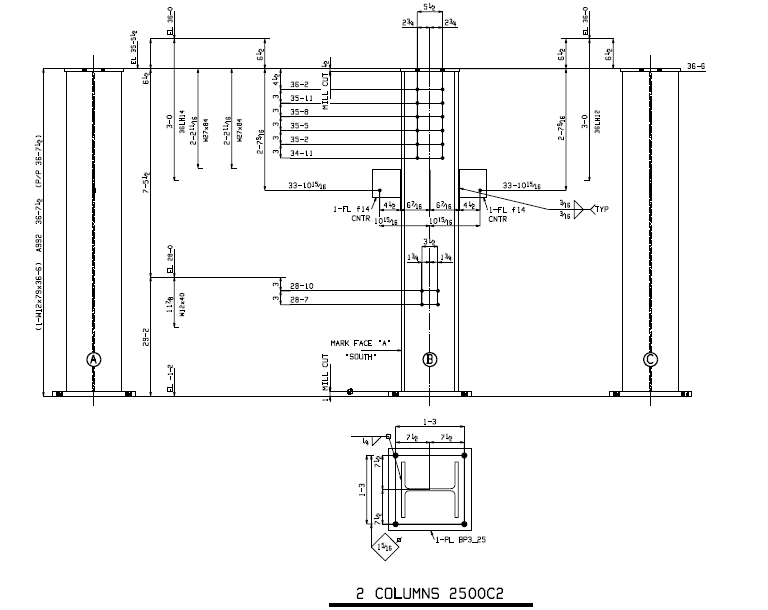
Example of Field Drawings for QA
Note also the lack of scale, which was initially confusing. The upper and lower holes are separated by c. 10”
Concurrently to this the concrete Slab on Grade (SOG) is being poured, with the second of four (2/4) pours complete already. The SOG is 6” thick with minimal bottom reinforcement and so the QA checks were fairly simple. An earlier RFI for the masonry walls location caught me out however as the approved reinforcement detail for the starter bars at these locations was drilled dowels, to be installed at a later stage, as opposed to what was shown on my field plans, which is the normal bent rebar protruding upwards.
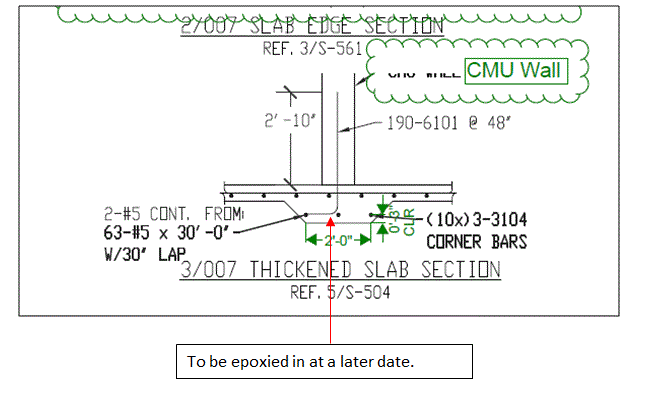
Lesson – keep abreast of the RFIs.
Mostly the pours went well but I saw an impact on the project which some of you may or may not have come across, but which is very difficult to mitigate.
About a quarter way into the 2/4 SOG pour at the point of the second slump test there was a recorded measurement of 11”. This is 2” out of tolerance and should have been caught as the first concrete came down the chute and into the pump. It is at this location where the first of arguably three slump tests is taken.
The worker here, who works for a third party QC contractor, is hugely experienced and can estimate to within a half inch what the slump of the concrete is. The reason I say that there are arguably three slump tests on the concrete is because as it comes down the chute he is supposed to estimate whether the concrete is compliant or not; if not the truck is immediately told to cease pouring so that only minimal deficient concrete enters the pump. This is done because the actual slump test cannot be conducted on the first 10% of concrete in accordance with ASTM C172 and ASTM C143. In short the issue is that the contractor at the chute should have identified the fact that the concrete was deficient. Instead he had given a positive reading to us that the slump was only 8”. Some might call this a lie.
As it turns out there is a bit of history with the worker in question who is, by all accounts, a disgruntled employee for reasons which I won’t go into here. Since it was too late to turn the truck away at this point and deficient concrete had already been placed it was noted exactly where the deficient concrete went in the slab (2 locations) and additional cylinders were ordered by the Principal Contractor. It is anticipated that these will close out the deficiency when tested as the slab is only rated at 4500psi (30N/mm2) and most of the tests come out higher than spec. but if not then core samples will be taken and the way forwards decided from there. Since the incident the worker in question is closely supervised. I’m not sure of the politics but to my mind he is tying up additional manpower and should probably be re-tasked.
Away from this I have had my first Health and Safety impact on site. The issue was to do with a slope stability problem next to one of the haul roads which runs adjacent to a sizeable chiller pipe chamber (essentially a big hole) As I was driving from the Coffee Cup back to the office I noticed that the batter angle on the slope was near vertical, and that there were track marks right on the edge of the road. I recognised the signs of a slope failure which I attributed to reduced shear strength of the soil (due to afternoon deluges we experience) and surcharge (of the tracked plant). My concern was that given the location of the tracks, which were right on the edge of the haul road, and the location of the haul road with respect to the gaping hole that a vehicle could easily cause further failure and would subsequently topple into said hole. I called the Principal Contractor who agreed to ‘have a look’ at the area. They obviously agreed with my assessment as the road was re-graded the next day and concrete barriers were placed along the edge of the road to prevent vehicles tracking too close to the edge again.
In other news
My car MPG is noticeably lower of late. As I’ve mentioned the weather is hotting up. The only reasonable explanation, from an E&M point of view, is that this has caused the many thirsty horses under my ‘hood’ to become thirstier. It did pass a rigorous 5 minute annual emissions test though. I’m not sure how, I can only assume that the test is to verify that it does have emissions.
I also recently participated in ‘Organization Day’ which marked the 240th birthday of the USACE, which is two days older than the Army apparently. It was a good day out with ‘soccer’ and volleyball tournaments. I was more use to the soccer team, with 2 goals helping ease the RSFO team to the trophy. Unfortunately I did little to halt the demise of the volleyball team, losing as we did 25-9. Good ‘cook out’ (BBQ) though.
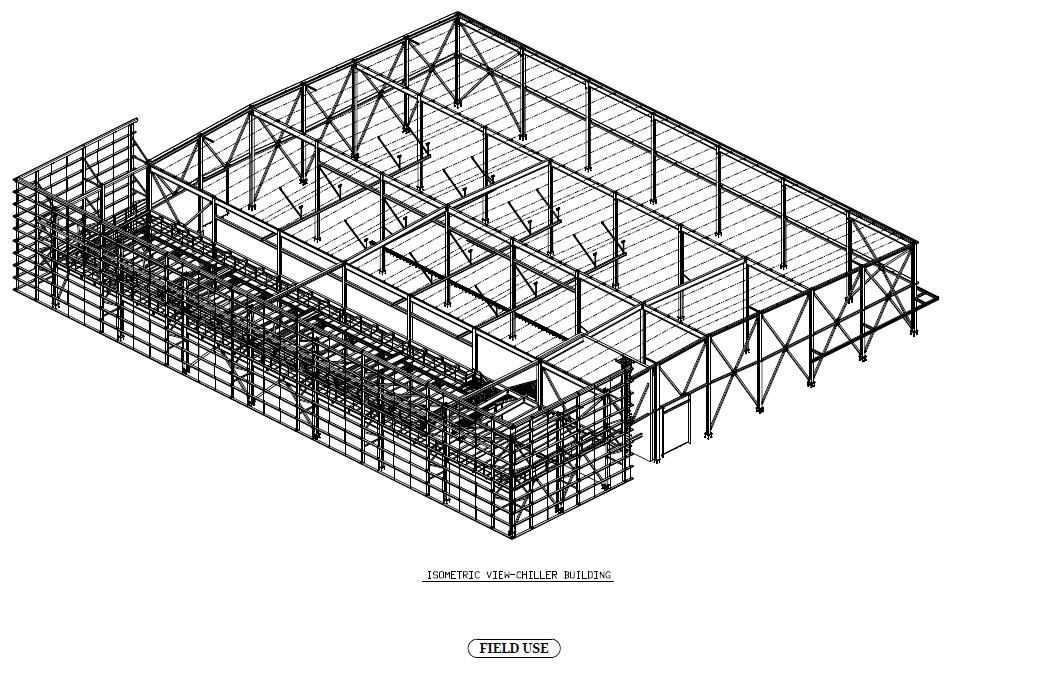
The Coffee Cup
 Holdfast Training Services Trial Blog