Archive
The Good, the Bad and the bloke setting out
It seems to me that there are two types of engineer. I don’t refer to those people that sub-contractors refer to as engineers that just carry a total station around all day, they are not engineers. Instead I refer to good ones and bad ones. A good one looks at something, asks a million questions about it, wants to know all the details and then enters them into a spreadsheet. A bad one says “fuck it – that’ll do” and moves on to the next thing.
On my site we have this:
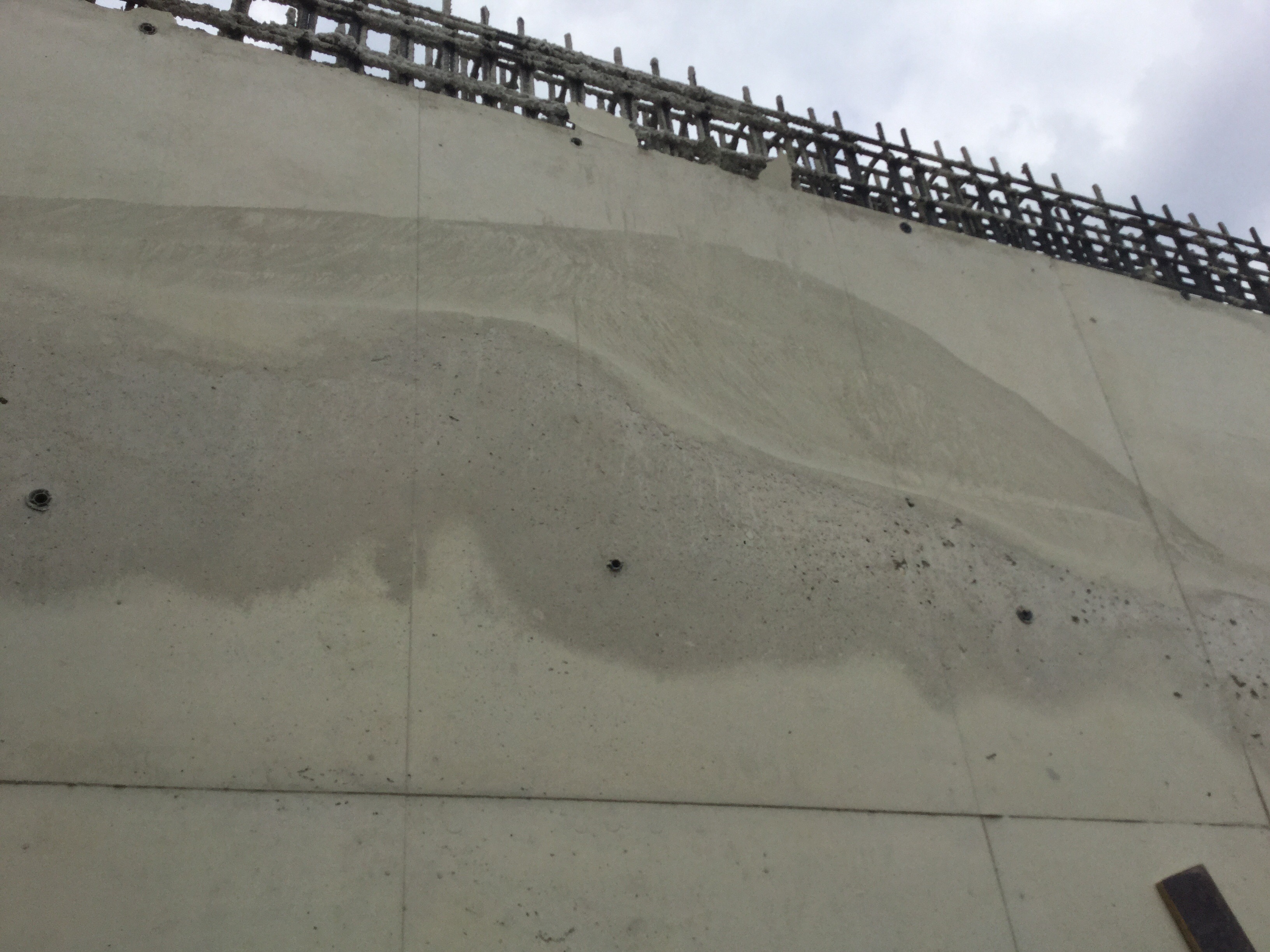
Discolouration in concrete retaining wall
I looked at it and went “oh look, funny colours”, then moved onto the next thing.
Luckily we have a resident engineer from Arup on site called Tom (who incidentally once held the world record for the tallest tower made of dominoes). He looked at it and asked “why has it done that?” And a good job he did too. It turns out the upper bit of darker concrete is simply a higher strength concrete that was put there by mistake, no dramas there then. The lower bit it turns out is where the cement and fines have migrated up within the concrete and the aggregate has settled out. While we can’t be sure why this has happened it is believed the concrete was at the sloppy end of the allowable slump test result and the man with the vibratory poker lift it in the concrete while he went for a fag.
This is a problem because if there is no cement or fines around the aggregate at the bottom it will not be bound together properly. If there is no aggregate in the top bit then it won’t be strong enough. So we’ve ordered some cores to be taken. If they pass we’re ok. If not the wall will have to come down.
I have learnt a lesson: Ask more questions! Ask why much more often. It might make all the difference!
Stay tuned for the results of the core tests and the DNA test to see if Tom is in fact related to Damo….

Tom and his dominoes
Commercial 101
Learned about the ‘start calc’. A walk through – talk through of a JHG system which identifies areas of risks and opportunities, and the monetary values attached to them. The estimating team feeds data from the project tender to us which is effectively the cost code budget. The forecast then informs the start card. Not used by all sectors within JHG, it is favoured by the operations manager (Dave) who the PM reports to. I liken him to John Moran – been around too long to entertain bullsh1t (pardon my Aussie).
The start card is a logical user friendly tool to turn qualitative opinions into quantitative estimates e.g. ‘we reckon we’re going to make a big margin’ as opposed to ‘how much’ do we reckon we will make? It takes the individual cost codes and churns out a plus or minus value from how we estimate we can do the ‘work’ for against what the estimators thought when we tendered for the project. It’s the profit ‘P’ of the triple bottom line.
In forecasting, I have produced product breakdown structures which have created work breakdown structures. From that I have built up cost breakdown structures (thank-you Steve Payne), and coughed up a dollar value for the ‘cost code’. If this is higher than the estimators envisioned, the code is in the red and vice versa equals in the black. Follow suit for all of the cost codes by the team members and we land up with a total bottom line red or black figure for the project. (It should be mentioned that my team does not use the APMP method and the feedback has been positive).
Too much in the black and JHG senior management will take money off our project to offset projects which are heading south. The trick seems to be to lie through your teeth with a smile on your face. Find places to ‘hide the fat’ e.g. $30k on ‘small tools’. The point being that if you show your cost breakdown to match (or darn near equal) the estimate from the tender estimate, the JHG powers that be will leave you alone. Dave wasn’t born yesterday and he knows the score, he just can’t prove anything – yet.
Another angle is that from a quantitative direct cost risk analysis process (as used on my project), both opportunities and risks are assigned monetary values. Take the value of the cost code and multiply it by the likelihood of an event occurring and voila – you have a red or black number (risk or opportunity). Any ‘fat’ i.e. black you accumulate is then used to offset the red figures from incompetent estimating or ‘Jonahs’. Essentially nothing more than a contingency fund. Like anything, too much of it (visible) is bad as the senior management will transfer it to another suffering project, not enough and the project is costing JHG money.
So this morning taught me to keep your friends close and your enemies closer. Hide the money up your sleeve. Also, bad news is best delivered early. Make your superiors aware of the curve early so that they can fleece other projects to help you, rather than waiting until the project is a hopeless flop and then begging for handouts.
In other news; supersize your kangaroo leather hat with a genuine kangaroo scrotum bottle opener for just $30 AUD extra.

Roo sack – gen.
A Novated Contract
My project was originally run to tender in 2007 but our bid fell short. When the economy did a summersault the project was shelved. In 2014 it was revived however our new bid was also declined and most of the tender work was thrown away. Within a matter of weeks BamNuttall were asked to resubmit it’s tender as T&Cs had not been agreed with the 2014 contract winner and the they had pulled out…cue alarm bells!
The revised 2014 quote was c.£400k lower than the initial 2014 quote. It was accepted pending two key conditions:
- A team would be mobilised with immediate effect and begin work (this took a week). This was necessary to comply with planning conditions outlined by the local authorities.
- The original designer who designed most (not the river bridge) of the 2007 scheme would be novated to us under a D&B contract but they would now become the sole designer for the whole scheme and adopt the original river bridge design from Halcrow.
Novated – I had to look it up but in effect it means that you take on the asset under the original T&Cs.
The Problems…
- The original river bridge was designed by Halcrow. The designs were handed to WSP but none of the supporting calcs, therefore WSP had to pretty much redesign the whole bridge prior to an external CAT3 check. This was not costed in the tender. It also lead to lengthy discussion as to whether WSP accepted the risk when agreeing to adopt the bridge design or whether they were explicit in outlining the cost associated with a redesign.
- TrentPort (Client) use JCT contract for all of their other project. This was already in place with WSP when our bid was finally accepted. We have entered into a D&B NEC3 contract with the client however; we have taken over the JCT contract with the designer. This means that when we all sit around the table we are not contractually talking the same language.
- Value Engineering benefits the designer. Within the NEC3 contact we have detailed that any value engineering change will benefit us 75% and the client 25%. If this is a method change then no VI is required however if a VI is required then the designer will be paid and the profit reduce prior to the split. However, because the designer is in a different contract he has tied our hands on numerous issues and we have been forced to pay hand over fist to move the most simply checks and tweaks through.
The Sticking Point…
The relationship with WSP is frosty to say the least. The designer working on our project is a nice guy who appear rather uncomfortable at meetings when he’s asked to comment or make quick amendment. He simply speaks on behalf of his master and repeats ‘please formally request the RFI or design change, we’ll quote you for the work and then you must instruct us to carry it out’. As you can imagine this is a long, slow and frustrating process which often takes weeks for tweaks!
The Solution…
We continue to press on often building at risk or making quick changes to the programme to re-order the construction sequence whilst we wait for answers.
A meeting has taken place between our commercial team, our design co-ord and WSP. Some form of payment (details are unknown) has been agreed in order to speed up VIs, RFIs, TQs. Over the last couple of weeks there has been a marked improvement however the it feels like a triangular mine field where no one is willing to step in to the middle but would rather tiptoe around the edge and waste time and money.
SWOT
Guz hit the nail on the head when he mentioned the use of a SWOT analysis or lack thereof. The speed that this project was established was rapid, I spoke to Steve Payne a couple of weeks ago and he was shocked at how quickly things had moved. It appear that the focus was very much on the ‘O’ with a little ‘S’ thrown in for good measure but I’m not sure a great deal of time and effort was invested in to the ‘W and T’.
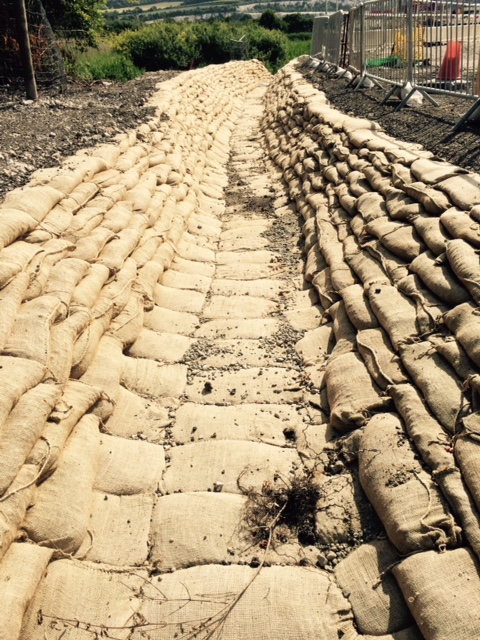
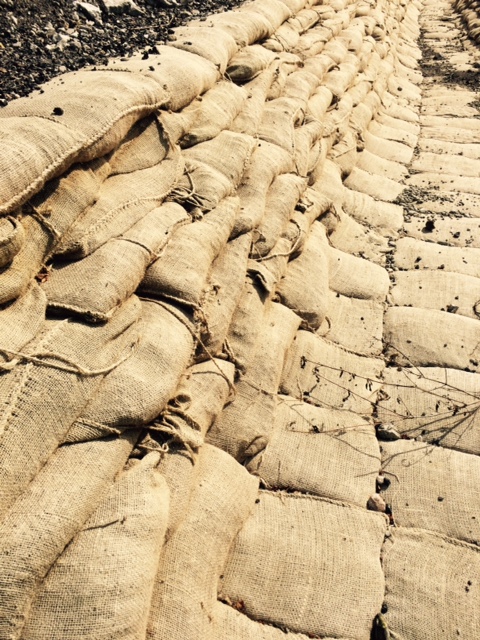
On a Lighter Note…Check out this sandbagging!
 Holdfast Training Services Trial Blog