The Good, the Bad and the bloke setting out
It seems to me that there are two types of engineer. I don’t refer to those people that sub-contractors refer to as engineers that just carry a total station around all day, they are not engineers. Instead I refer to good ones and bad ones. A good one looks at something, asks a million questions about it, wants to know all the details and then enters them into a spreadsheet. A bad one says “fuck it – that’ll do” and moves on to the next thing.
On my site we have this:
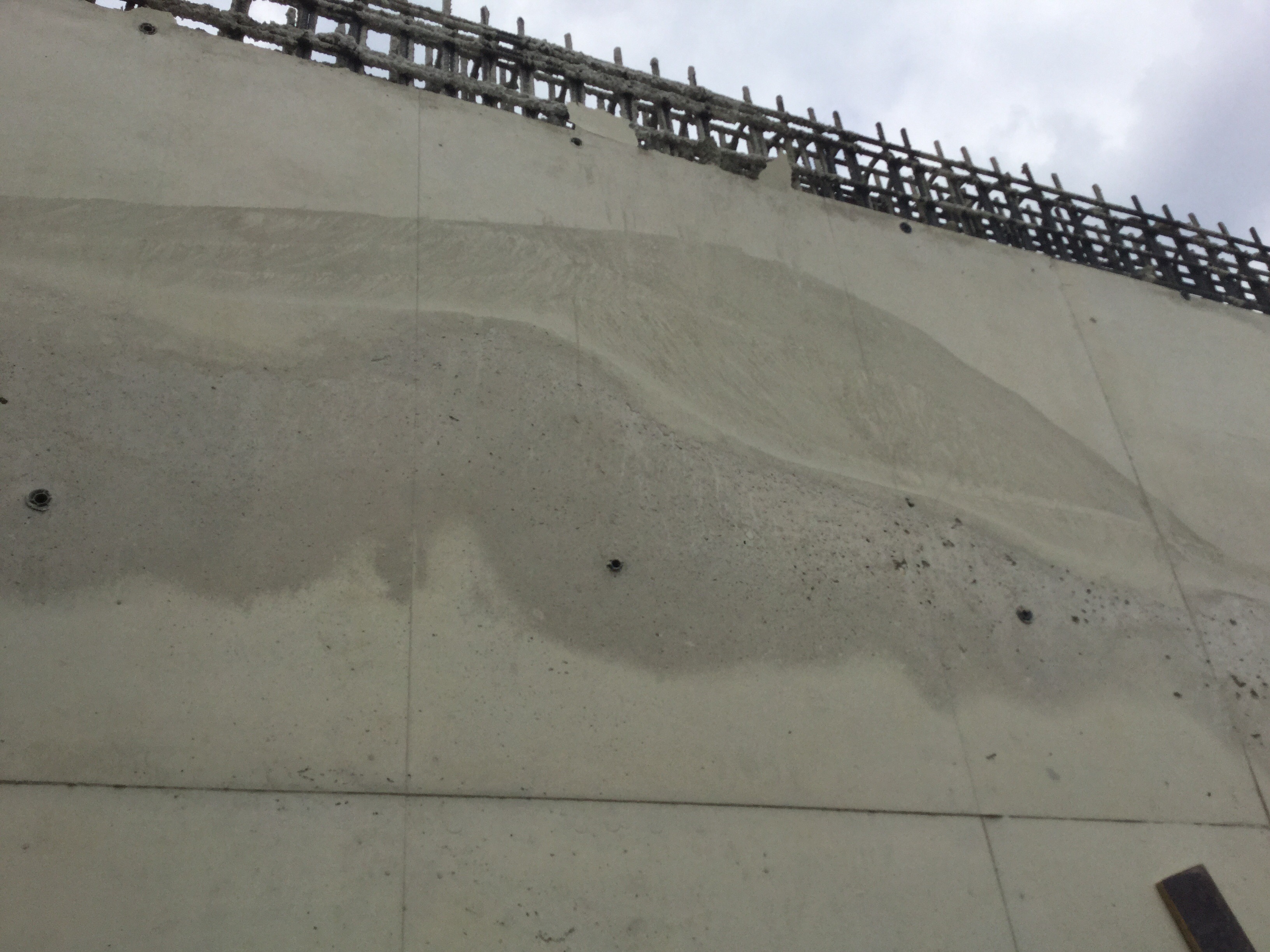
Discolouration in concrete retaining wall
I looked at it and went “oh look, funny colours”, then moved onto the next thing.
Luckily we have a resident engineer from Arup on site called Tom (who incidentally once held the world record for the tallest tower made of dominoes). He looked at it and asked “why has it done that?” And a good job he did too. It turns out the upper bit of darker concrete is simply a higher strength concrete that was put there by mistake, no dramas there then. The lower bit it turns out is where the cement and fines have migrated up within the concrete and the aggregate has settled out. While we can’t be sure why this has happened it is believed the concrete was at the sloppy end of the allowable slump test result and the man with the vibratory poker lift it in the concrete while he went for a fag.
This is a problem because if there is no cement or fines around the aggregate at the bottom it will not be bound together properly. If there is no aggregate in the top bit then it won’t be strong enough. So we’ve ordered some cores to be taken. If they pass we’re ok. If not the wall will have to come down.
I have learnt a lesson: Ask more questions! Ask why much more often. It might make all the difference!
Stay tuned for the results of the core tests and the DNA test to see if Tom is in fact related to Damo….

Tom and his dominoes
 Holdfast Training Services Trial Blog
Guz – Interestingly blog. A typically direct definition of an engineer!
Why were the two mixes mixed up? Was the rate of rise controlled due to formwork pressures or because of placement method?
It does seem like a long stretch to have been affected by over vibration – interesting that the visitor who spoke to us during the concrete module claimed you could not over vibrate concrete!
Who holds the risk on the pour if the core tests fail? Are you going to have to postpone other works to wait for the results?
Sorry, lots of questions and now one more:
Finally what was the temporary works platform/ working at height solution to get the domino tower record?
Yeah but no but yeah bit no but….
Damien had that right – it is nigh on impossible to over vibrate
Seggreagation is most likely in high consistence concrete with angular aggregate and low fines content….
Zoomin’ in a bit I can see a low of blow holes…. if anything this is under vibration
You often get blow holes near the top of a pour. They can be minimised by re-vibrating in the plastic state
Guz – Further consideration of the wall. The discolouration is simply due to the different cement content used in the higher strength concrete. You can pretty much see exactly where the different batch was used, how it was poured and flowed down to the right as you look at the photo. The jagged edge along the bottom is probably where the poker attempted to mix the 2 mixes together.
I am guessing, but I expect the different strength concrete had a different mix design, cement content or even type – hence the different colour. I would look at the pour history to confirm the details. Clearly a greater strength is technically fine, but visually not great!
I wonder if the different mix was used because you were waiting for concrete and were able to get some from a different mix (either that or the pour was not being controlled/delivery tickets checked)? If there was a time gap, it is possible a cold joint formed and the lower mix had started to cure? The issue would be if you had significant time between pours and the wall is in tension, there could be cracking along the joint (structural and waterproof issues). If the wall is in compression, clearly less of an issue.
Cracking photo – I recon there is a TMR worth of discussion here: from managerial aspects (pour controls) to technical aspects (cement content versus colour).
3 good comments from 2 good engineers clearly!
I wasn’t there when it was poured but I am told the two different mixes were from two different plants as it was getting on in the day and there was a concern that one plant couldn’t give us enough concrete in the time we had available.
I agree with the almost impossible to over vibrate comment, I have even made it myself on more than one occasion, so John might well/is definitely right (as always).
If the concrete should fail it’s the sub-contractor’s risk. They would have to break out and repour and make the time up or face a penalty. Not ideal when they’re currently 3 weeks behind having clawed their way back from 6!
John, we’ve banded this about in the office and we think you’re right. It was vibrated but not enough to get all the trapped air to the surface. We also think this is probably good news as it means that while it doesn’t look great it’s unlikely to adversely affect the strength.
And having conferred with Tom (who I am fairly sure is actually your long lost twin) he used a step ladder, a balcony, another ladder and a harness to do it. For more information please see: https://www.youtube.com/watch?v=p1kvM35eioY