Oz PCH – The BIM 360 Field Application and its use in Commissioning.
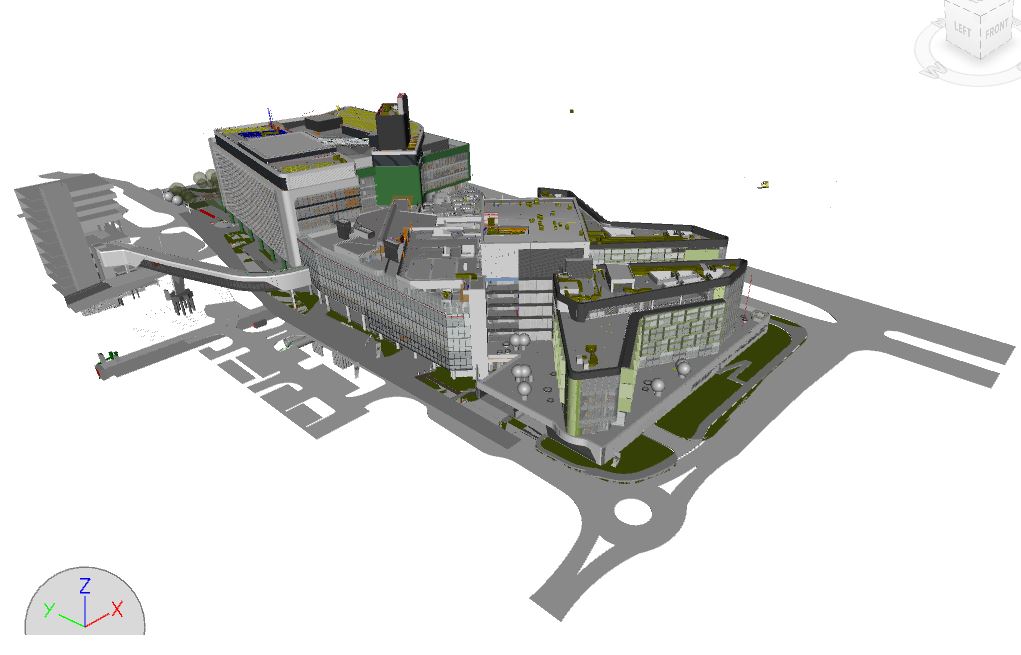
The PCH Federated BIM Model
Introduction
Continuing on from Olly and Howard’s blogged experiences with BIM, I thought I’d add mine too. From the sounds of it I have been a little more involved in its use, or I should point out it’s one of my roles and responsibilities of the project. This has meant I have had to understand BIM in its wider sense/application (hence I decided on BIM as my TMR 1 topic) and therefore grapple with it on this project. Due to various complexities and getting a brand new process up and running I have waited till now before blogging about it.
Why BIM?
Throughout the lifecycle of a project BIM based models continuously develop with vast amounts of information requiring data entry. This increased development of information is used to measure goals and milestones and is referred to as Level of Detail (LOD). There are six LODs; 100, 200, 250, 300, 400 and 500.
The Client (State of WA) required the use of BIM and in line with their Technical Brief JHG are to provide LOD 500 (A Facilities Maintenance and Management Model (based at BIM maturity level 3) for all equipment within the Federated BIM Model. This will be achieved through the utilisation of Autodesk’s BIM 360 Field application (BIM 360 Field is the QA/QC application used in construction, on-site in the ‘field’). The implementation of BIM 360 Field on this project is cutting-edge and so to my knowledge has never before been attempted anywhere in the world to this level on such a scale and complexity. Apart from ceiling and wall closure sign-off, the use of BIM 360 Field for the commissioning of building services is being implemented in a novel way and stretching its capability into unchartered territory. Mapping equipment in the Federated Model to all test, commissioning, operational and servicing documentation is vital to meeting the LOD 500 requirement. This not only serves as an electronic repository of as-built information but also aids in the Facilities Maintenance (FM) Management of all building services systems throughout the 24-month Defects Liability Period (DLP) and remaining lifecycle of the facility.
The aim of utilising BIM 360 Field as the means to linking this information is due to its technological superiority over other information management systems and to enable the PCH facility to accommodate future flexibility. It also aims to allow JHG to build upon their BIM implementation experience for future corporate knowledge and growth. This is all in order to satisfy the building services commissioning plan and to ensure LOD 500 is met.
Analysis of JHG’s BIM Implementation Strategy
The requirement set out above was always known from the start of the project however the use of BIM 360 Field as the management tool was not…
From the outset the well-established use of BIM for model collaboration and clash detection was adopted (BIM level 2), as this was a client contractual requirement based on its scale and complexity. JHG acknowledged their lack of BIM experience and so in order to implement it effectively they identified the need to utilise a specialist BIM consultancy service. CSI Global Systems, with a contract worth AUD$1.5 million were to devise a strategy, implement and manage BIM for the project. This investment was in addition to licence fees and hardware.
JHG’s intention is to use the PCH project, being the first to adopt a BIM strategy, to help shape the way they see BIM adoption across all business sectors from a strategic level. From an operational/project point of view BIM implementation works very well with the various models collaborating together and using clash detection effectively. However, on a tactical/detailed level there have been some extremely challenging aspects as the following decision timeline over the expected four-year project explains:
- Dec 2011 – Project Start Date.
- Jan 2012 – QA/QC Manager requests for a defects management tool (BIM 360 Field researched and proposed).
- Dec 2013 – Decision to trial BIM 360 Field finally granted.
- Feb 2013 – Trial completed with the use of iPads.
- Apr 2013 – Implementation of BIM 360 Field on wall and ceiling closures (aided by additional hire of a BIM consultant).
- Jun 2013 – Web programme and application of BIM 360 Field designed with students’ help through designing Application Programme Interfaces (APIs) thus allowing uploads of data mapping to the federated model and 6D elements.
- Dec 2015 – Estimated Practical Completion.
BIM 360 Field used for raising issues and as a defects management tool (its intended use) works extremely well as does the ability to have this data displayed on a dashboard through the BIM 360 Field web application. Many challenges came as a result of the late procurement of the application and therefore were not planned for in the implementation strategy. These were; lack of understanding, training and competence in its use in delivering the additional requirements of meeting LOD 500 (6D FM) (at maturity level 3); and data mapping to the federated ‘as-built model’. These are still causing issues but the biggest challenges are software design glitches. The BIM 360 Field application has been developed by Autodesk for the construction industry specifically to aid in transforming the way in which data is collected, connected, visualised and managed. It extends the benefits of BIM to the construction, commissioning, completion and facility management processes. However, the reality of utilising BIM 360 Field is that Autodesk had never used some of its features on a project of this size and complexity before and as such it could be argued they are using the PCH project as a test-bed for future enhancements. This has created numerous issues that have in reality hindered the application’s perceived benefits.
Initial Implementation Issues
Overall the keys issues/limitations of adopting BIM 360 Field have been:
- Late implementation (by approx. 2yrs).
- Little to no resources allocated for its dedicated implementation.
- Extra requirements added; LOD 500 6D (FM) and links to federated model.
- Poor/little implementation strategy.
In conclusion JHG’s initial BIM implementation strategy was sound, utilising BIM consultants due to their lack of BIM knowledge but particularly due to the complex nature of the project. The implementation at level 2 was coordinated well and continues to provide tangible benefits however the BIM 360 Field application proves to be challenging in delivering LOD 500. Maybe adopting BIM 360 Field from the outset with increased resources, education and training or on a much smaller project first could have helped ensure better success than what is being experienced at present.
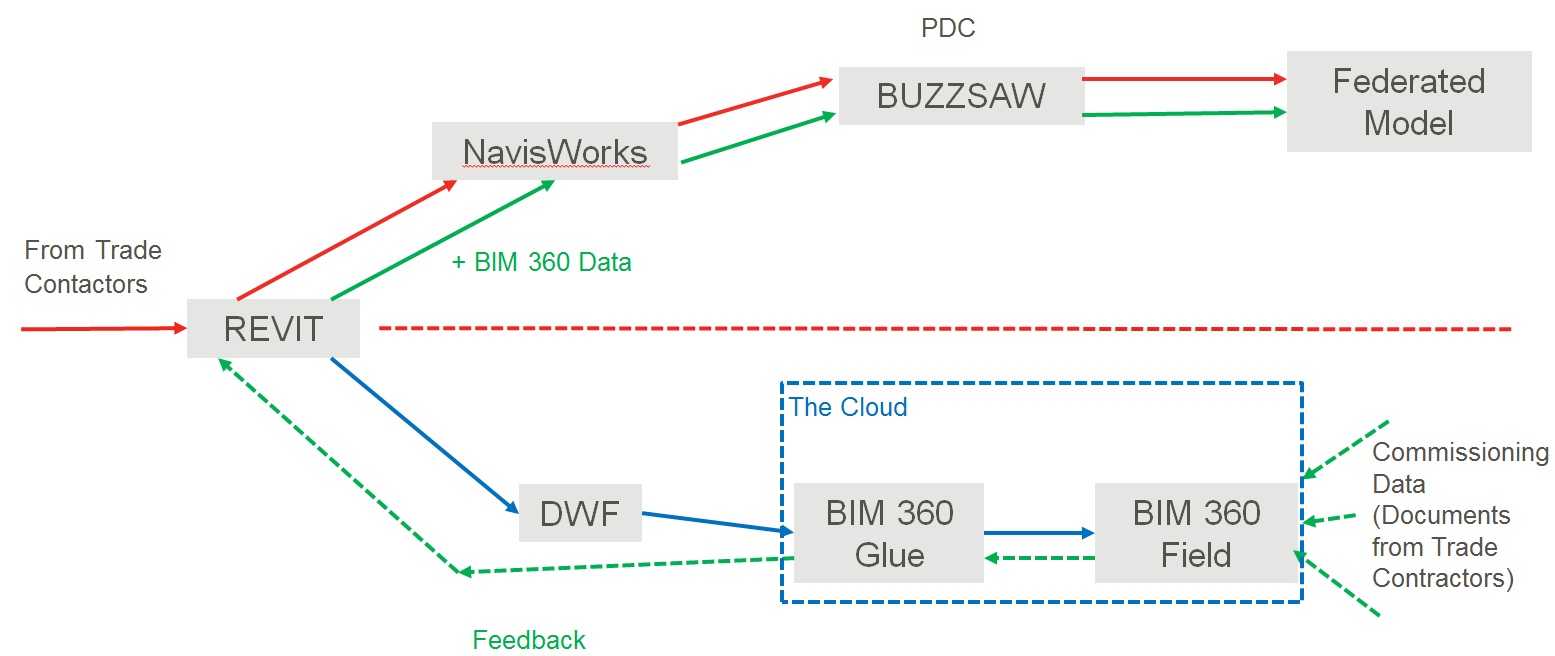
BIM Model Structure
BIM 360 Field Strategy Management – What have I done?
The Problem
We (the commissioning team) have been instructed to use BIM 360 Field for commissioning management and coordination across all commissionable systems throughout the project. This poses many challenges (as above), the key ones being:
Late Adoption. Due to late adoption, the BIM consultants (PDC) who wrote the BIM implementation plan for the entire project and who manage the Federated Model didn’t include the use of BM 360 Field. This means there is no strategy to follow and therefore from a technical point of view proves challenging to understand and ultimately costs time.
Lack of Understanding. How to utilise BIM 360 Field for commissioning related activities. This has meant experimentation and the process evolving as and when problems arose and were then subsequently resolved.
Lack of Support. From a technical perspective by Autodesk and from a commercial perspective by JHG in terms of manpower and financial resources.
Although BIM 360 Field has BIM in its title (how Autodesk packaged and sold it), it is nothing more than an information management tool. It allows the commissioning team and managers to view information and documentation flow according to the process. This is not part of commissioning per se but is the background administration necessary to enable interrogation of the commissioning register and find out what may be holding up the commissioning of services systems. This then aids us by creating efficiency in directing our focus on a particular area, important on such a large project with so many diverse systems, to solve a particular management or engineering issue.
Considered Options. With limited experience in the use of BIM 360 Field and what the application could offer, various options were difficult to conceive and so the commissioning team could only review the processes that were set-up for ceilings and wall closures. These processes relied upon the use of checklists updated via iPads in the ‘field’ by either the delivery team (building services coordinators) or trade contractors responsible for that area. There were many additional implications to consider when applying the same process to commissioning; primarily due to the requirement to commission by system rather than a specific area. Commissioning by system area delineation, rooms, zones and floors would have been a difficult undertaking especially as some systems are part installed by more than one subcontractor. The biggest challenge would be identification of issues as commissioning progresses so they can be efficiently resolved. This means having a robust information management system in place.
Chosen Solution. We decided to utilise bespoke checklists accessed through the iPad and created a Commissioning Register (spreadsheet) that acted as a commissioning progress (by system) display. The Commissioning Register is linked to the equipment in the BIM Federated Model through BIM 360 Glue (the software that links data from BIM 360 Field back to the ‘cloud’ and processes it back through to the original REVIT Model) and so when checklists are updated they subsequently update the Register thus displaying progress based on the traffic light system. More importantly, any issues that arise along the way are captured (through iPad use) and allow us to resolve them to closure. A key part of the solution was the communication of it and how we intended to implement it.
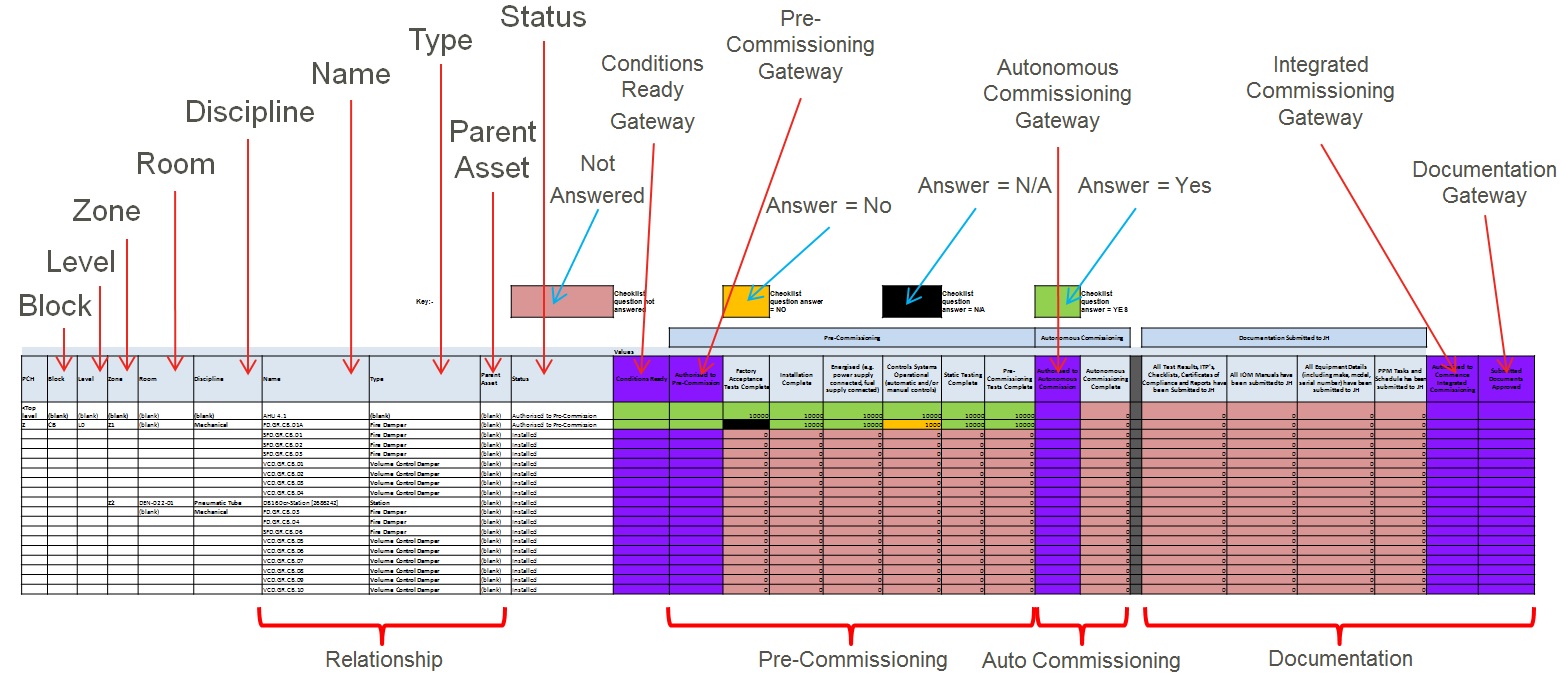
Commissioning Register – updated directly from BIM 360 Field inputs.
Justification. This was based on the need to find the easiest most efficient way of meeting the requirements as set by the Client and one that could be easily communicated to all involved and thus understood.
Implementation. We came up with a strategy to implementing our solution to the problem, the detailed process and what steps we took to get buy-in from both the JHG project delivery team and trade subcontractors. In summary it consisted of a greater understanding of BIM 360 Field and its capabilities, production of a commissioning management process, a Commissioning Register (for progress reporting) and a number of presentations communicating our coordination plan.
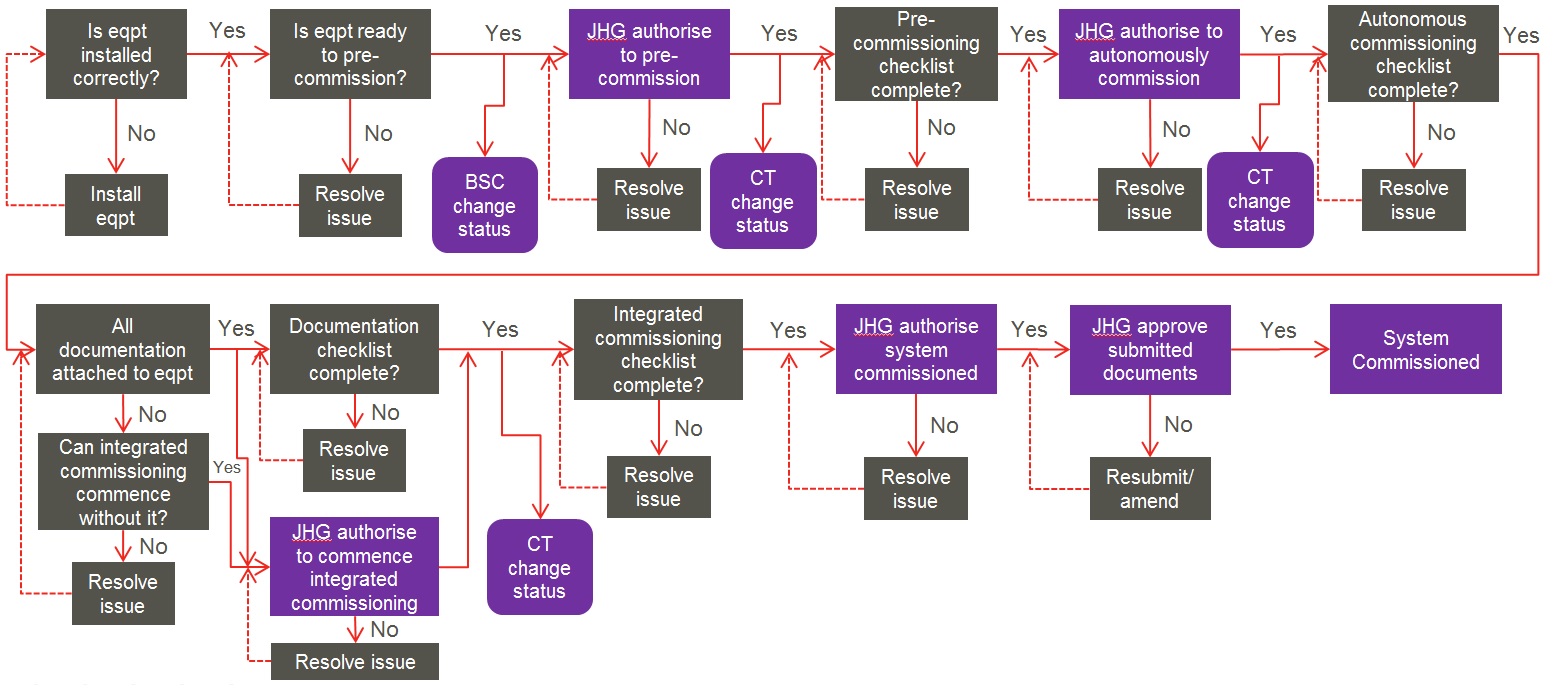
The Commissioning Process.
Associated Costs. The investment required was relatively small totalling in the region of AUD$330,000 for the Autodesk licence, consultant and data handling fees. What is more difficult to cost is the time spent in developing the process with multiple individuals and teams involved.
Food for thought
It would be interesting to hear other users views on BIM…
Upcoming ICE Event
The ICE are hosting the following conference at link below which seems very interesting. I wonder if anyone from the school, current Phase 1 students might be going.
ICE BIM 2015 – Realising the Promise Conference.
 Holdfast Training Services Trial Blog
Fran,
A really interesting blog. Well done. I think your work leads me to make a couple of observations:
– firstly, why just constrain yourself to a TMR on the subject? I should ink that there is sufficient material available to consider BIM as a subject for your thesis?
– secondly, the Corps is actively investigating the implementation of BIM. What does in mean for the RE? I have discussed your work already with the team as it has highlighted opportunities that were hitherto unthought of. Well done. You work is being watched! (For entirely good reasons)
SRL
Sir,
Thank you. I have considered BIM in two thesis topics on the Form A submission, one of which aims to aid the Corps in its BIM implementation. I am awaiting feedback from these in due course but am now getting an even stronger vibe to which will be suggested.
My only concern is accessibility to the Corps’ current plans to-date and any research documentation that may have been conducted; I am aware that DSTL have completed a study. I have already begun some initial investigation into who to speak to but I can foresee I may require some additional help from the school.
Not only is BIM an interesting subject in its own right but if a thesis can aid the Corps in making a better informed decision on its implementation then it will hold a much greater impetus for me in producing it.
Regards
Fran.
Fran – The RE lead and DSTL study author were both on my PET course! I can put you in touch. Drop me an email.