Two things are infinite.
Einstein said: ‘Two things are infinite: the universe and human stupidity; and I’m not sure about the universe.’ This is a theory I have long signed up to and today I can add another piece of empirical evidence to the data set.
One of the Access Control Points (ACP, or gate in English) to the camp at Harrisburg is being upgraded because of the perceived threat to the site from terrorists. On the security front I could wax lyrical about the fact there is a small airfield adjacent to the camp, that it has the lowest grade of fence in the U.S. military catalogue, or that I could squeeze through a gate on the Northern side of the perimeter fence. But greater minds than I have decreed that the weakness is at the main gate so that is what is being upgraded.
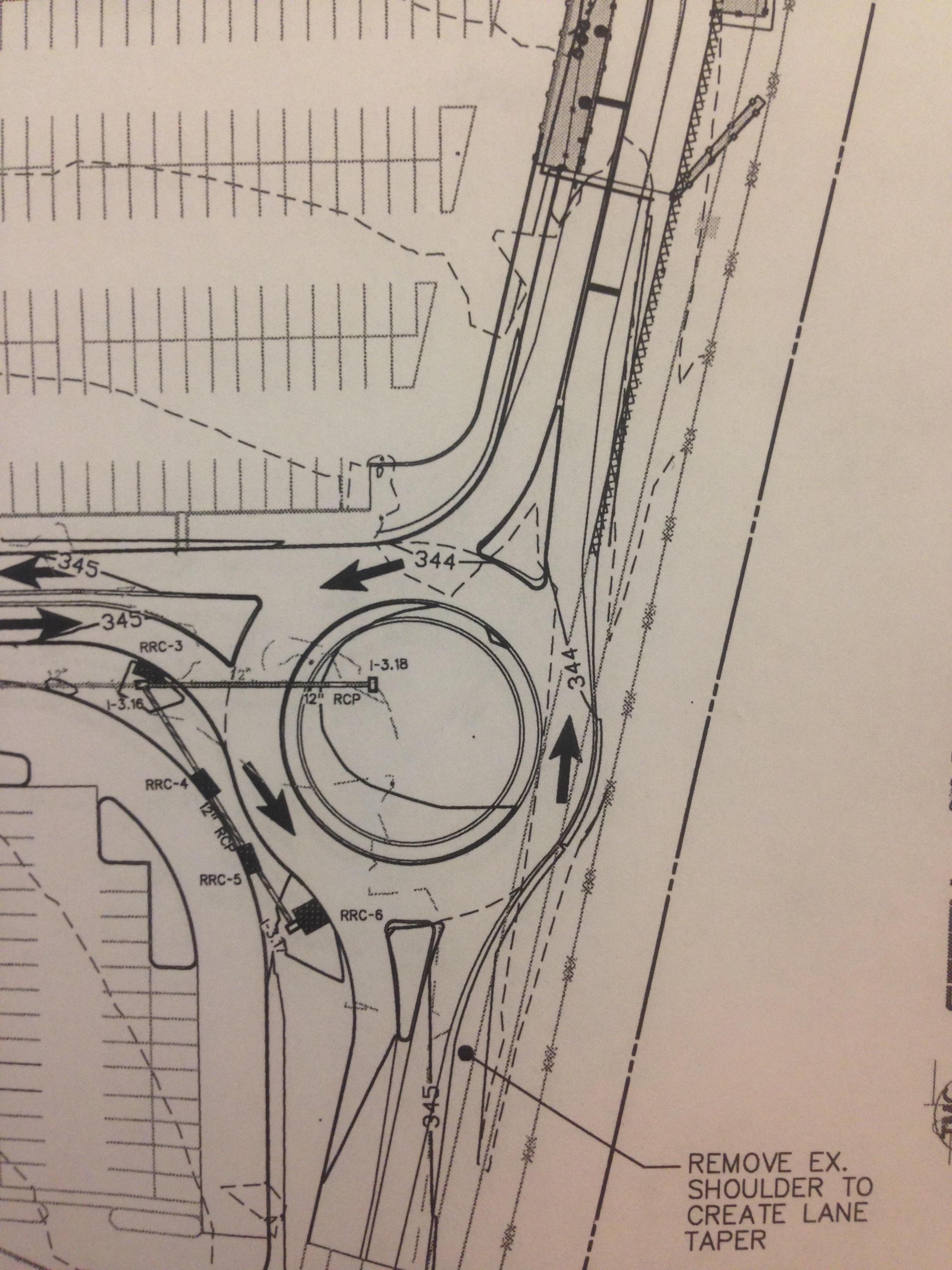
As part of the upgrade the road layout is being adjusted with an alien feature to American roads: a roundabout. I have seen less than 10 roundabouts (or traffic circles to use the vernacular) since being out here and each appears to have its own rules. People also appear to be petrified of them, probably because they are so rare and non-uniform. Because the construction is taking place on an operational road building the roundabout has been phased. It also means that everyone has driven past it for the last two months; which is probably enough of a lead up to know what might happen one day.
On Monday we signed of the transition to the next phase of construction and as a result the traffic route was changed in the afternoon for the next phase. Traffic now enters the camp in a different lane weaves about a bit and then hits the roundabout. To be more precise, only half the roundabout and the idea is obviously that you go ‘round’. So without looking at the artist’s impression below you can probably guess what happened this morning.
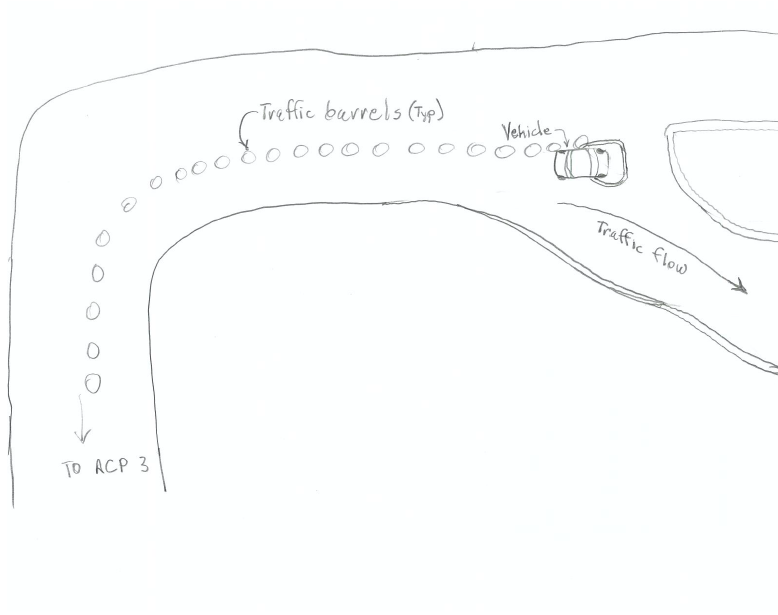
My Boss’s sketch of the incident (cameras were banned for security reasons)
A driver had managed to mount her car on the triangular lane splitter at the entrance to the roundabout. When in full operation this apparently shouldn’t be catastrophic as the kerb is ‘mountable’ and the level inside the triangle will be brought to the top of the kerb with concrete. At the moment, half constructed, the inside of the triangle is at road grade level, about 8 inches short of the final level. As she tried to reverse out of trouble she broke off her bumper and has apparently damaged her front axle assembly and because of that the car is ‘totalled’.
So what..
Well it lead me to thinking what could we have done about it. Filling the hole in would have reduced the damage sustained to a vehicle but would have caused rework or having to order in concrete. In the end more cones were placed in the triangle to ‘give more reflection’ as the driver said she hadn’t seen the kerb. My opinion is that more flashing lights and reflective bollards aren’t really going to help if someone is looking at their phone rather than the road and that human nature is always going to cause the odd accident. The best prevention of a future accident is the fact that everyone driving in that morning will have seen the car stranded and might be more vigilant: for a few days.
Fortunately no one was hurt in the accident, something I should have mentioned earlier. This was because, by chance, no work was being done in the area. Maybe, as a safety measure in the future though, a soak time of a couple of days after a road layout change might be a sensible safety precaution in an area where commuters operate on autopilot in the mornings.
The below pictures show the phases of construction for the roundabout. The accident happened in the phase 2 layout moving from the top of the image.
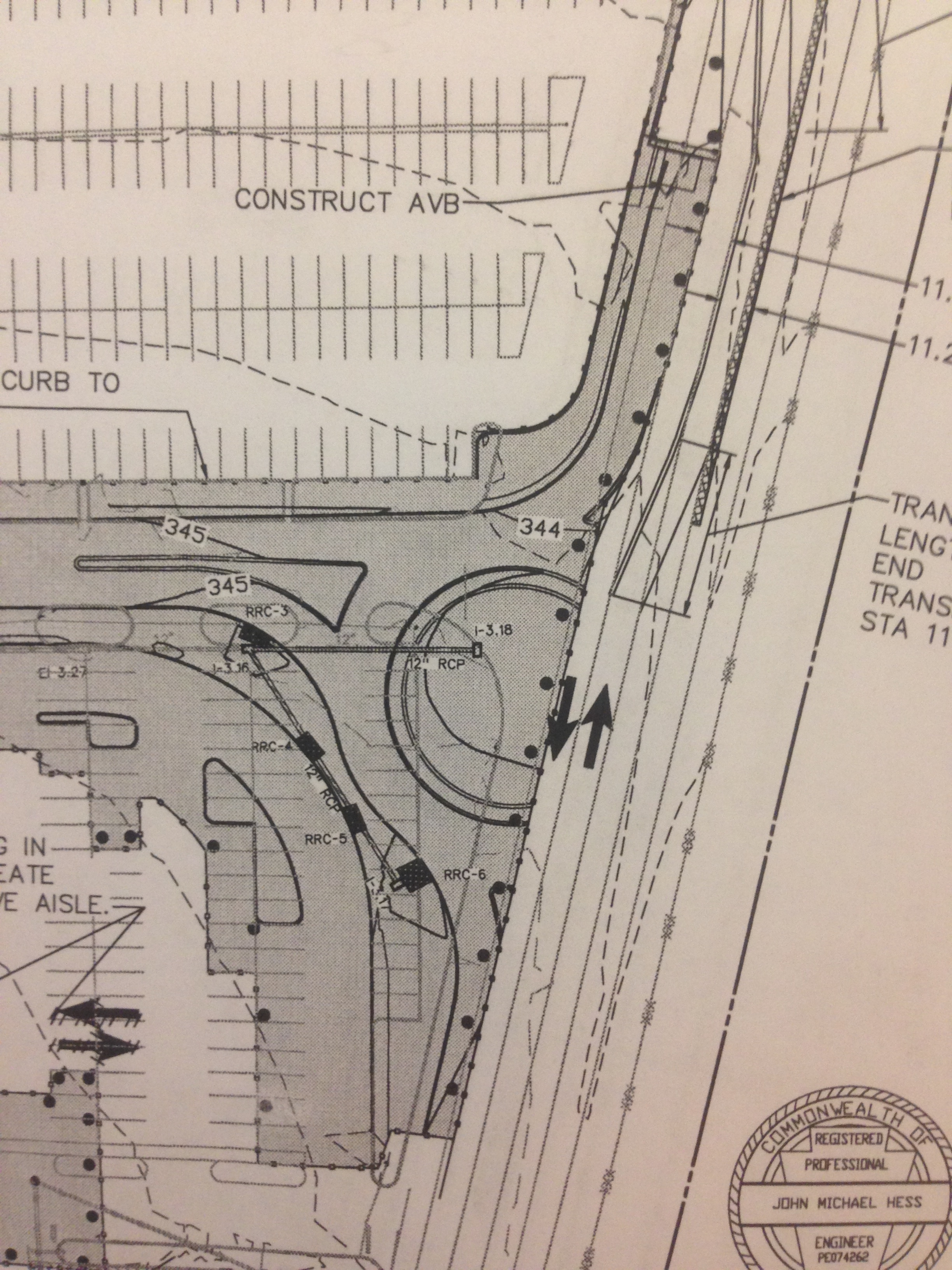
Phase 1
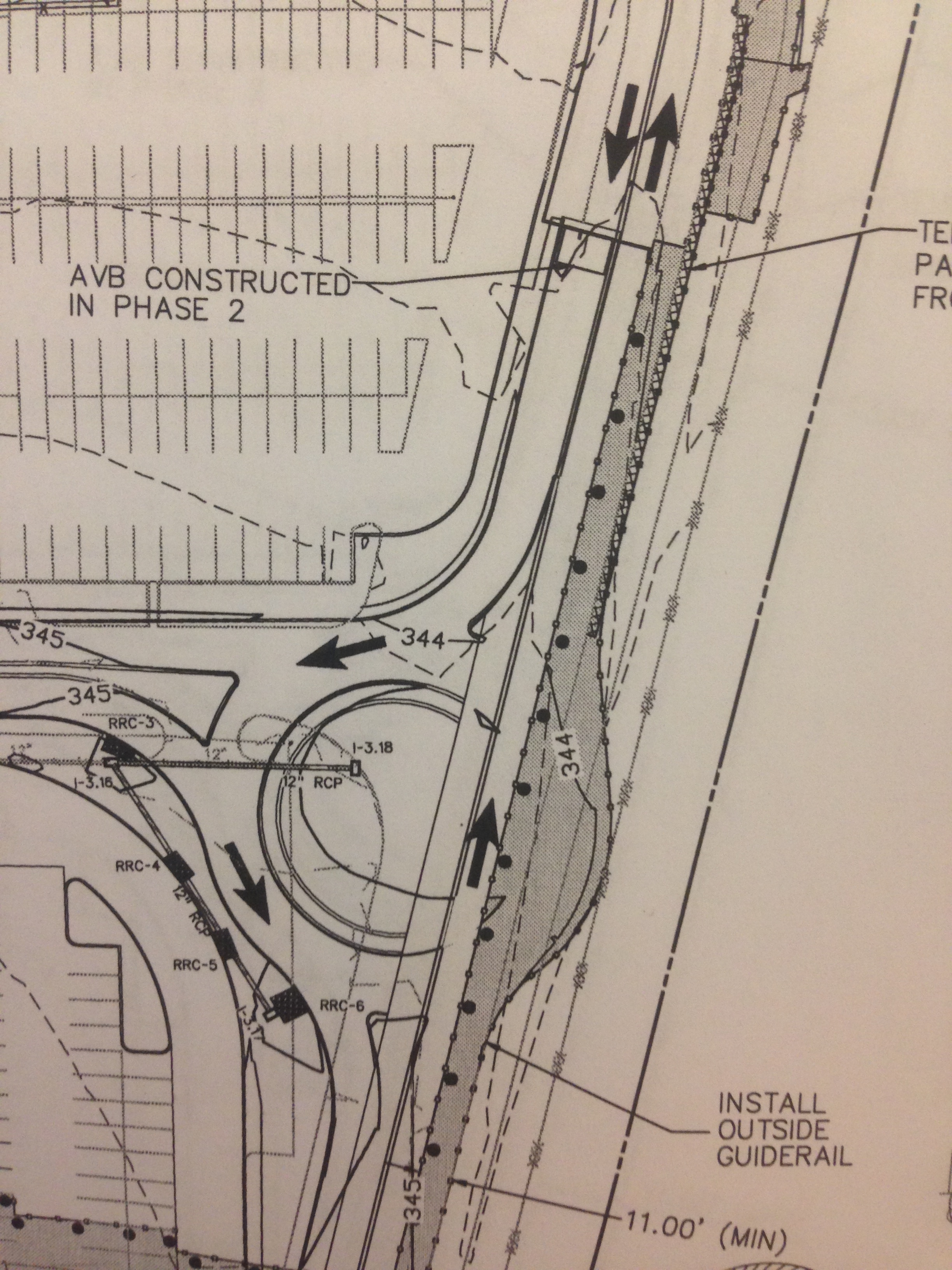
Phase 2 – the phase we have just moved to
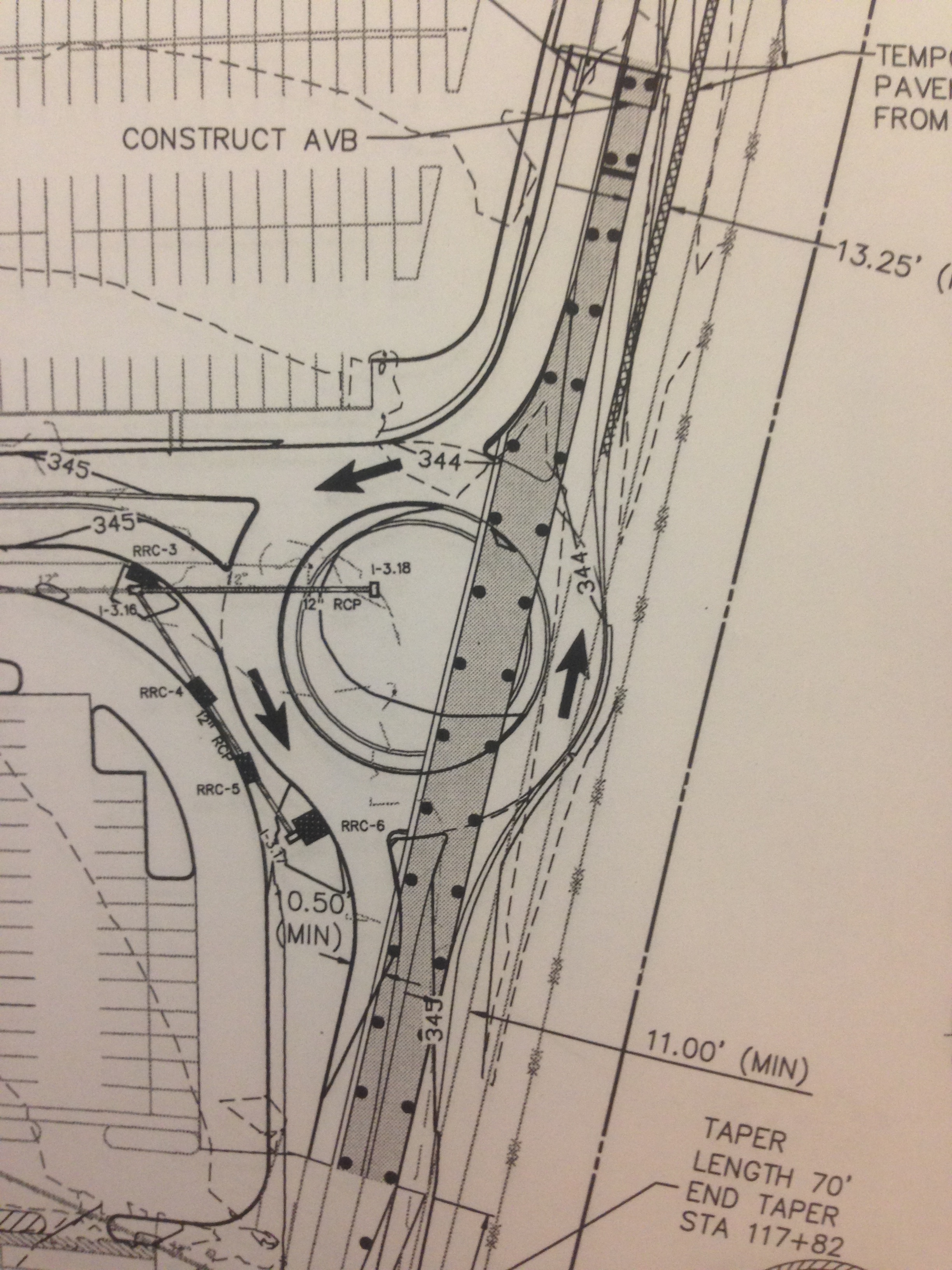
Phase 3 – This will be a safety concern for the workforce
Complete
Finally, to follow on from Damo’s post about cyclist safety:
It doesn’t sound like it will happen any time soon, however it could have huge implications for construction within whatever zone it was implemented. Damo, has the cycle safety scheme on your site been well received?
 Holdfast Training Services Trial Blog
It’s a francophile thing. I’m sure the traffic circles would hold less fear if they learnt to drive around them the other way (and therfore travelled ion the correct side of the road).
You are correct that transitioning is, of course the risk point and deliberately making a significant change can be used to assist with driver awareness. Do they operate a standard give way to the left system or filter in turn as in the channel islands?
What about a 5sec heads up brief by the security guard at the gate to every Dvr whilst they scan the cac card – that should focus the mind and flick off the autopilot which is no doubt the issue here. I remember well pouring over these drawings and wondering how long it would take for someone to hit something with the continual route changes…especially as majority of the camp’s employees have been there since birth. Either that or they are intently watching their speedo instead, in case ‘ robocop’ catches them doing 1mph over and takes them down to Chinatown! There’s a piece here on where risk management in design could have picked some of this up…but, as you know, this concept hasn’t quite taken hold yet across the Atlantic !!
Richard. Eventually it will be a proper roundabout where new arrivers give way to traffic in the circle. Currently there is no circular flow though whilst construction is ongoing, so it is merely a diversion.
Howard. A brief might have been a good plan, though by the time you get to the scanner you have already passed many an appealing kerb to crash into. Once complete I can definitely see the roundabout being a future doughnut eating spot for the ‘po po’ to get some easy ticket violations. I fear I will have left by the time it is operational as I’d probably look forward to the argument! As for risk management in design, you know not to curse around here!
Hi Henry, interesting points. I assume temporary roads as an intermediate solution were not practical/cost effective?
The article link is on the money but perhaps misses the point about safer vehicles, gunning for big headlines by opting for banning hgvs rather than explaining how to reduce underlying causes.
The Fleet Operator Recognition Scheme (FORS) is starting to become the norm for hgvs in London now. Basically sensors to warn people when turning left, signs on the vehicle, undercarriage barriers and some training. During procurement/establishment of subcontracts for material suppliers, part of the stipulation is to be FORS compliant. This is helping.
At Two Fifty One the site entrance crosses a borris cycle lane superhighway which is manned with 2 traffic marshalls to watch out for traffic, people and cyclists. This just about works but it is also helped by not starting the site until 0800 hrs when the commuting cyclists tend to have passed by.
Time will tell but I suspect there is an element of more construction happening at the moment, combined with more cyclists resulting in more deaths.
Damo,
I am not privvy to whether temporary roads were considered, but I think a complete seperate road would have probably been considered prohibitive. It would likely have to be black topped due to all the commuter traffic and length of time in service. Another alternative would be to use another of the gates as there are at least 2 more. That said, the disruption only amounts to roadworks on a minor road, which goes back to my initial quote!
Thanks for the update on the FORS. The headline was quite extreme, but I suppose it sereved its purpose as we both read it.
Henry, Damo,
I’m not convinced the FORS scheme is the answer to the problem of construction traffic and cycing safety, although it is a step in the right direction. At Battersea it is a contractual requirement for all HGVs coming onto site to be FORS compliant, but there are three levels to FORS: Bronze, Silver and Gold. Essentially Bronze is nothing more than proving as a fleet operator that your vehicles and management systems meet the legal requirements. Not exactly something to shout from the roof tops about. In addition once a company is a member of the FORS scheme its accreditation is only reviewed after 12 month – a lot can happen during this time and there is ancedotal evidence to suggest firms focus on passing the inspection as opposed to maintaining standards throughout the year. I think a much better approach would be use of proper construction logistic plans and feedback systems with regards to near misses & non-fatal collisions so that the data associated with the accident traingle can be assessed and measures taken to avoid a death. Incidentally the vast majority of cyclists killed have been women (6 of 8 as of June), in addition 82% of womes killed on bikes were killed by HGVs compared to 42% for men – perhaps the eduction of cyclists and drivers that occurs on sites needs to find a way of drawing more women in to avoid these incidents.
People working just to satisfy the inspections rather than maintain continuous standards…the very idea! With the FORS levels do you see a case where they will become more stringent in the future and raise standards with them? If large contractors such as Carrilion and LOR were to stipulate Silver only for example I assume the subcontractors would make the effort to stay on their tender lists?
When you talk about accident reporting are you just talking about on site? Presumably many of these cyclist deaths are occuring away from sites as lorries travel through London rather than specifically at site entrances.
Interesting point about women cyclists, though I suppose there could be any number of reasons.