Small tweeks…
I’d like to echo Damian’s point when he said that it’s important to question the design. It’s not just that the design might be wrong, although it often is, but also that when it is right, it could still be better. I’ll give two examples…
The next evolution of the blockwork saga takes us into the construction of a double skin wall that separates the car park area (a class 2 basement) with the clubhouse area (a class 3 basement). The difference in the classes comes down to a range of measures intended to make the space more inhabitable, such as ventilation, acoustic insulation and (the focus of this rant/blog) waterproofing.
Waterproofing is hugely important to the client because it you don’t get it right first time it cost loads of money to put right. Since SRM would ultimately foot the bill, there has consistently been a lot of pressure to get it right.
The clubhouse area has an additional waterproofing measure in the way of a cavity drainage system. The system interfaces with the block work wall as shown below:
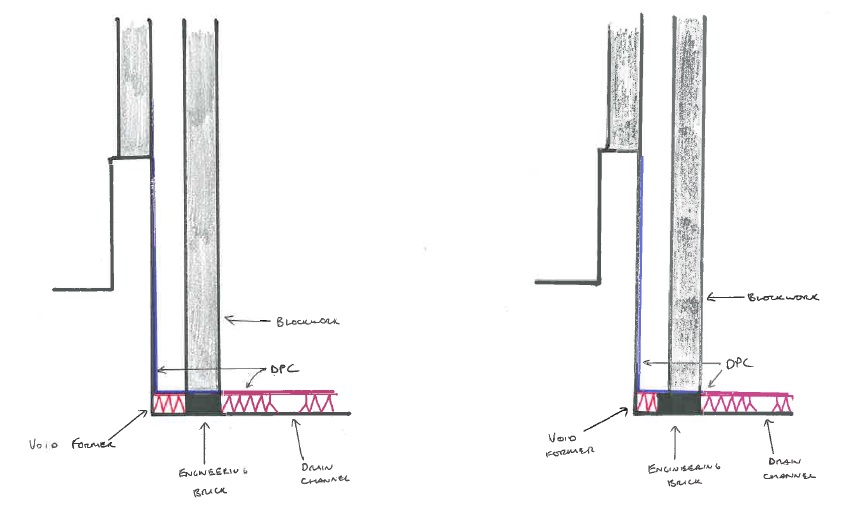
It’s worth noting that this does not align with the architects drawing, or the waterproofing designer’s drawing. But it does reflect reality and therefore I’m building it that way.
Now onto the point about questioning the design…
The bottom of the inner skin is sat onto engineering brick. The bricks are 205mm long and the blocks are 140mm wide. Therefore the bricks were to be cut down then laid side by side (as opposed to end to end) to give a 140mm strip to lay the blocks on. At the base of the cavity there is a void former that the dpc runs over the top of. So why are we cutting the bricks down? Cutting the bricks would cost more and take longer, and you also have to pay for more void former. I suggested laying full bricks to the architect and he was happy for us to do so, as was the waterproofing designer. So why did the additional design call for the bricks to be cut? Because the architect thought the drawing looked neater. I wish I was joking.
So to hark back to Damo’s point, I’ve just saved money by saving time without affecting quality.
The other example is that the inner skin will be dry lined, the only bit of block work that will. Yet the design still calls for paint grade block work. Why? It isn’t painted! I think I remember Pete having a similar thing with a ridiculus concrete finish on a bridge pier that would only ever be seen by a dingo…
In the beginning we had a lot of quality issues with the block work so we’ve got piles of blocks all around the place that we’ve taken down. So I’ve had it agreed that I can use them for the inner skin since it won’t be seen. So I’ve saved material and therefore money without affecting time or quality, and for good measure I’ve wrapped it in sustainability by reducing waste.
 Holdfast Training Services Trial Blog
Guz – Like it. 2 simple examples to clearly explain the issue. I would add some fluff and additional words to agree with you! Firstly I think that the site attachment gives you the clarity or site robustness to challenge these things. Without a bit of time to see what is what I think it would be difficult to spot poor designs. There is an ever increasing list of points of what not to do when/if I design something. One of which includes adding some explanation (mostly to drawings) as to why something was designed as it was. Perhaps a bit naive at this stage but it is certainly something I will try to remember.
Finally, a bit more to the point – is your DPC above the water table? If not is the water table variable? I permanently below the water table, what was the reason for choosing membrane over waterproof concrete?
We’re below the water table, but remember that this is all happening inside a concrete box that is waterproofed using a type 1 system (membrane) as well as a type 2 (usually waterproof concrete, but any slab greater than 300mm thick is deemed to be waterproof, ours is 600mm). This is an additional system to increase the classification of the basement from a class 2 to a class 3.
I agree with your point on design. There have been a few times – normally drainage – when if we’d have known why the designer had done something, we could have done something else that better fitted the site conditions but still fulfilled the intent, rather that being forced to stick slavishly to a drawing that didn’t make sense just because he wouldn’t pick up his phone!
Oh and a membrane system is cheaper. The additional crack limitation measures required in the waterproof concrete made it uneconomical given the area to be waterproofed and the volume of concrete required (in places our slab is 800mm thick!)
Guz, our basement slab is 450mm thick across the site and must be in waterproof concrete. You got a reference for the 300mm ? Membrane cheaper but how is it repaired if there is a leak in 2 yrs time?
Our designer, Waterman, will only use waterproof concrete and does not go for membrane solutions. Interesting that Arup is not on the same line of thought.
Damo,
Check this out: http://newtonwaterproofing.co.uk/news/waterproofing-concrete-admixtures
It’s got nothing to do with Arup. The waterproofing is designed by the architect, sub-contracted to the specialist – in this case Newton.
Guz, thanks for the link. I am a little surprised the waterproofing method is all from the architect. Grades would seem sensible, how that is achieved seems more relevant to the designer because it does not affect form so much.
Additionally, as Cather worked for Arup for 31 years I suspect he has had some influence on their normal practice. I’d say the article misses a couple of points: joints and penetrations are equally difficult so waterproof with either membrane or integral concrete systems. Agreed concrete cracking is a risk but then reinforcement design and the healing properties come into play. The other key point is maintenance – how do you repair a sub slab membrane when there is a hydrostatic head? Risk has perhaps advanced from client to facilities management if the system has outlasted the defects periods so maintenance may not be a concern of the contractor.
Guz
Good old common sense
Regards
Neil
Thanks Guz – good subject and I like the link. Interesting that render and the various paint on options are not included – Sika render and ‘black jack’ seem to hove into distant memory. all have interesting use maintenance and decommisioning issues. ‘Waterproof’ concrete being a pariah in the latter case!