Total Deadlock!!!
Just before my summer leave I attended the most frustrating meeting I think I will ever endure…it made a TFH ISTAR planning co-ord appear proactive!
The background
The embankment that approaches each bridge abutment has a series of piles called CMCs (Continuous Modulus Columns). These piles are placed on a 1m grid over the width of the road for around 50m. They do a number of things but mainly they stiffen the embankment material as they are displacment concrete piles and secondly they transfer some of the load through the constructed embankment to the stiff clay below. They contain no ReBar and are designed to fail if heavily overloaded.
The Problem
Given that the CMCs are not reinforced, they are designed to work in a specific way. Any structural movement will eat in to the tolerance of the CMCs, this means that it would be crazy to install the CMCs whilst our site is still undergoing large amount of settlement we’re still experiencing. Whilst the settlement is starting to slow it has not reduced to the level the Vibro Minard, the subby that is installing them has specified.
The Sticking Point
- Vibro will not give a warranty on the potential for differential settlement of the installation until the ground is at the strength originally specified.
- WSP, the designer, will not check the original spec or conduct any alteration without a FULL check of the whole scheme (big £££). Clearly they can see we’re over a barrel and know something has to give. Their argument is that a reduction in platform strength may have a fundamental impact elsewhere and that requires checking.
- We only have a six week window to get this done before it takes over as the critical path and causes programme delays.
- Kent Council are unlikely to accept the embankment without warranty (we don’t want to ask the question as it will likely open up a huge amount of questions and interest).
- We don’t have the budget to cover the warranty as the project is heavily in debt and this sort of warranty would be for an unknown sum given that no one internally really understands the actual design enough to predict what may happen.
We left the meeting looking at each other saying ‘so what now’.
So What
Quite simply we’re having to wait for the ground to ‘Get A Grip’ and toughen up.
We’ve conducted a number of onsite tests to check the current strength in the ground. The good news is that it’s higher than we expected based on the original model and pizo data however it’s not quite as high as we need.
We have asked the designer look over the findings a predict what the ground strength will be by the time Vibro mobilise if we give them the thumbs up now. It’s looking good, so fingers crossed.
The Disappointment
The sad thing was, everyone sat around that table knew how to solve the problem but hid behind lines like ‘this is what my design manager has said…’! Whilst I understand the requirement to make money, I will never understand the mentality that it is ok to do so whilst others fail, sink and lose out. What made it worse was the lack of spine demonstrated, if you’re going to represent your company then embrace the policies they set, don’t hide behind people who are not present in an attempt to deflect the criticism away from yourself.
The Good News
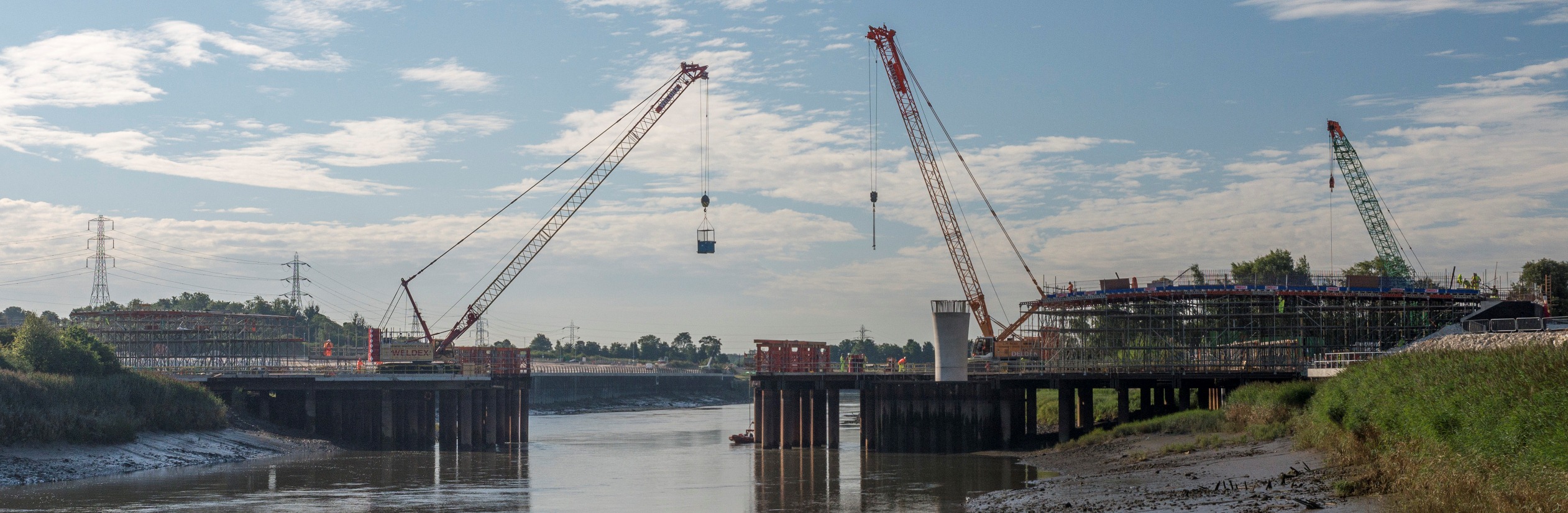
We have a structure that is starting to look like a bridge, peirs and all!
 Holdfast Training Services Trial Blog
Olly,
If you have been tracking the increasing strength, do you have data with a reasonable correlation to be able to predict when you will be at strength? If it is not within the 6 weeks you say that it will impact the ‘critical path’. So what? By that I mean are you stuck for time and/or what is the impact? Are Kent Council going to be after blood?
If the answer to Henry is, it will impact the critical path, has there been consideration of further surcharging – for example adding kentlidge to increase settlement? Was the time specified by Vibro or amount of settlement? How do you know you will ever reach that amount?
I agree with your comment about the people sent to these meetings. I am constantly frustrated by people attending meetings without the background knowledge or authority to make a decision or give any meaningful input.
Let’s assume for a minute you are delayed. What does the contract say with regards to penalties? And since no one is taking any ownership of the problem, where do you think that penalty will ultimately lie?
I’ll try and answer all of your points as a collective, if i miss anything please let me know.
One of the problems is we haven’t logged the actual material (alluvial deposits) strength as its now buried under the embankment. We have predicted the strength based on pore water data collected from a series of piesometers. We know the start strength and have done some recent testing to get the current strength however we don’t know the gradient of the increase which makes predicting very hard. In hindsight, more testing would have been done, however…!
The embankment is currently 6-8m high (Damo, same height as when you visited). The CMCs need to be installed at this level. once they are in we will build the site up to 13m-ish and then strip back to 12m (1m of surcharge). Once the chalk has been used and compacted it SHOULD NOT be stripped and reused. Of course applying more surcharge will increase the rate of strength gain, however, we are talking about a lot of material, haulage to site, mobilising plant to place it and then stripping it, muc away, only to then build the whole area back up after the CMCs are in. So, yes we could do that however, the cost would be massive and we would be better taking the risk of of the warranty.
We can be confident (geo confident) we will reach the required strength because we have surpassed it on other areas of the site, under the same condition, that have had longer to settle.
Kent Council will simply demand to know who is covering the warranty. They will adopt the bridge but are not responsible for structural repair for the first 10 years.
Charges for late handover of the bridge are £60k a week and as this is a design and construct contract the penalty will firmly sit with us. The contract with the piling subby states he will work with a ground strength of 35kPa. He will be well within his right to refuse to pay anything. We conducted a costing exercise yesterday and worked out that significant repairs to the final road would be around the same cost as two weeks delay, therefore it was decided that should it come to it, carrying a warranty risk is a better solution than accepting a delay.
Situation update – our in-house Geo Shaman is confident we will be good within a few weeks and has given Vibro the go ahead knowing it will take them a few weeks to actually start. A few days prior t them arriving we’ll do some more in-situ testing and the results will decide who will one the warranty. Above 35kpa it’s them, below 35kpa it’s us and somehow, once again our designer has done absolutely NOTHING.
It’s really difficult to get a clear handle on what Controlled Modulus Columns are meant to do.
In installation the method displaces material sideways- so I suppose it stiffens and strengthens the material generally
The ‘controlled modulus’ bit is to do with the following
If you lined up a brick and a sponge (with the same dimensions as the brick) and then slapped a load on the two: well you’d expect that the load would transfer to the brick
The reason for this is that one is stiff and the other ‘brick’ is not; so it’s a strain compatibility thing
The modulus thing is that the column stiffness will not be a shed load greater than the soil around it so that the load of the settling shit does not just transfer to the columns ( as piles) . But some does.
Now beyond that, it is difficult to find any science to this
What you’ll get is a stiffer lump- so the differential displacement across the piece will be limited. But it is difficult to see why the total settlement of the lump , over the long term, would be affected at all.
Since the whole issue here is unlikely to be strength ( unless there are circular failure modes at the sides of the embankment, in which case the CMCs also form additional shear resistance in the way of soil nails) then it’s got f-all to do with strength…it’s a stiffness thing!
The CMCs extend through the constructed embankment and the alluvial deposits that are consolidating and gaining strength through to the v.stiff clay below, just. That means that in part, the CMCs act like standard piles and the clay offers a degree of end bearing resistance.
There is a circular failure mode. The key limiting factor for the rate of construction of the embankment is the failure of the alluvium which will either result in differential settlement or in a circular failure. That is why we are monitoring, with inclonomiters, the tilt in the ground at the area of greatest loading.
olly
must get my steel out of the way and then come to visit.
this recent rain cannot help
regards
Neil
I’m with the increased stiffness due to lateral displacement and added material with the aim being uniform displacement and imprved ability of a subgrade to carry transitory loads on a flexible pavement. Of course risk could be reduced by using CRCP. What is going on top of this?
In short…more chalk!
The chalk embankment will be built up another 4m-ish (it’s on a slope) on top of the CMC platform to road level. The CMCs increase in frequency and therefore an increase in stiffness will be experienced as they get closer to the abutment. Furthermore a floating concrete slab will bridge the overlap from the abutment (resting on a step at the back of the abutment) to the CMC platform.
The idea being that you drive from a flexible road to an CMC platform that increase in stiffness, to a really stiff floating concrete slab and finally on to the rigid bridge. This should remove the noticeable step that is often experienced when driving onto a bridge that is often covered by a steel plate.